
Working out how many rolls of artificial grass a plot needs is not a division problem, and treating it as one is how orders land short. A roll has a fixed width and the plot has a fixed width, and the two rarely divide evenly. We quote whole rolls every week, so the same two mistakes keep arriving on the same two shapes.
The figure that actually governs the order is strip count, not area. What follows converts a measured plot into strips, whole rolls, seams and a batch you can accept on delivery.
Why Area Divided by Roll Area Fails
Divide 200 m² by the 100 m² a 4 m roll covers and the answer is two rolls. That answer happens to be right, which is why the method survives, and it is right by accident. It falls apart on the next plot.
Two constraints set the count instead. Roll width is fixed, so the plot width must be divided by the roll width and rounded up to whole strips. Fibre direction is also fixed, so every strip runs the same way and odd shapes cannot be patched with small pieces.
So the arithmetic behind how many rolls of artificial grass you need is two rules. Strips equal the plot width divided by the roll width, rounded up. Seams equal strips minus one. A 20 ft wide lawn usually lands on two strips and one seam, and an 8 m plot lands the same way on 4 m rolls.
Measuring every zone before any of this is the step that feeds these numbers, so start with how to measure each zone first.
What Each Roll Size Actually Covers
Every strip count starts from what one roll actually covers. Coverage per roll is the number that turns how many rolls of artificial grass into a figure you can check. Our turf rolls are supplied in 2 m, 4 m, 5 m and custom widths, all cut to a 25 m roll length.
The table below fixes coverage for each width and pairs it with the scene that width suits and the trade-off it carries.
| Rollenbreite | Abdeckung pro Rolle | Typical scene | Main trade-off |
|---|---|---|---|
| 2 m × 25 m | 50 m² (about 538 sq ft) | Narrow strips, side returns and tight site access | Most strips and seams on any wide plot |
| 4 m × 25 m | 100 m² (about 1,076 sq ft) | Most garden, landscape and field zones | Widest supply, so extra rolls stay easy to source |
| 5 m × 25 m | 125 m² (about 1,345 sq ft) | Large open fields and wide sports areas | Fewest seams, but heaviest and costliest to move |
| Individuelle Breite | Made to your strip plan | Long runs where no seam is acceptable | Specialist, higher-priced option with fewer stock widths |
A 2 m roll carries 50 m², a 4 m roll carries 100 m² and a 5 m roll carries 125 m², all on the same 25 m length. Readers holding an imperial quote can work from roughly 538, 1,076 and 1,345 sq ft.
Choosing between rolls versus tiles as a format is a separate decision from choosing a width.
How Roll Width Sets Your Strip Count
One clean plot settles the whole argument. Take 8 m wide by 25 m long, which is 200 m² of ground, and run the three metric roll widths through it.
With 4 m rolls it takes two strips, two whole rolls, one seam and 200 m² ordered. With 2 m rolls it takes four strips, four rolls and three seams for the same 200 m². With 5 m rolls it still takes two strips and one seam, but you order 250 m², which is 50 m² more than the plot needs.
| Plot 8 m wide x 25 m long | Rollenbreite | Strips | Whole rolls | Nähte | Area ordered |
|---|---|---|---|---|---|
| 200 m² footprint | 4 m | 2 | 2 | 1 | 200 m² |
| 200 m² footprint | 2 m | 4 | 4 | 3 | 200 m² |
| 200 m² footprint | 5 m | 2 | 2 | 1 | 250 m² |
The same 200 m² footprint drives three different orders, and the whole gap sits in the width you pick. Wider rolls cut seam count on wide plots, while narrow zones add cuts and waste.
Our position is blunt: on any plot wider than two roll widths, buy the widest roll site access will allow.
Once the strips are fixed, which way to lay each strip decides where they meet.

Which Width Leaves the Least Waste
Wastage is the number buyers argue about most, because published advice contradicts itself. One method plans a flat 10% on every job. Another adds 5% to 10% for cutting and seaming. A third applies no automatic allowance at all and leaves the buyer to add about 5%. Use the wrong one and the order is either short or far too heavy to unload.
Shape, not carelessness, decides how much spare grass a plot needs, which is why the working bands below are split by layout.
| Grundriss | Wastage band | What counts as this layout |
|---|---|---|
| Simple rectangle | 5% to 10% | Straight edges, one open span, few internal corners |
| Moderate curves or obstacles | 10% to 15% | Curved borders, a few posts, trees or planting beds |
| Complex layout | 15% to 20% | Multiple zones, tight corners, L-shapes, narrow passages |
Note: three public methods coexist here. One plans a flat 10%, one adds 5% to 10% for cutting and seaming, and one applies no automatic allowance. This guide uses the shape-banded range, because waste follows the layout. State the band you used when you send zone areas, so both sides quote the same order.
Do You Round Up or Buy the Exact Area
Working out how many rolls of artificial grass to order means answering three rounding questions instead of one. Rounding up is a constraint rather than a preference, and each of the three adds coverage you pay for.
Rounded strips
A plot width almost never divides evenly by a roll width, so the last strip is usually part-covered. The order still contains that strip in full.
Rounded length
Roll length is fixed at 25 m, so a strip laid along a 12 m run leaves 13 m of spare roll. On a 4 m width that offcut is 52 m² for every strip.
Rounded units
Orders also round on the unit of sale. A measured 500 sq ft area can become a 510 sq ft order once whole strip widths and whole roll lengths are applied.
None of that disappears with better measuring. It is the arithmetic of a fixed-width, fixed-length product, and the only real choice is which width wastes least on your plot.
Warning: an under-order costs more than an over-order, because a top-up may not match the first batch. Keep the spare rolls from the same batch as a maintenance allowance instead of treating them as dead stock.
When two suppliers return different roll counts for the same plot, comparing two suppliers’ roll counts usually exposes a different wastage band being used.

When an L-Shape Forces a Second Strip
An L-shape breaks the area method, because the plot is no longer one rectangle. Treat it as one area and the order comes up short on the longest run.
Picture a garden 4.1 m wide along its longest run. One 4 m roll leaves 10 cm uncovered for that whole length. The spare width on the roll cannot fill the gap, because the missing piece has to run the full length as one strip. So the order needs a second roll, at a 2 m width, for the last 10 cm.
Two habits keep an irregular order honest. Quote every strip from the widest point of its zone. Split the L into two rectangles, count strips in each, then add the two counts.
A seam allowance does not rescue a narrow strip. Ten centimetres of overlap per seam and edge, plus 5 cm to 10 cm for trimming a factory edge, are margins to work inside rather than extra coverage to buy.
On a site we quoted, one 4 m roll plus a 2 m companion was the whole answer. The 2 m strip ran the full length beside the main run.

How Seams and Blade Direction Change the Count
Seam count is a purchasing figure rather than a fitting detail. It follows from the roll width and the layout direction together, so it is fixed the moment you choose a width.
On the same 8 m plot, a 4 m roll gives one seam and a 2 m roll gives three. Every extra seam is another two edges to align and another place where the pattern can shift.
Blades lean one way as they come off the line, so the strips behave like hardwood boards. A piece laid the other way round reads as a different shade, even when it came from the same roll.
That is why an odd shape cannot be patched with offcuts. The filler piece would face the wrong way against everything around it.
Seams should therefore be planned on purpose, in low-traffic areas or along a natural line such as a walkway or border. The width you order should leave them in those places.
How the strips get joined on site also matters if the layout has to meet an existing edging line.
What to Send a Supplier for an Exact Roll Count
Send the zone areas, the roll width you want and the wastage band you used, and the count becomes a quote.
Not sure how many rolls your area actually needs?
Tell us your zone areas and the roll width you prefer. We match width and backing to your strip plan and quote whole rolls from one batch.
Can You Buy Extra Rolls Later to Top Up
Top-up orders look cheap and rarely are. The reason is batch matching, and it is worth understanding before the first purchase order goes out.
One production batch, called a creel, runs between 500 m² and 3,000 m² in 2 m or 4 m widths. Every roll from that run carries the same batch number on its wrapper label.
Colour recipes and yarn specifications are repeated for every run, yet the finished turf still varies slightly between batches. Temperature, humidity and storage conditions all move the shade, and the difference shows where two batches meet.
That is why a lawn with more than one section should come from a single roll or from rolls of one batch number. A top-up delivered months later, especially in the slower-moving 2 m width, may not be matchable at all.
Buyers who ask why two batches look like two lawns usually discover the answer at the seam.
The cost of a mismatch is not the price of the extra roll. It is a lawn that reads as two lawns, with the join running across the middle of the most visible area. A visitor sees one lawn or two, never a batch number.
Bulk sites make the same point in the other direction. A school field or sports surface is ordered as one batch in one delivery, because a second delivery cannot be colour-matched after the fact.
So settle the waste band, the strip count and the roll width before the first purchase order. Then buy every roll in one order rather than splitting it across two.
Ask for the batch number in writing on the order confirmation. A written batch reference is the only practical way to check that a staged delivery still belongs to the same run.
The planning number is simple: order the whole count once, from one batch, and hold the surplus as an allowance rather than as a decision you defer.
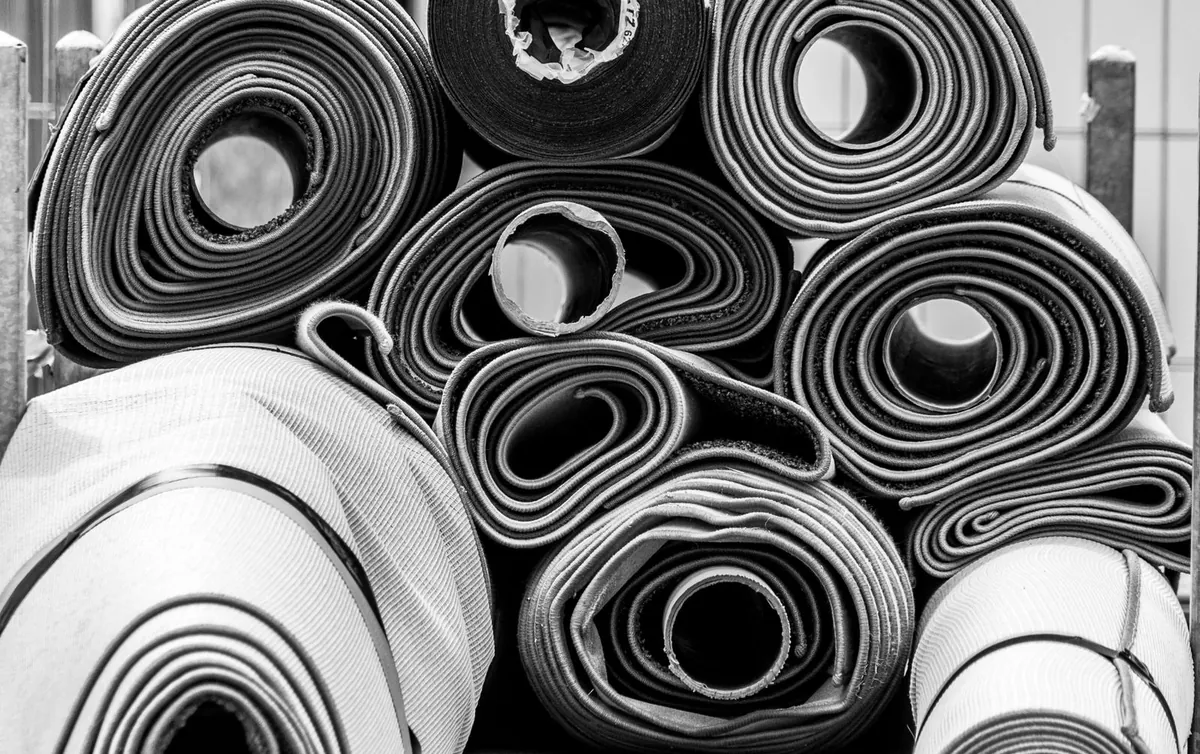
How Many Rolls Fit in a Container
Bulk buyers need the answer in containers, not in square metres, because that is the unit the freight plan runs on. A 20 ft container carries roughly 2,500 to 3,000 m² of turf at about 7 to 9 tonnes. A 40 ft container carries roughly 5,000 to 6,000 m² at about 18 to 22 tonnes. Those capacity figures are published third-party loading guidance rather than a fixed rule.
Converted to whole rolls at the covered areas above, a 20 ft container is roughly 50 to 60 rolls of 2 m turf. On 4 m turf it takes roughly 25 to 30 rolls. A 40 ft container doubles that to roughly 100 to 120 and 50 to 60 rolls.
| Container | Published turf capacity | Published payload | Whole 2 m rolls | Whole 4 m rolls |
|---|---|---|---|---|
| 20 ft | 2,500 to 3,000 m² | 7 to 9 tonnes | about 50 to 60 | about 25 to 30 |
| 40 ft | 5,000 to 6,000 m² | 18 to 22 tonnes | about 100 to 120 | about 50 to 60 |
Loading is not fixed by the container alone. Pile height, density, backing type and the roll width and length all change how much fits, which is why a loading plan is calculated before shipment.
Published production tolerances are plus or minus 1% on width, plus or minus 1% on length and plus or minus 5% on weight. Quote a roll count with the single-roll weight and volume alongside it, so the shipping plan and the site plan agree.
One trade listing for a 2 m by 25 m roll gives 50 m², 0.45 CBM and 110 kg, with a 45 cm roll diameter. Treat it as one published example rather than a fixed figure for every construction.
The one variable buyers can control is what separates a consistent roll from a cheap one, because density and backing drive both weight and area per container.
Häufig gestellte Fragen
Wie viele Rollen künstlichen Rasens benötige ich für 100 Quadratmeter?
At least two 4 m by 25 m rolls of 100 m² each, but only if the plot is at least 8 m wide with no waste. Round the strip count up and add the wastage band for the shape.
Do I divide my area by the roll size to get the roll count?
No. Dividing area by roll area ignores strip width and fibre direction, so it under-orders on almost any real plot. Count strips from the widest point instead.
How many rolls of artificial grass do I need for an L-shaped garden?
Split the L into two rectangles and count each one. A 4.1 m wide zone cannot be covered by a 4 m roll, so it needs a second roll for the last 10 cm.
Is it cheaper to under-order and top up later?
No. A top-up order may come from a different production batch, whose colour can differ slightly, and the mismatch shows where the two pieces meet.
How many rolls of artificial grass fit in a 20 ft container?
A 20 ft container holds roughly 2,500 to 3,000 m², which is about 50 to 60 rolls of 2 m turf or 25 to 30 rolls of 4 m turf.
How much waste should I add to a roll order?
Match the band to the shape: 5% to 10% for a simple rectangle, 10% to 15% for curves or obstacles, and 15% to 20% for a complex layout.


 German
  English
  Arabic
  French
  Portuguese
  Russian
  Spanish