
Relyir Gras
Kunstgras ab Werk seit 2006 — vollständige Individualisierung, Muster und schnelle Angebote.
Kunstrasen-Systeme
50 mm PE monofilament engineered for the scrum impacts and high-speed running demands of rugby. Factory-direct from Relyir since 2006.
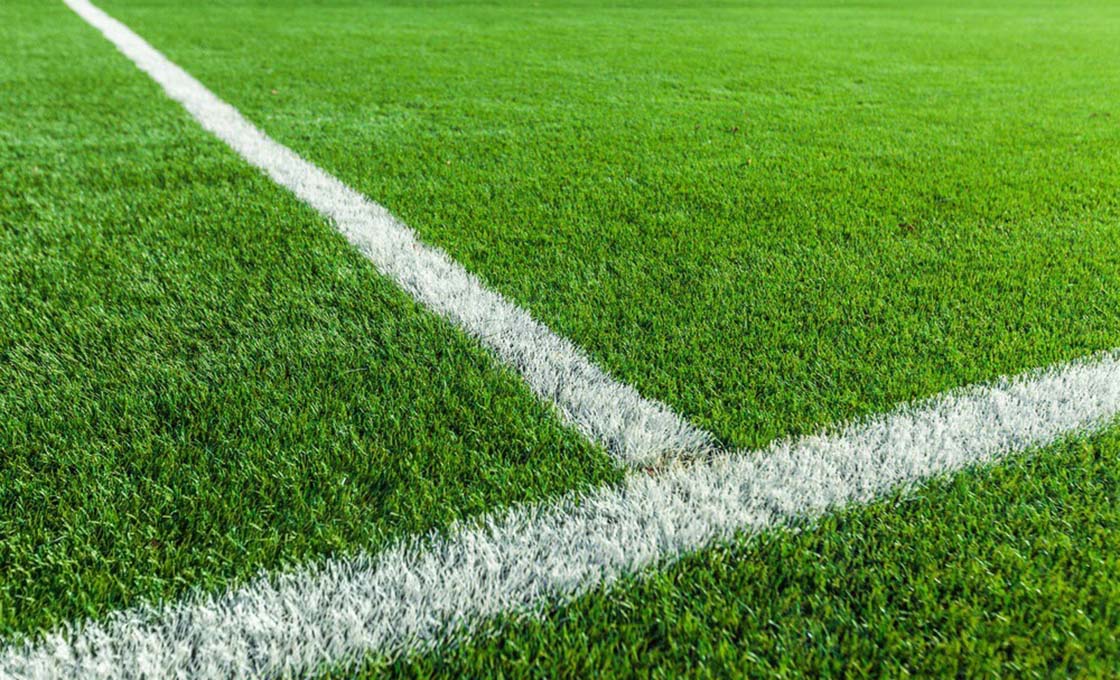
Warum 50-mm-Monofilament spezifizieren
Rugby places the strictest head-injury and skin-abrasion requirements on any artificial surface. World Rugby Regulation 22 sets an impact attenuation threshold that few sports approach. Every Relyir rugby specification is developed with those benchmarks in mind.
Regulation 22 requires an installed-field HIC of at least 1.45 m critical fall height — among the toughest head-safety thresholds in sport. A 50 mm pile combined with a shock pad is the standard route to achieving that value on the installed system.
Rugby’s sliding tackles and ground-level contact demand controlled skin friction. PE monofilament fibers produce measurably lower abrasion than fibrillated yarn, and the 50 mm pile depth cushions the contact zone between skin and infill.
Scrums and mauls concentrate enormous static and dynamic forces on a small area of turf. Dense 10,500 tufts/m² with reinforced three-layer backing resists the fiber displacement and infill migration those repeated set-pieces cause.
Produktsortiment
One proven platform — 50 mm pile, 3/4″ gauge, 10,500 tufts/m² — with distinct blade structures and colorways. All models share reinforced three-layer backing with optional PU coating upgrade. World Rugby favors 60 mm carpet; 50 mm systems require supplementary declarations on pile weight and infill depth.
| Modell | Florhöhe | Garn | Dichte | Drahtstärke | Reihenzahl | Trägergewebe | Farben |
|---|---|---|---|---|---|---|---|
| Diamond Overcome 50 | 50 mm | PE-Monofilament | 10.500 Büschel/m² | 3/4″ | 20/10 cm | PP + Vlies + PP (PU optional) | Feldgrün / Apfelgrün |
| U & Stem Ideal 50 | 50 mm | — | 10.500 Büschel/m² | 3/4″ | 20/10 cm | PP + Vlies + PP (PU optional) | Feldgrün / Apfelgrün |
| Double Stem Wonder 50 | 50 mm | PE-Monofilament | 10.500 Büschel/m² | 3/4″ | 20/10 cm | PP + Vlies + PP (PU optional) | Feldgrün / Gelbgrün |
| Wave Zeal 50 | 50 mm | PE-Monofilament | 10.500 Büschel/m² | 3/4″ | 20/10 cm | PP + Vlies + PP (PU optional) | Feldgrün / Apfelgrün |
| Wave Vitality 50 | 50 mm | PE-Monofilament | 10.500 Büschel/m² | 3/4″ | 20/10 cm | PP + Vlies + PP (PU optional) | Feldgrün |
Roll sizes: 4 × 25 m or 2 × 25 m, maximum roll width 5 m. White line tufting and team logo integration available on request. Full datasheets — including yarn weight and total weight — are provided with your quotation.
Leistungsdesign
Rugby’s defining characteristic — full-body contact at speed — makes it the most demanding sport for artificial surface safety. World Rugby Regulation 22 is the governing framework: it specifies laboratory and field tests for shock absorption, energy restitution, vertical deformation, head-impact attenuation (HIC), rotational resistance, ball rebound and skin friction.
The HIC requirement is the headline challenge. On an installed field, the surface must demonstrate a critical fall height of at least 1.45 meters — meaning a player’s head can survive an impact from that height without exceeding the injury threshold. Achieving this on artificial turf almost always requires a shock pad beneath the carpet, paired with controlled infill depth.
Regulation 22 also mandates retesting within two years of installation, and major-event venues may be tested within three months. This retesting cycle means the turf system must hold its performance characteristics through seasons of play, not just on day one.
Skin abrasion is another Regulation 22 parameter that sets rugby apart. Sliding tackles and ground-level rucks expose bare skin to fiber friction. PE monofilament produces measurably lower abrasion values than fibrillated yarn, and the 50 mm pile depth ensures a cushioned interface between skin and the sand-rubber infill column.
Relyir supplies the turf product with full specification documentation and supports your field-test laboratory through the Regulation 22 compliance process.
Factory Direct from Jiangsu
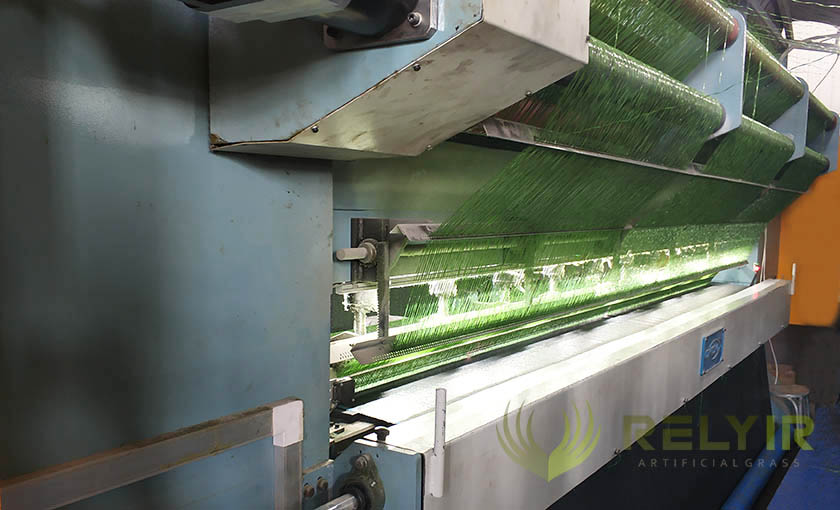
Relyir stellt seit 2006 Kunstrasen in Jiangsu her. Jeder Schritt – vom rohen PE-Granulat bis zur fertigen Rolle – läuft vor Ort, so kontrollieren wir die Qualität und halten die Preise 30–50% unter internationalen Vergleichsprodukten.
Alle acht Produktionsstufen werden vor Ort verwaltet, was die Qualitätslücken beseitigt, die entstehen, wenn Compoundierung, Florverlegung und Beschichtung in verschiedenen Anlagen erfolgen. Die 2015 in Betrieb genommene automatisierte Sportkunstrasenlinie erhöhte die Produktionskapazität um 150% und stärkte die Konsistenz bei Großaufträgen.
Anpassung ist in die Linie eingebaut: Faserdichte, Florhöhe und Faserfarben werden an die Projektspezifikation angepasst, mit PP + Netz- und PU-Rückseiten-Optionen. Das Exportteam hat seit 2009 an über 500 Kunden in 50+ Länder geliefert und bearbeitet alle Dokumentationen – von Rechnungen bis zu Ursprungszeugnissen.
Systemaufbau
Die Belagrolle ist eine Komponente eines vierschichtigen Systems. Wir liefern den Belag und geben für jedes Projekt Aufbau-Richtlinien weiter, damit Installateure das im Entwurfsstadium definierte Feldverhalten erreichen.
Compacted aggregate or asphalt with engineered drainage — the foundation that manages water and distributes the concentrated loads from scrums and mauls.
Silica sand, typically 20–30 kg/m², brushed into the pile to weigh the system and hold fibers upright. Infill depth is closely controlled for Regulation 22 compliance.
SBR, TPE, EPDM or organic (cork) at 8–15 kg/m². Infill grain size, form and mass must match declared values for Regulation 22 field testing.
Strongly recommended for rugby — the elastic layer beneath the turf is the primary mechanism for reaching the HIC ≥ 1.45 m critical fall height threshold.
Regulation 22 includes field checks for infill depth consistency and infill containment — splash is capped at 3.5%. Perforated backing ensures water moves through the carpet without carrying infill particles to the drainage system.
Because Regulation 22 requires retesting within two years, the turf system must retain its structural integrity through seasons of play. UV-stabilized PE fibers and reinforced three-layer backing resist degradation under sun exposure and the mechanical stress of contact rugby.
Regulation 22 specifies laboratory and field tests for shock absorption, energy restitution, vertical deformation, head-impact attenuation (HIC ≥ 1.45 m on installed fields), rotational resistance, ball rebound, skin friction and skin abrasion. Pile height must be at least 50 mm, and World Rugby favors 60 mm carpet. Relyir supplies full documentation to support your testing program.
Rugby involves full-body contact at speed — tackles, rucks and mauls — where players’ heads can impact the surface from standing height or higher. The 1.45 m critical fall height requirement reflects this risk. Achieving it almost always requires a shock pad beneath the turf carpet, paired with carefully controlled infill depth.
Yes. Regulation 22 requires field retesting within two years of installation, and major-event venues may be tested within three months. This means the turf system must hold its performance characteristics through seasons of play. Relyir designs its products with long-term performance retention in mind.
Yes. Community rugby pitches frequently share with football. A well-specified 50 mm system with shock pad can serve both codes, making the investment case for dual-use clubs and municipal facilities. Line markings for both sports can be tufted into the carpet during production.
Regulation 22 includes skin friction and skin abrasion parameters because rugby involves frequent ground-level contact. PE monofilament fibers produce measurably lower abrasion values than fibrillated yarn. All five Relyir models use monofilament or monofilament-equivalent construction to address this requirement.
Standard rolls are 4 × 25 m or 2 × 25 m with a maximum width of 5 m. We tuft white line markings and team logos directly into the carpet, and can adjust blade density, pile height and fiber colors to project requirements.
Senden Sie uns Ihre Feldmaße, Ihren Nutzungsplan und Ihren Zielzeitrahmen. Unser Exportteam antwortet innerhalb von 12 Stunden mit Modellempfehlungen, Spezifikationsblättern und Werkpreise.
Kostenloses Angebot anfordern German
  English
  Arabic
  French
  Portuguese
  Russian
  Spanish