
A backyard lawn can look flawless on install day and still fail its first real storm. Water pools in the low spots, the blades mat down, and within a week the dog’s favourite corner starts to smell. In almost every case the turf itself is innocent. The failure hides in what goes under artificial grass, the stack of layers that has to carry every rainfall away from the surface.
We dissect that stack the way a factory sees it, from the turf backing at the top down to the graded soil at the bottom. Each layer gets its job, its typical thickness and the honest truth about whether you can skip it. What you will not find here is the roll-out-and-seam sequence, because that craft belongs to the installers and has its own walkthrough.
Why the Layers Under Turf Matter
The base is the one part of a lawn that nobody inspects at handover. Installers know this, and the weak ones quietly skip compaction or thin out the stone, because the mistake stays buried. You only meet the consequences months later, when the surface dips under the swing set and rainwater sits there for a day. By then the fix means lifting the whole lawn.
The failure chain is predictable. A soft or flat base lets water collect, standing water breeds mildew and odor, and saturated stone slowly shifts under foot traffic. Pet owners feel it first, because urine has nowhere to flush and the smell rises instead of draining away. A base built in the right order breaks that chain before it starts.
So treat this as the inspection sheet you wish you had on day one. We will tell you which layers are structural and which are optional, and we will name the one layer the pet industry loves to oversell. Where numbers matter, you get the figures installers actually build to.
What Goes Under Artificial Grass, Top to Bottom
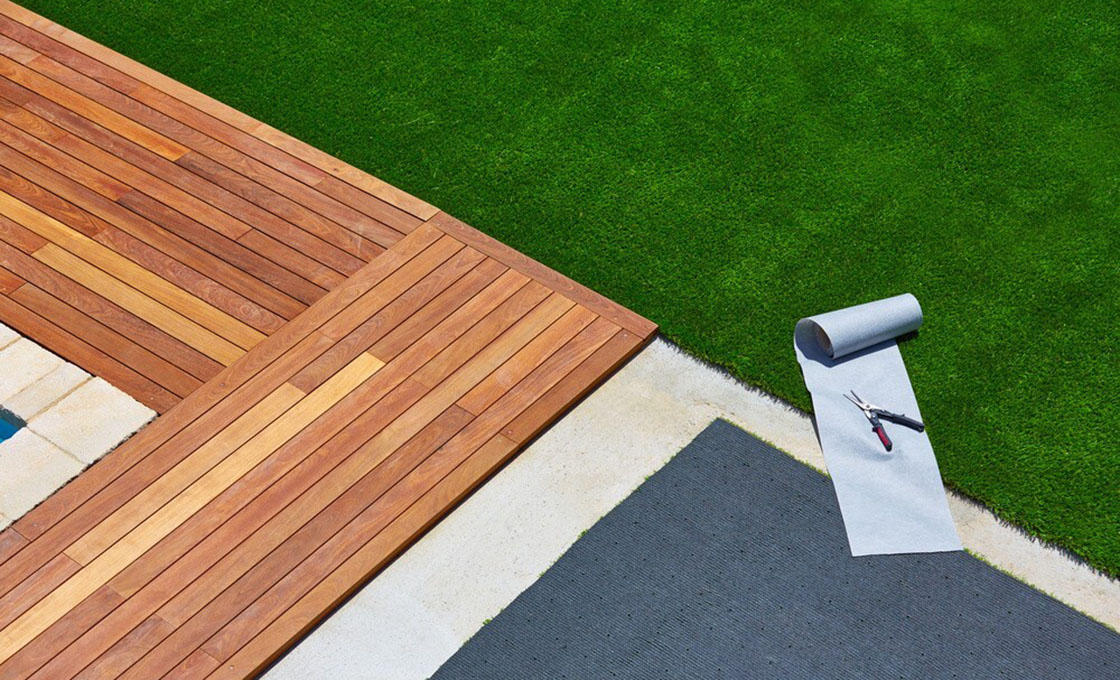
Think of the build as a layer cake, where the bottom tiers decide whether the top holds its shape. What goes under artificial grass is a fixed sequence of jobs, not a pile of random material. Water enters at the surface, passes through the backing, and must keep moving down and across until it leaves the system. Every layer either helps that journey or gets in its way.
| Layer, top to bottom | Typical thickness | Job it does | Can you skip it? |
|---|---|---|---|
| Turf with perforated backing | Set by pile height | First drainage gate into the base | Never |
| Leveling layer of sharp sand or stone fines | About 1/2 inch | Smooths the stone so the turf lies flat | Yes, on simple builds |
| Geotextile weed membrane | Thin fabric sheet | Stops stone and soil from mixing | Yes, and for pets |
| Compacted crushed stone sub-base | 2-4 inches, up to 6 for heavy use | Carries loads and stores drainage | Never |
| Graded native soil | Excavate 2-4 inches for the build-up | Slopes the whole system to shed water | Never |
Only two layers are truly structural: the compacted stone and the slope beneath it. The leveling layer and the fabric are refinements, useful in some projects and wasteful in others. A full build-up typically claims around 6-6.5 inches of excavated depth once turf, stone and bedding are counted. Keep that figure in mind before you order stone, because depth is the one thing you cannot fake after the fact.
The Turf Backing: First Drainage Gate
Most landscape turf is manufactured with small holes punched through the backing, so rain drops straight into the stone below. Better specification grades go further with a fully permeable backing that drains across its whole area, not just at the punch points. The difference matters most on pet lawns and rooftops, where water volume per square meter is high. A backing that drains everywhere asks less of the layers underneath.
This is where the factory view earns its keep. We produce turf on PP+Net and PU backings, and the backing you choose changes how the base should be planned. A wider roll also means fewer seams sitting on the base. Our césped artificial residencial range comes in 2, 4 and 5 metre widths by 25 metre rolls, covering roughly 50, 100 and 125 square metres per roll. Fewer seams mean fewer spots where the surface can bridge a dip in the leveling layer.
Weed Membrane: Above or Below the Base?
Ask three sources where the fabric goes and you may get three answers. One popular guide tells readers to roll a weed barrier under the base in step one, then places a geotextile above the stone in step three of the same article. Meanwhile, experienced installers argue that fabric buried under the base barely stops weeds and can trap bacteria in the moisture it holds. Both camps cannot be right, and the confusion costs buyers money.
Our position is blunt. Geotextile fabrics are separation layers, useful where fine soil would migrate up into clean stone. If you use one at all, it belongs between the sub-base and the leveling layer. For pet projects we tell buyers to skip it entirely, because a urine-soaked sheet buried under stone is a smell you fabricate yourself. Good compaction and a proper slope do more against weeds than any buried cloth.
The Sub-Base: Stone Choice and Thickness
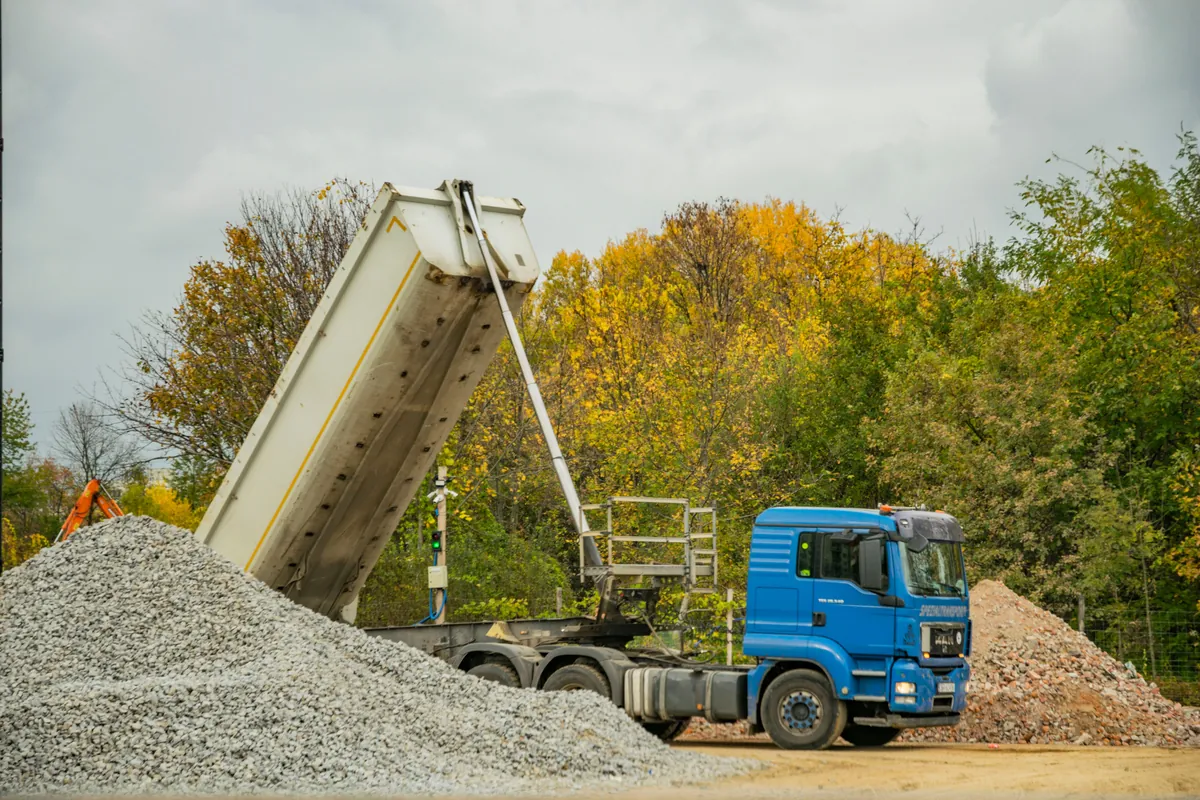
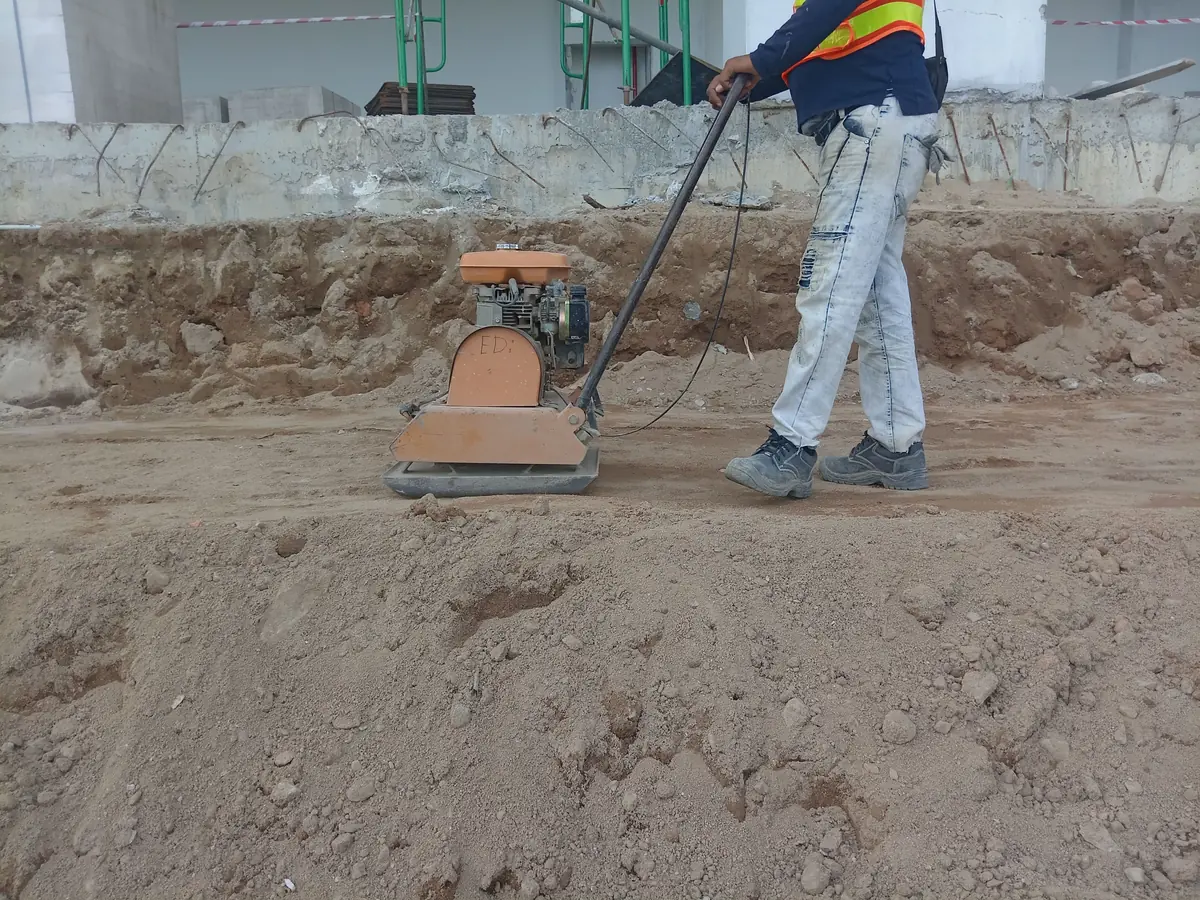
This is the layer that answers the question for real. Ask any builder what goes under artificial grass on soil and the answer starts with crushed, angular stone, packed tight enough to walk on without a footprint. Manufacturers of professional installs call for Class II road base, spread 2-3 inches deep and compacted hard with a plate compactor. UK specifications reach for the same idea as Type 1 MOT. The general rule across guides is crushed stone at 2-4 inches, pushed up to 6 inches for play areas and other heavy use.
Stone selection follows one physics rule: angular pieces lock, round pieces roll. Guides converge on crushed stone 3/4 inch or smaller, and Northeast installers favour 3/8-inch angular bluestone, compacted to a 3-4 inch slab that sets almost like concrete. DIY builders who cannot source road base use decomposed granite at about 2 inches, then mist and roll a stabilizer into it so rain cannot wash the base away. Whichever stone you pick, the compaction passes and moisture control that follow are their own craft, and the full walkthrough lives in our artificial turf installation walkthrough.
Extra Drainage Layers for Wet Yards
Some sites defeat the standard stack before it is even built. Where the yard has a dip that always stays soggy, installers put a French drain in the low spot so water leaves the profile instead of pooling under the stone. Heavy clay soils and enclosed edges get a channel drain instead, a grated trench that catches surface runoff and pipes it to a safe outlet. Both sit below the stone, which is why they are decisions for the planning stage, not fixes for later.
Hard surfaces need the same thinking in reverse. Over concrete or rooftop decks, a drainage grid or air-gap mat lifts the turf off the waterproof surface so water can travel and the system can breathe. Installers commonly name products like AirDrain or DrainCore for this job. If your project lives in this corner of the map, tell us the surface and the water story, and we will help you match the stack before you order.
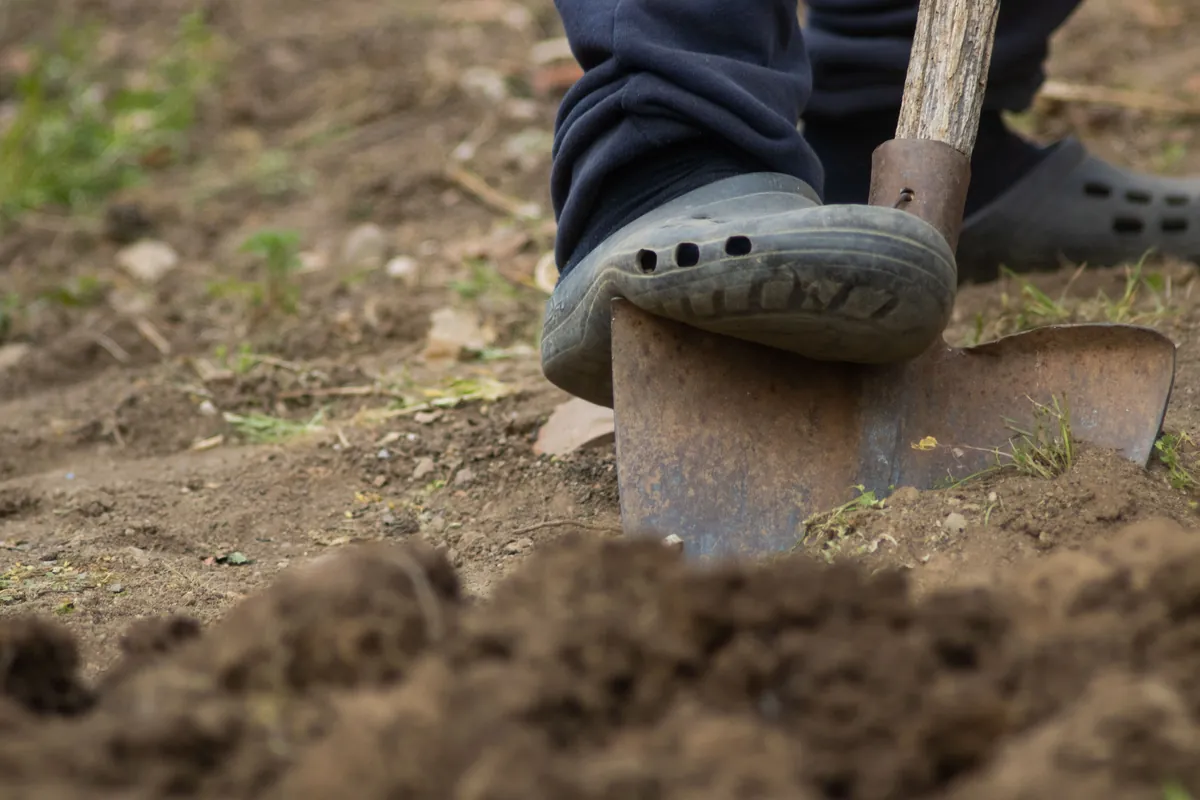
Asegura la base antes de que llegue el césped
Corregir una apilación de capas en el papel es barato, pero corregirla después de que se coloque la piedra es costoso. Envíanos tu superficie, medidas y condiciones del terreno, y el equipo de la fábrica confirmará juntos el soporte, los anchos de rollo y el plan de base antes de que te comprometas.
Grading the Soil Below Everything
La capa de drenaje más económica no cuesta nada de comprar, porque es la propia forma del terreno. Mucho antes de que alguien pregunte qué va debajo del césped artificial, la pendiente del terreno ya ha decidido hacia dónde irá la lluvia. Las guías coinciden en que una pendiente de 1-2% funciona mejor, lo que los instaladores traducen en una caída de uno a dos pulgadas por cada ocho pies, siempre alejándose de los edificios. En suelos arcillosos o de drenaje deficiente, esa suave pendiente no es opcional, ya que el suelo bajo la piedra no absorberá el agua por sí solo. Los instaladores verifican la pendiente con un nivel y una soga mientras dan forma, no después.
La preparación comienza despojando el terreno. Las guías recomiendan retirar unos 2-4 pulgadas de suelo superficial, junto con cada raíz, roca y escombro antiguo que pueda pudrirse o provocar levantamientos posteriormente. La profundidad total de excavación para una construcción estándar ronda las 6-6,5 pulgadas una vez que el césped, el lecho y la piedra se apilan en el plan. Mide la profundidad dos veces antes de pedir piedra, porque la excavación es la única capa que no puedes recuperar después. El suelo expuesto se compacta entonces, dando a la piedra un suelo firme para que todo el sistema no pueda migrar hacia abajo.
Matching the Layers to Your Project
Las apilaciones estándar se adaptan a proyectos reales, y los ajustes suelen ser pequeños una vez que conoces las reglas. La tabla siguiente reúne las construcciones sobre las que más nos consultan, desde áreas para perros hasta bordes transitables. Para propietarios que planean un patio completo, las opciones comienzan con nuestra guía de grado residencial y terminan con lo que hace tu suelo en una tormenta. El césped mismo cuesta $7-60 por metro cuadrado (indicativo, solicita cotización exacta) según el grado, mientras que la piedra de debajo la fija tu proveedor local.
| Proyecto | Qué cambia en la apilación |
|---|---|
| Césped de patio trasero | La construcción estándar: 2-4 pulgadas de piedra compactada sobre suelo con pendiente de 1-2%. |
| Área para perros | La misma piedra, sin geotextil, más una capa de unos 1/4 de pulgada de zeolita sobre la base compactada para controlar olores. |
| Patio o balcón de hormigón | Sin excavación. Añade una rejilla de drenaje para crear un espacio de aire y luego pega el césped. |
| Patio con pendiente | Malla de alambre a través de la base hasta 15 grados; una celda de membrana de estabilización con una capa de 1/2 de pulgada de granito más allá de ese ángulo. |
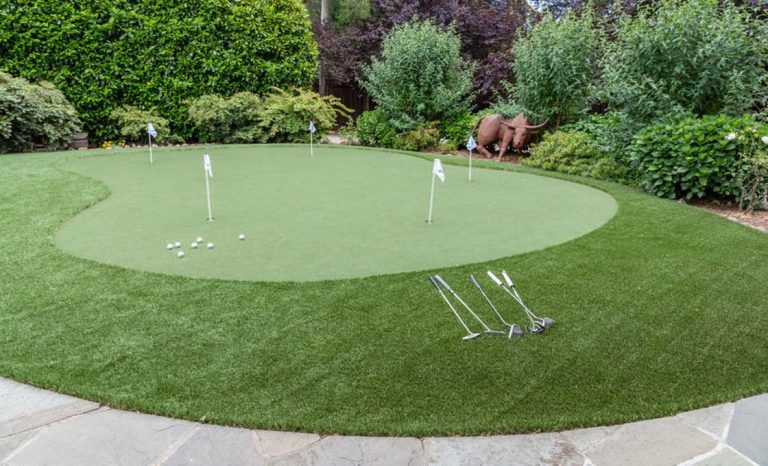
| Green de putting | Base de camino compactada rematada con una capa fina de granito descompuesto para que las hondonadas nunca se muestren en pile corto. |
| Borde transitable o de estacionamiento | Losetas permeables de geotextil asentadas sobre la subbase estándar antes de que se coloque el césped. |
Una nota de planificación vincula las capas con los propios rollos. Las disposiciones anchas con pocas juntas solo te recompensan si la base está nivelada, así que nivela la piedra a la altura terminada antes de que llegue el césped. Nuestros rollos vienen en anchos de 2, 4 y 5 metros por 25 metros, y se pueden fabricar tamaños personalizados sin costuras internas para superficies grandes o difíciles. El recorrido completo de instalación muestra cómo esos rollos se unen a la base el día de la instalación.
Preguntas Frecuentes
¿Se puede colocar césped artificial directamente sobre tierra?
No. El suelo desnudo se compacta de manera irregular y retiene agua, de modo que la superficie se hunde y forma charcos en pocos meses. Mantén al menos una.
¿Cuál es el mejor material de base bajo el césped artificial?
La piedra triturada compactada es la opción probada: base vial de Clase II o MOT Tipo 1 de 2 a 4 pulgadas, o aproximadamente 2 pulgadas de granito descompuesto para una instalación casera.
¿Necesitas una barrera antihierbas bajo el césped artificial?
Normalmente, no. Cuando los instaladores sí utilizan una, se coloca sobre la subbase, pero el tejido enterrado puede atrapar bacterias y se omite en céspedes para mascotas en favor de un drenaje rápido.
¿Qué se pone bajo el césped artificial para perros?
La misma subbase de piedra con drenaje libre, con la capa de tejido eliminada, una capa de zeolita de aproximadamente 1/4 de pulgada para el control de olores, y un revestimiento trasero permeable para que la orina se drene directamente.
¿Se puede colocar césped artificial sobre hormigón?
Sí, siempre que el agua pueda evacuarse. Añade una rejilla de drenaje o una capa de cámara de aire, fija la hierba con adhesivo exterior y comprueba primero que la propia losa no retenga charcos.
 Spanish
  English
  Arabic
  French
  German
  Portuguese
  Russian