

Buyers usually ask which grass is best first. The real decision is the supply format, because that decides what the site can actually take. A four-metre roll will not fit up a narrow stair, a tile clicks down with no adhesive, and a wall panel is a different product line entirely. Choose the wrong format and every later step follows it wrong.
We build artificial grass rolls on our own production line, which is why format choice is the first thing we discuss with specifiers. The artificial grass product types that matter for a project are rolls, tiles, wall panels, practice mats and putting surfaces, not just a single “grass” product. Browse our turf product ranges to see which formats we supply and how each one is built.
Why Supply Format Comes Before End Use
Most artificial turf installations begin as a roll, because a roll is the default that warehouses stock and crews know. That default hides a problem: the format is picked before the site is understood, and the site is what should pick the format. A loading bay, a stair width and a balcony rail are format decisions in disguise.
The lesson we repeat to specifiers is simple. Format is the first specification, not the last. Get it right and seams, fixing and transport fall into place; get it wrong and you fight the product all the way to handover. This guide navigates the formats so the site leads the choice.
The Five Formats and What They Suit
Most buying guides treat turf as one product. It is not. The format you receive changes transport, seams, edge fixing and repair, so it sets every later decision. The table below maps the five artificial grass product types to the sites they suit, the fixing each one takes and the limit each one carries.
| Format | Convient à | Fixation des bords | Size or module | Key limit |
|---|---|---|---|---|
| Rolls | Large lawns, sports fields, playgrounds, pet areas | Glue, nails or turf pegs, plus jointing tape | 2 m, 4 m or 5 m wide by 25 m long | Heavy; needs cutting and seam work |
| Tiles | Balconies, rooftops, gyms, pool surrounds | Interlocking edges, no adhesive or fixings | 1 by 1 ft or 1 by 2 ft modules | Many grid seams; pricier per square metre |
| Wall panels | Backdrops, fences, passageways, vertical gardens | Pin-and-hole locking with zip ties | 40 by 40 in or 50 by 50 cm panels | Fixed module sizes; vertical load only |
| Practice mats | Gym corners, trade shows, drills, events | Loose-laid, no fixing required | 6 by 9 ft mat, also 4 by 6 or 9 by 12 ft | Small area; indoor or temporary use |
| Putting surfaces | Golf practice, compact training greens | Loose-laid over a level hard surface | Cut to the practice area on site | Roll-curl memory; needs planned stowage |
Rolls own the large, flat, high-traffic site. Tiles own the small, irregular, elevated site. Wall panels and mats are not floor products at all, and treating them as such is the most common mis-specification we see. That separation is the spine of this guide, and it is the part most competitors never put in one place.
Rolls and What They Own
Rolls are continuous carpet-style sheets supplied in fixed widths. Our line runs 2, 4 and 5 metre widths at 25 metres long, and a wider roll covers more ground with fewer joins. Large artificial turf installations rely on rolls because only a continuous sheet gives a seamless field that reads as one surface.
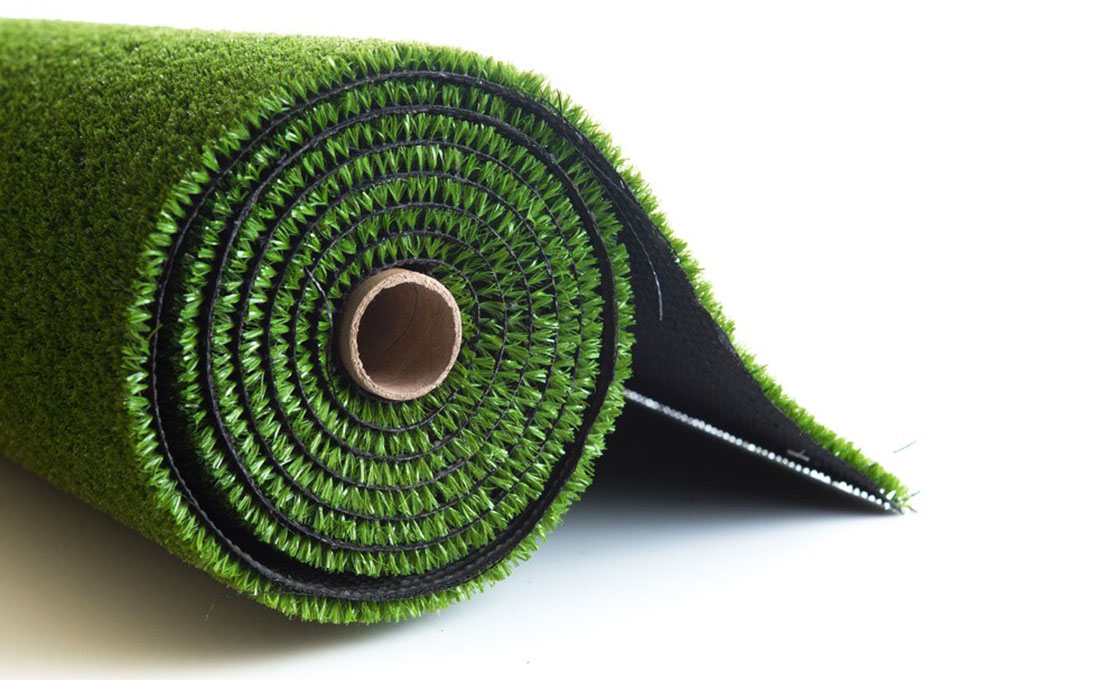
A 4 metre by 25 metre roll covers 100 square metres, while a 2 metre roll covers 50 and a 5 metre roll covers 125. For a 20 by 40 metre hall of about 800 square metres, that is 16 narrow rolls, 8 standard rolls or 7 wide rolls. See the rolls in our product range for the full width and backing menu before you fix a layout.
Rolls need cutting, seaming tape and a clean edge, so they suit crews with the right tools and a clear path. Not all artificial grass product types reach that scale, and rolls earn their place when the area is wide and flat. How synthetic turf is manufactured and supplied is covered in neutral detail by third-party reference sources. The roll stays the workhorse for sports and landscape because nothing else reaches the same seamless area.
Tiles, Panels and Practice Mats
Tiles are pre-cut squares with interlocking edges, and mats are the smallest format, often used indoors or for golf putting. Both favour the site where a roll would be awkward: a balcony, a rooftop or a gym corner. Note that the choice between rolls and tiles for a do-it-yourself floor is a separate question we answer in our rolls versus tiles for DIY projects guide.
Wall panels are a vertical format, not a floor format, and they belong in this navigation because our catalogue lists grass wall as a co-equal product line. How wall panels are built and fixed, using pin-and-hole locking, zip ties and any surface, is covered in our decorate grass walls guide. Keep the panel in its own lane.
Practice mats and putting surfaces are portable siblings of the roll. A trade-show mat can weigh as little as 25 pounds and stow in a cupboard, while a putting surface carries roll-curl memory that decides how you store it. None of these replace a roll on a sports field, and the format you pick sets the transport and stowage trade-offs that follow it.
How Width Decides Your Seams
Seam count is a function of roll width, not just the vague idea of “fewer seams”. Take a 10 by 20 metre room of 200 square metres laid across its 10 metre width. Two-metre rolls need five side by side and leave four seams. Four-metre rolls need three and leave two seams. Five-metre rolls need two and leave a single seam.

Wider rolls cut the seam count sharply, and that is a decision-grade input most guides never work out with real numbers. Fewer seams mean less tape, less labour and a cleaner surface, but also a heavier roll to move through the site. Our custom backing and roll size options let you match width to the access and the layout before the roll is made.
Edge Fixing Across Every Format
Edge fixing is not one method; it is a menu that changes with the artificial grass product types you specify. Rolls are secured with glue, nails or turf pegs and joined with jointing tape and adhesive. Tiles click together with built-in connectors and need no fixing at all. Wall panels use pin-and-hole locking with zip ties, and mats simply lay loose on a hard floor.
Most artificial turf installations combine at least two of these fixes, so the edge detail is never a single choice. No method is wrong; each fits its format, and the mistake is applying a roll’s fixing logic to a tile or expecting a panel to behave like flooring. Our materials, fibres and backings explained guide breaks down the backing choices that sit behind each fixing system, so the edge you specify matches the product you receive.
Weight, Transport and Upper-Floor Access
Weight is where format choice turns physical. Third-party event turf is specified at 0.36 to 0.75 pounds per square foot, a weight per unit area. A standard landscape roll is cited at 200 pounds or more, but that is a whole-roll total. The two are different measures, so they should not be ranked against each other. For handling planning, applied to a 4 metre by 25 metre roll of about 1,076 square feet, that band works out at roughly 390 to 810 pounds.
That whole-roll weight decides access. Upper-floor artificial turf installations need a lift or stair plan, mechanical handling and a clear path, while a tiled balcony arrives in hand-carried boxes. Specifiers who skip this step are the ones who stall a project at the loading bay, so plan the carry before you fix the format and the roll width together.
Specify a Format That Fits Your Site
Not sure which format fits your site?
Tell us the area, the access and how it will be fixed. We build the rolls on our own line, so the range shows what will fit your site.
Storage, Replacement and Repair Behaviour
Repair behaviour follows the format too. A damaged tile lifts out and a new one drops in, which independent guides say can add three to five years of life in busy areas. A roll needs a cut-and-patch, and a panel swaps as a unit. The format you choose sets how a future repair feels on site.
Storage is the quiet difference between formats. Rolls stand on their ends and need height; tiles stack in flat boxes; mats fold or roll into a cupboard. Independent buying guides cite eight to fifteen years for typical turf, though that always depends on use and care. The les facteurs de qualité qui distinguent un gazon durable are worth reading before you commit to a format.
Wear shows up differently across formats as well. Rolls wear evenly across the surface, while tiles show wear at the connecting points first. On most artificial turf installations the replacement path is set by the format, because one module lifts out where a continuous sheet must be patched. Plan that path during the first layout, not after the first repair.

Formats That Get Specified Wrong
Most format errors repeat, and three show up often enough that we list them here with the consequence each one carries. Reading them now is cheaper than reworking a floor after delivery.
Mistake 1: Sizing a small site with rolls
A narrow balcony or a rooftop corner handled with a four-metre roll means cutting most of it away and hauling dead weight upstairs. Tiles or a mat would have arrived in a box and clicked down in minutes. The wrong format here is a weight and waste problem, not a grass problem at all.
Mistake 2: Counting seams by area alone
Buyers compare price per square metre and forget that a 2 metre roll lays four seams where a 5 metre roll lays one. The seam maths changes labour, tape and the look of the finished surface. Width is a specification, not a footnote buried in the order form.
Mistake 3: Treating a panel like flooring
A wall panel is fixed vertically with pin-and-hole locking and zip ties, then expected to take foot traffic it was never built for. It will not hold. Vertical and floor formats are built for different loads, and mixing them is the fastest route to a failed install and a wasted order.

Questions fréquentes
Quels sont les principaux types de produits en gazon artificiel ?
Les formats disponibles sont les rouleaux, les dalles, les panneaux muraux, les tapis d'entraînement et les surfaces de putting. Les rouleaux conviennent aux grands sites plats, les dalles aux petits sites ou aux emplacements surélevés, et les panneaux et tapis répondent aux besoins verticaux et à la mobilité.
Le gazon synthétique est-il disponible en dalles ?
Oui. Les carreaux sont des carrés prédecoupés et emboîtés, souvent d'un pied sur un pied ou de deux pieds sur un pied, qui s'assemblent sans adhésif. Ils conviennent aux balcons, toitures et surfaces irrégulières où un rouleau serait difficile à manipuler.
Quel est le meilleur gazon artificiel pour une petite surface ?
Des tuiles ou un tapis d'entraînement. Les tuiles s'emboîtent dans les espaces irréguliers sans colle, et un tapis pèse aussi peu que vingt-cinq livres et se range dans un placard. Les rouleaux conviennent aux grandes surfaces où une couverture sans couture est plus importante que la portabilité.
Comment les largeurs de rouleau influencent-elles le nombre de coutures ?
A ten by twenty metre room takes four seams with two-metre rolls, two seams with four-metre rolls, and one seam with five-metre rolls. Wider rolls sharply cut seam count, labour and tape on the same floor area.
Can wall panels be used as flooring?
No. Wall panels lock vertically with pin-and-hole fittings and zip ties, and they are built for vertical loads on fences and backdrops. For a floor you need rolls or interlocking tiles, which are made to take foot traffic and wear.


 French
  English
  Arabic
  German
  Portuguese
  Russian
  Spanish