
A backyard lawn can look flawless on install day and still fail its first real storm. Water pools in the low spots, the blades mat down, and within a week the dog’s favourite corner starts to smell. In almost every case the turf itself is innocent. The failure hides in what goes under artificial grass, the stack of layers that has to carry every rainfall away from the surface.
We dissect that stack the way a factory sees it, from the turf backing at the top down to the graded soil at the bottom. Each layer gets its job, its typical thickness and the honest truth about whether you can skip it. What you will not find here is the roll-out-and-seam sequence, because that craft belongs to the installers and has its own walkthrough.
Why the Layers Under Turf Matter
The base is the one part of a lawn that nobody inspects at handover. Installers know this, and the weak ones quietly skip compaction or thin out the stone, because the mistake stays buried. You only meet the consequences months later, when the surface dips under the swing set and rainwater sits there for a day. By then the fix means lifting the whole lawn.
The failure chain is predictable. A soft or flat base lets water collect, standing water breeds mildew and odor, and saturated stone slowly shifts under foot traffic. Pet owners feel it first, because urine has nowhere to flush and the smell rises instead of draining away. A base built in the right order breaks that chain before it starts.
So treat this as the inspection sheet you wish you had on day one. We will tell you which layers are structural and which are optional, and we will name the one layer the pet industry loves to oversell. Where numbers matter, you get the figures installers actually build to.
What Goes Under Artificial Grass, Top to Bottom
Think of the build as a layer cake, where the bottom tiers decide whether the top holds its shape. What goes under artificial grass is a fixed sequence of jobs, not a pile of random material. Water enters at the surface, passes through the backing, and must keep moving down and across until it leaves the system. Every layer either helps that journey or gets in its way.
| Layer, top to bottom | Typical thickness | Job it does | Can you skip it? |
|---|---|---|---|
| Turf with perforated backing | Set by pile height | First drainage gate into the base | Never |
| Leveling layer of sharp sand or stone fines | About 1/2 inch | Smooths the stone so the turf lies flat | Yes, on simple builds |
| Geotextile weed membrane | Thin fabric sheet | Stops stone and soil from mixing | Yes, and for pets |
| Compacted crushed stone sub-base | 2-4 inches, up to 6 for heavy use | Carries loads and stores drainage | Never |
| Graded native soil | Excavate 2-4 inches for the build-up | Slopes the whole system to shed water | Never |
Only two layers are truly structural: the compacted stone and the slope beneath it. The leveling layer and the fabric are refinements, useful in some projects and wasteful in others. A full build-up typically claims around 6-6.5 inches of excavated depth once turf, stone and bedding are counted. Keep that figure in mind before you order stone, because depth is the one thing you cannot fake after the fact.
The Turf Backing: First Drainage Gate
Most landscape turf is manufactured with small holes punched through the backing, so rain drops straight into the stone below. Better specification grades go further with a fully permeable backing that drains across its whole area, not just at the punch points. The difference matters most on pet lawns and rooftops, where water volume per square meter is high. A backing that drains everywhere asks less of the layers underneath.
This is where the factory view earns its keep. We produce turf on PP+Net and PU backings, and the backing you choose changes how the base should be planned. A wider roll also means fewer seams sitting on the base. Our residential artificial grass range comes in 2, 4 and 5 metre widths by 25 metre rolls, covering roughly 50, 100 and 125 square metres per roll. Fewer seams mean fewer spots where the surface can bridge a dip in the leveling layer.
Weed Membrane: Above or Below the Base?
Ask three sources where the fabric goes and you may get three answers. One popular guide tells readers to roll a weed barrier under the base in step one, then places a geotextile above the stone in step three of the same article. Meanwhile, experienced installers argue that fabric buried under the base barely stops weeds and can trap bacteria in the moisture it holds. Both camps cannot be right, and the confusion costs buyers money.
Our position is blunt. Geotextile fabrics are separation layers, useful where fine soil would migrate up into clean stone. If you use one at all, it belongs between the sub-base and the leveling layer. For pet projects we tell buyers to skip it entirely, because a urine-soaked sheet buried under stone is a smell you fabricate yourself. Good compaction and a proper slope do more against weeds than any buried cloth.
The Sub-Base: Stone Choice and Thickness
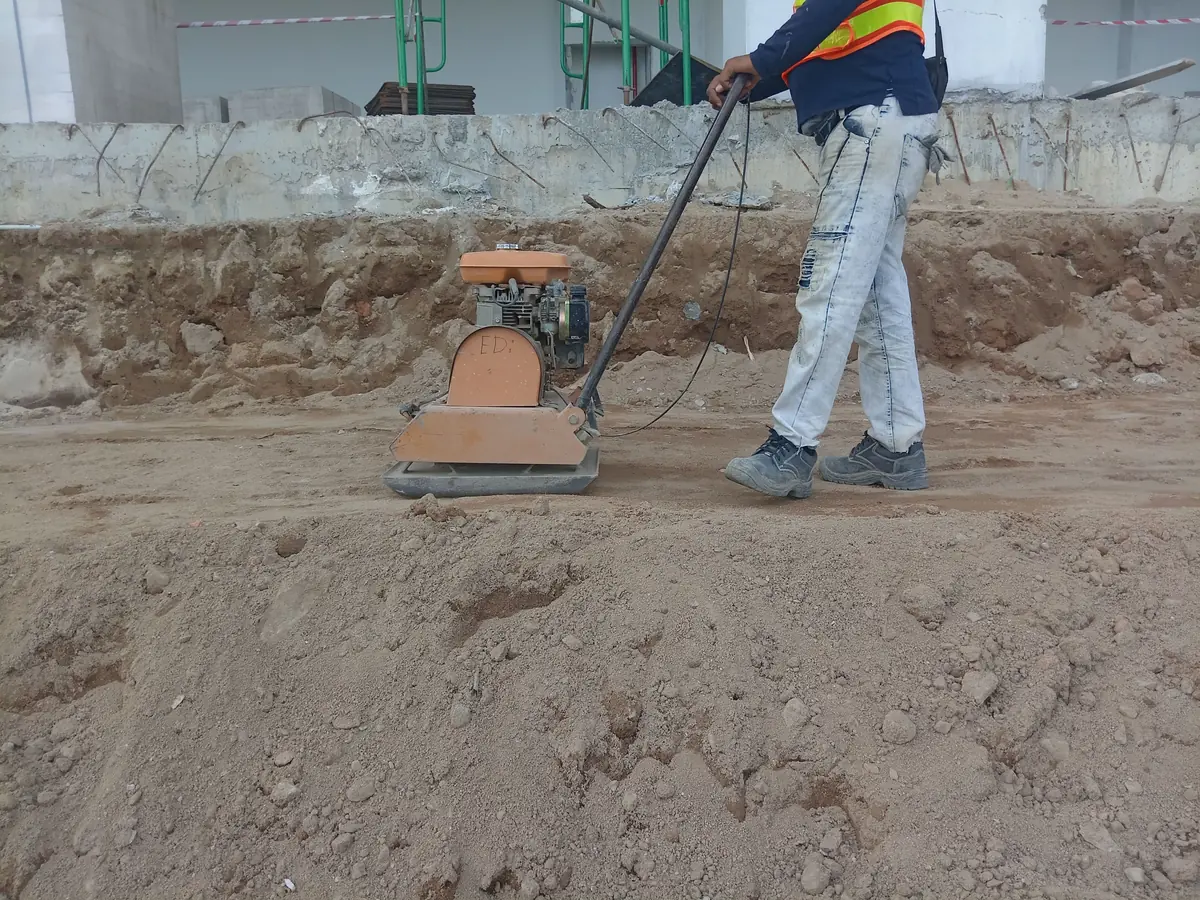
This is the layer that answers the question for real. Ask any builder what goes under artificial grass on soil and the answer starts with crushed, angular stone, packed tight enough to walk on without a footprint. Manufacturers of professional installs call for Class II road base, spread 2-3 inches deep and compacted hard with a plate compactor. UK specifications reach for the same idea as Type 1 MOT. The general rule across guides is crushed stone at 2-4 inches, pushed up to 6 inches for play areas and other heavy use.
Stone selection follows one physics rule: angular pieces lock, round pieces roll. Guides converge on crushed stone 3/4 inch or smaller, and Northeast installers favour 3/8-inch angular bluestone, compacted to a 3-4 inch slab that sets almost like concrete. DIY builders who cannot source road base use decomposed granite at about 2 inches, then mist and roll a stabilizer into it so rain cannot wash the base away. Whichever stone you pick, the compaction passes and moisture control that follow are their own craft, and the full walkthrough lives in our tutoriel d'installation de gazon synthétique.
Extra Drainage Layers for Wet Yards
Some sites defeat the standard stack before it is even built. Where the yard has a dip that always stays soggy, installers put a French drain in the low spot so water leaves the profile instead of pooling under the stone. Heavy clay soils and enclosed edges get a channel drain instead, a grated trench that catches surface runoff and pipes it to a safe outlet. Both sit below the stone, which is why they are decisions for the planning stage, not fixes for later.
Hard surfaces need the same thinking in reverse. Over concrete or rooftop decks, a drainage grid or air-gap mat lifts the turf off the waterproof surface so water can travel and the system can breathe. Installers commonly name products like AirDrain or DrainCore for this job. If your project lives in this corner of the map, tell us the surface and the water story, and we will help you match the stack before you order.
Réalisez correctement la base avant l'arrivée du gazon
Une pile de couches est facile à corriger sur le papier et coûteuse à corriger une fois la pierre en place. Envoyez-nous votre surface, les dimensions et les conditions du site, et l'équipe d'usine confirmera l'endos, les largeurs de rouleau et le plan de base ensemble avant que vous ne vous engagiez.
Grading the Soil Below Everything
La couche de drainage la moins chère ne coûte rien, car elle est la forme du terrain lui-même. Longtemps avant quiconque se demande ce qui se place sous un gazon artificiel, la pente du terrain a déjà décidé où l'eau de pluie se dirigera. Les guides s'accordent sur le fait qu'une pente de 1-2% est la plus efficace, que les installateurs traduisent en une baisse d'un à deux pouces par huit pieds, en s'éloignant toujours des bâtiments. Sur un sol argileux ou mal drainant, cette pente douce n'est pas optionnelle, car le sol sous la pierre n'absorbera pas l'eau de lui-même. Les installateurs vérifient la pente avec un niveau et une ligne à corde pendant le façonnage, et non après.
La préparation commence par déblayer le terrain en profondeur. Les guides recommandent de retirer environ 2 à 4 pouces de terre végétale, ainsi que toutes les racines, pierres et anciens débris qui pourriraient ou gonfleraient plus tard. La profondeur totale de fouille pour une construction standard atteint environ 6 à 6,5 pouces une fois le gazon, la couche de litage et la pierre empilés selon le plan. Mesurez la profondeur deux fois avant de commander la pierre, car la fouille est la seule couche qu'on ne peut pas rajouter par la suite. Le sol exposé est ensuite compacté, offrant à la pierre un sol ferme afin que l'ensemble du système ne puisse pas descendre.
Matching the Layers to Your Project
Les empilements standards s'adaptent aux projets réels, et les ajustements sont généralement minimes une fois les règles connues. Le tableau ci-dessous rassemble les constructions dont on nous demande le plus souvent, des enclos pour chiens aux bords praticables. Pour les propriétaires qui planifient une cour complète, les choix commencent par nos recommandations résidentielles et se terminent par ce que votre sol fait lors d'une tempête. Le gazon lui-même est à $7-60 par mètre carré (indicatif, demandez un devis précis) selon la qualité, tandis que la pierre en dessous est tarifée par votre fournisseur local.
| Projet | Ce qui change dans l'empilement |
|---|---|
| Gazon de cour | La construction standard : 2 à 4 pouces de pierre compactée sur un sol nivelé à 1-2%. |
| Enclos pour chiens | Même pierre, sans tissu, plus une couche de zéolite d'environ 1/4 de pouce sur la base compactée pour le contrôle des odeurs. |
| Terrasse ou balcon en béton | Aucune fouille. Ajoutez une grille de drainage pour créer un espace d'air, puis fixez le gazon avec de la colle. |
| Cour en pente | Treillis métallique à travers la base jusqu'à 15 degrés ; une membrane de stabilisation en nid d'abeille avec une peau de granit de 1/2 pouce au-delà. |
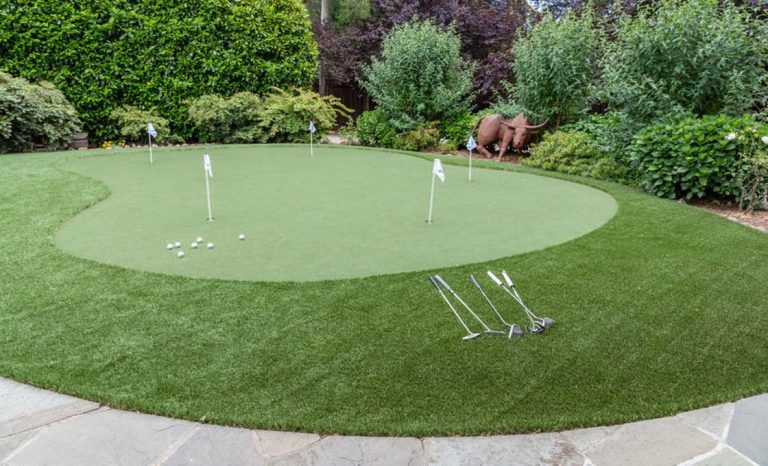
| Green de putting | Base routière compactée finition avec une fine couche de granit décomposé pour que les creux ne se voient jamais sur un gazon à pile courte. |
| Bord praticable ou de stationnement | Pavés perméables en géotextile posés sur la sous-couche standard avant la pose du gazon. |
Une note de planification relie les couches aux rouleaux eux-mêmes. Les grandes largeurs à peu de joints ne vous récompensent que si la base est plane, donc nivelez la pierre à la hauteur finie avant l'arrivée du gazon. Nos rouleaux sont disponibles en largeurs de 2, 4 et 5 mètres sur 25 mètres de longueur, et des dimensions sur mesure peuvent être réalisées sans joints internes pour les emprises grandes ou irrégulières. Le guide complet de l'installation montre comment ces rouleaux rencontrent la base le jour J.
Questions fréquentes
Peut-on poser du gazon artificiel directement sur la terre ?
Non. La terre nue se compacte de manière inégale et retient l'eau, de sorte que la surface se creuse et se forme en flaques en quelques mois. Maintenez au moins une sous-couche de gravier concassé, nivelée et compactée, entre le sol et le gazon.
Quelle est la meilleure matière de base sous un gazon artificiel ?
La pierre concassée compactée est le choix éprou.
Faut-il placer une barrière anti-mauvaises herbes sous le gazon synthétique ?
En général, non. Quand les installateurs en utilisent une, elle est placée au-dessus de la sous-couche, mais un tissu enterré peut retenir des bactéries et est omis sur les pelouses pour animaux au profit d'un drainage rapide.
Que place-t-on sous le gazon synthétique pour chiens ?
La même sous-couche en gravier à drainage libre, avec la couche de tissu supprimée, une couche de zéolite d'environ 1/4 de pouce pour le contrôle des odeurs, et un verso perméable pour que l'urine s'évacue directement.
Peut-on poser du gazon synthétique sur du béton ?
Oui, à condition que l'eau puisse s'évacuer. Ajoutez une grille de drainage ou une couche de vide d'air, fixez la pelouse avec de la colle pour extérieur, et vérifiez d'abord que la dalle elle-même ne retient pas d'eau stagnante.
 French
  English
  Arabic
  German
  Portuguese
  Russian
  Spanish