
A school athletic director walked us through her field one March morning. The goalmouth was grey, flattened and starting to split, while the wings still looked brand new. Same roll, same installer, same season of rain. That patchwork is not bad luck. It is a spec sheet showing exactly where the load landed.
Wear resistance artificial lawn claims get thrown around by every supplier, but the term resolves into about eight measurable factors. We manufacture the carpet on our own line, and here we take each factor apart and tell you which buying decision it should drive. We will not rank brands, and this is not a full quality overview either. Wear is one dimension of quality, and our separate checklist covers the rest. Where a right answer depends on your traffic profile, we say so instead of quoting a number.

What Actually Wears Out on Artificial Lawn
Wear on synthetic turf shows up in three ways. First, abrasion thins the blade surface until fibers split and break off. Second, blades lose their memory and lie flat, which is the matting you can feel underfoot. Third, the structure fails, meaning tufts pull out or the backing separates. Abrasion and matting are gradual, but structural failure is terminal.
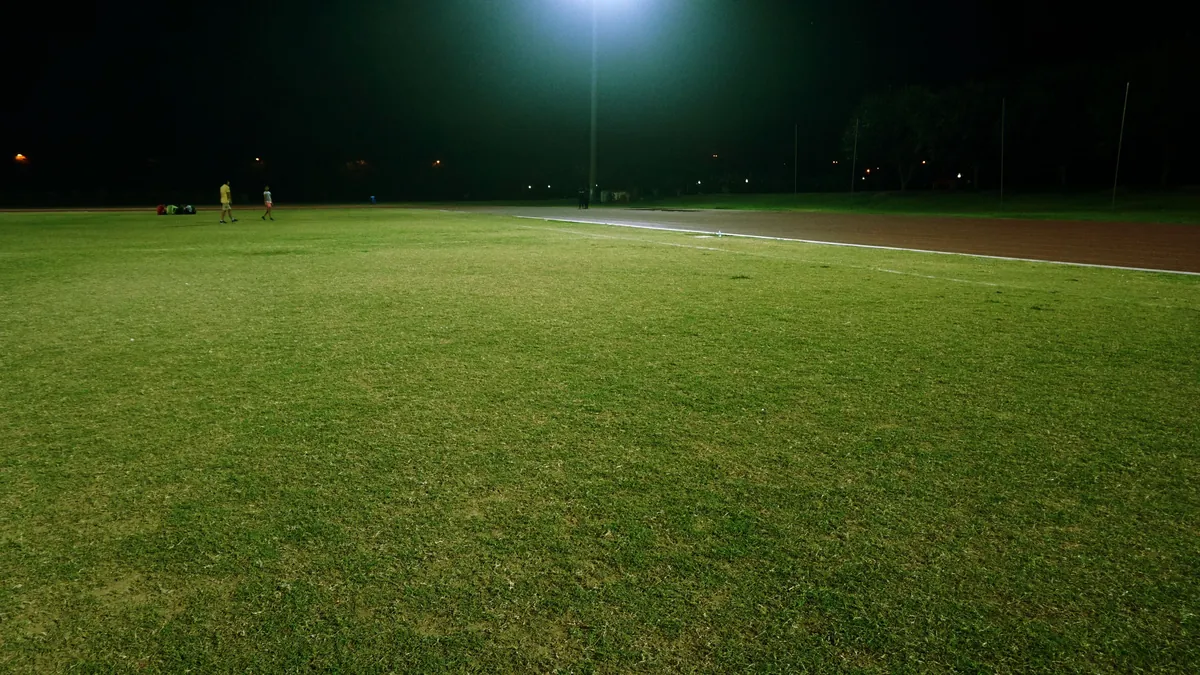
Load decides where all three show first. Goalmouths, corner zones and the strip in front of every goal take a disproportionate share of pivots and studs. A field that looks uniform on delivery can wear in patches within two seasons. That is why we ask for a map of your load zones before we talk about any spec.
UV aging and traffic wear are easy to confuse in the first year. Sunlight fades everything at roughly the same pace, so a patch that is both faded and flat is telling you about load. Brochure photos cannot show that distinction. A site walk can, in about ten minutes.
Anyone shopping wear resistance artificial lawn should start from that map too. Wear is also only one dimension of quality, and yarn chemistry, UV stabilization and drainage all sit outside this piece. The full quality checklist we run on every turf lives in our quality factors guide. Here we stay on the wear axis and go factor by factor.
Yarn Material Sets the Wear Baseline
Every wear conversation starts with the polymer the blade is made of. Sports and landscape yarns come from three families: polyamide, polypropylene and polyethylene. Turf Tek USA, a US installer, frames nylon as the most durable option in its eleven-factor quality checklist. The same source notes polypropylene wears faster under pressure and heat. Our own default for hour-heavy sports fields is polyethylene, because it keeps a skin-friendly feel while carrying serious traffic.
Construction matters as much as chemistry. Our standard sports carpet pairs PE monofilament blades with a curled PP thatch layer, and the thatch quietly props the blades upright. At the twisting step of our production line we also set how tightly each yarn bundle holds itself. A loose twist blooms open under traffic and mats early. A firm twist springs back, season after season.
There is a fuller taxonomy of yarn constructions in our football turf silk type guide, including where fibrillated tape earns its keep. For wear planning, the headline is simple: the polymer sets the ceiling for everything else. No pile height or density trick outruns a yarn that was too soft for the job. When you compare wear resistance artificial lawn quotes, ask which polymer each line is priced on.
Blade Shape Resists Flattening Under Traffic
Two blades can share a polymer and a thickness and still wear differently, because the cross-section decides how they take a boot. Flat blades look glossy in a showroom sample and lie down under the first season of pivots. Spined profiles, C shapes and gentle waves carry a memory of their own shape. Turf Tek’s checklist makes the same point: C, W and U profiles resist flattening more effectively than flat blades.
Think of it like tire rubber. The tread pattern matters, but the real question is how the compound springs back after a hard corner. A blade with a spine is a spring, while a flat blade is a flap. We extrude our own yarns in several cross-sections, and shape is one of the levers you can specify on a factory-direct order.
Picture a kindergarten corner where four children pivot around the same spot every morning. Flat-blade carpet in that corner mats by mid-year. A spined blade in the same spot stays upright and hides the traffic much longer. Shape is cheap insurance once you know where the pivots happen.
Dtex and Face Weight Decide Blade Substance
Dtex is the weight in grams of a 10,000-meter strand of yarn, and it is the closest thing our industry has to an honest thickness number. Face weight rolls the whole carpet together: total yarn mass per square meter. More polymer per blade means more material to lose before the blade gives up. That is why we check substance before height on any sample that crosses our bench.
The industry reference points are worth knowing. CCGrass, one of the largest producers, markets a flagship diamond-shape yarn at 400 micrometers thick and cites 30,000+ cycles on the Lisport XL abrasion rig. We are not affiliated with them, and their product is not ours. The takeaway is that serious manufacturers publish substance numbers and wear-cycle data. If a quote gives you neither, the silence is the answer.
Reading Dtex on a quote takes exactly one question. Ask the supplier to print the yarn Dtex next to the pile height, then compare those two lines across every quote on your desk. A tall pile on a light yarn photographs beautifully and sheds early. Substance per blade, not blade length, is what your hourly traffic eventually consumes.
On our own spec sheets, Dtex is quoted on request, because the right value depends on sport and hours rather than a catalogue default. When a buyer asks us to trim a price, Dtex is the first line we look at honestly. When they ask us to beat a field that wore out early, it is the first line we raise. Dtex is where wear resistance artificial lawn marketing either gets honest or stays vague.
Pile Height Trades Cushion for Resilience
Pile height is the length of the blade from backing to tip, and buyers often read it as a proxy for quality. Under traffic, the trade runs the other way. A taller blade has a longer lever, so the same boot folds it more easily at the base. A shorter, well-supported blade stands back up instead of folding.
Sport context settles most of the argument. Football codes want long, filled systems where the infill carries part of the supporting. Hockey and tennis carpets use much shorter fibers, an approach Wikipedia’s artificial turf overview notes for field hockey. They survive because the blades are not asked to carry loads they cannot.
For school and club fields we usually push substance and density before we push height. If your priority list starts with cushion and ends with hours, say both out loud, because they pull the spec in opposite directions. Sport-by-sport pile guidance sits in our pelouse artificielle sportive guide, including the heights each surface actually runs.
Density Spreads the Load Across More Blades
Density is the number of stitches per square meter, set by row spacing and stitches per row. The mechanical logic is simple: more blades share the same load, so each blade loses less per crossing. A sparse carpet concentrates every pivot on fewer fibers and shows gaps as soon as the thatch tires. Density is also the spec buyers most often trade away to hit a price.
Picture walking a snowy path in a stiletto heel, then in a snowshoe. Same weight, same ground, completely different footprint. A dense carpet is the snowshoe: it spreads each step until no single blade is overloaded. That is what keeps a field even instead of patchy.
At the tufting machine, density is a precision question as much as a counting question. Consistent gauge and stitch spacing matter, because a carpet that varies across its width wears unevenly no matter how high the average is. We treat density as a per-zone decision on custom orders, since it is the most practical wear resistance artificial lawn lever to upgrade without touching anything else. Your goalmouth does not need the same spec as your sprint track.
Backing and Coating Keep the Carpet Stable
Wear does not only happen at the tips of the blades. If the coating fails to lock the tuft, blades pull out whole, and no amount of yarn quality saves the surface. Our line coats, then dries, then perforates, and the coating penetration is the point we watch closest in that sequence. A weak coat reads as shedding long before it reads as holes.
Under the yarn sits the primary backing, and ours run from PP+Net through to PU compositions. Backing choice affects dimensional stability, how the carpet handles water, and how it copes with years of expansion and contraction. Turf Tek’s checklist puts it bluntly: weak backing separates or wrinkles after repeated use. A ripple in month eight is a wear problem, not just a cosmetic one.
One layer further down, the base under the backing carries the same logic. Installers working on soil commonly build a compacted road-base layer a few inches thick before the carpet goes down, because a moving foundation works every seam and tuft. We build carpet for that system, but we do not install it, so treat base design as its own project.
Infill Supports the Blades Between Steps
Whatever infill family your system runs, its job in the wear story is ballast. Infill weighs the carpet down, cushions the collision, and props each blade from the base so the blade does not stand on its own. When infill runs low, blades fold at the root and rub against each other at every crossing. Fiber-on-fiber abrasion is the quiet kind, and it never shows up on an invoice.
Under-filled fields are the ones we can diagnose from a photo. The blades lean one way, the surface looks shiny where fibers have polished each other, and the sand has drifted toward the sidelines. Topping up is not a cosmetic purchase. It is the cheapest wear resistance artificial lawn lever you own after the spec itself.
A useful habit is checking infill in your worst corner, not your best. The goalmouth loses material first while the corner flag still looks perfect. If the worst corner still passes, the rest of the field is already fine.
Tell Us Where the Load Lands
Send us your sport, your weekly hours and your busiest zones. We will answer with a spec sheet that argues its own corner, plus free 20 x 20 cm samples shipped by DHL or FedEx in 4-6 days. Custom sample builds take 10-15 days extra.
Maintenance Habits That Slow Visible Wear
L'entretien n'apporte pas une résistance à l'usure que la pelouse artificielle n'a jamais possédée, mais il détermine à quelle vitesse la spécification que vous avez achetée s'érode. Le brossage avec une brosse à poils durs redresse les brins et réouvre le feutre avant qu'il ne se compacte. Les réapprovisionnements en granulat de remplissage restaurent le lest qui maintient les brins en appui à leur base. L'élimination des feuilles, de la boue et des débris organiques empêche les trous de drainage et la surface des fibres de vieillir plus vite que prévu.
Le schéma opposé est tout aussi fiable. Un terrain qui n'est jamais brossé, jamais réapprovisionné et balayé seulement après réclamation a l'air fatigué des années avant que ses fibres ne cèdent réellement. Prévoyez le brossage avant de budgéter la moquette. Un terrain bien spécifié sans routine perd face à un terrain modeste qui en a une.
Commencez la routine dès le premier mois, pas la deuxième année. Un brossage mensuel pendant la saison chargée, une vérification du réapprovisionnement après les grands événements et une rapide inspection après les orages permettent de détecter la plupart des problèmes tôt. Nous avons vu une moquette modeste surpasser en durée de vie une moquette premium grâce à la routine seule. La spécification lance le chronomètre, et l'entretien fixe le rythme.
Une limite honnête ici : le brossage corrige l'aplatissage, pas l'abrasion. Si la surface des fibres est déjà fissurée, aucune brosse ne peut l'annuler. C'est précisément pourquoi les facteurs ci-dessus comptent plus que tout plan de soins postérieurs.
Matching Specs to Your Hourly Traffic Profile
Chaque facteur ci-dessus se résume en une question.
| Traffic profile | What wears first | Where we push the spec | Watch-out |
|---|---|---|---|
| Low: decorative lawns, rooftop terraces, retail displays | Matting under furniture lines and repeated photo setups | Feel and look lead; yarn substance can ease for budget | Doorways, chair legs and planter edges |
| Medium: family gardens, offices, light garden play | Walk paths, gate lines and trampoline landings | Balanced PE yarn with honest density, curled thatch | Tall thin pile photographs better than it wears |
| High: schools, kindergartens, dog runs, playgrounds | Pivot corners, gate funnels and slide landings | Density plus spined blade over height | Grooming schedule from day one |
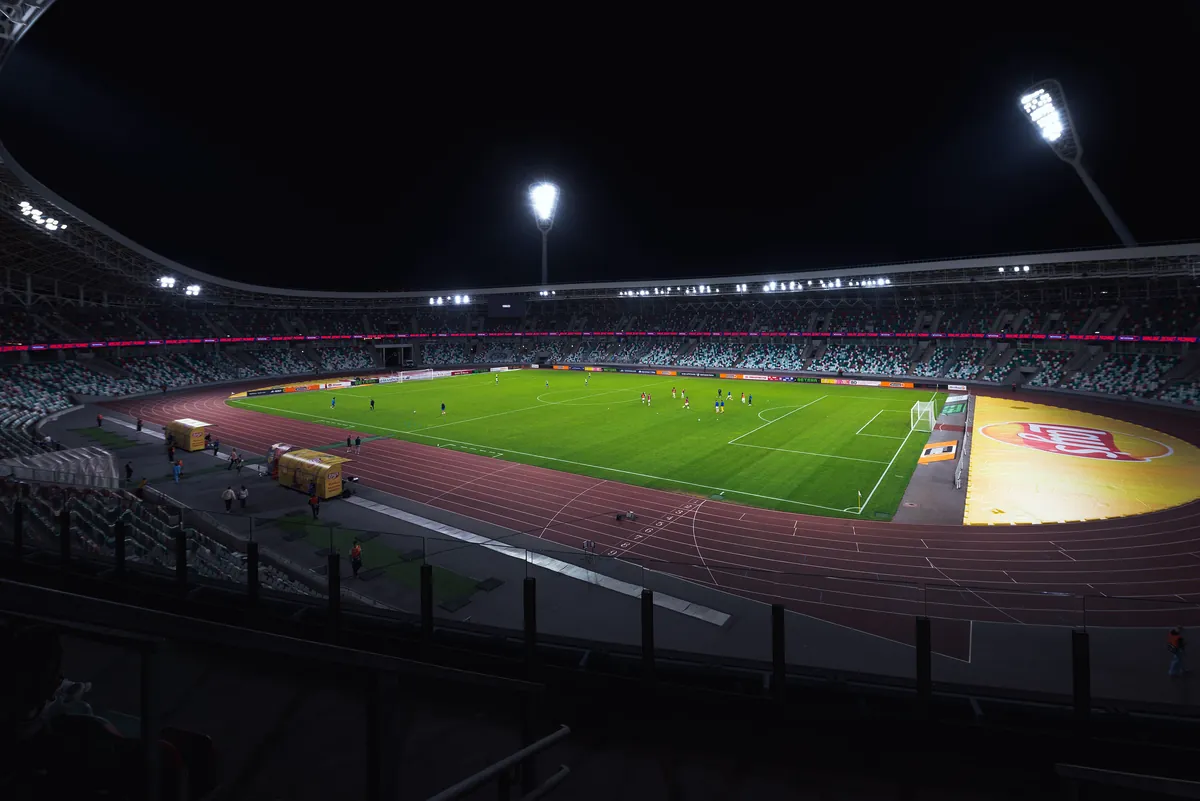
| Sport: academies, match fields, daily training | Goalmouths, center circle, penalty spots | Substance (Dtex), filled system, strong coating lock | Infill top-ups and load-zone rotation |
| Events: temporary venues, exhibitions, festivals | Laying paths and pallet or forklift routes | Thicker primary backing and firm coating | Seam and join inspection after every move |
Price follows the tier, not the other way round. Our material pricing runs $7-60 per square meter depending on padding, grade and type, which is indicative only and moves with the exact spec. Rolls come in 2, 4 and 5 meter widths by 25 meters, and custom widths run seam-free where the job justifies them. Matched to the right tier, a commercial field can run for up to 10-15 years, while a mismatched one ages in a couple of seasons.
Kindergartens and dog runs sit in the same high tier for different reasons. Children pivot in the same spots wearing hard soles, while dogs patrol fence lines and gates to the meter. Same tier, different wear map. That is why we ask for photos of your busiest corners before we finalize density.
Comparing wear resistance artificial lawn quotes without a traffic tier is how fields end up mismatched to their calendars. Give the supplier the hours and the sport, then let them defend each line. If they cannot tell you the polymer, the Dtex and the stitch rate, they are selling you a color.
Questions fréquentes
Which factor affects wear resistance the most?
Traffic hours combined with yarn substance, in our experience. Pile height gets the attention, but polymer choice and density decide how a field ages under real schedules. Send us your hours and we will weight the spec for you.
Does taller pile last longer?
No. Taller blades have a longer lever, so the same traffic folds them sooner unless infill supports them well. Shorter, denser carpet usually stands up to hourly use for longer.
Can I judge wear resistance from a sample?
Partly. Press and twist the sample, watch how the blade springs back, and compare Dtex between quotes. For load zones, ask for a filled sample that matches your real system.
What does infill do for wear?
It props each blade from the base and absorbs impact. Under-filled fields fold at the root and fibers grind each other down. Keep infill at spec and topped up.
Which spec sheet lines should I request?
Polymer type, Dtex, pile height, stitch rate, gauge and backing composition, plus the coating system. A supplier who will not print those lines is not pricing wear resistance, only color.
 French
  English
  Arabic
  German
  Portuguese
  Russian
  Spanish