
Slice a finished lawn with a sharp spade and the profile tells you why it behaves the way it does. Green blade tips sit on top, with grains of sand settled between them to hold every fibre upright. Under the visible pile lies the backing that locks the fibres in and lets rainwater through. Below that comes a thin leveling bed, then the compacted aggregate base that carries every footstep, and finally a sheet of geotextile over graded native soil. That is the full stack of artificial turf layers, read from the top down.
We build these systems factory-direct, and the questions that reach us are rarely about the green carpet itself. They are about what each layer should be made of, how thick it goes and which steps crews are tempted to skip. This piece follows the stack in build order, top to bottom, giving the working specification for each layer plus the mistakes we see most often. For the question-and-answer view of the same ground, our separate piece on o que vai por baixo da grama artificial is the place to start. Where a layer is genuinely optional, we say so plainly.
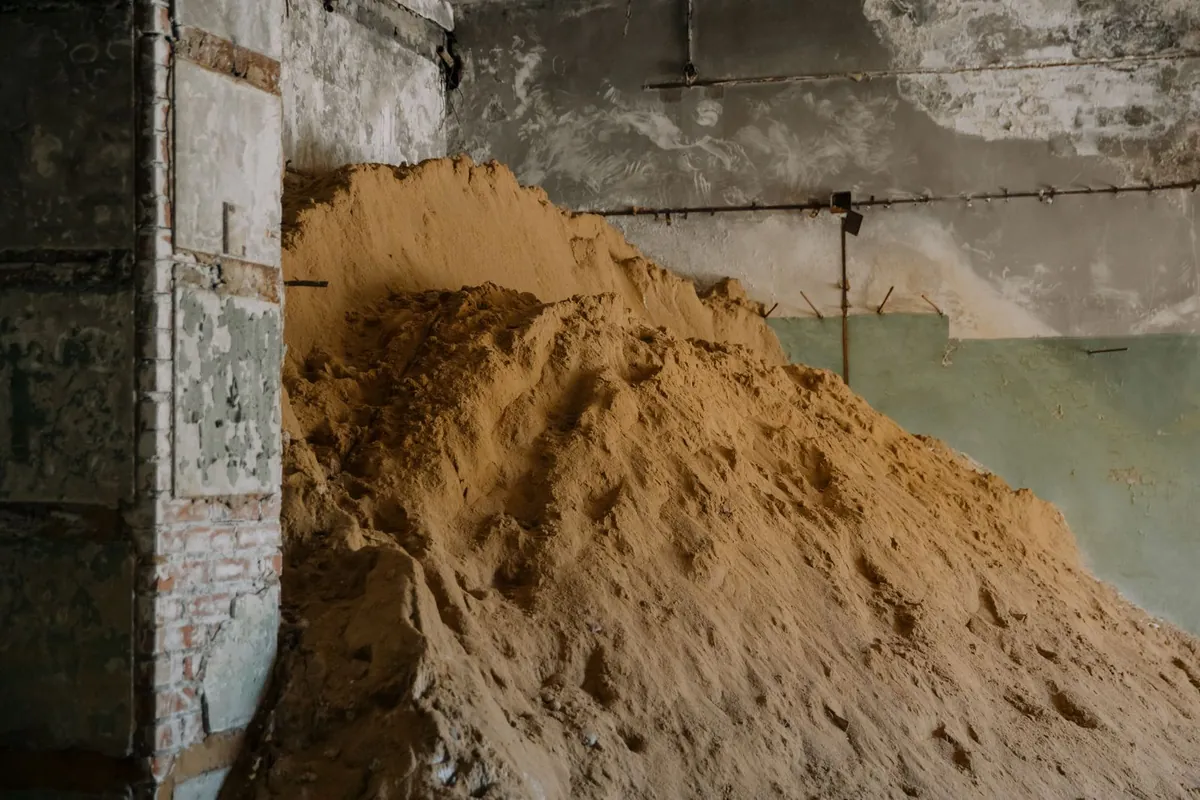
Por Que a Ordem das Camadas Determina Como o Gramado Envelhece
Builders work bottom-up, but buyers who understand the stack read it top-down. The five artificial turf layers only work as a set: each one assumes the layer beneath it is doing its job. Get one layer wrong and the fault migrates upward until it shows on the surface.
The analogy we give crews is a roof: shingles shed water only because the deck beneath them stays straight. The carpet you walk on stays flat for the same reason. A premium pile rolled over a weak base is an expensive skin over a cheap skeleton. Our advice is blunt: spend on the base before you spend on a thicker pile.
This matters most on dos gramados sintéticos residenciais, where the same crew often digs, compacts and lays in a single day. Rushed schedules are exactly when layers get merged or skipped. Naming each layer, and its spec, is the cheapest insurance you can buy.
Camada 1: O Material de Infiltração que Mantém os Fios Eretos
Layer one, counted from the surface, is the infill: silica sand brushed between the blades. Weight is its first job, holding the carpet down against wind lift and traffic. Support is the second, propping each blade so the pile stands instead of leaning. Protection is the third, cushioning the fibre root where ultraviolet exposure is harshest.
For landscape lawns the working rate is 1 to 2 pounds of sand per square foot. Heavier-use specifications can call for up to 3 pounds per square foot, so follow the product sheet rather than a rule of thumb.
Of all the artificial turf layers, infill is the one cheap quotes leave out first. The last hour of every install ends the same way: a power broom working sand into the pile until the fibres stand. Skip the infill entirely and the pile lies flat within months, shining where traffic mats it down.
Camada 2: O Tapete de Gramado e
Layer two is the carpet itself: polyethylene monofilament blades mixed with a polypropylene thatch underneath for body and colour depth. That pairing is what we run on our own tufting line, because the monofilament carries the look while the thatch fills the gaps that cheap turf leaves flat.
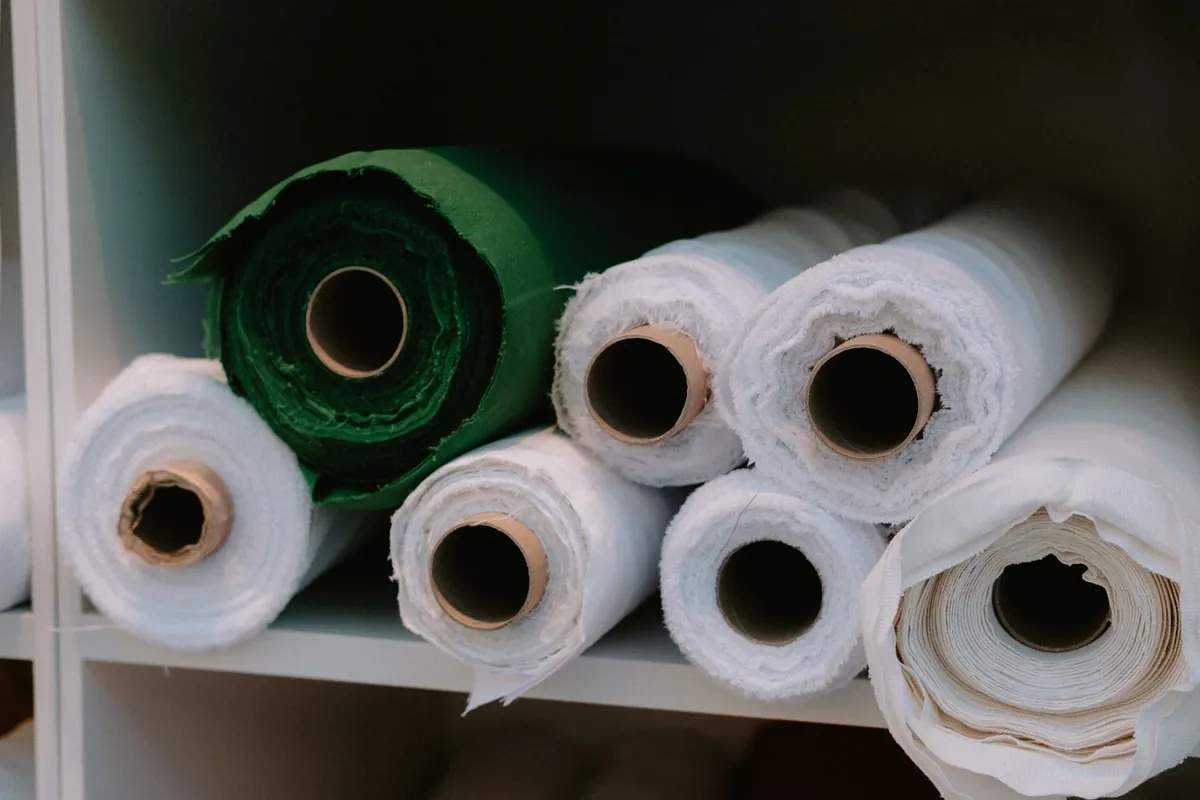
Turn the roll over and judge the backing, not the face. Ours are polypropylene, plain or reinforced with a net, with an optional polyurethane coating where extra durability is wanted. Perforations punched through the backing are the drainage path: rainwater passes into the base below and onward to the subgrade.
The common mistake here is buying on pile colour alone. A carpet is only as good as the layer holding it: if the backing delaminates, no amount of blade quality saves the lawn. Ask what the backing is made of before you ask about pile height.
Camada 3: Uma Camada Fina de
Layer three is the bedding the backing actually rests on: a thin screed of fine screenings or decomposed granite, a quarter to half an inch deep. Raked, watered lightly and screeded flat, it gives the carpet a continuous bed instead of a gravel mattress.
It plays the role of a bedsheet on a made mattress: thin, but it decides whether the surface feels even. Lay the carpet directly on coarse stone and every piece of aggregate prints its outline into the backing over time.
The mistake runs in both directions. A bed thicker than an inch stays soft and shifts under load, showing seams within a season. Keep it thin, keep it compacted, and it does its one job invisibly.
Layer 4: The Compacted Aggregate Base
Layer four is the base, and every other layer in the stack depends on it. For a lawn the working depth is 3 to 4 inches of compacted angular crushed stone. Dogs and play areas go 4 to 5 inches, sports surfaces 4 to 6, and freeze-thaw climates add another inch.
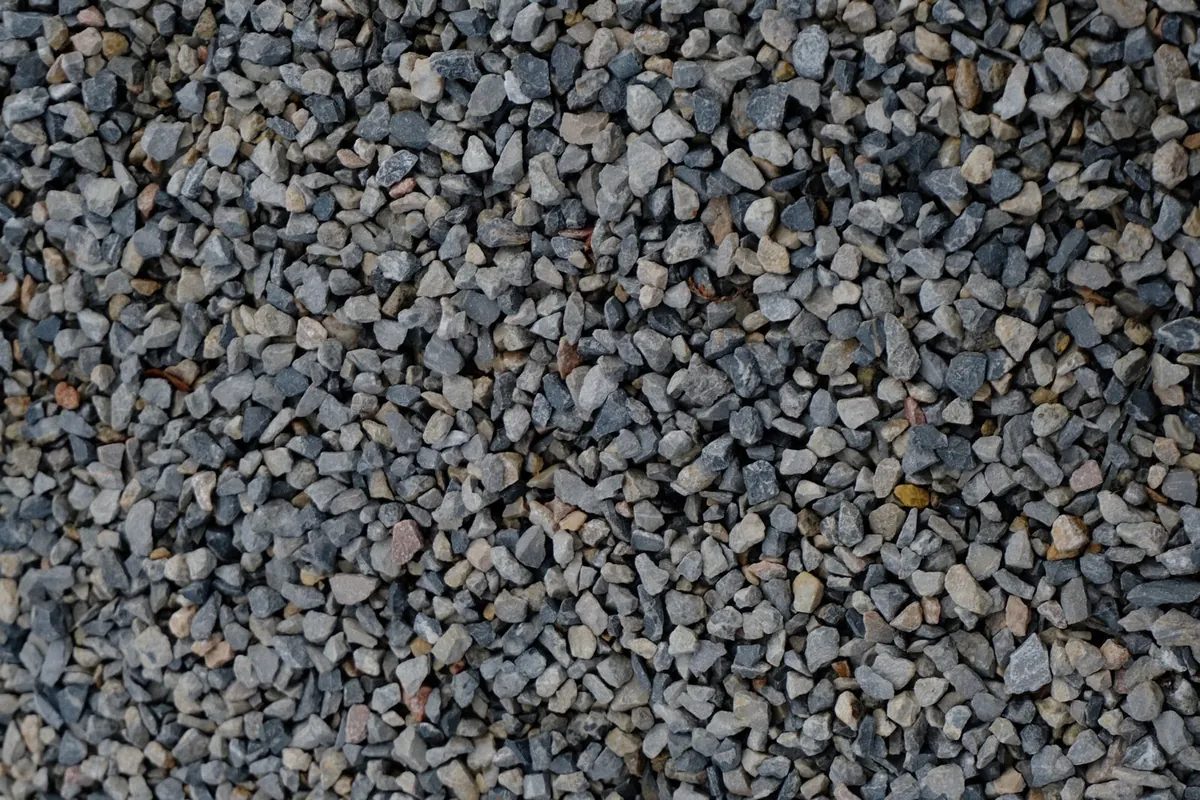
Material matters as much as depth. The standard spec is 3/4-inch minus crushed stone or Class II road base, angular enough to interlock when compacted. Round pea gravel never locks, no matter how long the plate compactor runs.
Compact in 2-inch lifts, moistening lightly, until the surface reads about 90 percent density and a boot leaves no print. Grade the finished base at a 1 to 2 percent slope away from buildings so water has somewhere to go. Water that stands on the base will stand on your lawn.
We have walked lawns that skipped this discipline, and the evidence arrives by August: soft ripples tracing the wheelbarrow route from spring. The crews that excavated too shallow or compacted in one thick pass always call us about the carpet. The carpet was never the problem.
Layer 5: Weed Barrier Over Graded Native Soil
Layer five is the ground itself, prepared. Strip every root, stone and scrap of organic matter, because buried organics decompose and the surface above them settles into dips. Grade and compact the exposed subgrade before anything else goes down.
Over it goes a non-woven geotextile around 3 to 5 ounces, seams overlapped several inches. The fabric lets water through while keeping soil from migrating up into the base, and it starves the weeds that would otherwise find their way to daylight. Plastic sheeting does the opposite: it blocks drainage and pools water under the carpet.
On soft or weedy ground this is the layer crews skip first, and the regret is patient. Weeds punch through seams in year one; fine soil silts up the base in year two. Five minutes of fabric laying is the cheapest weed control you will ever buy.
One honest exception: over sound concrete or asphalt there is no aggregate base at all. A drainage tile or foam pad goes straight onto the cleaned slab, and the slab must already carry its own slope to a drain. The layer names change; the logic of water leaving never does.
Spec the Stack With Our Team
Share the area, the soil type and the traffic level, and we will match roll width, backing and infill to the job before you commit. Free 20 cm by 20 cm swatches let you check colour and pile in person first.
The Five Layers Side by Side
Specifications are easier to hold onto as one sheet. The table below is the version we would hand a site foreman: all five artificial turf layers, their working spec and what fails when a layer is skipped.
| Layer, top down | What it is | Working spec | If you skip it |
|---|---|---|---|
| Enchimento | Silica sand brushed into the pile | 1-2 lbs per square foot; up to 3 by spec | Blades mat flat; the carpet lifts at edges |
| Turf carpet and backing | PE monofilament blades with PP thatch; perforated PP backing, PU optional | Contradouro compatível com a drenagem do local | O contradouro se delamina; a água não tem caminho para descer |
| Camada de nivelamento | Sujeira fina ou granito decomposto | De 1/4 a 1/2 polegada, desempenada | Impressões do agregado transmitem através do contradouro |
| Base de agregado | Pedra britada de 3/4 de polegada ou menos, ou base de rodovia Classe II | 3-4 polegadas em gramados, 4-5 para pets, 4-6 para esportes, +1 para ciclo de congelamento-descongelamento; compactação de ~90 por cento em camadas de 2 polegadas; inclinação de 1-2 por cento | Depressões, ondulações e água parada em uma estação |
| Geotêxtil sobre o solo nativo | Tecido não tecido sobre subleito conformado e compactado | Tecido de 3-5 onças, emendas sobrepostas | Ervas daninhas pelas emendas; base silicificada, com drenagem lenta |
Sizing the Roll and the Budget
Tudo isso fica sob o rolo, então a última especificação é o próprio rolo. Nossos rolos Relyir vêm em larguras de 2, 4 e 5 metros, cada um com 25 metros de comprimento. Um único rolo de 4 metros cobre 100 metros quadrados, e larguras maiores significam menos emendas no gramado. Rolos estreitos de 2 metros são ideais para áreas pequenas, difíceis e com manuseio mais leve.
O orçamento segue a especificação em vez de um número fixo. Preços direto de nossa linha, a faixa é $7-60 por metro quadrado indicativo — solicite um orçamento exato para seu tipo, amortecimento e volume. Cada uma das camadas de grama sintética acima custa menos para corrigir no papel do que no solo.
Você não precisa julgar nada disso por uma tela. Amostras grátis de 20 por 20 cm são enviadas por DHL ou FedEx em 4 a 6 dias, para que a cor e o pelo cheguem antes de você decidir. Segure um cartão de cor contra a luz e as perguntas sobre qualidade se respondem sozinhas.
Perguntas Frequentes
Quanto deve ser a profundidade da base sob um gramado?
Preveja de 3 a 4 polegadas de pedra britada compactada para gramados, 4 a 5 polegadas para áreas de cães e recreação, e 4 a 6 polegadas para uso esportivo. Climas com ciclo de congelamento-descongelamento adicionam mais ou menos uma polegada.
Dá para instalar grama sintética diretamente sobre o solo?
Não. O solo se move, retém água e cria ervas daninhas, então o tapete ondula, tem drenagem ruim e mostra emendas. Em vez disso, escave e construa uma base compactada, com drenagem livre.
O que vai entre a base e a grama?
Uma camada fina de nivelamento de sujeira fina ou granito decomposto, de um quarto a meio polegada de profundidade, desempenada. Isso dá ao contradouro uma base uniforme e impede impressões do agregado.
Quanto enchimento um gramado precisa?
Gramados de paisagem exigem de 1 a 2 libras de areia de sílica por pé quadrado, incorporada com um vassourão motorizado. Especificações mais pesadas podem exigir até 3 libras, então siga a ficha técnica do produto.
Uma barreira contra ervas daninhas é realmente necessária?
Sobre solo, sim: um geotêxtil não tecido sobre o subleito conformado impede ervas daninhas e mantém o solo fora da base. Evite lona plástica, que bloqueia a drenagem.
 Portuguese
  English
  Arabic
  French
  German
  Russian
  Spanish