
Tranchez un gazon terminé avec une bêche pointue et le profil vous explique pourquoi il se comporte ainsi. Les pointes de brins verts reposent en surface, avec des grains de sable déposés entre eux pour maintenir chaque fibre droite. Sous la couche visible se trouve la toile qui verrouille les fibres et laisse l'eau de pluie traverser. En dessous vient un fin lit de nivellement, puis la base de granulats compactés qui supporte chaque pas, et enfin une feuille de géotextile sur un sol natif nivelé. C'est l'ensemble des couches de gazon synthétique, lues de haut en bas.
We build these systems factory-direct, and the questions that reach us are rarely about the green carpet itself. They are about what each layer should be made of, how thick it goes and which steps crews are tempted to skip. This piece follows the stack in build order, top to bottom, giving the working specification for each layer plus the mistakes we see most often. For the question-and-answer view of the same ground, our separate piece on ce qui va sous le gazon synthétique est le point de départ. Quand une couche est réellement optionnelle, nous le disons clairement.
Pourquoi l'ordre des couches détermine le vieillissement du gazon
Les constructeurs travaillent de bas en haut, mais les acheteurs qui comprennent la pile la lisent de haut en bas. Les cinq couches de gazon synthétique ne fonctionnent qu'ensemble : chacune suppose que la couche inférieure remplit son rôle. Erreur sur une couche et le défaut migre vers le haut jusqu'à se manifester en surface.
L'analogie que nous donnons aux équipes est le toit : les ardoises écartent l'eau uniquement parce que la charpente en dessous reste droite. La moquette sur laquelle on marche reste plate.
This matters most on residential artificial grass, where the same crew often digs, compacts and lays in a single day. Rushed schedules are exactly when layers get merged or skipped. Naming each layer, and its spec, is the cheapest insurance you can buy.
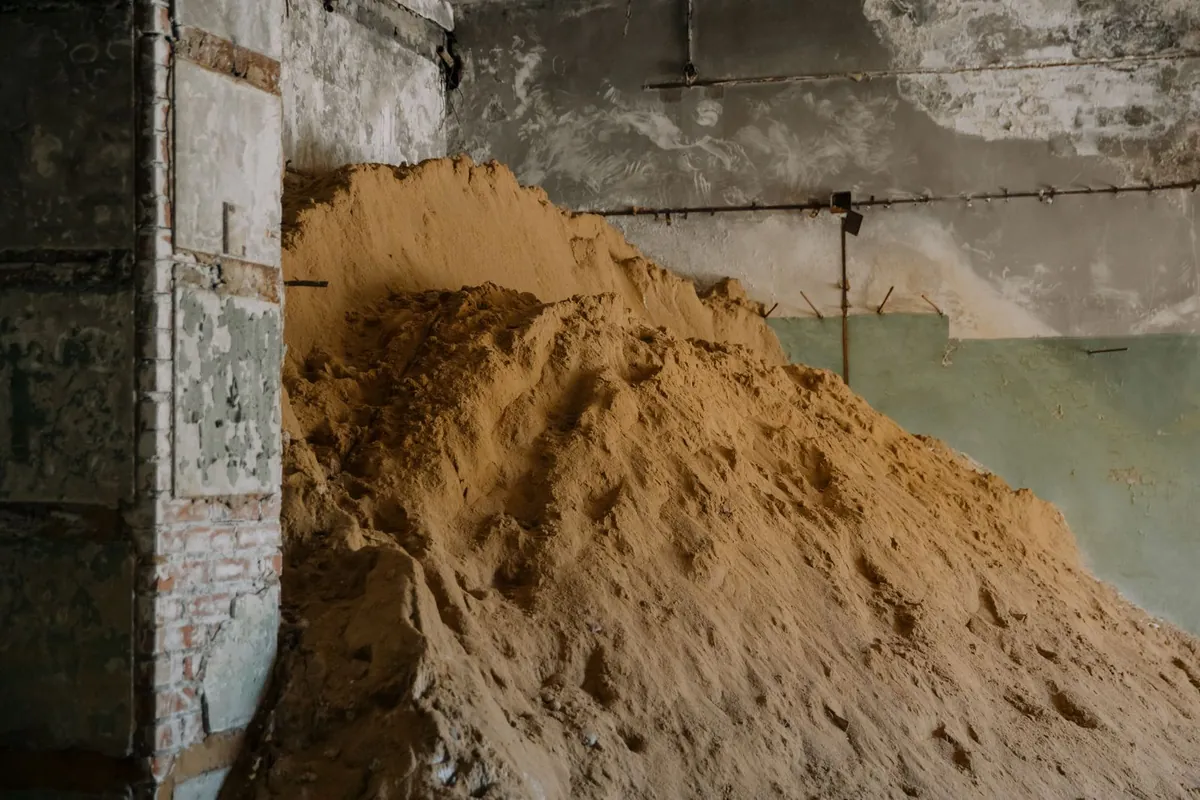
Couche 1 : Le granulat de remplissage qui maintient les brins droits
Layer one, counted from the surface, is the infill: silica sand brushed between the blades. Weight is its first job, holding the carpet down against wind lift and traffic. Support is the second, propping each blade so the pile stands instead of leaning. Protection is the third, cushioning the fibre root where ultraviolet exposure is harshest.
For landscape lawns the working rate is 1 to 2 pounds of sand per square foot. Heavier-use specifications can call for up to 3 pounds per square foot, so follow the product sheet rather than a rule of thumb.
Of all the artificial turf layers, infill is the one cheap quotes leave out first. The last hour of every install ends the same way: a power broom working sand into the pile until the fibres stand. Skip the infill entirely and the pile lies flat within months, shining where traffic mats it down.
Couche 2 : La moquette de gazon et sa toile
Layer two is the carpet itself: polyethylene monofilament blades mixed with a polypropylene thatch underneath for body and colour depth. That pairing is what we run on our own tufting line, because the monofilament carries the look while the thatch fills the gaps that cheap turf leaves flat.
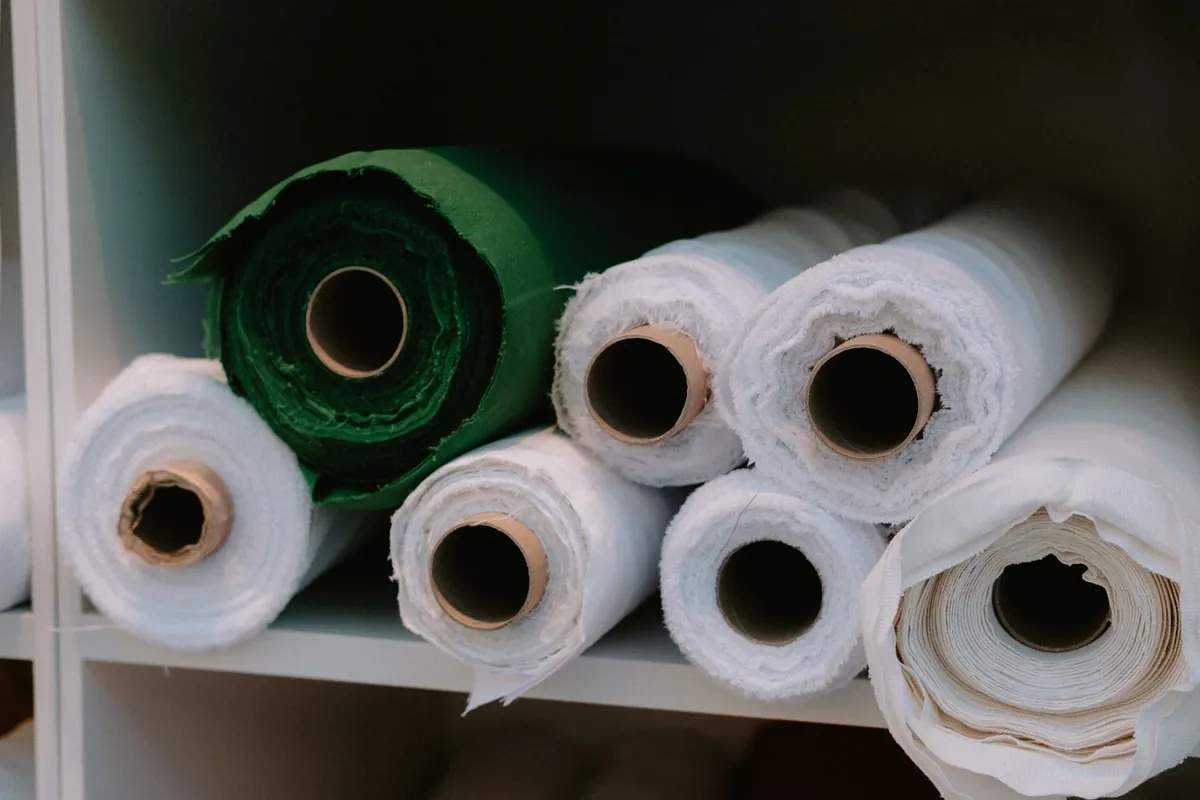
Turn the roll over and judge the backing, not the face. Ours are polypropylene, plain or reinforced with a net, with an optional polyurethane coating where extra durability is wanted. Perforations punched through the backing are the drainage path: rainwater passes into the base below and onward to the subgrade.
The common mistake here is buying on pile colour alone. A carpet is only as good as the layer holding it: if the backing delaminates, no amount of blade quality saves the lawn. Ask what the backing is made of before you ask about pile height.
Couche 3 : Un lit de nivellement fin sous le gazon
Layer three is the bedding the backing actually rests on: a thin screed of fine screenings or decomposed granite, a quarter to half an inch deep. Raked, watered lightly and screeded flat, it gives the carpet a continuous bed instead of a gravel mattress.
It plays the role of a bedsheet on a made mattress: thin, but it decides whether the surface feels even. Lay the carpet directly on coarse stone and every piece of aggregate prints its outline into the backing over time.
The mistake runs in both directions. A bed thicker than an inch stays soft and shifts under load, showing seams within a season. Keep it thin, keep it compacted, and it does its one job invisibly.
Couche 4 : La base de granulats compactés
Layer four is the base, and every other layer in the stack depends on it. For a lawn the working depth is 3 to 4 inches of compacted angular crushed stone. Dogs and play areas go 4 to 5 inches, sports surfaces 4 to 6, and freeze-thaw climates add another inch.
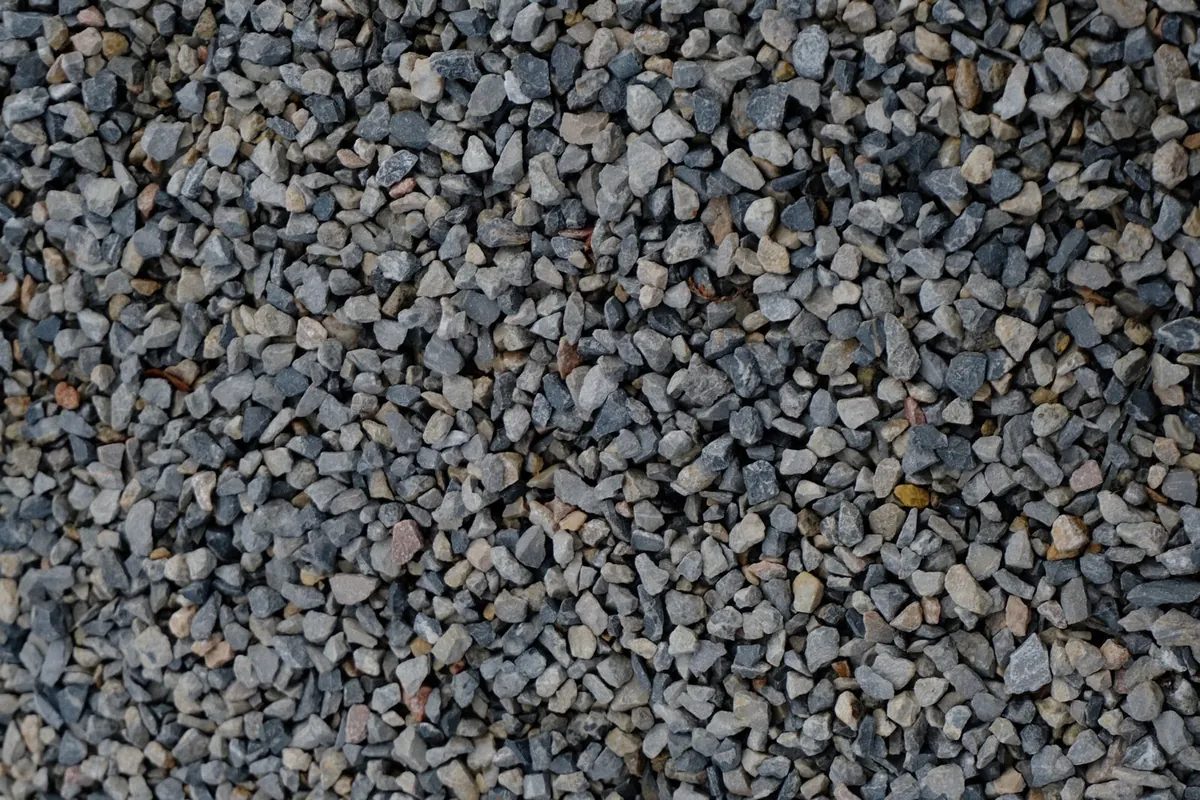
Material matters as much as depth. The standard spec is 3/4-inch minus crushed stone or Class II road base, angular enough to interlock when compacted. Round pea gravel never locks, no matter how long the plate compactor runs.
Compact in 2-inch lifts, moistening lightly, until the surface reads about 90 percent density and a boot leaves no print. Grade the finished base at a 1 to 2 percent slope away from buildings so water has somewhere to go. Water that stands on the base will stand on your lawn.
We have walked lawns that skipped this discipline, and the evidence arrives by August: soft ripples tracing the wheelbarrow route from spring. The crews that excavated too shallow or compacted in one thick pass always call us about the carpet. The carpet was never the problem.
Couche 5 : Barrière anti-mauvaises herbes sur sol natif nivelé
Layer five is the ground itself, prepared. Strip every root, stone and scrap of organic matter, because buried organics decompose and the surface above them settles into dips. Grade and compact the exposed subgrade before anything else goes down.
Over it goes a non-woven geotextile around 3 to 5 ounces, seams overlapped several inches. The fabric lets water through while keeping soil from migrating up into the base, and it starves the weeds that would otherwise find their way to daylight. Plastic sheeting does the opposite: it blocks drainage and pools water under the carpet.
On soft or weedy ground this is the layer crews skip first, and the regret is patient. Weeds punch through seams in year one; fine soil silts up the base in year two. Five minutes of fabric laying is the cheapest weed control you will ever buy.
One honest exception: over sound concrete or asphalt there is no aggregate base at all. A drainage tile or foam pad goes straight onto the cleaned slab, and the slab must already carry its own slope to a drain. The layer names change; the logic of water leaving never does.
Spec the Stack With Our Team
Share the area, the soil type and the traffic level, and we will match roll width, backing and infill to the job before you commit. Free 20 cm by 20 cm swatches let you check colour and pile in person first.
Les cinq couches côte à côte
Specifications are easier to hold onto as one sheet. The table below is the version we would hand a site foreman: all five artificial turf layers, their working spec and what fails when a layer is skipped.
| Layer, top down | What it is | Working spec | If you skip it |
|---|---|---|---|
| Remplissage | Silica sand brushed into the pile | 1-2 lbs per square foot; up to 3 by spec | Blades mat flat; the carpet lifts at edges |
| Moquette de gazon synthétique et revêtement | Lames monofilament en PE avec feutrage en PP ; revêtement perforé en PP, PU en option | Revêtement adapté au drainage du site | Le revêtement se délamine ; l'eau n'a pas de chemin d'écoulement |
| Couche de regularization | Fines tamisées ou granit décomposé | 1/4 à 1/2 pouce, régnée à plat | Les empreintes de gravier se transfèrent à travers le revêtement |
| Couche de grave | Gravats concassés de 3/4 pouce ou moins, ou base routière de classe II | 3-4 po pour les pelouses, 4-5 pour les animaux, 4-6 pour le sport, +1 gel-dégel ; ~90 % de compactage par couches de 2 po ; pente de 1 à 2 % | Creux, ondules et eau stagnante en une saison |
| Géotextile sur sol naturel | Tissu non tissé sur sous-couche nivelée et compactée | Tissu de 3 à 5 oz, joints en recouvrement | Herbes à travers les joints ; base ensablée, drainage lent |
Dimensionner le rouleau et le budget
Tout cela se place sous un rouleau, donc la dernière spécification est le rouleau lui-même. Nos rouleaux Relyir sont disponibles en largeurs de 2, 4 et 5 mètres, chacun de 25 mètres de long. Un rouleau de 4 mètres couvre 100 mètres carrés, et les largeurs plus importantes réduisent le nombre de joints sur une pelouse. Les rouleaux étroits de 2 mètres conviennent aux petites zones difficiles d'accès et à une manipulation plus légère.
Le budget suit la spécification plutôt qu'un chiffre fixe. Tarifé directement depuis notre gamme, la fourchette est de $7-60 par mètre carré à titre indicatif — demandez un devis précis pour votre grade, coussin et volume. Chacune des couches de gazon synthétique ci-dessus coûte moins cher à corriger sur le papier que dans le sol.
Vous n'avez pas besoin de juger tout cela à travers un écran. Des échantillons gratuits de 20 x 20 cm sont expédiés par DHL ou FedEx en 4 à 6 jours, afin que la couleur et la hauteur de pile arrivent avant votre engagement. Tenez un échantillon en contre-jour et la plupart des questions de qualité se répondent d'elles-mêmes.
Questions fréquentes
Quelle doit être l'épaisseur de la couche de base sous une pelouse ?
Prévoyez 3 à 4 pouces de gravats concassés compactés pour les pelouses, 4 à 5 pouces pour les chiens et les aires de jeux, et 4 à 6 pouces pour un usage sportif. Les climats à gel-dégel ajoutent environ un pouce supplémentaire.
Peut-on poser du gazon synthétique directement sur le sol ?
Non. Le sol se déplace, retient l'eau et pousse des herbes indésirables, si bien que la moquette ondule, draine mal et montre les joints. Creusez et construisez plutôt une base compactée à drainage libre.
Que met-on entre la base et le gazon ?
Une fine couche de regularization de fines tamisées ou de granit décomposé, d'un quart à un demi-pouce d'épaisseur, régnée à plat. Elle offre au revêtement un lit régulier et empêche les impressions de gravier de transparaître.
Quelle quantité de matériau d'infiltion une pelouse nécessite-t-elle ?
Les pelouses paysagères nécessitent 1 à 2 livres de sable de silice par pied carré, brossées avec une balayeuse motorisée. Des spécifications plus lourdes peuvent demander jusqu'à 3 livres, donc suivez la fiche produit.
Un anti-herbe est-il vraiment nécessaire ?
Sur sol naturel, oui : un géotextile non tissé sur la sous-couche nivelée stoppe les herbes indésirables et empêche le sol de pénétrer dans la base. Évitez le film plastique, qui bloque le drainage.
 French
  English
  Arabic
  German
  Portuguese
  Russian
  Spanish