
Ein nasser Samstag verwandelt einen Familiengrasplatz in ein Problem, das alle ins Haus zieht, auf Schuhen und auf Pfoten. Dann folgen der Mähalmanach, der Düngplan und die schattige Stelle, an der Gras einfach nicht wachsen will. Hauseigentümer wechseln selten aus einem einzigen Grund zu Kunstrasen; fünf oder sechs Frustrationen kommen zusammen.
Die zehn wichtigsten Wohnanwendungen für Kunstrasen lösen diese Frustrationen zonespezifisch. Ein Hundelauf, eine Poolterrasse und ein Putting Green beanspruchen eine Fläche auf völlig unterschiedliche Weise. Wir fertigen Grasrollen in eigener Linie und lesen ein Wohnprojekt daher als Liste von Zonen, nicht als einen einzigen Rasenplatz. Zehn Anwendungen folgen, jede mit der benötigten Faserhöhe, dem Garn, dem Infill und der Rollenbreite. Eine Kunstrasen-Installation lohnt sich nur, wenn die Specification zur Zone passt.
Warum Hauseigentümer weiterhin Kunstrasen wählen
Das stärkste Argument ist Wasser. Die durchschnittliche amerikanische Familie verbraucht zu Hause mehr als 300 Gallonen Wasser am Tag. Der Außenbereich macht etwa 30 Prozent des Haushaltsverbrauchs aus, und in trockenen Regionen, in denen Bewässerung dominiert, ist dieser Anteil deutlich höher. Ein Rasen, der all das nicht benötigt, sticht auf jeder Abrechnung heraus.
Schlamm ist das zweite Argument. Regen verwandelt dünnen oder schattigen Naturrasen in einen Schlammband, der durchs Haus getragen wird, und geneigte Ecken werden zur gefährlichsten Mähzone auf dem Grundstück. Chemische Programme sind das dritte: Eine hochwertige Synthetikfläche benötigt überhaupt kein Herbizid, Pestizid oder Dünger.
Die zehn Anwendungen auf einen Blick
Behandeln Sie die folgende Tabelle wie eine Speisekarte, nicht wie eine Einkaufsliste. Die zehn wichtigsten Wohnanwendungen profitieren jeweils von einer anderen Specification, und eine einzelne Rolle für alle zehn Zonen zu bestellen ist der stillschweigende Fehler, der Installationen zone für zone scheitern lässt.
| Application | Pile height | Garn und Faserichtung | Infill-Ansatz | Roll width |
|---|---|---|---|---|
| Aktivrasen im Garten | 30–40 mm | Weiches PE-Monofilament, mehrfarbig mit Moos-Effekt | Leichtes Quarzsand, 0,5–1 kg/m² | 4 m |
| Vorgartengestaltung | 30–40 mm | Gleiche Rasen-Serie, vierfarbig grün | Leichtes Quarzsand | 4 m |
| Seitenstreifen | Kurz, dicht | Fester Halmblock, verdeckt Trittspuren | Keiner oder leichter Sand | 2 m |
| Hundezone oder Haustierrasen | 20–30 mm | Gewelltes PE mit antibakterieller Beschichtung | Zeolith- oder geruchskontrollierender Infill | 2 m oder 4 m |
| Kinderspielbereich | Ca. 30 mm | Dichtes PE-Monofilament | Unterlage, falls Geräte darauf stehen | 4 m |
| Poolumrandung | 25–35 mm | Weiches PE, chlorbeständig | Keiner oder leichter Sand | 4 m |
| Dachterrasse | Kurz, dicht | Leichtbau, geringe Belastung | Keine | 2 m oder 4 m |
| Balkon oder Terrasse | 20–25 mm | Dicht und weich unter den Füßen | Keine | 2 m |
| Putting Green im Garten | 10–15 mm | Texturiertes gewelltes Nylon oder PP | Quarzsand, eingebürstet | 2 m |
| Einfahrtstreifen oder Fuge zwischen Pflastersteinen | Kurz, dicht | Verkehrsresistenter, fester Halmblock | Keiner oder leichter Sand | 2 m |
Pile height is the first dial: taller reads softer but flattens under load, while shorter cleans faster and rolls truer. Backing and drainage come second, because pools, rooftops and pet zones all die from standing water long before they wear out.
Rasenflächen im Hinter- und Vorgarten
1. The Backyard Activity Lawn
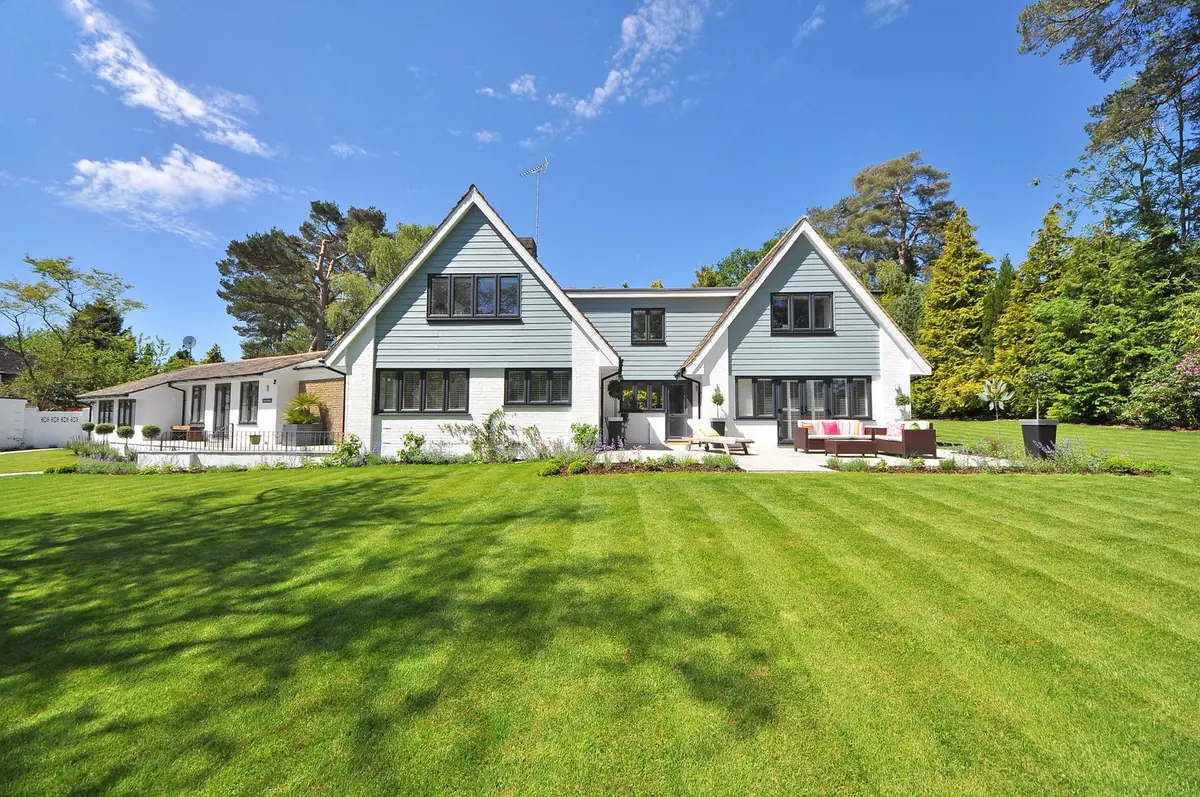
The backyard carries the heaviest mixed traffic in the house: games, furniture, trampolines and dogs on the same square metres. A 30–40 mm PE monofil pile with a brown thatch layer reads natural and springs back, and stitch rates around 14,000–18,000 per square metre stop it looking sparse by autumn.
Infill stays light, roughly 0.5–1 kg per square metre of silica sand, enough to hold the pile upright without turning the surface hard. Maintenance shrinks to brushing the fibres upright and clearing leaves. A backyard artificial turf installation lives or dies on that drainage path.
2. The Front Yard Landscape
The front yard changes the brief from durability to first impressions. Traffic is lighter, so the same 30–40 mm band works. But colour realism now outranks wear rating, and a four-tone green with thatch keeps the surface believable from the street all year.
The pitfall is neglect by design. Front lawns sit under trees, so leaf litter, not footfall, is the maintenance story, and a weekly clear keeps the drainage pores open.
3. Side Yards and Narrow Strips
Side yards fail with natural grass because no mower fits and shade wins. A short, dense roll turns the corridor green, and a 2 m roll carried through the side gate is often the only width that reaches the site at all.
Drainage decides everything here, since narrow strips collect runoff from both neighbouring surfaces. The layer stack that goes under artificial grass matters more in a side yard than anywhere else on the property.
Haustierrasen und Kinderspielplätze
4. Dog Runs and Pet Potty Zones
A pet zone is the one application judged on liquid, not rain. Urine must leave the surface fast, so the spec drops to a 20–30 mm curled PE pile with an antibacterial coating. Stitch rates of 16,000–18,000 per square metre keep it dense, and zeolite infill neutralises the ammonia in urine.
Rinse weekly and the zone stays fresh; skip the rinse and no pile height will save it. Sand-only infill is the classic mistake here, because plain silica does nothing for odour. Our turf built for dogs covers the full drainage and cleaning routine.

5. Children’s Play Areas
Play turf splits into two surfaces: the open play lawn and the fall zone under equipment. The lawn takes a dense PE monofil at about 30 mm, soft to land on and easy to keep clean of mud.
Under a climbing frame the surface becomes protective, so a shock pad goes beneath the turf and the fall height of the equipment drives the choice. Cushioning is the reason this zone exists, and playground turf systems pair the two layers deliberately.
Poolterrassen, Dachterrassen und Balkonböden
6. Pool Surrounds
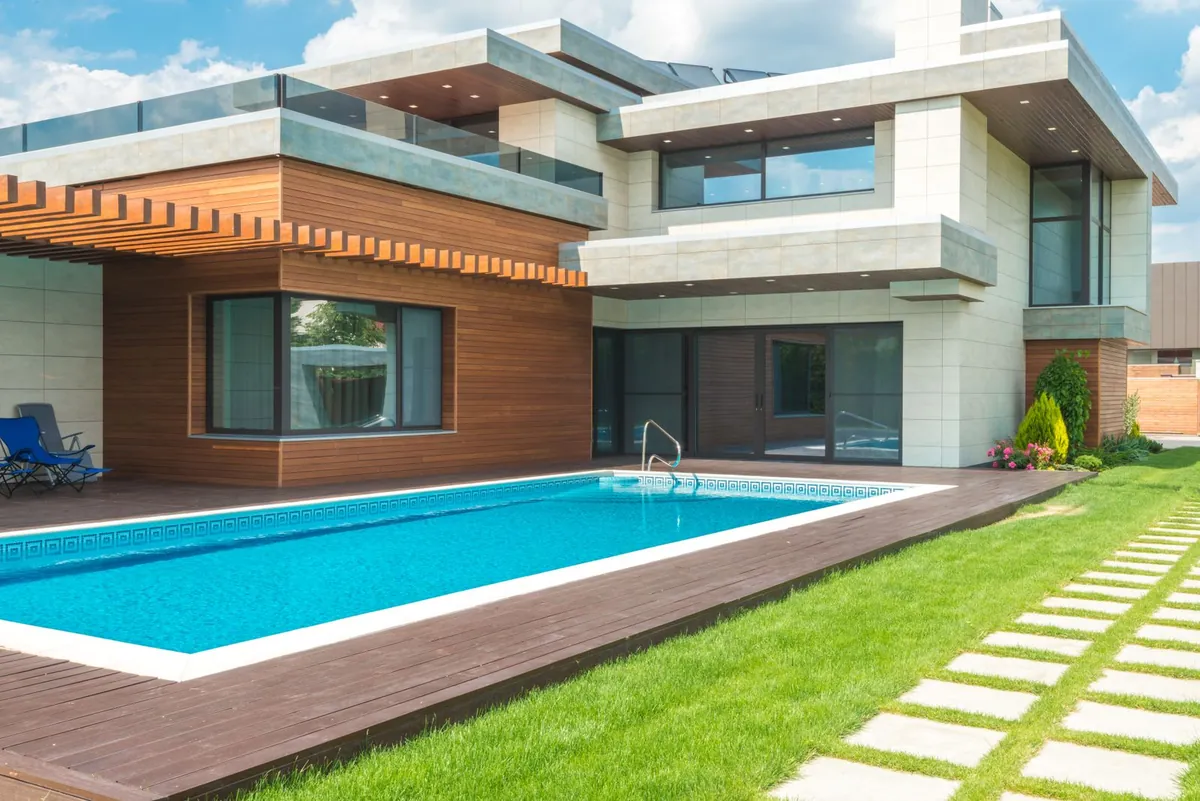
A pool deck is the most punishing surface around a home: wet-dry cycles, bare feet, chlorine and strong sun on the same day. A 25–35 mm PE pile feels good underfoot, and a fully permeable backing moves splash through faster than simple perforation. A poolside artificial turf installation must survive what no lawn ever meets.
The yarn needs chlorine stability and the infill needs discipline, applied in controlled amounts or skipped entirely, so nothing loose tracks into the water on wet feet. Hard decks stay hotter and slicker; turf keeps grip and drains.
7. Rooftop Terraces
Rooftops are checked twice before a single metre is ordered: weight load first, drainage second. A lightweight, low-build surface with no loose infill keeps the load down and stops wind scattering material across the roof.
Done right, a bare slab becomes a lounging, dining or practice space that sod could never serve, because irrigation and soil weight were never options up there.
8. Balconies and Covered Patios
Balcony turf is cut precisely to fit, from a narrow gallery to a full terrace, at a 20–25 mm pile that stays soft without bulk. The surface before the turf matters most, and the guide on preparing a hard floor for synthetic grass covers the levelling and bonding steps.
Water must exit faster than it arrives, so confirm where the balcony drains before the roll is cut, since some have no floor drain at all.
Putting Greens, Einfahrten und Fugen zwischen Pflastersteinen
9. Backyard Putting Greens
A green is the only residential application ordered by ball behaviour. The putting surface is a short, dense, texturised curl at 10–15 mm, framed by a 32–45 mm fringe that catches chips and softens landings.
Silica sand sets the speed, and a brushed green can hold a reading of 9 to 11 on the Stimpmeter scale, the fun, realistic band for home play. One rule is absolute: never place a shock pad under the green itself, because cushioning destroys a true roll; a thin pad under the fringe is fine. Start with the backyard putting green turf options before shaping cups.

10. Driveway Strips and Paver Gaps
Ribbons of turf between pavers or along a driveway soften hard geometry and stay mow-free forever. The spec is short and dense with a firm, traffic-tolerant blade, because wheels and heat, not football, are the load.
Edge restraint is the whole game here. Unsupported borders lift within a season, so the strip is only as good as the frame holding it.
Rollen für gemischte Wohnprojekte auswählen
Few homes order one zone at a time, so roll format drives the project. Standard rolls come in 2 m, 4 m and 5 m widths at 25 m long, covering 50, 100 and 125 square metres respectively. The standard roll formats and widths page sets out the trade-offs. Roll format is what keeps one artificial turf installation seamless across every zone.
Across the top 10 residential applications, four-metre rolls suit lawns and pool decks, two-metre rolls reach side yards and balconies, and wide, seam-hungry lawns justify five-metre stock. Where zones meet, plan the seam lines and fibre direction first, because a mismatched join reads louder than any colour choice.
Custom pile height, density, colour and backing are all open on a written schedule, which is how mixed projects keep one supplier and ten honest specifications.
Ordered the Wrong Turf for Half Your Zones?
One spec never fits ten zones: mismatched pile flattens and pools water. We tailor pile, density and backing to each zone. Factory-direct, typically 30–50% below market on like-for-like specifications.
Wo Kunstrasen im Wohnbereich noch Pflege benötigt
Honesty keeps a residential artificial turf installation healthy. In direct sun a synthetic surface runs hotter than grass, so rinse it before barefoot play on peak days or plan shade over the zones that matter.
- Brush the pile monthly and clear leaf litter weekly, especially under trees.
- Rinse pet zones weekly and top up infill where levels drop.
- Walk the seams and edges each season; lifts caught early stay cheap.
None of that compares with the mowing, watering and feeding calendar it replaces. But whichever of the top 10 residential applications is on the list, a surface sold as zero-maintenance will still be resented if it is treated as zero-attention.
Erst Proben und kundenspezifische specifications
Before any zone is ordered, put the schedule on paper: zone, pile, yarn, infill and roll width, one row each for the top 10 residential applications. Then test the shortlist in real daylight.
Free 20 by 20 cm samples, usually three to four pieces, ship by courier in four to six days. Pile, density and colour can then be judged on site rather than from a screen. Our line takes custom pile heights, densities, colours and PP+Net or PU backing against that written schedule, and free samples are the fastest way to start.
Häufig gestellte Fragen
Welche Grasbreite eignet sich am besten für einen Rasen zu Hause?
Die meisten Rasenflächen liegen zwischen 30 und 40 mm, was einen guten Kompromiss aus Weichheit und Rücksprungvermögen bietet. Für Haustierbereiche eignen sich 20 bis 30 mm, da sie sich leichter reinigen lassen, und für Putting-Flächen werden 10 bis 15 mm verwendet.
Can artificial grass go straight onto a balcony?
Yes. On sound concrete it is cut to fit and laid over a drainage layer, with edges fixed against wind. Check where water exits first, because some balconies have no floor drain.
Schädigt Poolwasser Kunstrasen?
Not when the yarn is chlorine-stable and the backing drains freely. A 25 to 35 mm pile feels good barefoot, and a quick rinse keeps splash residue from building up.
How do I stop smells in a dog run?
Rinse weekly and fill with zeolite, which neutralises the ammonia in urine. A shorter 20 to 30 mm pile leaves less fibre for waste to cling to.
Which roll width should a residential project order?
Vier-Meter-Rollen mit 25 Metern Länge decken die meisten Rasenflächen mit weniger Fugen ab. Zwei-Meter-Rollen passen zu Seitengärten, Balkonen und schmalen Zugängen, während Fünf-Meter-Rollen sich für breite Rasenflächen eignen.
How do I check quality before buying rolls?
Fordern Sie Muster im Format 20 × 20 cm an, in der Regel drei bis vier Stück, und beurteilen Sie Flor, Dichte und Farbe bei Tageslicht. Die Lieferung per Kurier dauert vier bis sechs Tage.
 German
  English
  Arabic
  French
  Portuguese
  Russian
  Spanish