
Dos vecinos con un patio del mismo tamaño pueden abrir dos presupuestos de césped artificial que apenas parecen describir el mismo trabajo. Una línea se lee como un precio de material; la otra, como una pequeña obra de construcción, y nadie explica qué mitad de la diferencia es real.
Esta guía traduce un presupuesto en partes simples: por qué el número varía, dónde va el dinero y cómo leerlo antes de firmar. Cotizamos desde la fábrica, por lo que las cifras de aquí describen el mercado y la construcción, no un margen de venta al por menor. Los factores por metro cuadrado que determinan el césped en sí se tratan en una guía separada.
Hasta dónde llegan realmente los precios del césped artificial
Lo primero que hay que aclarar es el alcance. Una cifra solo de suministro cubre el rollo de césped y poco más. Una cifra de instalación completa agrupa la base, la mano de obra y el acabado en una sola línea. La mayoría de la confusión sobre los precios del césped artificial comienza aquí, porque dos presupuestos que parecen iguales suelen cotizar mitades distintas del mismo trabajo.
Desde la fábrica, una banda orientativa de $7-60 por metro cuadrado cubre el material por grado, y el acolchado y el revestimiento mueven la cifra dentro de ese rango. Ese es el extremo de solo suministro. En cuanto un equipo entra en escena, la excavación de la base, la compactación y la colocación elevan la cifra total muy por encima del césped por sí solo. El producto en sí es una forma de césped artificial, y la especificación, no la marca, decide en qué parte de la banda se ubica un rollo.
| Tipo de presupuesto | Qué cubre | Dónde se sitúa la cifra |
|---|---|---|
| Solo suministro | Rollo de césped, recortes y cinta de unión | La banda orientativa de fábrica de $7-60 por metro cuadrado |
| Suministro e instalación | Césped más base, mano de obra y acabado | Por encima del césped por sí solo una vez añadidos la base y la mano de obra |
En los principales mercados de venta al por menor, la escalera mantiene la misma forma aunque cambie la moneda. En el Reino Unido, una línea de solo suministro orientativa se mueve en línea con esta banda de fábrica, y la misma escalera aparece en Australia y entre los distribuidores de EE. UU. La banda va desde rollos de paisajismo ligeros en el extremo de entrada hasta construcciones densas y resistentes en el extremo premium. Leer la escalera con honestidad es la primera comprobación de cualquier precio de césped artificial que se cote en línea o en impreso.
Mantenga los dos alcances separados al analizar el mercado. Una línea barata de solo suministro y una línea de instalación completa no son el mismo producto, y alinearlas lado a lado es la forma más rápida de malinterpretar un presupuesto. Para la vista de total de proyecto y una referencia por pie cuadrado, consulte cuánto cuesta el césped artificial por pie cuadrado en nuestra guía dedicada.
Por qué las presupuestaciones de césped artificial varían tanto
Un comprador en una pequeña ciudad costera me mostró una vez dos presupuestos para el mismo patio de 40 metros cuadrados. Uno estaba en el extremo bajo de la banda de material; el otro lo triplicaba. La diferencia no era un truco de margen. Un presupuesto cotizaba solo suministro, el otro una construcción completa con excavación profunda, y ninguno lo decía en palabras claras.
Los presupuestos se separan por cuatro causas a la vez. Cotizan distintos alcances, distintas especificaciones de césped, distintas condiciones del terreno y mano de obra regional distinta. La mayoría de las instalaciones de césped artificial del mismo patio terminan con totales distintos porque el denominador nunca se compartió. Hasta que alinee esas cuatro causas, la dispersión es ruido y no señal.
Nuestro punto de vista es directo: compare el alcance antes de comparar números. Un presupuesto que parece caro quizás simplemente incluye la base que el barato omitió. Pida a cada proveedor que indique qué hay debajo del césped, y la diferencia aparente suele reducirse o explicarse sola. Las ponderaciones de un solo factor que mueven el precio del césped pertenecen a la guía de factores por metro cuadrado, no aquí.
Las cuatro causas anteriores no son abstractas. Un patio de 35 metros cuadrados con fácil acceso y una subbase llana se negocia en un nivel de la banda. Los mismos 35 metros cuadrados detrás de una adosada con pendiente y una puerta estrecha se negocian en otro nivel. Especificación por especificación, el costo de la superficie se mantiene estable; el costo del proyecto no. Esa diferencia es lo que hace que el presupuesto de un patio parezca no tener relación con el de otro, y la mayoría de los compradores lo sienten antes de poder nombrarlo.
La mayoría de las instalaciones de césped artificial del mismo patio terminan con totales distintos precisamente por esta razón, y las cuatro causas simplemente nombran las cuatro capas que un presupuesto puede ocultar. Alinear esas cuatro es la primera lección de lectura, y es la que convierte cualquier presupuesto de un número único en una lista de decisiones.
Lo que cubre el precio y lo que deja fuera
Una línea que dice “suministrado e instalado” explica menos de lo que parece. Las palabras cubren mucho en teoría y sorprendentemente poco en la práctica, porque la construcción tiene más pasos de los que la frase sugiere. Leer los artículos incluidos es la única forma de saber qué está comprando realmente.
La mayoría de los presupuestos de instalación de césped artificial que se leen.
| Normalmente incluido | A menudo omitido |
|---|---|
| Material de césped | Eliminación del césped antiguo y el contenedor |
| Excavación y compactación de la base | Corrección del drenaje |
| Mano de obra para la colocación y el ensamblado de juntas | Dificultad de acceso al terreno |
| Relleno y terminación de bordes | Permisos y entrega a larga distancia |
Exija por escrito la lista de exclusiones antes de comparar dos presupuestos. El desglose detallado en el otro lado de esta división, incluidos los cargos ocultos, se explica en lo que debe incluir un presupuesto de instalación de césped. Trate cualquier presupuesto que no especifique sus exclusiones como el primero que debe cuestionarse.
A line that breaks out each item lets you check the build in writing. If a quote packs base work and old-lawn removal into a single line, ask the installer to split them. That single line usually hides the saving.
A roll of turf takes about the same time on any reasonable site, so any large gap between two complete breakdowns usually means the lower one trimmed a step. Compare the item lists rather than the totals and the difference becomes visible.
Names like base, infill and edging matter more than any brand label on the roll. The same picture shows up in the questions buyers bring to us when an artificial turf installation quote looks too good to be true. The lines to question are the ones that bundle multiple steps into a single number.
Las capas de precio: de la fábrica al césped instalado
The same square metre carries a different tag at each step of the chain. At the factory it is a material cost. At the wholesale desk it carries a margin. At the distributor it carries another, and at the installer it carries the last one plus the labour to lay it. Each hand adds a layer before the next takes it.
Picture the price as a baton passed down that chain: the factory sets it, each layer adds a margin, and the installer handles the final hand. By the time it reaches a retail buyer, the same roll can cost several times its factory tag. That spread is normal, not a red flag, as long as you know which hand you are paying.
Buying where the chain is short removes the retail and distribution margins from your square metre. We sit at the factory end, which is why the indicative band stays at $7-60 per square meter rather than climbing through several resale steps. When a quote arrives, ask which layer is pricing you, because that answer settles half the comparison on its own.
The factory sits at the start of that chain, so the price band stays close to the raw material cost plus the conversion steps needed to make a roll. By the time the same roll clears the regional distributor, the tag has climbed several steps by the time it reaches a shelf.
A retail garden centre can add further still. The chain is a structure rather than a scam, and the structure decides who carries which cost on every quote. Most artificial turf installation buyers hit at least two of these layers before the lawn is laid, which is why reading the chain matters even on a small yard.
Where you enter the chain is one of the few voluntary choices a buyer makes. Reading any quote against the layer it sits in turns the discussion from price alone into price, plus context, plus the trade-off each layer adds.
Variables de producto que encarecen el precio
The turf itself moves on a set of linked specs. Pile height, face weight, stitch rate and yarn family rise together, because a denser, taller build uses more material and a dearer polymer. Reading one spec in isolation, say pile height alone, is how buyers mis-price a roll against its neighbours.
Yarn choice sets the floor of the cost curve. Polypropylene sits at the entry, polyethylene in the middle, and nylon at the top for wear. None of those names change the factory band; they shift where a roll lands inside the $7-60 per square meter range. Backing type, PP net or a coated build, adds the last variable in the material price.
The variables travel as a group, not one at a time, so spec a roll by the job it must survive rather than by a single headline number. The ranked weight of each factor, and how far each one moves the metre, is the subject of the per-square-metre price factors guide. This section only names the dials; the next one names the site.
Different jobs push different specs. A family lawn wants more yarn than a decorative strip, and a pet-friendly yard wants a tougher face and a faster drainage path. Stating the use first, then the spec, keeps the conversation honest and the roll decisions anchored to the build.
Buyers who spec the product before naming the use end up overpaying for fibre they will never feel. Spec the build for what it has to survive, and the rest of the project falls into a natural place.
Variables de proyecto que cambian el número final
The yard, not just the turf, writes the final line. A small area spreads the same fixed costs, skipping and compaction, over fewer square metres, so the per-metre rate climbs. A large, plain rectangle spreads those costs thin and drops the rate. Both statements are true at once.
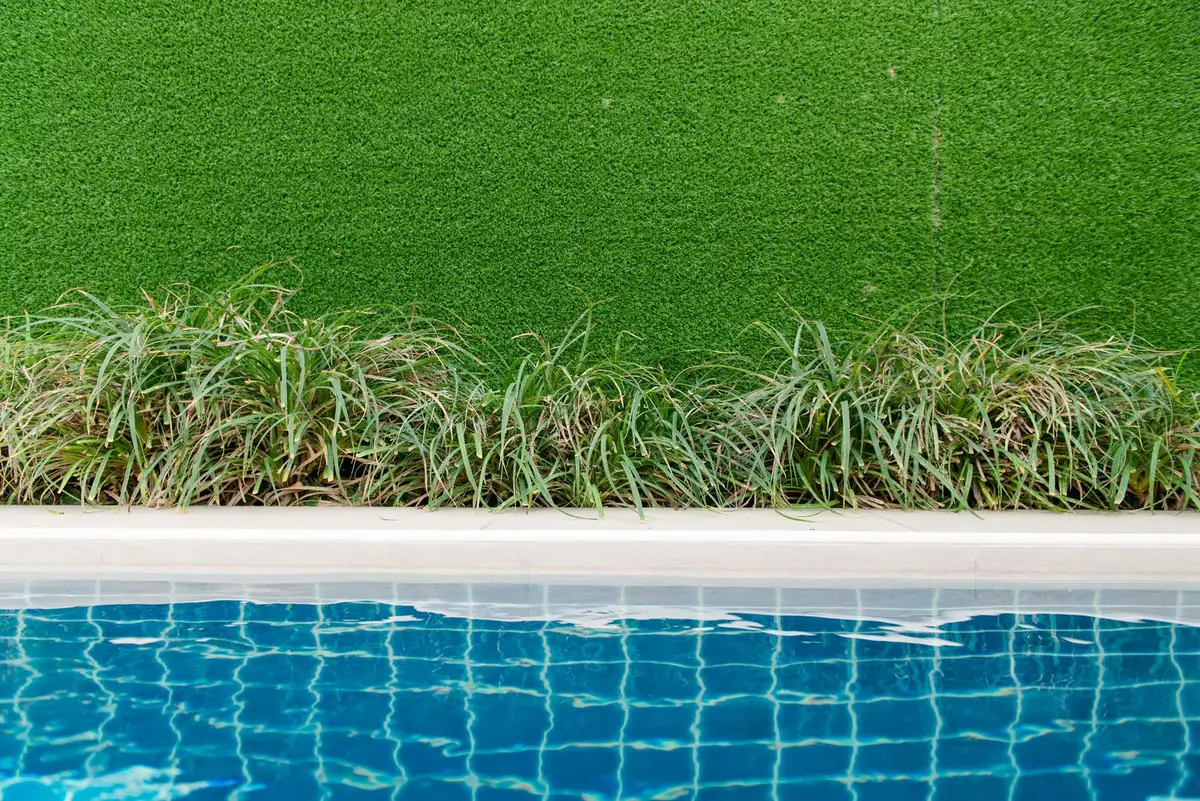
Shape and ground add the softest, easiest-to-cut layer. Curves, circles and pool decks waste material and add precise cutting time. Slopes ask for grading and sometimes drainage work. The American Society of Landscape Architects frames these as standard cost drivers in landscape builds, and artificial turf installation quotes in metro areas rise further on local labour rates.
Our opinion is plain: an unusually low quote usually means the base depth or the removal step was quietly cut. Those are the items a buyer cannot see once the lawn is down, which makes them the first place a number gets trimmed. Ask for the base spec in writing, and a low price becomes either a fair deal or a warning you can act on.
Before quoting, weigh access points, ground slope and any tree root or paving line that runs under the area. A ground crew that can drive a small dumper straight to the edge takes a fraction of the time of one that has to barrow material up steps. The fewer hours the crew spends fixing site problems, the smaller the project line on the invoice.
Most artificial turf installation quotes for tight-access sites run ahead of the same yard on open ground. The access line can be a large share of the visible difference. Walk the access route before the crew arrives and you can read the gap in advance.
Where two yards take the same crew the same time, the price lines should match. Where one takes longer, the difference shows up in the quote, and that is the kind of detail a good buyer learns to ask about in writing.
Price It From the Factory Floor
Send us your yard size and intended use, and we will return indicative numbers without the retail layer, including roll-width planning and free samples. Align the scope first, then compare the figures.
Cómo leer un presupuesto de césped artificial
A quote is one line until you pull it back into five questions. Is it supply only or fully installed? Which specs are fixed in writing? How deep is the base? Does it include removal and drainage?
Those four answers already sort most surprises before they reach the contract. The fifth question is what area the price is built on, and whether that area is the rough yard or the finished, trimmed lawn.
Lining up three quotes becomes a method rather than a chore once the questions are fixed. Take the cheapest of the three, mark every line it leaves out, and read its competitor breakdowns line by line. The mid quote is usually the complete one, and the high quote either adds scope the others missed or simply marks up the build. The residential artificial grass range shows what a finished spec looks like in a home setting, and you can order free samples and compare specs in hand before any commitment. A sample turns a number into a texture and a colour you can judge, which is the surest way to confirm a quote describes the roll you want.
Una verificación de precio antes de comprometerse
Four checks close the loop before you sign. Confirm the scope matches across every quote. Confirm the spec is written, not implied. Confirm the base depth is stated. Confirm the exclusions are listed.
Those four checks catch most of what a low price hides. A quote that fails any one of them is not ready to compare, whatever its total says.
A price far below the rest deserves the hardest look. The saving often sits in the base or the removal step, the parts you cannot see once the lawn is laid. Treat a sample as the last check, because the roll in your hand is the one you are actually buying.
The fuller list of buying moves, including batch sizing and roll-width matching, lives in ways to cut the cost of artificial turf. This page stays at the comparison layer: read the quote, align the scope, and let a sample settle the spec. That order protects the budget more than chasing the lowest line on the page.

Preguntas Frecuentes
How much does artificial grass price usually range from?
Material-only supply runs across an indicative factory-direct band of $7-60 per square meter by grade. A fully installed quote adds base and labour, so the all-in figure sits well above the turf alone.
Why do artificial grass quotes vary so much?
They rarely quote the same thing. Two numbers can differ on scope, turf spec, site condition and regional labour at once. Align those four before comparing totals, or the gap is noise.
What is usually included in an artificial grass price?
A supply quote covers the roll. An installed quote should cover turf, base compaction, labour, infill and edging. Old-lawn removal, drainage fixes, access and permits are the items most often left out.
Is a cheap artificial grass price a warning sign?
Sometimes. A quote far below the rest often quietly drops base depth or skip removal. Ask for the base spec in writing before you read the low number as a saving.
Does buying direct from a factory lower the price?
Removing the retail and distribution layers lowers the cost of the same square metre. The final number still moves with spec and freight, so compare a sample in hand before you commit.
 Spanish
  English
  Arabic
  French
  German
  Portuguese
  Russian