En cada temporada de licitaciones, nuestro equipo responde la misma pregunta de contratistas y compradores de clubes: césped híbrido vs césped artificial para un campo con lista completa de partidos. Tenemos una línea directa de fábrica, y nuestro banco ve ambos tipos de superficie especificados en el mismo proyecto. No son competidores en un solo eje. Uno mantiene una planta viva en la capa de desgaste, y el otro elimina la planta por completo.
Esta comparación separa ambas superficies por lo que le compromete al comprador: horas de juego disponibles, carga de mantenimiento, drenaje y obra de base, y la lista de aceptación el día de la entrega. También muestra dónde una cancha reforzada aún depende de un componente sintético, y esa es la parte que suministra nuestra fábrica. Léalo como un marco de adquisiciones en lugar de un folleto de producto.
Qué es exactamente el césped híbrido en obra
El césped híbrido es una superficie viva con un esqueleto sintético. La semilla o el césped enrollo se colocan sobre un sustrato de raíz en el que se han inyectado, cosido o transportado fibras sintéticas. Las fibras se ubican por debajo y entre las láminas. A medida que la masa de raíces crece, se une a ellas, y ambos materiales comienzan a comportarse como una sola capa de desgaste.
Tres familias constructivas cubren la mayor parte del mercado. Los sistemas inyectados empujan las fibras hacia abajo en un perfil a base de arena. Los sistemas cosidos cosechan hileras de fibra en ese perfil. Los sistemas de tapete colocan un tapete sintético bajo una capa de arena o suelo, y el césped crece a través de él. Los tres dejan una planta real que sostiene la superficie jugable.
Esa distinción es la que un comprador paga. El césped híbrido es agricultura con refuerzo, por lo que necesita luz, agua, abono y tiempo de recuperación. Cuando un especificador pregunta dónde termina el componente sintético, nuestro equipo señala las mismas familias de hilos que tuftamos para rollos de paisaje y deportes. Esos son monofilamentos de polietileno y polipropileno, con el respaldo elegido por drenaje en lugar de por estética.
Qué significa el césped artificial completo en la práctica
Una instalación de césped artificial completo elimina la planta. Las fibras tuftadas de polietileno o polipropileno se fijan en un respaldo recubierto y reciben arena e infiltras de rendimiento. El rollo se coloca sobre una base de ingeniería, con una almohadilla de shock donde la altura de caída lo requiera. Nada en la superficie es vivo, por lo que nada necesita corte.
El rendimiento se convierte entonces en propiedad de la construcción en lugar de de la temporada. Rodada de balón, rebote, tracción y drenaje dependen de la altura de pelo, el peso superficial, la profundidad de infiltrado y la base bajo ellos. Esos valores se miden en fábrica y se verifican en la entrega, por eso las instalaciones de césped artificial se especifican en filas en lugar de describirse con adjetivos.
El intercambio es térmico y estético. Una superficie sintética no se repara a sí misma, y no se enfría como lo hace la transpiración de una hoja viva. Almacena calor bajo sol fuerte. Dentro de una grada de estadio sombreada con mala circulación de aire, esa misma propiedad puede funcionar a favor del cliente.
La referencia estándar para césped artificial describe la misma construcción. Para el contexto del producto en el lado deportivo, vea el gama de césped artificial deportivo que fabricamos para proyectos de campo.
Dónde se separan el césped híbrido del césped artificial
El argumento césped híbrido vs césped artificial usualmente comienza en la sensación, y debería comenzar en las horas. Una cancha natural reforzada aún necesita recuperación entre partidos. Una cancha sintética no, por eso el mismo recinto puede soportar un calendario mucho más denso después de una conversión.
El mantenimiento se divide de la misma manera. El césped híbrido hereda todas las tareas de un césped natural: corte, riego, abono, aireación, sobresembrado y una ventana de renovación. El sintético completo cambia esas tareas por cepillado, relleno de infiltrado y limpieza profunda periódica.
| Trabajo en la superficie | Césped híbrido | Césped artificial completo |
|---|---|---|
| Corte | Semanal durante la temporada de crecimiento | Never |
| Riego | Requerido para la planta viva | Solo para enfriamiento y limpieza |
| Abono y sobresembrado | Requerido en un programa estacional | No requerido |
| Cepillado y relleno de infiltrado | No aplicable | Periódico, según nivel de tráfico |
| Ventana de renovación | Cierre anual o estacional | No requerido |
| Horas utilizables | Extendidas sobre césped natural, aún con límite | La más alta de las tres familias |
| Comportamiento térmico | La transpiración enfría la hoja | La superficie almacena calor bajo sol fuerte |
Nada de esto hace que una opción sea mejor en abstracto. Hace que sean contratos diferentes. Un club con personal de campo, una ruta limpia de luces y un calendario de un solo deporte puede justificar una cancha híbrida. Un operador municipal que gestiona cinco deportes durante todo el día usualmente no puede. La clasificación de césped artificial para jardín guía clasifica estas familias por material, pelo y respaldo.
Las horas de juego deciden más que el aspecto
Comience toda conversación de especificación con el calendario, no con la muestra. Cuento las horas que la superficie debe ser jugable cada semana, luego cuente las horas en que puede cerrar para recuperación. Ese solo ejercicio elimina una de las dos opciones en la mayoría de los proyectos antes de que se discuta algún precio.
Reinforced natural grass extends what a grass pitch can carry, but the plant remains the limiting factor. Wear concentrates at goal mouths, centre circles, and touchlines, and those areas need recovery time or a renovation window. Shade, low sun angles, and poor airflow inside a stadium bowl make that recovery slower still.
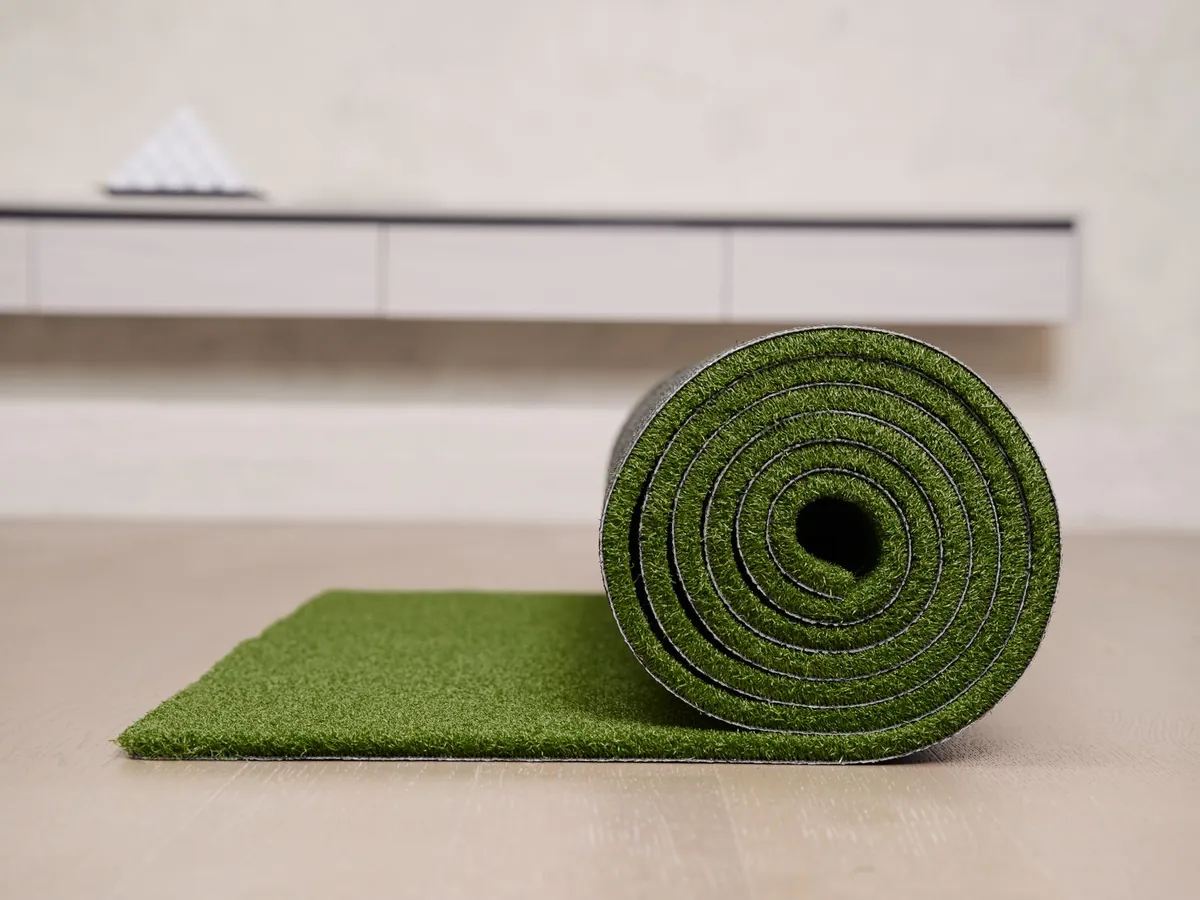
Full synthetic removes the recovery clause. Community use, training blocks, and back-to-back fixtures can share one day, provided the crew keeps up with grooming and infill levels. Our plant ships the widest roll format for heavy-use pitches, because every seam is a future maintenance item. Pile and infill depth differ by generation, as covered in césped artificial 2G vs 3G.
Las cargas de mantenimiento señalan en direcciones opuestas
Hybrid grass does not release the grounds crew. It changes what the crew does. Mowing, irrigation, and feeding continue on the natural schedule, while the fibres hold the surface together through wear that would tear a pure natural pitch apart.
Full artificial turf removes mowing and irrigation but adds its own discipline. Infill migrates toward the high-traffic lanes and has to be redistributed. Pile has to be brushed upright. Deep cleaning clears the fines that clog the drainage path through the backing perforations. Skip those tasks and the drainage rate falls long before the fibre wears out.

One line in the specification settles many school and municipal decisions. A synthetic surface needs no weedkiller, no pesticide, and no fertiliser, and the materials are non-toxic and free of allergens. On artificial turf installations at schools and municipal sites, that line often carries more weight than the play-hour figure. A hybrid pitch still runs a chemical and water programme every season.
El drenaje y la obra de base marcan el presupuesto real
Both surfaces stand or fall on what sits underneath. A hybrid pitch needs a rootzone that drains freely while still holding moisture for the plant, which is a narrower target than most first-time buyers expect. A synthetic pitch needs a base that sheds water through the backing perforations into a stone layer designed for the load.
This is where the hybrid grass vs artificial turf comparison stops being a product question. Two quotes for one site can differ more in the base than in the surface, and the base line is the one most often missing from the first budget.
| Línea de presupuesto | Hybrid grass project | Full artificial turf installation |
|---|---|---|
| Surface material | Seed or sod plus reinforcement | Turf roll plus infill and shock pad |
| Base and drainage | Rootzone profile with irrigation | Engineered stone base with drainage layer |
| Irrigation system | Required | Optional, for cooling and cleaning |
| Ongoing maintenance | Grounds crew on a natural schedule | Grooming, infill top-up, deep cleaning |
| End of cycle | Overseed and renovate | Replace the wearing layer |
Indicative factory-direct pricing sits at $7-60 per square meter before base work, infill selection, and freight. Request an exact quote against your own area and drainage design instead of comparing a headline number. On artificial turf installations of any size, the base line usually decides the tender. Our artificial grass roll formats page lists the widths that change seam count.
Cómo se leen las dos opciones en una oferta
Read a hybrid quote and a synthetic quote side by side, and the line structure tells you what you are buying. A hybrid quote carries a construction line, an irrigation line, and a grounds-equipment line that first-time buyers rarely expect. It is a civil engineering scope wearing a turf label.
An artificial turf installation quote splits differently: surface roll, shock pad, sand and performance infill by the tonne, seam tape, adhesive, and edge finishing. Each line carries its own unit, and each unit is auditable before the container is paid for.
Our rolls run 2 m, 4 m and 5 m wide by 25 m long, and the width choice changes the seam count on a full-size pitch. A 5 m roll reduces seams and waste across open area. A 2 m roll moves through tight access and keeps each lift lighter on site. Every roll runs the same eight steps at our plant: compounding, extruding, twisting, tufting, coating, drying, perforating, rolling up. Width, backing, pile height, and colour can all be set on our tailor-made specification line.
Normalise both quotations to the same five lines before anyone signs. Where a supplier bundles infill into the roll price, ask for the split. Where a hybrid quote omits irrigation, add it yourself. The comparison only means something at matched scope.
Spec Your Pitch Against a Factory-Direct Turf Line
We have run a factory-direct artificial grass line since 2006, with 18 years of export experience behind every order.
Rolls ship 2 m, 4 m and 5 m wide by 25 m long, with pile, gauge, colour and backing set to your specification. Backings come in PP+Net and PU. Free 20 by 20 cm cuttings ship from the production run.
Contractors, distributors, clubs and municipal buyers: request a quote to compare options for your site.
Leer una muestra antes de comprometer un contenedor
Ask for two samples and test them against different lists. A hybrid sample reads as a rootzone specimen: fibre depth, fibre density, and how the root mass behaves after a season of wear. A synthetic sample reads as a wearing layer: pile height, face weight, backing type, and drainage rate.
We ship free 20 by 20 cm cuttings, and our team cuts them from the same production run the order would come from. On a synthetic sample, bend it, wet the backing, and time the water through it. On a hybrid rootzone, pull the fibres and watch how much soil moves with them. Start the request on the free samples page.
Then write the numbers into an acceptance form and bring that form to the delivery inspection. Most disputes we see are not about quality. They come from a buyer testing a system sample against a roll checklist, or the reverse.
Qué compradores deberían elegir cada superficie
Reinforced natural grass suits an owner with grounds staff, natural light, and a single-sport calendar at the top end of the market. It suits a venue where the feel of real grass is part of the product and where the surface can be closed for recovery.
Full synthetic suits everyone else with a heavy timetable: schools, municipal multi-use fields, training centres, and clubs running several teams across one pitch. It also suits indoor and heavily shaded sites, where no amount of reinforcement will keep a living plant alive.
So the hybrid grass vs artificial turf question is rarely about which surface is better. It is about who holds the maintenance budget, how many hours the site must run, and whether the plant gets enough light. Answer those three and the specification writes itself.
Preguntas Frecuentes
What is the difference between hybrid grass and artificial turf?
Hybrid grass keeps a living plant anchored by synthetic fibres. Artificial turf replaces the plant with tufted fibre over a backing. One is maintained like a lawn, the other like a floor.
Does hybrid grass still need mowing and irrigation?
Yes. The fibres stabilise the surface but do not remove the maintenance load. Mowing, irrigation, feeding, aeration and overseeding all continue on the natural schedule.
Which surface gives more usable play hours?
Full artificial turf. Reinforced natural grass extends the hours a grass pitch can carry, but the plant still needs recovery time and a renovation window.
¿Es el césped híbrido más barato que el césped artificial?
No en un ciclo completo. El pasto híbrido suele tener un menor costo de materiales y un mayor costo de mantenimiento, porque la planta viva todavía necesita agua, fertilizante y corte cada semana.
¿Se puede convertir un campo híbrido a césped artificial 100%?
Yes, and the reverse is harder. Most reinforced rootzones must be removed before a synthetic system can be built, so the conversion cost belongs in the first budget conversation.
¿Qué superficie es adecuada para un campo escolar o municipal?
Full artificial turf in most cases. Multi-use fields carry heavy timetables and mixed sports, and a living surface rarely recovers between fixtures. Reinforced grass suits single-sport venues with grounds staff.
 Spanish
  English
  Arabic
  French
  German
  Portuguese
  Russian