
Artificial turf has changed bocce ball courts from seasonal club amenities into year-round design features. The surface plays true in every season and looks as good in January as it does in July.
This complete guide covers everything a buyer needs to know about bocce ball court turf. It compares the alternatives and breaks down costs and sizing. Deeper detail on each topic is linked throughout.
Bocce Meets Turf: The Complete Short Version
Bocce court turf is a short-pile synthetic grass installed unfilled over a compacted base. It delivers a smooth, all-weather playing surface that replaced the crushed oyster shell and sand courts demanding constant raking. The rest of this guide explains what that means for your project.
The material science behind modern bocce turf has advanced significantly since the first-generation products. Multi-tone pile combines two or three shades of green in a single sheet, creating depth that single-colour turf cannot match. Thatch layers between the pile rows mimic the natural dead grass that gives live turf its texture. And UV inhibitors are now manufactured into the yarn itself rather than sprayed on as a coating that washes off.

What a Turf Bocce Court Looks Like
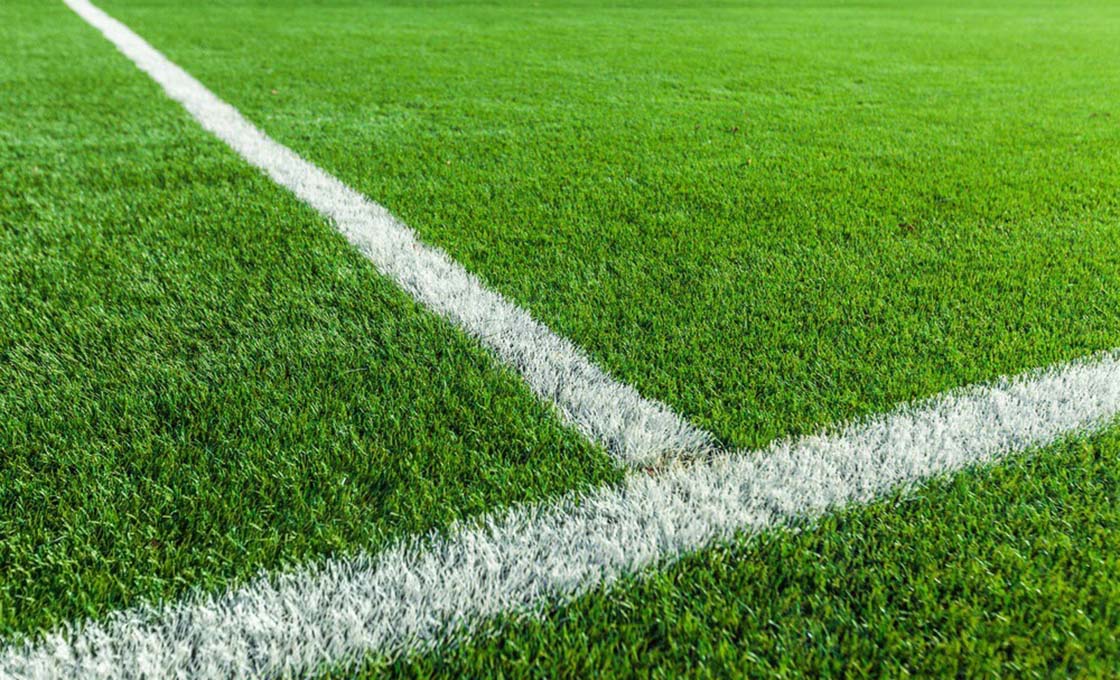
A finished turf court reads as a clean, bordered lane of short green grass inside a frame of lumber or steel. The bocce ball court turf surface is flat and dry, with lines marking the boundaries and the centre line. No sand, no dust and no mud.
The playing area is typically 10 to 13 feet wide. Courts run 40 to 91 feet long depending on the space available. A surround of paving, gravel or planted beds catches over-thrown balls and defines the court edge.
Surfaces Compared in One Minute
Four surfaces compete for bocce courts, and the choice drives cost and cleanliness.
Crushed oyster shell is the traditional gold standard but demands constant raking. Clay is durable but drains poorly. Sand and pea gravel are the cheapest options but the material wanders into shoes, pools and planting beds.
Synthetic turf outlasts all three on maintenance and cleanliness, and the growth has been steady.
Surface installers report a decade of steady growth for a game that predates the Roman Empire. The la tradition de la bocce traces to ancient Rome. The practical difference shows up in three places.
Rain: shell washes and clay turns slippery, while turf drains through. Cleaning: shell dust and sand particles track into shoes and buildings, while turf stays on the court. Consistency: shell speed changes with moisture, while turf plays the same in July and January. For the full comparison, see our guide to turf versus natural grass for bocce courts.
The choice between these surfaces also affects who can play. A shell court requires someone to rake and re-dress the surface after every session, which means someone has to care enough to do the work. A turf court requires nothing more than the players showing up, which is why facilities that struggle with volunteer maintenance are the fastest converts to synthetic surfaces.
The transition from shell to turf is also a transition in who plays. Shell courts tend to attract experienced players who accept the maintenance as part of the tradition. Turf courts attract families, casual players and venues that want the activity without the commitment, which is why the demographic of bocce players has widened as turf adoption has spread.
Specs That Matter in One Table
| Spécification | Ce que disent les guides |
|---|---|
| Hauteur de la pile | Shorter pile gives more rebound |
| Système de surface | Padded or brushed-in infill |
| Perméabilité | Drains through the surface |
| Support | PP+Net or PU for stability |
Those five bocce ball court turf specs are where every quote starts. A supplier who cannot address all five in writing is selling a surface without a system behind it. That is the fastest filter for a quote pile.
Pile height is the spec buyers argue about most. Shorter pile plays faster and truer, which competitive players prefer. Longer pile gives a touch more cushion for social play.
The right answer depends on who uses the court, not on what looks best in a showroom. Those rows also frame the conversation with your supplier. If a quote skips any of them, ask why before you commit.
The full numbers behind each row and the spec checklist are in our guide to bocce court turf specifications.
The sample-to-installation timeline is worth planning around. Free 20 by 20 centimetre samples ship by DHL or FedEx in 4 to 6 days. That is enough to feel the pile and check the colour against your frame material. Custom colours, inlaid lines or non-standard pile heights add 10 to 15 days of production before shipping. Planning around this lead time is the difference between a court that arrives when the weather is right and one that arrives after the season has started.
Building One: The Full Sequence
The build sequence is short: set the frame, prepare the base, lay the drainage, roll the turf and brush in the lines. Each step of the build is covered in detail in our guide to building a bocce ball court. The tools are simpler than an outdoor build. A turf cutter or spade strips the site.

A plate compactor sets the base.
A utility knife trims the rolls. A stiff broom finishes the pile. Nothing exotic, which is why crew availability rather than equipment sets the schedule. The process runs inside a normal working week for most backyard projects, which is why the DIY segment has grown alongside the professional market. for most backyard projects once materials arrive on site.
Designs, Sizes and Costs Compared
Court sizing is the first design decision for any bocce ball court turf project. Regulation courts run 86 to 91 feet long, but backyard builds commonly land at 10 by 60 feet. Compact urban courts go as small as 6 by 20 feet.
Material pricing runs $7 to $60 per square metre depending on pile, density and backing. The range is indicative until the specification is fixed. For the full budget breakdown by tier, see our guide to softball field construction cost, which shares the same base economics at a smaller footprint. The design questions follow the sizing: what colour scheme matches the property, whether lines are inlaid or painted, and how the frame meets the surrounding landscape. These are the decisions that make the court feel designed rather than installed.
The cost conversation should also include what the court replaces. A backyard turf court replaces a lawn that was already being mowed, watered and fertilised, so the net new cost is lower than the gross cost. A facility court replaces a booking revenue stream that depends on weather and season, so the net new revenue is higher than the gross revenue.
Is Turf Right for Your Court?
The honest answer depends on how the court will be used. Facilities running leagues need the availability that only turf delivers. Backyard owners who play weekly get the same benefit. A once-a-month garden can happily stay in grass.
For facility operators weighing the comparison, our guide to the best bocce court surface for facilities compares all four surfaces from the operator’s chair.
Get a Bocce Turf Plan for Your Court
Send us your court dimensions and level of play. We will return turf specification options, a roll width plan and indicative material pricing.
Bocce Court Turf in Ten Questions
Quelle est la taille d'un terrain de bocce ? Les dimensions officielles font 86 à 91 pieds de long sur 13 pieds de large.
A-t-il besoin de remplissage ? Non, la plupart des pelouses de bocce se jouent sans remplissage.
Combien de temps dure-t-il ? Une pelouse de qualité dure jusqu'à 10 à 15 ans avec des soins basiques.
Est-ce sans danger pour les enfants ? Oui, la surface est non toxique et ne contient aucun allergène.
Peut-il supporter la pluie ? La pelouse perméable draine l'eau, le jeu peut donc reprendre peu de temps après l'arrêt de la pluie.
A-t-il besoin d'arrosage ? Non.
Peut-il être personnalisé ? Oui, la hauteur de pile et la couleur sont spécifiées par projet.
Quel est le délai de livraison ? Les échantillons gratuits sont expédiés en 4 à 6 jours.
Fonctionne-t-il en pente ? Une pente douce favorise le drainage.
Quel est le coût ? Les tarifs des matériaux vont de $7 à $60 le mètre carré. Cette fourchette couvre tous les produits que nous fabriquons, du paysage entrée de gamme aux spécifications sportives professionnelles. La différence réside dans la hauteur de la pile, la densité et la composition du support.
Three Bocce Court Turf Myths
Le premier mythe est que la pelouse devient trop chaude pour être utilisée. Les systèmes modernes sans remplissage avec pigments réfléchissants restent confortables au soleil direct.
Le second mythe est que la pelouse ne convient qu'aux installations professionnelles. Les aménagements résidentiels constituent le segment en croissance la plus rapide.
Le troisième mythe est que toute la pelouse a un aspect artificiel. Les piles et couches de faux gazon multitonales modernes produisent une surface qui paraît naturelle de toute distance de visionnage normale. Les piles multitonales produisent une surface que la plupart des visiteurs ne peuvent pas distinguer d'une pelouse naturelle bien entretenue.

Questions fréquentes
How long does bocce court turf last?
La pelouse commerciale de qualité dure jusqu'à 10 à 15 ans avec un brossage et un nettoyage basiques. Le support et la densité de la pile permettent à un terrain de traverser toute sa durée de vie prévue.
Quel entretien la pelouse de bocce nécessite-t-elle ?
An occasional brush and rinse. No mowing, no watering and no fertilising, which is why facilities and homeowners are switching from natural surfaces.
What does bocce court turf cost?
Relyir material pricing runs from $7 to $60 per square metre, indicative until the specification is fixed. Installation costs depend on site preparation.
What size should a bocce court be?
Regulation courts run 86 to 91 feet long by 13 feet wide. Backyard builds commonly use 10 by 60 feet, and compact courts fit 6 by 20 feet.
Le gazon pour bocce peut-il être personnalisé ?
Oui. La hauteur de poil, la densité, la couleur et le support sont tous spécifiés par projet, et les dimensions de rouleau sur mesure éliminent les coutures internes sur la plupart des courts.
 French
  English
  Arabic
  German
  Portuguese
  Russian
  Spanish