Systèmes de pelouse de sport
50 mm PE monofilament engineered for consistent ball behavior on cricket pitches and outfields. Factory-direct from Relyir — 20 years of manufacturing.
Why Specify 50 mm Monofilament for Cricket
Cricket outfields demand a surface that delivers consistent ball speed, predictable bounce and the ability to play through rain without waterlogging. Every design choice in the Relyir cricket range addresses one of these measurable criteria.
A 50 mm pile with sand and performance infill creates a uniform surface where ground strokes and boundary runs travel at a predictable speed. Fiber density at 10,500 tufts/m² holds that consistency from the first over to the last, in dry and damp conditions alike.
The combination of PE monofilament fibers, three-layer backing and optional shock pad produces a controlled ball rebound that closely mirrors well-maintained natural turf — a key factor for clubs and schools transitioning from grass squares.
Synthetic cricket outfields drain rapidly after rain, letting clubs resume play far sooner than natural grass. Dense PE monofilament with reinforced backing is engineered to hold blade structure through seasons of matches, net sessions and UV exposure.
Gamme de produits
One proven platform — 50 mm pile, 3/4″ gauge, 10,500 tufts/m² — with distinct blade structures and colorways. All models share reinforced three-layer backing with optional PU coating upgrade for high-moisture environments.
| Modèle | Hauteur de pile | Fil | Densité | Jauge | Taux de couture | Support | Couleurs |
|---|---|---|---|---|---|---|---|
| Diamond Overcome 50 | 50 mm | Monofilament PE | 10 500 touffes/m² | 3/4″ | 20/10 cm | PP + trame + PP (PU optionnel) | Vert terrain / vert pomme |
| U & Stem Ideal 50 | 50 mm | — | 10 500 touffes/m² | 3/4″ | 20/10 cm | PP + trame + PP (PU optionnel) | Vert terrain / vert pomme |
| Double Stem Wonder 50 | 50 mm | Monofilament PE | 10 500 touffes/m² | 3/4″ | 20/10 cm | PP + trame + PP (PU optionnel) | Vert terrain / vert jaune |
| Wave Zeal 50 | 50 mm | Monofilament PE | 10 500 touffes/m² | 3/4″ | 20/10 cm | PP + trame + PP (PU optionnel) | Vert terrain / vert pomme |
| Wave Vitality 50 | 50 mm | Monofilament PE | 10 500 touffes/m² | 3/4″ | 20/10 cm | PP + trame + PP (PU optionnel) | Vert de champ |
Roll sizes: 4 × 25 m or 2 × 25 m, maximum roll width 5 m. Boundary rope markings and club logo integration available on request. Full datasheets — including yarn weight and total weight — are provided with your quotation.
Conception performante
The playing character of a cricket outfield is governed by surface pace and ball bounce. On natural turf, these qualities depend on grass length, soil moisture and rolling schedules — variables that change daily. A synthetic outfield removes most of that variability while preserving the pace characteristics players expect.
Each of the five Relyir blade profiles — diamond, stem, double-stem and two wave variants — distributes ball contact forces differently. Diamond-profile fibers resist compression under the ball’s impact, maintaining pace consistency in high-traffic zones between the wickets. Stem and wave profiles offer a softer touch preferred at some club venues.
For the pitch itself — the central strip where bowling and batting occur — a separate short-pile or woven wicket carpet is typically specified. Relyir’s 50 mm range covers the outfield, while the pitch system is designed to integrate with standard clay stump boxes at both wicket ends.
The three-layer backing — polypropylene, reinforcing mesh cloth, and a second polypropylene layer — anchors every tuft and transfers load across the carpet. An optional PU coating adds moisture resistance for venues in tropical climates or those with heavy dew conditions.
Relyir supplies the outfield turf product, full specification documentation and works with your installer through the project to ensure the pace and bounce characteristics match the club’s requirements.

Vente directe d'usine depuis le Jiangsu
Relyir fabrique du gazon artificiel au Jiangsu depuis 2006. Chaque étape — des granulés de PE bruts aux rouleaux finis — se déroule sur place, ce qui nous permet de contrôler la qualité et de maintenir des prix inférieurs de 30–50% aux équivalents internationaux.
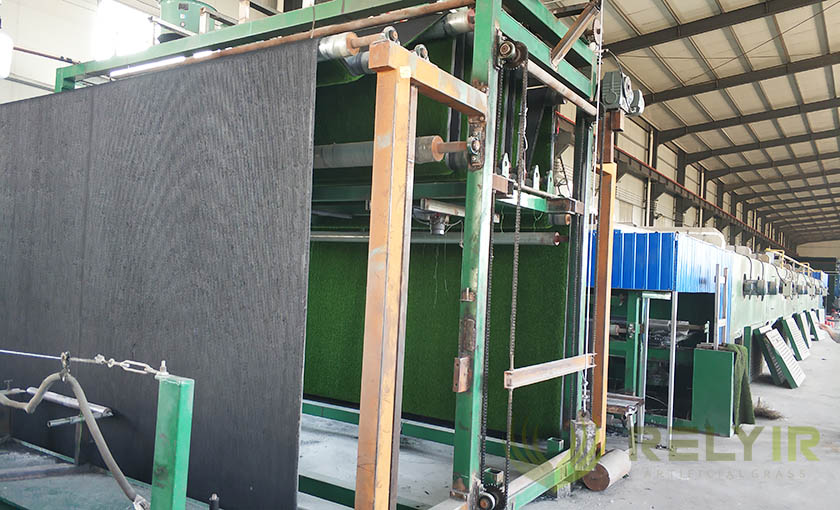
Les huit étapes de production sont gérées en interne, éliminant les écarts de qualité qui surviennent lorsque le mélangeage, le tissage en boucles et le revêtement sont effectués dans des installations séparées. La ligne automatique de gazon sportif, mise en service en 2015, a augmenté la capacité de production de 150% et renforcé la cohérence sur les commandes de gros volumes.
La personnalisation est intégrée à la ligne : la densité de filaments, la hauteur de la pile et les couleurs des fibres sont ajustées selon la spécification de chaque projet, avec des options de dos PP + filet et PU. L'équipe export a expédié à plus de 500 clients dans plus de 50 pays depuis 2009 et gère toute la documentation — des factures commerciales aux certificats d'origine.
Montage du système
The turf roll is one component of a multi-layer system. We supply the turf and share build-up guidance with every project so installers achieve the pace and drainage characteristics specified at design stage.
Compacted aggregate or asphalt/tarmac base with engineered drainage — the foundation that controls surface regularity and vertical drainage for the entire outfield.
A thin shock pad may be added for player comfort; pad-free installations tend to produce more realistic cricket bounce and faster pace.
Silica sand brushed into the pile to weigh the system and hold fibers upright — typically 15–25 kg/m² for cricket outfield applications.
The central wicket strip uses a separate short-pile or woven carpet, with clay stump boxes at each end. The 50 mm outfield turf is seamed to the pitch carpet for a seamless transition.
Every Relyir cricket outfield turf ships with perforated backing — drainage holes punched during our dedicated perforating step — so water moves through the carpet into the base rather than pooling. This allows play to resume faster after rain than on natural grass squares.
Routine maintenance includes periodic brushing to keep fibers upright, sand-level checks, and moss or algae treatment in shaded or damp climates. UV-stabilized PE fibers resist degradation under prolonged sun exposure.
Cricket outfields typically use 25–50 mm fibers. The 50 mm height in our range offers a balance of ball pace and fiber durability, with sand infill stabilizing the system. Shorter piles (9–13 mm) are reserved for the central pitch strip, which uses a separate woven or tufted carpet.
Pad-free systems tend to mimic natural turf bounce most closely, which is why many cricket clubs prefer them. A shock pad can improve player comfort but may slow the outfield pace and soften ball bounce. We recommend discussing the tradeoff with your installer based on the level of play intended.
Our 50 mm monofilament range covers the outfield. The central pitch typically requires a separate short-pile or woven wicket carpet with clay stump boxes. Relyir can coordinate supply of both components and provide specification documentation for the complete system.
Synthetic outfields deliver more consistent pace regardless of weather, as the fiber and infill system does not soften or slow after rain the way natural grass does. The pace level itself is determined by pile height, sand dressing depth and whether a pad is used — all adjustable at design stage.
Standard rolls are 4 × 25 m or 2 × 25 m with a maximum width of 5 m. Boundary rope markings and club logos can be tufted directly into the carpet. Blade density, pile height and fiber colors are adjustable to project requirements.
No synthetic outfield is maintenance-free. Plan for regular brushing to keep fibers upright, periodic sand top-up, moss and algae treatment in damp climates, and seam inspections. Relyir provides maintenance guidance with every installation package so the outfield holds its playing characteristics through its service life.
Send your ground dimensions, usage plan and target timeline. Our export team replies with model recommendations, specification sheets and factory-direct pricing within 12 hours.
Obtenir un devis gratuit