
A portable putting green earns its place when the weather shuts the course and the short game still needs work. We build artificial grass rolls on our own line, so the question we hear most is blunt: will a roll I can put away actually putt true?
The honest answer is that a Tragbarer Putting Green works when three things line up: room size, floor flatness, and storage that does not wreck the roll. Below is the verdict buyers actually need, not a brochure.
When a Portable Putting Green Actually Works
A portable green is the right call for winter practice, a clubhouse corner, or a retail display that must pack away after a show. It solves the “course is closed” problem without committing floor space year round.
It is the wrong call when you want sculpted breaks, a regulation contour, or a surface tuned weekly. Those belong to a fixed build. Know which problem you are solving before you order turf.
Our putting green turf range covers a 3 m by 4 m room with a single no-seam cut, and the same roll serves a showroom bay or a home office. Selection starts with the room, not the catalogue. A roll you can walk away from is the one feature a fixed build can never offer.
What You Give Up Versus a Built Green
The trade is real, and it is worth stating plainly. A portable roll gives you convenience and a true-enough roll; a built green gives you speed control and contour you cannot reproduce on a rolled mat. If your floor and commitment both allow it, you can still build a fixed green instead. A fixed artificial turf installation earns its cost only when you want contour and weekly speed tuning.
| Abmessungen | Portable roll | Built green |
|---|---|---|
| Speed ceiling | Set by the spec you order, commonly Stimp 9–11 | Tunable with infill; tour-grade nylon reaches Stimp 12.5 |
| Break and contour | Flat roll, no sculpted break | Slopes and cups engineered into the base |
| Base requirement | Lays on your existing floor | Excavated, compacted sub-base |
| Speed adjustment | Set at the factory | Top-dressed over the green’s life |
| Portability | Rolls away for storage | Permanent, single location |
| Lebensdauer | Set by handling and storage | Built for years of outdoor use |
None of this makes a portable roll inferior. It makes it a different tool, aimed at repetition and convenience rather than tournament replication.
How Flat Does Your Floor Need to Be?
This is the question every search misses. A fixed artificial turf installation is judged on a compacted sub-base, roughly 90-plus percent density and about 95 percent for stability. Your portable roll has no sub-base; it sits on the room floor as it is.
The relevant tolerance is the flooring standard, not the turf spec: about 3 mm of deviation over a 2–3 m span. Anything past that and the ball drifts, because the roll follows the floor beneath it. A permanent artificial turf installation hides a poor floor behind a compacted sub-base; a portable roll has no such cushion.
Carpet, tile or sealed concrete all work if they are flat and dry. A thin underlay can steady a slightly uneven slab, but it cannot fix a wavy floor. Measure before you commit to a size.
Sizing a Room for Real Putts
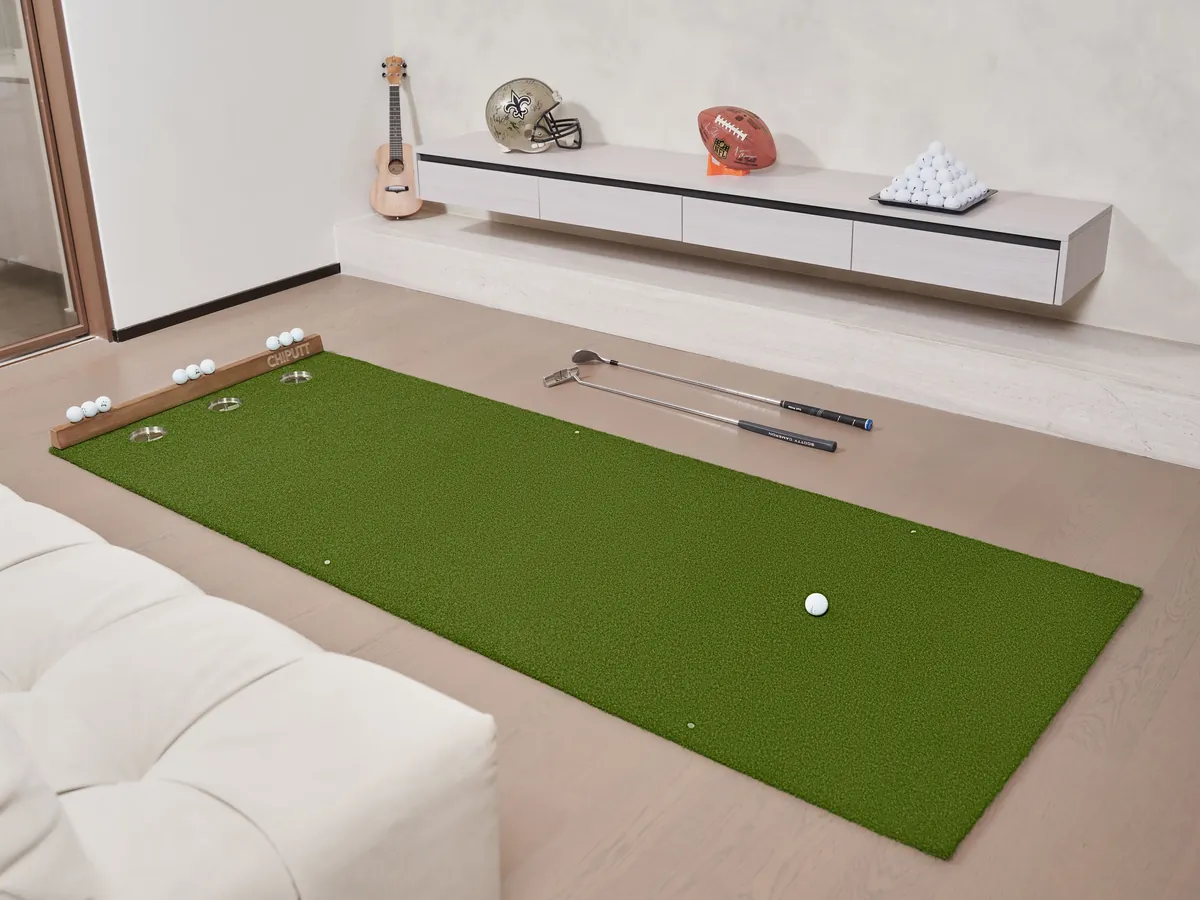
A mat length is not a room size. Size the room to your longest putt plus your stance and backswing clearance, then add a meter for comfort.
A short mat around 8 ft fits a spare bedroom corner. A 9 ft 6 in mat needs a clearer run and a wider stance arc, so it rules out tight spaces. Think in putts, not product codes. Measure the longest putt you practice, then add a metre for stance and backswing.
For a 3 m by 4 m room, a 4 m-wide roll cut to 3 m yields one 12 m² piece with no seam. A 2 m roll would need two strips joined, so 4 m width is the cleaner choice for a 3–4 m room.
Predicting Speed From Pile and Fibre
Speed is not mysterious once you read the spec. Lower, stiffer pile rolls faster, and a dense, upright fibre keeps the ball riding high instead of dragging.
Most home greens target a Stimp of 9–11, a neutral industry speed rating measured by the same ramp device courses use. Tour-grade nylon can reach 10–12.5, but a 12-plus surface punishes a weak stroke.
Pile for putting sits near 10–16 mm; landscape turf at 25–37 mm is far too tall to roll true. Read the published Stimp, pile and fibre before you buy, and match the putting turf in our roll range or talk to us about custom pile height and backing. Most speed advice for an artificial turf installation assumes a built, infill-tuned base. And on a roll there is no infill dial to tune afterwards, so the spec you order is the speed you get.

Does Rolling It Up Ruin the Turf?
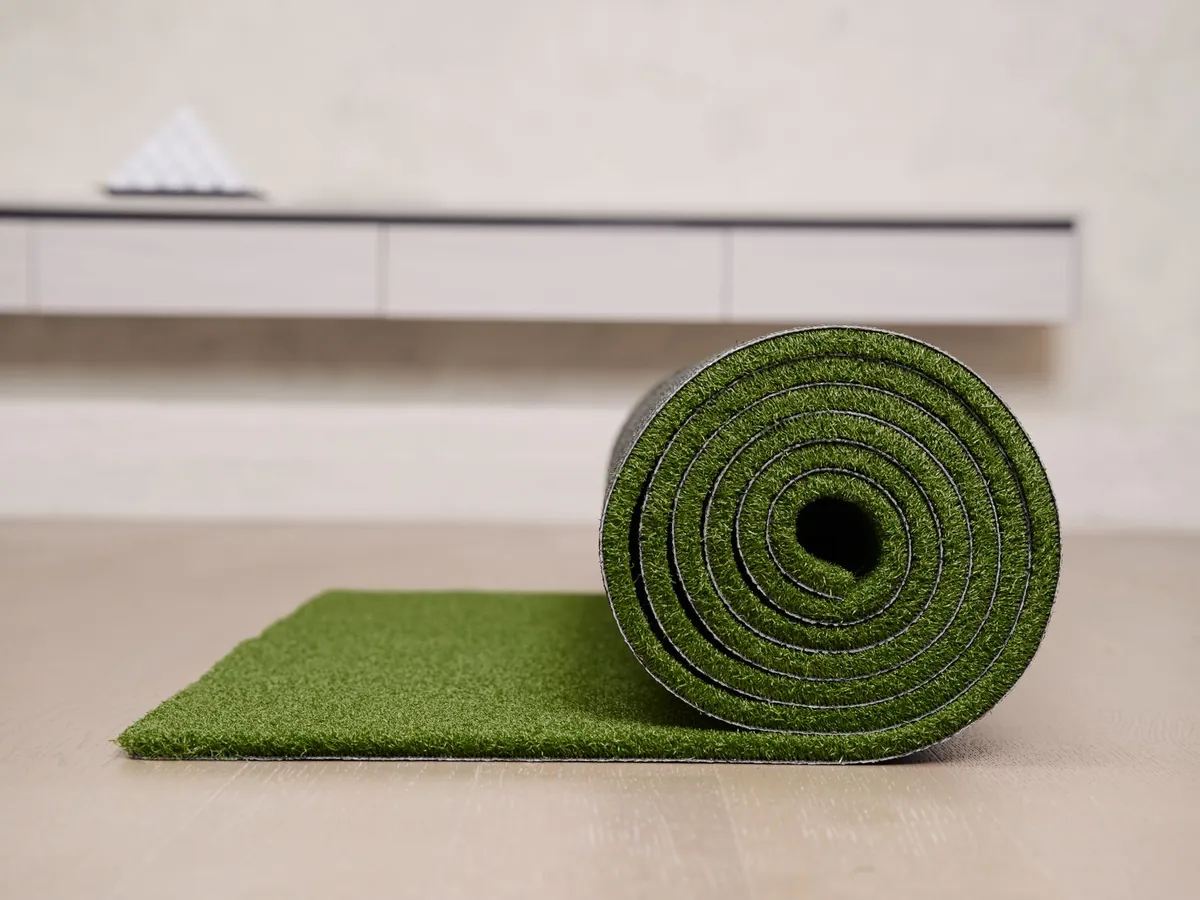
Short answer: not if you roll it correctly. The damage comes from folding or rolling surface-in, which lets the backing set a permanent “memory” crease that no amount of flattening fully removes.
Roll loosely with the putting surface facing outward, and stand the roll upright in a dry, temperature-stable space. Wrinkles from shipping relax in sun for one to two hours as the backing softens and the fibres stand up.
The fibre and backing behaviour under repeated rolling is the part no seller explains well. A dimensionally stable, non-porous backing such as PU resists curl memory, which is why backing choice is not cosmetic. A latex coating is more prone to the shrinkage and wrinkling that pulls a roll out of flat. See the quality factors that keep turf true for the full picture.
Roll it right: never fold; roll loosely, surface out; store dry and upright. A correct roll stays true for seasons. A folded green keeps its crease for good.
For the physics of how synthetic surfaces are built and behave, the entry on how synthetic turf surfaces are built and behave is a useful neutral reference.
Match Pile and Backing to Your Room
Pile that putts true sits in the 10–16 mm band, and both that height and the backing are selectable when you order. Match them to the room: a roll you move weekly wants a stable PU backing that resists curl memory; a bay that stays down can take denser, heavier turf.
Not sure a roll will stay true?
Tell us your room size and how often you roll it; we match pile and backing to that use and send a 20 x 20 cm sample of the spec.
Storing and Moving a Portable Green
Storage is where portables win or lose. A 25 m roll, rolled on a core, becomes a cylinder roughly 25–35 cm in diameter and as long as the roll width. That fits a closet upright but not a drawer. A fixed artificial turf installation stays down all season; a portable roll must come up and go back without taking a set.
The diameter is an estimate from roll length and an assumed 2–4 mm carpet-plus-backing thickness, not a measured product figure. Treat it as planning guidance, not a guarantee.
For transport, a 4 m by 25 m roll is the bulkier format; a 2 m roll is easier to move through a doorway but covers less per piece. Match the width to how you will carry and store it.
Rolls and Ready-Made Mats Compared
Two formats compete for the same corner. A roll is turf you cut and seam yourself, while a ready-made mat is fixed in size and feel. Lighter roll-up mats are easier to carry but can compromise feel and stability.
Rolls win on size and seam control, while mats win on instant setup. Neither is “best” outside its use case.
For a multi-bay display or a club that grows the space, rolls scale cleanly. See how a putting course differs when one green becomes several.
Keeping an Indoor Green Rolling True
Care is simple but specific. Vacuum with suction only and the beater bar off, or you will fray the fibres. Brush against the grain to lift them, then with the grain to lay them for a fast, even roll.
Dust is the silent speed killer. A quick vacuum and brush regularly holds the roll; a periodic deep clean keeps the surface looking new. No water, no mower, no chemicals.
Learn how to keep the surface clean indoors so the green stays true between sessions and the ball never develops that tell-tale wobble.
Häufig gestellte Fragen
Wird das Aufrollen eines Putting Greens ihn ruinieren?
Nein, wenn Sie es locker mit der Oberfläche nach außen rollen und niemals falten. Beim Falten oder Rollen mit der Oberfläche nach innen bildet die Rückseite eine dauerhafte Knittermarke. Ein trockener, aufrechter und temperaturstabiler Lagerort hält die Rolle zwischen den Nutzungen in Form.
Wie groß sollte ein Raum für ein Putting-Grün sein?
Planen Sie für Ihren längsten Putt sowie Stand- und Backswing-Freiraum genug Platz ein. Eine 8-Fuß-Matte passt in einen kleinen Nebenraum, während eine 9-Fuß-6-Matte mehr offene Fläche benötigt. Ein 3 m × 4 m großer Bereich deckt eine nahtlose 12 m²-Rolle ab.
Wie schnell rollt ein portables Putting-Grün?
Die Geschwindigkeit hängt von der Florhöhe und der Fasersteifigkeit ab, nicht vom Format. Bei einer Florhöhe von etwa 10–16 mm mit dichten, steifen Fasern rollt der Ball schneller, und bei Rollenware legt die werkseitige Spezifikation die Geschwindigkeit fest. Private Grüns zielen normalerweise auf einen Stimp-Wert von 9–11 ab, eine neutrale Industriebewertung.
Can you put a putting green on carpet?
Yes, on a flat, clean carpet, but avoid deep pile and inspect for bumps first. The floor tolerance is about 3 mm over 2–3 m; anything beyond that deflects the roll. A thin underlay can steady an uneven surface.
How should I store a portable green between seasons?
Roll it loosely, surface out, and stand it upright in a dry, temperature-stable space. A 25 m roll stores as a 25–35 cm diameter cylinder (an estimate from roll length and assumed thickness) that fits a closet, not a drawer.


 German
  English
  Arabic
  French
  Portuguese
  Russian
  Spanish