








A portable putting green earns its place when the weather shuts the course and the short game still needs work. We build artificial grass rolls on our own line, so the question we hear most is blunt: will a roll I can put away actually putt true?
The honest answer is that a portable putting green works when three things line up: room size, floor flatness, and storage that does not wreck the roll. Below is the verdict buyers actually need, not a brochure.
When a Portable Putting Green Actually Works
A portable green is the right call for winter practice, a clubhouse corner, or a retail display that must pack away after a show. It solves the “course is closed” problem without committing floor space year round.
It is the wrong call when you want sculpted breaks, a regulation contour, or a surface tuned weekly. Those belong to a fixed build. Know which problem you are solving before you order turf.
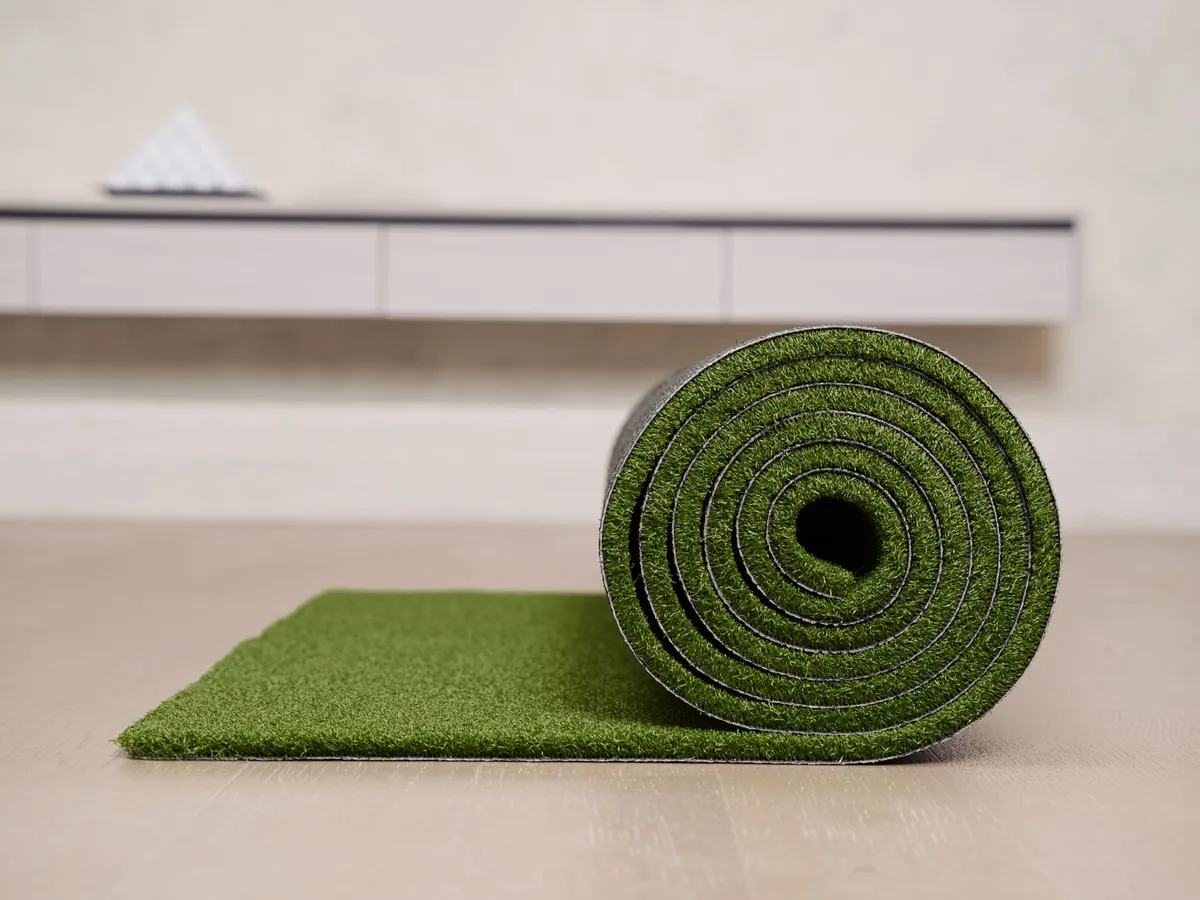
Our putting green turf range covers a 3 m by 4 m room with a single no-seam cut, and the same roll serves a showroom bay or a home office. Selection starts with the room, not the catalogue. A roll you can walk away from is the one feature a fixed build can never offer.
What You Give Up Versus a Built Green
The trade is real, and it is worth stating plainly. A portable roll gives you convenience and a true-enough roll; a built green gives you speed control and contour you cannot reproduce on a rolled mat. If your floor and commitment both allow it, you can still build a fixed green instead. A fixed artificial turf installation earns its cost only when you want contour and weekly speed tuning.
| Dimension | Portable roll | Built green |
|---|---|---|
| Speed ceiling | Set by the spec you order, commonly Stimp 9–11 | Tunable with infill; tour-grade nylon reaches Stimp 12.5 |
| Break and contour | Flat roll, no sculpted break | Slopes and cups engineered into the base |
| Base requirement | Lays on your existing floor | Excavated, compacted sub-base |
| Speed adjustment | Set at the factory | Top-dressed over the green’s life |
| Portability | Rolls away for storage | Permanent, single location |
| Service life | Set by handling and storage | Built for years of outdoor use |
None of this makes a portable roll inferior. It makes it a different tool, aimed at repetition and convenience rather than tournament replication.
How Flat Does Your Floor Need to Be?
This is the question every search misses. A fixed artificial turf installation is judged on a compacted sub-base, roughly 90-plus percent density and about 95 percent for stability. Your portable roll has no sub-base; it sits on the room floor as it is.
The relevant tolerance is the flooring standard, not the turf spec: about 3 mm of deviation over a 2–3 m span. Anything past that and the ball drifts, because the roll follows the floor beneath it. A permanent artificial turf installation hides a poor floor behind a compacted sub-base; a portable roll has no such cushion.
Carpet, tile or sealed concrete all work if they are flat and dry. A thin underlay can steady a slightly uneven slab, but it cannot fix a wavy floor. Measure before you commit to a size.
Sizing a Room for Real Putts
A mat length is not a room size. Size the room to your longest putt plus your stance and backswing clearance, then add a meter for comfort.
A short mat around 8 ft fits a spare bedroom corner. A 9 ft 6 in mat needs a clearer run and a wider stance arc, so it rules out tight spaces. Think in putts, not product codes. Measure the longest putt you practice, then add a metre for stance and backswing.
For a 3 m by 4 m room, a 4 m-wide roll cut to 3 m yields one 12 m² piece with no seam. A 2 m roll would need two strips joined, so 4 m width is the cleaner choice for a 3–4 m room.
Predicting Speed From Pile and Fibre
Speed is not mysterious once you read the spec. Lower, stiffer pile rolls faster, and a dense, upright fibre keeps the ball riding high instead of dragging.
Most home greens target a Stimp of 9–11, a neutral industry speed rating measured by the same ramp device courses use. Tour-grade nylon can reach 10–12.5, but a 12-plus surface punishes a weak stroke.
Pile for putting sits near 10–16 mm; landscape turf at 25–37 mm is far too tall to roll true. Read the published Stimp, pile and fibre before y