
Relyir Grass
Factory-direct artificial grass since 2006 — full customization, samples and fast quotes.
Sports Turf Systems
12 mm dense turf for gym flooring, sled lanes and functional training areas. Factory-direct from Relyir since 2006.

Why Specify Dense Short-Pile Turf for Gyms
Modern functional fitness gyms need a surface that handles extreme abuse — weighted sleds, dropped barbells, sprint intervals — while remaining comfortable for burpees, lunges and floor exercises. Artificial grass bridges this gap where rubber tiles and bare concrete fall short.
Sled push and pull exercises drag hundreds of kilograms across the surface. Gym Grass is built with dense, short curly pile that resists fiber tearing and matting under this load, maintaining a smooth track session after session.
The same turf that handles a loaded sled also cushions hands and knees during burpees, planks and crawling drills. The 12 mm pile over a rubber underlay delivers the balance of firmness and give that bodyweight exercises require.
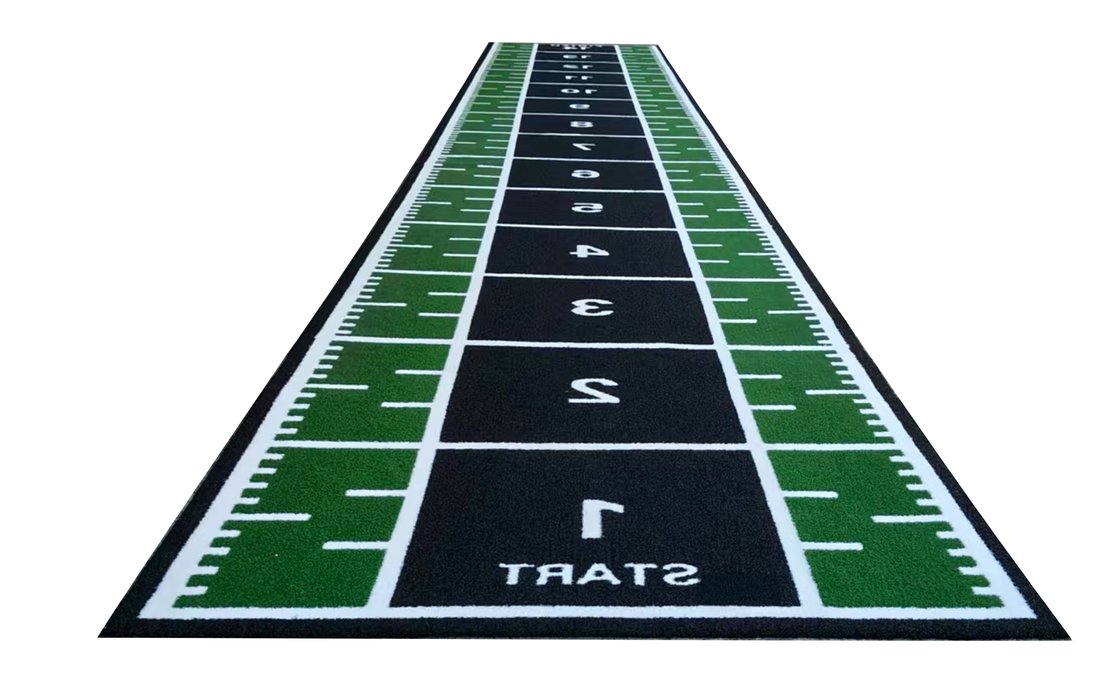
Gym turf zones define functional training areas visually and create a professional look that sets the facility apart. Distance markings and gym logos can be tufted directly into the carpet during production for branded training zones.
Product Range
Gym turf has one enemy: abrasion. Sleds and loaded carries abrade a surface far faster than any ball, so we specify for wear first and comfort second.
Performance Design
Traditional gym flooring forces a compromise. Rubber tiles handle dropped weights but shred under sled friction. Bare concrete handles sleds but destroys joints and creates noise. Foam mats cushion bodyweight work but tear under equipment drag. Gym turf eliminates this compromise by delivering all three requirements from a single surface.
Gym Grass uses a short, dense curly pile that sits at the intersection of durability and comfort. The high fiber density distributes sled-runner abrasion across thousands of contact points — preventing the wear channels that form in less dense products after weeks of heavy sled training.
At the same time, the short pile and PE monofilament construction create a surface that cushions hands, knees and elbows during floor exercises without being so soft that it destabilizes standing lifts or sprint starts.
Installation uses PU adhesive to bond the turf to a clean concrete subfloor, and the optional PU backing upgrade adds moisture resistance for facilities that mop frequently. No infill is used, keeping the surface clean and eliminating the bacteria-trapping granules that create odor issues in gym environments.
For gym chains outfitting multiple locations, the consistency of factory-direct supply means every facility gets the same pile height, density and color — roll after roll, order after order.
Factory Direct from Jiangsu
Relyir has manufactured artificial grass in Jiangsu since 2006. Every step — from raw PE pellets to finished rolls — runs on-site, which is how we control quality and hold pricing 30–50% below international equivalents.
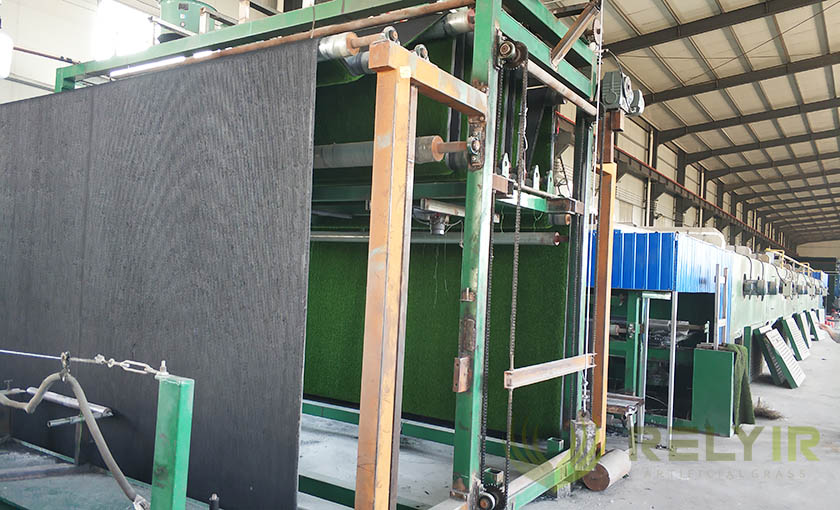
All eight production stages are managed in-house, eliminating the quality gaps that arise when compounding, tufting and coating happen in separate facilities. The automated sports turf line, commissioned in 2015, lifted production capacity by 150% and tightened consistency across high-volume orders.
Customization is built into the line: blade density, pile height and fiber colors are adjusted to each project’s specification, with PP + net and PU backing options. The export team has shipped to more than 500 customers across 50+ countries since 2009 and handles all documentation — from commercial invoices to certificates of origin.
Every order is produced to specification — pile height, density, blade shape and color, backing composition and roll dimensions are all configured to your project requirements.
System Build-Up
Gym turf installation is straightforward — bond to a clean concrete floor and secure the edges. The simplicity of the system is part of its appeal for gym operators.
Clean, dry, level concrete. Any cracks or uneven areas are filled and ground smooth before installation. Subfloor condition directly affects adhesion and sled travel.
A thin rubber or foam pad adds impact absorption for plyometric exercises and reduces noise transmission to spaces below the gym floor.
PU adhesive bonds the turf to the subfloor across the entire area, preventing shifting under sled loads and lateral foot forces during training.
Perimeter edges are secured with adhesive and transition strips at junctions with rubber flooring or other gym surfaces. Distance markings complete the installation.
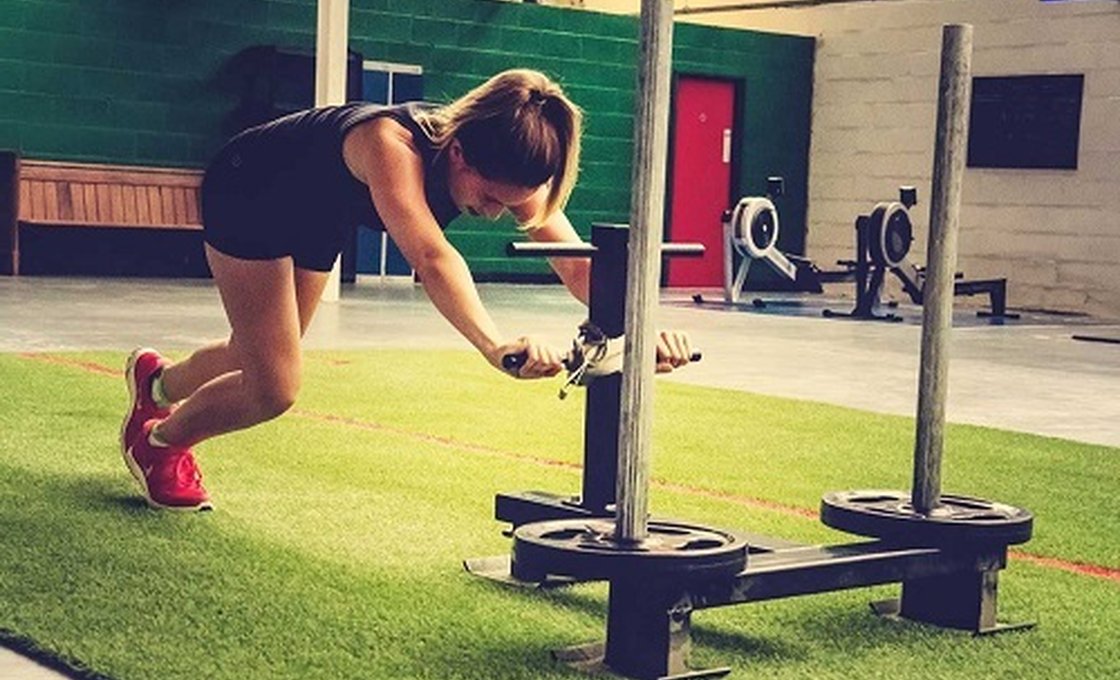
Gym Grass delivers the density to handle daily sled work while remaining comfortable for bodyweight movements. The no-infill installation keeps the facility clean and easy to maintain between sessions.
Gym turf is chosen by face weight, pile height and backing more than by looks. Sled work demands a short, extremely dense pile with strong fiber anchorage so sled runners glide without digging; agility and conditioning zones favor slightly taller fibers for foot grip. Face weight — the amount of yarn per square meter — is the single best indicator of how a track will survive years of sled runners and weighted implements.
Most sled-track installations use a low pile — around 10–15 mm — dense enough that sled runners ride on top of the surface. A slightly higher pile is fine for pure agility zones where foot grip matters more than sled speed.
Yes. Colors, lane markings, logos and sprint distances are produced to order, which is why training facilities use the track itself as part of their branding.
Yes. Gym Grass is purpose-built for high-wear applications including sled push and pull. The dense, short pile resists tearing and matting under heavy loads. For dedicated sled lanes, see our sled turf page.
Yes. The 12 mm pile provides cushioning for burpees, planks and crawling exercises without being so soft that it destabilizes standing lifts. For areas where extra cushion is preferred, a rubber underlay can be added beneath the turf.
Regular vacuuming or sweeping for dust and debris. Occasional damp mopping for sweat and spills. The no-infill system means there is no rubber granule to redistribute or replace — maintenance is comparable to rubber gym flooring.
Yes. Installation requires a clean concrete subfloor, PU adhesive and seam tape. Rolls are laid out, trimmed to fit, seams taped and glued, and perimeter edges secured. We provide installation guidance with every order.
Yes. Distance markings, measurement lines and gym logos can be tufted directly into the carpet during production. This is a popular option for CrossFit affiliates and commercial gym chains that want branded training zones.
Standard rolls are 4 × 25 m or 2 × 25 m with a maximum width of 5 m. Custom widths and lengths can be arranged for specific gym layouts. Full datasheets are provided with your quotation.
Yes. Samples are free of charge — you only cover the shipping. Standard swatches are 20 × 20 cm and we typically send three to four models per project so you can compare pile heights and colors side by side. Standard samples ship via DHL or FedEx within 4–6 days; custom-matched samples add 10–15 days of production.
Yes. Choose between two options: delivered to your destination port, with export customs clearance in China, international ocean freight and cargo insurance included in one all-inclusive cost; or delivered to a Chinese port if you prefer to work with your own freight forwarder. Other delivery arrangements can be accommodated on request.
Orders range from single rolls for smaller installations to full container loads for large developments. Roll sizes of 2 m, 4 m and 5 m widths (25 m length) cover most layouts, and custom dimensions are produced to order. Volume pricing applies as order size increases.
Send your training zone dimensions and usage plan. Our export team replies with model recommendations, specification sheets and factory-direct pricing within 12 hours — typically 30–50% below international equivalents..
 English
  Arabic
  French
  German
  Portuguese
  Russian
  Spanish