
Relyir Grass
Factory-direct artificial grass since 2006 — full customization, samples and fast quotes.
Sports Turf Systems
12 mm heavy-duty turf engineered for sled push and pull training. Factory-direct from Relyir — 20 years of sports turf manufacturing.
Why Specify Ultra-Dense Short Pile for Sled Lanes
Sled turf serves a specific purpose: a dedicated lane for pushing and pulling weighted sleds. The surface must reduce friction enough for smooth sled travel while remaining tough enough to resist abrasion from the sled runners — session after session, year after year.
Short pile (12 mm) at 52,500 tufts/m² creates a smooth, firm surface that lets sled runners glide without catching. The turf is short enough to prevent the sled from sinking but dense enough to provide cushion underfoot for the athlete.
A busy gym sled lane may see hundreds of loaded passes per day. PE monofilament at 52,500 tufts/m² distributes the abrasion across a dense fiber field, preventing the wear channels that develop in less dense products under continuous sled traffic.
While the sled needs low friction, the athlete needs grip. The turf surface provides enough traction for aggressive push-off and stable footing during pull exercises — without the excessive rotational resistance that could strain joints during directional changes.
Product Range
Sled training is the harshest use any turf sees: concentrated load dragged repeatedly over the same line. Wear resistance is the whole specification.
Every Relyir surface is extruded, tufted and coated in our own plant, so the specification above is a starting point, not a catalogue limit. Send us your sport, level of play and sub-base and we will engineer the pile height, gauge, yarn, backing and infill around it.
Request a QuotePerformance Design
Sled training is one of the most surface-demanding activities in functional fitness. The sled itself needs a low-friction path to glide smoothly, while the athlete pushing or pulling it needs firm grip underfoot. Generic gym flooring fails in both directions — rubber tiles tear under sled runners, and bare concrete provides no cushion for the athlete’s joints.
A purpose-built sled surface addresses both requirements: a short pile keeps the sled runner riding on top of the fibers rather than sinking into them, while the extreme density distributes abrasion across enough fiber contact points to prevent wear-through.
Sled turf is typically installed as a narrow strip — 1–2 m wide and 10–20 m long — running the length of the training area. This format also doubles as a sprint lane and agility training area when the sled is not in use.
Different sled designs create different wear patterns. Push sleds with flat runners, pull sleds with rope attachments, and wheeled tank sleds all interact with the surface differently. The 52,500 tufts/m² density handles all three sled types, though flat runners and wheeled sleds create less concentrated wear than narrow metal runners.
No infill is used on sled turf — the short pile stands upright on its own at this density, and an infill-free surface ensures smooth, consistent sled travel without granule displacement under the runner.
Factory Direct from Jiangsu
Relyir has manufactured artificial grass in Jiangsu since 2006. Every step — from raw PE pellets to finished rolls — runs on-site, which is how we control quality and hold pricing 30–50% below international equivalents.
All eight production stages are managed in-house, eliminating the quality gaps that arise when compounding, tufting and coating happen in separate facilities. The automated sports turf line, commissioned in 2015, lifted production capacity by 150% and tightened consistency across high-volume orders.
Customization is built into the line: blade density, pile height and fiber colors are adjusted to each project’s specification, with PP + net and PU backing options. The export team has shipped to more than 500 customers across 50+ countries since 2009 and handles all documentation — from commercial invoices to certificates of origin.
Every order is produced to specification — pile height, density, blade shape and color, backing composition and roll dimensions are all configured to your project requirements.
System Build-Up
Sled turf installation is straightforward — bond the turf to the gym floor and secure the edges. No infill is used, keeping the strip clean and low-maintenance.
Clean, dry concrete is the standard base. Any surface irregularities are filled and smoothed — bumps under a sled lane create friction points that affect sled travel and athlete safety.
Rolls are cut to the strip width (typically 1–2 m) and laid along the training lane. Seams are minimized by using full-width rolls where possible.
PU adhesive bonds the turf to the subfloor. Full bonding is essential — any loose area will lift under sled runners and create a tripping hazard.
Distance markers can be tufted into the turf during production or painted after installation. Tufted markings last the life of the carpet and do not wear off under sled traffic.
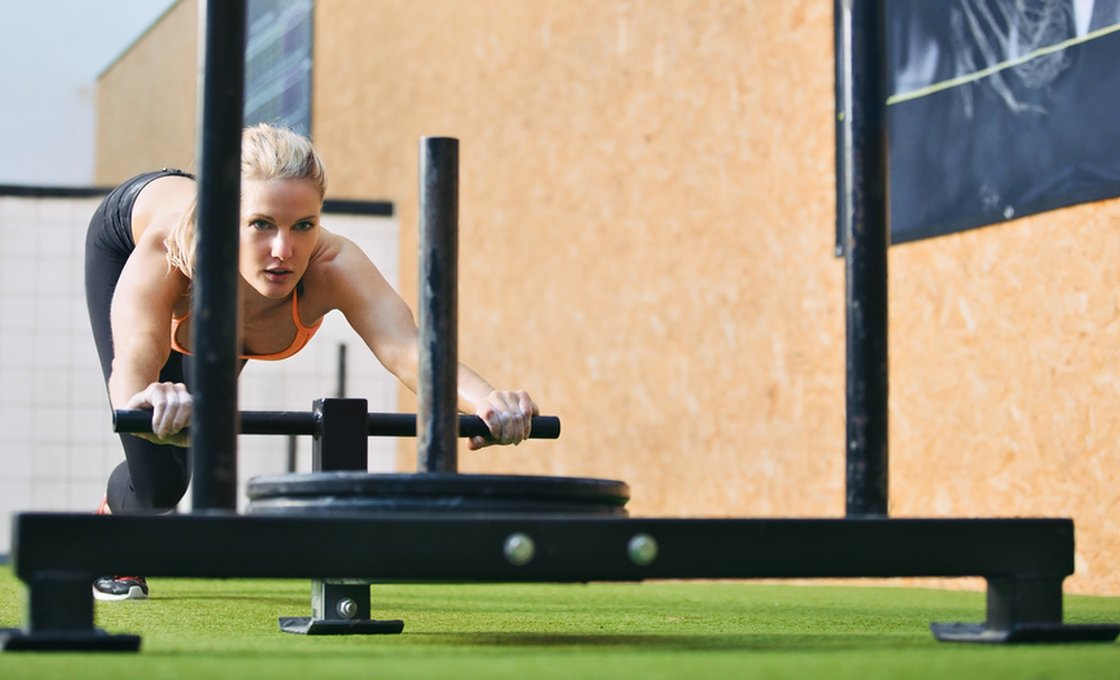
Generic gym flooring fails in sled lanes — rubber tiles tear, bare concrete destroys sled runners. Our made-to-order sled turf provides the specific friction profile sled training demands: low enough for smooth sled travel, dense enough to survive thousands of loaded passes.
Synthetic sledding surfaces give resorts and parks a tubing or sled run that operates without snow: a purpose-made low-friction turf is installed on the prepared slope, and venues keep it slick with light water application in warm months. Commercial installations specify by slope length, lane count and throughput — the surface has to survive thousands of tube runs per season, which is where fiber density and seam strength carry the investment.
The low-friction surface is sprayed with a fine mist of water in warm weather to restore glide; in freezing months it runs on frost or snow as-is. Resorts use the same run year-round instead of closing between seasons.
Commercial runs are engineered to the site — slope, run-out length and lane count are the design variables, and the surface is produced to the layout. Send us the hill’s dimensions and expected throughput and we will spec the system.
They can use the same product — our short-pile sled surface works for both. The difference is in the installation format: sled turf is typically a narrow strip (1–2 m wide) optimized for sled travel, while gym turf covers a wider training zone. See our gym turf page for wider-area applications.
Standard sled strips are 1–2 m wide, which accommodates most push and pull sleds with room for the athlete alongside. We supply rolls in 2 m and 4 m widths — a 2 m roll works as a single strip, while a 4 m roll can be cut into two strips.
Sled runners create wear, but the 52,500 tufts/m² density distributes abrasion across a large number of fibers. Flat runners and wheeled tank sleds create less wear than narrow metal runners. Rotating the sled’s position on the strip periodically extends turf life.
No. Sled turf is installed without infill. The short 12 mm pile stands upright on its own at 52,500 tufts/m², and an infill-free surface ensures smooth, consistent sled travel without granule displacement.
Absolutely. The same surface properties that make the turf suitable for sled work — firm grip underfoot, short pile for speed — make it ideal for sprint intervals, shuttle runs and agility ladder drills.
Standard rolls are 4 × 25 m or 2 × 25 m with a maximum width of 5 m. Custom widths and distance markings can be arranged on request. Full datasheets are provided with your quotation.
Yes. Samples are free of charge — you only cover the shipping. Standard swatches are 20 × 20 cm and we typically send three to four models per project so you can compare pile heights and colors side by side. Standard samples ship via DHL or FedEx within 4–6 days; custom-matched samples add 10–15 days of production.
Yes. Choose between two options: delivered to your destination port, with export customs clearance in China, international ocean freight and cargo insurance included in one all-inclusive cost; or delivered to a Chinese port if you prefer to work with your own freight forwarder. Other delivery arrangements can be accommodated on request.
Orders range from single rolls for smaller installations to full container loads for large developments. Roll sizes of 2 m, 4 m and 5 m widths (25 m length) cover most layouts, and custom dimensions are produced to order. Volume pricing applies as order size increases.
Send your lane dimensions and quantity. Our export team replies with model recommendations, specification sheets and factory-direct pricing within 12 hours — typically 30–50% below international equivalents..
 English
  Arabic
  French
  German
  Portuguese
  Russian
  Spanish