
Relyir Grass
Factory-direct artificial grass since 2006 — full customization, samples and fast quotes.
Sports Turf Systems
12–25 mm turf systems for indoor training facilities and multi-sport halls. Factory-direct from Relyir — 20 years of manufacturing.
Why Specify Short-Pile Turf for Indoor Facilities
Indoor sports turf operates in a controlled environment but faces its own set of challenges — high-frequency use on a fixed footprint, hygiene requirements, and the need for a surface that accommodates diverse training activities without rubber infill.
Indoor facilities host batting cages, fielding practice, sprint drills, agility ladders and conditioning work — sometimes all in the same session. Short-pile turf at 12 mm provides a versatile, cleat-friendly surface that handles every activity without surface changes.
Rubber infill traps sweat, bacteria and odor in enclosed spaces. Our 12 mm pile at 52,500 tufts/m² stands upright without infill support, and the surface can be vacuumed or mopped like any other indoor flooring — keeping the facility clean between sessions.
Indoor facilities run every day without weather downtime. The ultra-dense fiber construction distributes wear across 52,500 tufts/m², preventing the visible wear paths and fiber breakdown that develop in less dense products under continuous indoor use.
Product Range
Indoors the spec changes: no UV load, no drainage requirement, but far more scrutiny on slip resistance, acoustics and behaviour on a sprung sub-base.
Every Relyir surface is extruded, tufted and coated in our own plant, so the specification above is a starting point, not a catalogue limit. Send us your sport, level of play and sub-base and we will engineer the pile height, gauge, yarn, backing and infill around it.
Request a QuotePerformance Design
Indoor sports turf is not simply outdoor turf moved inside. The controlled environment eliminates drainage and UV concerns but introduces new requirements — fire classification, acoustic dampening, hygiene maintenance, and compatibility with HVAC systems. Every specification decision starts from these indoor-specific factors.
The 15 mm pile of Quest KDK 1525 is specified for indoor use because its 52,500 tufts/m² density holds fibers upright without infill. This is critical: infill in an indoor facility creates cleaning challenges, traps moisture and bacteria, and can migrate into adjacent flooring areas. A no-infill system eliminates all three problems.
For facilities where a slightly softer surface is preferred — youth training areas or multi-use zones where floor exercises complement sport-specific drills — our 15 mm court pile, with optional underlay, provides extra cushion while still functioning without heavy infill.
Installation over concrete uses PU adhesive for full bonding or perimeter-only fixing for semi-permanent setups in leased facilities. A rubber underlay adds impact absorption and reduces noise transmission — important in multi-use buildings where sports share space with offices or classrooms.
Indoor facilities must also meet local fire codes. We provide material composition data and testing documentation for your fire safety assessment. PE monofilament turf with PP backing is evaluated under standard fire classification methods.
Factory Direct from Jiangsu
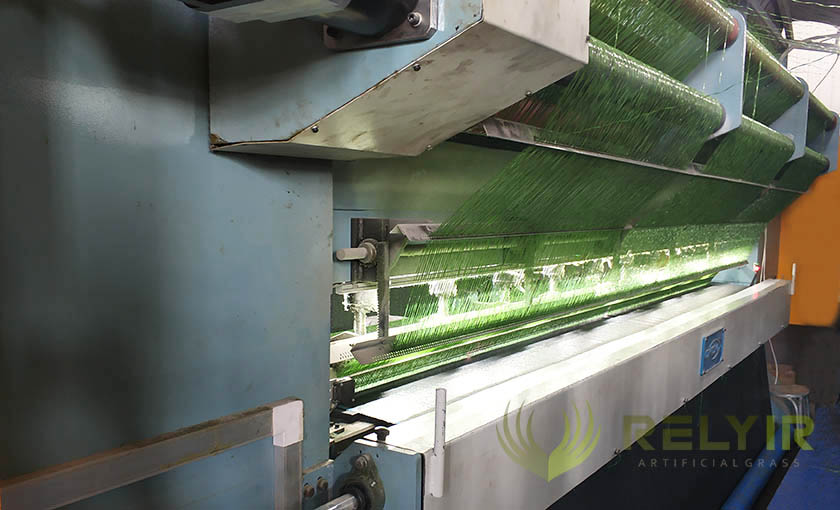
Relyir has manufactured artificial grass in Jiangsu since 2006. Every step — from raw PE pellets to finished rolls — runs on-site, which is how we control quality and hold pricing 30–50% below international equivalents.
All eight production stages are managed in-house, eliminating the quality gaps that arise when compounding, tufting and coating happen in separate facilities. The automated sports turf line, commissioned in 2015, lifted production capacity by 150% and tightened consistency across high-volume orders.
Customization is built into the line: blade density, pile height and fiber colors are adjusted to each project’s specification, with PP + net and PU backing options. The export team has shipped to more than 500 customers across 50+ countries since 2009 and handles all documentation — from commercial invoices to certificates of origin.
Every order is produced to specification — pile height, density, blade shape and color, backing composition and roll dimensions are all configured to your project requirements.
System Build-Up
Indoor installation is simpler than outdoor — no drainage base required — but has specific requirements around adhesion, hygiene and edge finishing.
A clean, level concrete subfloor is the standard base. The surface must be free of dust and moisture for proper adhesive bonding.
A rubber or foam underlay adds impact absorption and acoustic dampening. Recommended where plyometric or agility training is a primary activity.
Rolls are seamed with tape and PU adhesive. Perimeter edges are secured to prevent lifting under cleat traffic. The installation can be fully bonded or perimeter-fixed for semi-permanent setups.
The turf is installed without infill for hygiene and cleaning ease. A light sand dressing may be used where extra fiber stability is needed in specific zones.
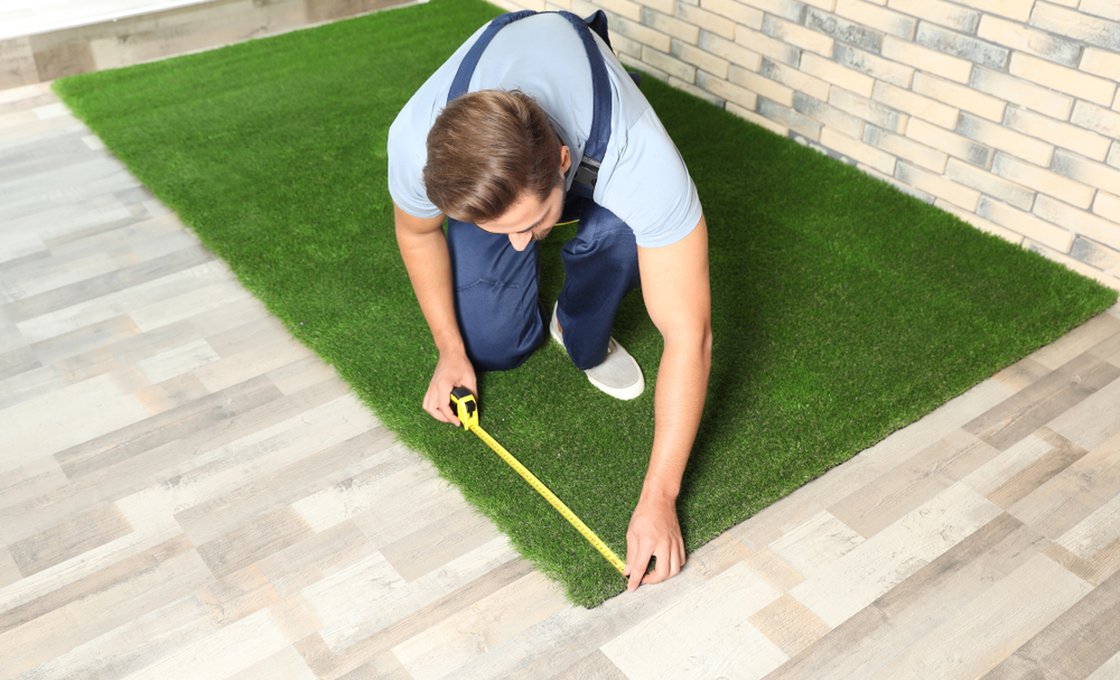
Indoor sports turf faces constant foot traffic in a confined space. Our Quest KDK 1525 at 52,500 tufts/m² delivers the density to hold up under daily use, while the no-infill installation keeps the facility clean and easy to maintain between sessions.
Indoor facilities buy turf to make floor space programmable: one surface serves batting cages, agility lanes, strength zones and youth training on the same day. Indoors there is no rain-out and no UV degradation, so the product choice shifts toward face weight and seam quality — the two things that determine how the surface survives rolling equipment and daily reconfiguration. Low-pile, dense products dominate because they suit both shoes and sleds.
UV stabilization matters less, while fire code compliance, seam quality and pile density matter more. Indoor surfaces also need to tolerate rolling goals, batting cages and partitions being moved across them daily.
Usually yes. Indoor turf commonly installs directly over concrete with adhesive or a foam underlay, and low-pile products keep door thresholds and equipment ramps manageable.
No. Indoor turf is typically installed without infill for hygiene and ease of cleaning. The short, dense pile (12 mm at 52,500 tufts/m²) stands upright without infill support. A light sand dressing may be used where extra stability is needed in specific zones.
Yes. Indoor turf can be bonded to concrete, plywood or existing hard flooring with PU adhesive. For semi-permanent installations (leased facilities, seasonal setups), perimeter-only fixing allows the turf to be removed later.
Regular vacuuming or sweeping removes dust and debris. Spills can be mopped with water and mild detergent. The no-infill installation means there are no granules to redistribute or replace during cleaning.
Yes. Short-pile turf at 12 mm provides a low-friction surface for sled push and pull exercises. See our sled turf page for more detail on dedicated training-strip specifications.
Indoor facilities must meet local fire codes. We provide material composition data and testing documentation for your fire safety assessment. PE monofilament turf with PP backing is evaluated under standard fire classification methods.
Yes. Indoor facilities often need turf cut to specific zone dimensions — batting lanes, agility strips, fielding circles. We supply rolls in standard widths (2 m or 4 m) and can pre-cut to your layout plan, or supply full rolls for on-site cutting.
Yes. Samples are free of charge — you only cover the shipping. Standard swatches are 20 × 20 cm and we typically send three to four models per project so you can compare pile heights and colors side by side. Standard samples ship via DHL or FedEx within 4–6 days; custom-matched samples add 10–15 days of production.
Yes. Choose between two options: delivered to your destination port, with export customs clearance in China, international ocean freight and cargo insurance included in one all-inclusive cost; or delivered to a Chinese port if you prefer to work with your own freight forwarder. Other delivery arrangements can be accommodated on request.
Orders range from single rolls for smaller installations to full container loads for large developments. Roll sizes of 2 m, 4 m and 5 m widths (25 m length) cover most layouts, and custom dimensions are produced to order. Volume pricing applies as order size increases.
Send your facility dimensions and training zone layout. Our export team replies with model recommendations, specification sheets and factory-direct pricing within 12 hours — typically 30–50% below international equivalents..
 English
  Arabic
  French
  German
  Portuguese
  Russian
  Spanish