
A gridiron turf specification usually fails the same way. The geometry is written on one page and the surface performance on another. Nobody merges them into a single signable document. Acceptance then reports a G-Max over the limit or an infill weight that does not reconcile, on an installed field.
American football field turf specifications belong in one chain: envelope, markings, pile height, density, infill, backing, impact attenuation and acceptance. We tuft and coat turf rolls on our own line, so we read that chain from the carpet outward on any artificial turf installation. This page covers gridiron fields only, and points to sister pages where another axis is already covered.
Why Gridiron Turf Is Not Just Short Soccer Turf
Treating a gridiron surface as a shortened soccer spec is the first mistake to correct. The field is 120 yards long overall, made of a 100-yard playing field plus two 10-yard end zones, and 53 1/3 yards wide. A soccer pitch is wider and shorter, so the two envelopes rarely map onto each other.
Play also produces a different load profile. Helmets strike the surface, linemen push off repeatedly at close range, and a three-point stance concentrates pressure on a small patch of fibre. Cleats then ask for an explosive change of direction. Football and lacrosse are therefore specified at 1.5 to 1.75 inches of pile, against 2 to 2.25 inches for soccer.
Acceptance is a third difference. College rules govern artificial surfaces through impact attenuation, skin abrasion resistance and rotational resistance, assessed by third-party testing rather than fibre count. A spec that lists yarn numbers and stops there cannot be verified. We keep the wider football turf spec checklist for the general football axis, and this page stays on gridiron. Stadium inventories and raw grass-versus-turf player data sit on separate pages, because neither one fixes a roll specification.
What Field Dimensions and Markings Must Be Fixed
Geometry is the first input to american football field turf specifications, ahead of any carpet number on an artificial turf installation. Yard lines cross the width every 5 yards and are numbered every 10 yards. Hash marks are short 1-yard segments set 70 feet 9 inches from each sideline at the professional level, and every play starts on or between them.
Three rule sets decide the rows below. A high school field sets hash marks 53 feet 4 inches from each sideline, and 53 feet 4 inches apart. College hash marks sit 60 feet from each sideline, 40 feet apart. Professional hash marks sit 70 feet 9 inches from each sideline, the tightest spacing of any level.
Goal posts sit at the centre of the end line with a 10-foot crossbar and uprights 18 feet 6 inches apart. College numbers stand nine feet tall, 12 yards in from the sideline. The table maps where each level departs.
| Abmessungen | NFL / professional | NCAA / college | NFHS / high school |
|---|---|---|---|
| Feldabmessungen | 120 yd x 53 1/3 yd | same | same |
| Struktur | 100 yd field plus two 10 yd end zones | same | same |
| Hash mark from sideline | 70 ft 9 in | 60 Fuß | 53 ft 4 in |
| Hash mark spacing | 18 ft 6 in | 40 ft | 53 ft 4 in |
| Hash mark length | 2 ft | — | — |
| Goal-post crossbar | 10 ft | 10 ft | 10 ft |
| Uprights apart | 18 ft 6 in | 18 ft 6 in | 23 ft 4 in |
| Upright above bar | at least 35 ft | at least 30 ft | at least 20 ft |
| Yard-line numbers | — | 9 ft tall, 12 yd in | — |
Two areas come out of the same envelope, and the spec has to name one. Including both end zones, the surface is 57,600 square feet, about 5,351 square metres. Excluding them, the playing field alone is 48,000 square feet, about 4,459 square metres. That difference decides the roll order, so put the chosen number in writing. The soccer pitch size references for comparison follow a different convention, which is one more reason to state the gridiron envelope explicitly.
How Hash Marks and Goal Posts Change Layout
Hash-mark position is the next input to american football field turf specifications. Subtract the two offsets from the 160-foot field width and the working band appears. It is 18.5 feet at the professional level, 40 feet in college and 53.33 feet in high school. A narrow band pushes more plays through one corridor, so marking accuracy matters more there.
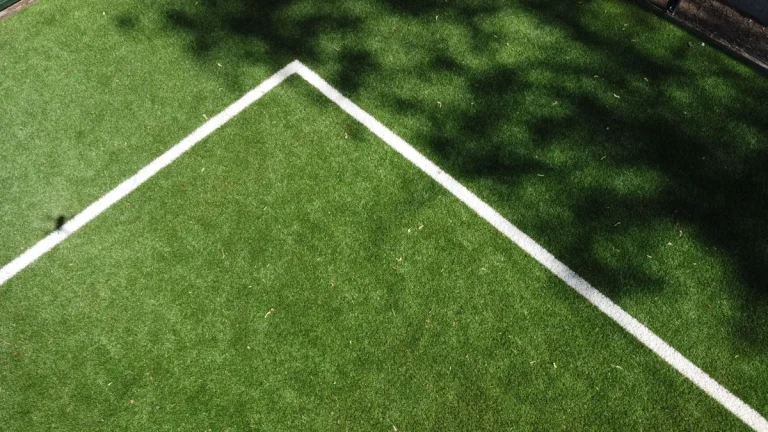
Yard lines and hash marks are line-segment markings, not area markings. A yard line crosses the full width every 5 yards, while a hash mark is a short segment every 1 yard. Inlaid line work is estimated by segment count, segment length and line width, and white turf comes in smaller rolls for that cut length.
Goal posts stand at the centre of the end line, with the crossbar 10 feet above the ground. The end line sits 10 yards behind the goal line, so the end zone is a 10-yard strip of turf. Upright bases and the safety area around them take part of that strip out of play.
Which Pile Height and Density Suit Gridiron Play
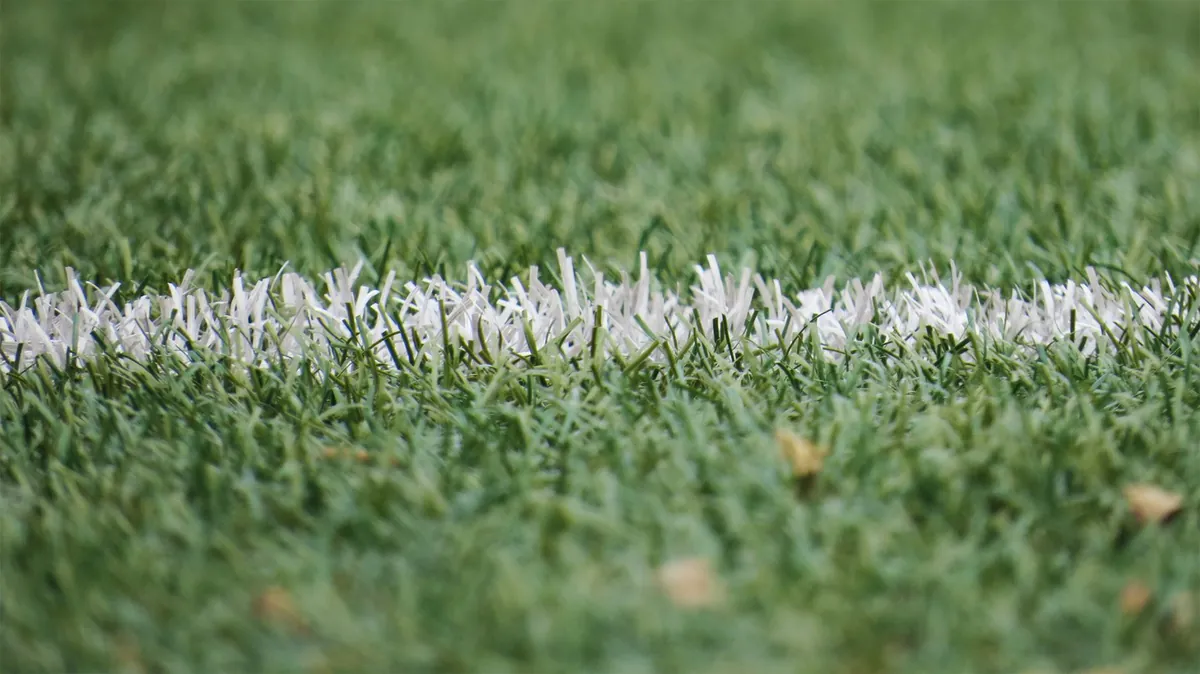
Pile height is the next line in american football field turf specifications, and on any artificial turf installation it is a load decision, not a taste one. Football and lacrosse sit at 1.5 to 1.75 inches so cleats bite and direction changes stay sharp. Soccer runs 2 to 2.25 inches so the ball rolls smoothly, and a multi-sport field settles in the middle. Heavy-traffic programmes are often advised to pair 1.25 to 1.75 inches of pile with a face weight of 70 ounces or more.
Published systems show the same spread. One multi-use specification lists 2.0 inches of pile, 46 ounces per square yard of face weight and 74 ounces per square yard in total. A gridiron system is published at 60 mm of pile over a 25 to 35 mm elastic layer.
| Use or sport | Flornappehöhe | Flächengewicht und Dichte | Main trade-off |
|---|---|---|---|
| Gridiron, lacrosse | 1.5 to 1.75 in | heavy-traffic guide 70 oz or more | cleat grip and hard cuts |
| Soccer | 2 to 2.25 in | published multi-use system, 46 oz face | smooth ball roll |
| Multi-sport | mid-range | same published 2.0 in system | compromise on both |
| Published gridiron build | 60 mm | 25, 30 or 35 mm elastic layer | thicker build |
| Published supplier variants | 40, 50, 55 or 60 mm | 5/8 in gauge, 140 stitches per m | covers several duties |
| Published 49 mm system | 49 mm | 185 stitches per m, 11,655 tufts per sq m | density is counted |
Read the table as a duty rating, not a ranking: the short-pile row trades ball roll for grip. how fibre, infill and backing specs are built is therefore a project question, because catalog pile heights and face weights are nominal.
What Infill Type and Depth Should Be Specified
Infill is the paragraph most specifications skate over. High-purity silica sand runs above 90 percent purity. SBR crumb rubber comes from recycled tyres. Organic blends mix about 10 to 15 percent cork or coconut with 85 to 90 percent sand. Each changes how the surface cushions, drains and settles over a season.
| Füllmaterialtyp | Rolle | Common load | Main risk |
|---|---|---|---|
| Silica sand above 90 percent purity | ballast and fibre support | 25 to 30 kg per sq m | hard surface if under-filled |
| SBR crumb rubber | cushioning and elastic response | 6 to 9 kg per sq m | migration and segregation |
| Sand plus rubber blend | ballast and cushion | published 1/2 in sand with SBR | ratio hides total weight |
| Organic cork or coconut with sand | softer feel, lower heat | 10 to 15 percent organic, 85 to 90 percent sand | low stability, decomposes |
| Total system weight | what acceptance checks | 6 lb per sq ft minimum | depth alone does not prove weight |
Two minimums belong in the written american football field turf specifications. Infill depth on an artificial turf installation should not fall below 1.5 inches for contact sports, and infill weight should not fall below 6 pounds per square foot. Converted, 1.5 inches is 38.1 mm, about 64 percent of a 60 mm pile, leaving roughly 22 mm of exposed fibre. On the full envelope, 6 pounds per square foot comes to about 157 tonnes.
Ratios and percentages hide the number that matters: a 70/30 rubber-to-sand ratio never states total system weight. Require the infill weight in the product specification sheet, in writing. how infill quantity is calculated follows from that weight, not from depth alone.
Specification check: a minimum depth of 1.5 inches with no weight attached can be met on day one and lost by year two. Write the infill weight, not the ratio.
Does PU or Latex Backing Change Under Load
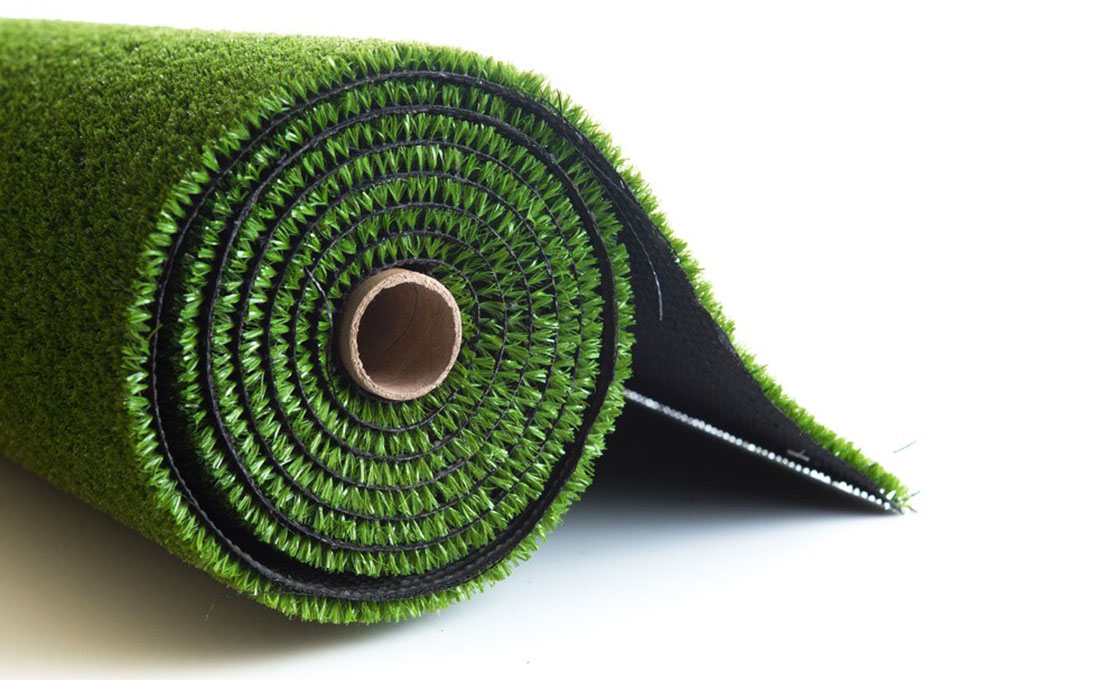
Backing carries the load underfoot. Football turf commonly uses a dual structure: a latex layer for flexibility plus a polyurethane layer for strength and weather resistance. Perforations through the backing let water leave the surface.
A heavy face weight and a deep infill load put more tension on every seam in an artificial turf installation. That is where a polyurethane-coated primary backing earns its place, because seam strength is what holds the strips together. One competition multi-use system specifies a dual-layer perforated backing with exactly that coating. The choice between latex versus PU backing systems shows up at the seam, where the load concentrates.
Write the backing as a construction, not a label. A bare PU line says nothing about perforation pattern, coating weight or the primary cloth. Published examples include a 1/2 inch gauge system and a PP cloth reinforced with netting and coated with SBR latex.
How G-Max and Shock Attenuation Are Specified
Impact testing is where two methods get confused. One standard drops a 9.1 kg missile from 610 mm and reports G-Max. The Clegg Impact Soil Tester drops 2.25 kg from 455 mm and is the reference method for natural turf. The two scales are not interchangeable, and published regression work puts the relationship near F355 times 0.66 minus 9.3.
For american football field turf specifications, the table below must be pinned down before bids are compared. Each row carries a method, a number and a level of use, because a value without its test method cannot be judged.
| Kriterium | Methode | Wert | Gilt für |
|---|---|---|---|
| ASTM F1936 upper limit | ASTM F355 drop test | 200 G-Max | the accepted ceiling |
| Synthetic Turf Council Empfehlung | ASTM F355 | not above 164 | a stricter owner target |
| Field-monitoring guidance | ASTM F355 | below 165 | programmes wanting margin |
| College-referenced target | ASTM F355 | about 150 | cited guidance for sports fields |
| Professional game-day rule | Clegg Impact Tester | below 100 at every location | before each game |
| Professional product test | STRIKE impact tester | 45 g to 90 g peak g | submitted systems, official event |
| Natural grass reference | ASTM F355 | about 85, or 42 Clegg | the comparison baseline |
Three rules decide which row applies. Match the criterion to the level of play, to the body that signs acceptance, and to whether a shock pad sits under the carpet. A shock pad moves a field from the 140 to 160 band down into the 90 to 110 band.
Testing is not a one-off: a field is measured on installation and then at least once a year. Each visit takes three drops at each of ten locations. A single drop above the standard puts the field in need of maintenance. G-Max rises with use, compaction and infill segregation, and remediation runs from an infill top-off in two to three days to sectional replacement in two to three weeks. how G-Max testing protects players is only half the picture, because a second sport on the same carpet disturbs the same load path.
Regulatory note: 200 G-Max is a floor for acceptance, not a design target. Programmes that want margin specify a lower number.
Specify Gridiron Turf Rolls to Match Your Field
Spec sheet open and not sure which roll fits?
Send the field envelope and the infill depth you must hit. Then see the gridiron roll specs built to your pile height, density, backing and width.
Can One Field Serve Soccer and Football
Gridiron co-field decisions sit inside american football field turf specifications, and both the load path and the marking set change when a second sport is added. One surface can serve both games, but the turf envelope on the artificial turf installation has to grow to make room. how multi-sport turf specs are written starts with that footprint. A gridiron field is longer and a soccer pitch is wider, so the shared surface is sized to hold both sets of boundaries inside the carpet. Published multi-use projects report envelopes of 210,000 to 230,000 square feet.
Markings are where the conflict becomes visible. Soccer 11-a-side lines are white, small-sided formats take a secondary colour, and gridiron markings take a third. The centre line and centre circle compete with the 50-yard line. Penalty areas and goal areas overlap the end zones and the goal-post landing zone.
| Konflikt | Why it fights | Order of resolution | Consequence |
|---|---|---|---|
| Centre line and circle against 50-yard line | both want the middle of the field | name the primary sport first | the secondary line is offset |
| Penalty and goal areas against end zone and post base | box markings sit in the end zone | fix the primary sport, then the marking list | a line crosses a landing zone |
| Two sets of sidelines at each end | both pairs must stay parallel | enlarge the envelope, or share an edge | the field plays crowded at the ends |
| Line width against safety margin | wider lines eat the run-off | set line width before the envelope | less clear space outside the line |
| Two-tone or three-tone markings | each sport needs a colour | fix the colour hierarchy at design stage | lines cannot be told apart |
The resolution order is fixed: choose the primary sport, set the colour hierarchy, then choose between inlaid and painted lines. Inlaid lines are contrast-colour turf cut, seamed and glued in. They last well, but they become the weakest points of the carpet if the seaming is poor, while painted lines fade faster. Adding a sport after the infill is installed is a rebuild of the marking set, not a touch-up. A third-party published range puts each extra sport’s inlaid lines at about USD 0.30 to 0.50 per square foot.
Two published thresholds help size the shared surface. Organised contact play is often advised to include a 20 mm shock pad under the backing, which holds the padded band of 90 to 110 G-Max.
What Drainage and Base the Surface Demands
Base and drainage come before the carpet, and on an artificial turf installation they set limits the carpet cannot undo. Envelope dimensions and finished levels fix the direction the rolls run, which in turn fixes strip count and seam count. Water that cannot leave the base keeps the infill wet, and wet infill compacts and segregates.
That compaction is what pushes G-Max upward over a season. Once the reading climbs, remediation starts with an infill top-off that takes two to three days and can end with sectional replacement that takes two to three weeks. A compacted stone base of 4 to 8 inches and a perforated backing keep water moving through the system.
Writing the responsibility line avoids most disputes. The sub-base and drainage belong to the base contractor and the installation team, while the roll supplier answers for the roll. A specification should name who completes measurement and acceptance before material is laid. Published guidance states that the sub-base does more for a field’s lifespan than any single line on the data sheet. Base, infill, pad and installation together run comparable to the turf material itself.
Scope note: record the base and drainage conditions the surface assumes, so acceptance can check them against the finished field.
How to Write and Verify the Turf Specification
A signable version of american football field turf specifications fixes six lines and leaves nothing to interpretation. Write the field envelope, with or without the end zones. List the primary sport and every shared sport, then pile height and face weight. State infill type and total infill weight, never a ratio. State backing construction, perforation, the impact criterion and who tests it.
Acceptance is a schedule, not a signature. Test on installation and then at least once a year, and treat one drop above the limit as a maintenance trigger. A written once-a-year routine is described as unlikely to hold up in a liability case, so keep the readings on file.
| Line to write | Warum es wichtig ist | Who verifies |
|---|---|---|
| Field envelope, with or without end zones | drives area, roll count and line length | owner and installer |
| Primary sport and shared-sport list | fixes the marking set before infill goes in | design team |
| Pile height and face weight | sets grip, ball roll and traffic tolerance | specifier and supplier |
| Infill type and total weight | weight, not ratio, is the acceptance number | testing party |
| Backing construction and perforation | governs seam strength and drainage | supplier and installer |
| Impact criterion and test method | one number needs one method behind it | third-party test house |

Roll-side checks can be done without instruments: confirm width, strip count, seam count, texture direction and roll area against the order. Base and installation items are signed off separately. For ordering, a 48.8 m field width takes 10 strips and 9 seams in 5 m rolls. The same width takes 13 strips and 12 seams in 4 m rolls, and 25 strips and 24 seams in 2 m rolls. The full envelope needs 43, 54 or 108 whole rolls across those widths, while the playing field alone needs 36, 45 or 90.
A published reference puts an 11-a-side soccer field of 105 by 68 m with 12 cm lines at about 100 square metres of white inlaid turf. Line work is quoted by cut length on an artificial turf installation, not by field area. Gridiron lines run every 5 yards with hash marks every yard, so that cut length has to be counted, not estimated.
Häufig gestellte Fragen
Welche Florhöhe wird für American-Football-Rasen verwendet?
Gridiron-Felder werden üblicherweise mit einer Pilehöhe von 1,5 bis 1,75 Zoll angegeben. Die kürzere Faser gibt den Stollen Griff und hält Schnitte scharf, oft bei einem Flächengewicht von 70 Unzen oder mehr.
Wie viel Füllmaterial für Kunstrasenplätze wird für ein Gridiron-Feld benötigt?
Two minimums apply: a depth of 1.5 inches and a weight of 6 pounds per square foot. Across a 57,600 square foot envelope, that weight reaches about 157 tonnes.
What G-Max should a football field turf meet?
The ASTM F1936 ceiling is 200 G-Max on the F355 drop test. Stricter published targets sit at 164 to 165, and professional game-day rules require every location below 100 on the Clegg tester.
Can soccer and American football share one turf field?
Yes, if the envelope is enlarged so both boundaries sit inside the carpet. Published multi-use envelopes run 210,000 to 230,000 square feet, and each extra sport adds marking cost.
How are hash marks and yard lines marked on artificial turf?
Yard lines cross the full width every 5 yards, and hash marks are short segments every 1 yard. Both are inlaid as contrast-colour turf cut, seamed and glued in.
How many turf rolls does a full gridiron field need?
The full envelope takes about 43 rolls in 5 m by 25 m, 54 in 4 m and 108 in 2 m. The 100-yard field alone takes 36, 45 or 90.


 German
  English
  Arabic
  French
  Portuguese
  Russian
  Spanish