








Three quotes for the same pitch can land six figures apart, and every number in them can still be honest. The usual reason is that each bidder priced a different system wearing the same name. One quoted a sand-filled short-pile carpet, one a long-pile field with rubber crumb, one added a shock pad and a premium infill. Reading enquiries for artificial grass sports fields at our spec desk, we see this mismatch every week.
The way out is to read the system the way a factory spec desk does. What is the carpet physically, which sport must it serve, and what will it cost to buy and to run. Infill, base layers and shock pads enter here as selection topics, because those decisions move budgets harder than most brochures admit. Every figure in this article comes from published third-party research, and each one carries its own source qualifier.
What Counts as a Sports Field Turf System
When a supplier says field, they mean a stack, not a roll of green carpet. Read from the ground up, the system is a compacted subgrade, then a crushed-stone aggregate base of roughly 4-10 inches. Above that sit an optional shock pad, a perforated backing, the fibers themselves, and a granular infill settled between the blades. The layering comes from one installer guide’s construction breakdown, and it explains why two carpets with identical specs can behave differently once laid.
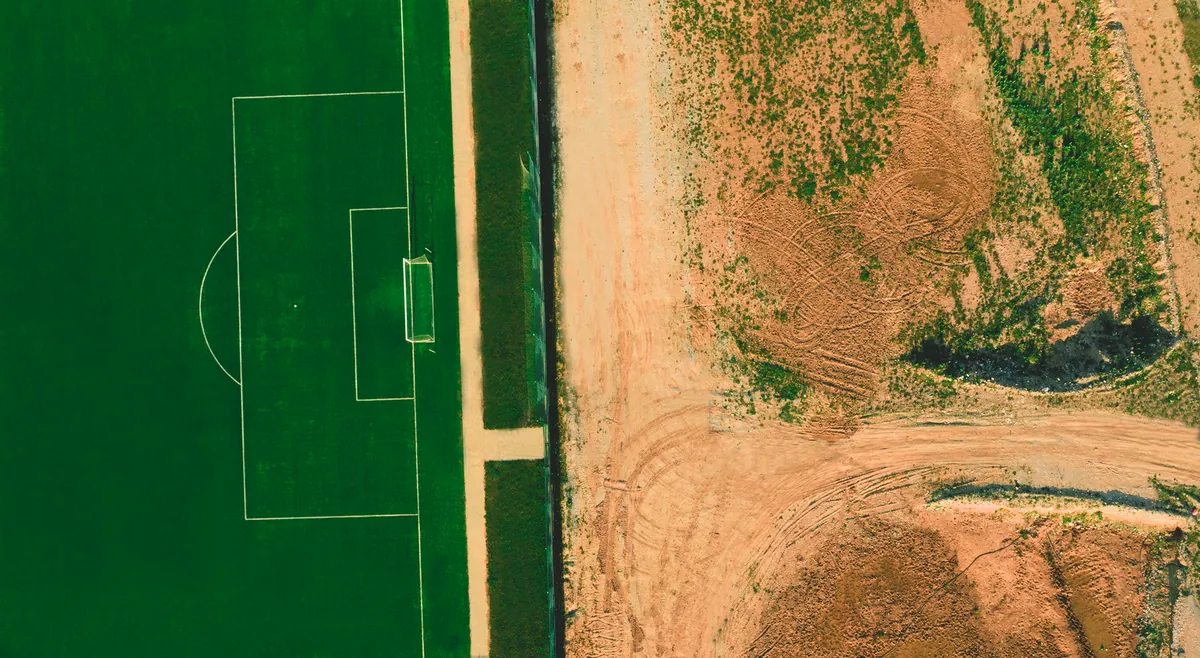
Yarn choice is where field systems separate themselves from landscape roll. Sports yarns across the industry use polyethylene, polypropylene or polyamide, and the common field recipe pairs a polyethylene monofilament face with a polypropylene thatch layer. Fiber shape then decides recovery: spined monofilaments in C, S and diamond profiles stand back up after cleats compress them. Flat blades, by contrast, lie down within a season or two, which is why shopping on face weight alone is a mistake. Where one surface must serve several codes, purpose-built multi-sport turf options for shared fields simplify the whole decision.
Backing choices in practice come down to PP+Net and PU, and whichever is specified has to survive grooming passes and water exposure for the life of the carpet. Roll logistics are the quiet cost lever on big fields. Standard rolls run 2 m, 4 m or 5 m across and 25 m long, with tailor-made widths available for large areas such as sports fields. Wider rolls mean fewer seams across a full-size pitch, and fewer seams mean fewer joints to check and re-dress every year. On artificial grass sports fields, seam count is a maintenance line item long before it is an aesthetic one.
A field carpet spec sheet should read like an order form. Pile height, yarn polymer and shape, density, backing composition and roll width are all made to order in this industry, so every one of those lines should carry a number. A vague sheet is a warning sign in itself, and it is where two quotes for the same field quietly become two different products.
Turf Generations: 2G, 3G and Non-Fill
Generation labels get heavy marketing use, and on artificial grass sports fields they mostly sort into four physical system types that government and industry guidance describes precisely. Knowing the vocabulary keeps quotations comparable, because a 2G pitch and a 3G pitch are different products that both happen to be green. Our dedicated comparison post covers how 2G and 3G pitches differ in practice in depth.
The Four System Types, Defined
- 2G sand-filled: a typically 18-25 mm open pile with sand maintained to within 2-3 mm of the fiber tips, a durable and cost-effective multi-sport surface per the SAPIA industry code.
- 3G long pile: 35-70 mm, with sand keeping fibers upright and crumb infill meeting performance requirements; crumb has commonly been rubber, with cork and coconut fibre alternatives now developing, per the NSW government guideline.
- Long-pile non-fill: 35-70 mm using different yarn blends without performance crumb; the guideline’s own wording says these surfaces are in early stages of development and have not yet been recognised by sport governing bodies.
- Needle-punch: 8-16 mm carpets for multi-use fields and playgrounds, sand-filled after installation, per the same industry code.
Choosing between them comes down to sport priority and budget. A 2G carpet serves shared community use at the lowest rung of the cost ladder. A 3G field serves code-driven match play, while needle-punch serves schools that need one carpet for everything a school calendar throws at it. The practical habit is to pick the surface for the highest-priority sport first, then confirm the secondary codes still play acceptably on it. A surface chosen for everyone usually serves nobody well.
Around the carpet itself, shock pads are supplied as flat rolls or interlocking tiles generally 10-23 mm thick, with type and thickness dictated by the priority sport. Across the whole market, the pile spectrum runs from about 10 mm tennis surfaces to 60 mm football and rugby. Hybrid fields sit at the boundary of the type list: synthetic patches reinforce wear zones such as goal mouths without replacing the whole natural field.
Marketing generation numbers can outrun what governing bodies have actually validated. A brochure calling a surface fourth generation does not make it recognised for match play, so ask what a system is validated for, not what the label says.
Pile Height by Sport: The Selection Matrix
Sport decides pile height more than any other line in the specification. An industry spectrum runs from about 10 mm tennis surfaces to 60 mm football and rugby. That span leaves most codes needing their own band, and vendor catalogues rarely publish the full picture. The matrix below is carried verbatim from the NSW government guideline for decision makers.