








Blades flatten, seams begin to show, and the usual suspect is the turf itself. In most cases the grass never moved – the sand did. Owners blame the carpet while the real story runs underneath: granules have migrated away, blades have lost their support, and the backing starts to read through a thinning surface.
The question sounds simple – what is artificial turf infill – yet the answer decides whether a lawn stands up or lies down. We supply the carpet side of that partnership, so this guide explains the invisible half: what the granules do and what their absence looks like.
What Infill Actually Is and Where It Sits
Start with the definition, because everything else follows from it. Health authorities define what is artificial turf infill as one or more granular materials worked between the fibres during installation, per the NY State Department of Health. Every word in that sentence does work: granular, between the fibres, installed rather than laid on top.
The Layer Map Under Your Feet
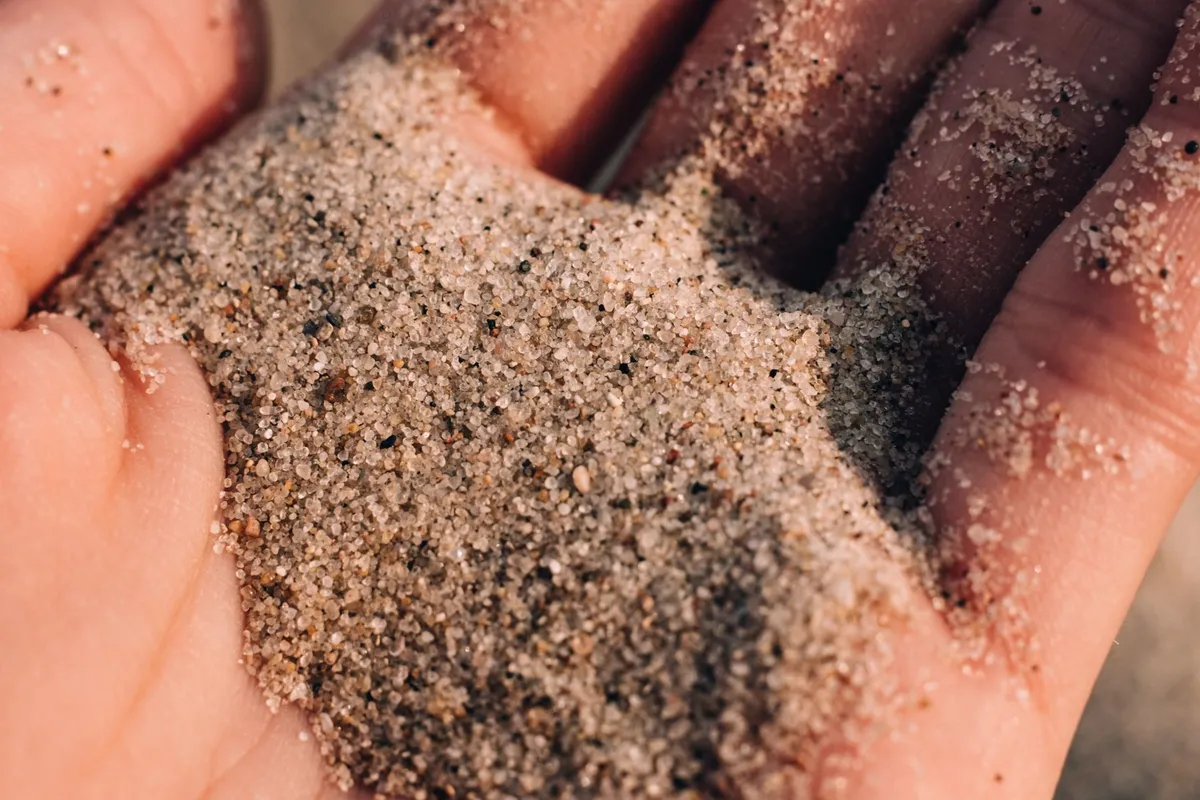
Picture the build from the top down. Grass fibres are stitched into a carpet backing, and the granular fill sits between those fibres. Beneath the backing lies an optional shock pad, and a compacted base carries drainage below that. The fill is the only layer that lives inside the carpet rather than under it, which is why it behaves as part of the grass rather than an accessory underneath.
Two Jobs, One Word
Governing bodies split the role in two. Per the World Rugby surfaces guidance, a modern system names performance infill for play characteristics and stabilising infill for structure. Both layers sit above the carpet backing and below the fibre tips. The distinction matters because one granule type rarely does both well – which is why materials exist as a family rather than a single product.
Why Plastic Blades Cannot Stand Alone: Four Jobs
Plastic is not grass. A polyethylene blade has no root, no sap and no stiffness of its own, so the system borrows engineering from elsewhere. Per the Sport and Recreation Victoria artificial grass guide, the fill carries a defined list of duties. It props the pile upright, ballasts the carpet down, cushions play and passes loads into the base.
Standing Upright: The Size Match
A blade stays vertical only while granules pack tightly around its base. The fibre’s width and the particle’s size have to couple – coarse fill around a fine fibre leaves gaps, fine fill around a heavy fibre packs loose. When grading matches the fibre, particles shear-stack into a dense ring that props each blade individually.
Absorbing Impact by Spreading It Sideways
When a foot lands, the granule bed converts vertical impact forces into horizontal energy dispersion. The load travels outward through particle contact instead of concentrating under the landing point. That spreading is why a filled field feels softer than the same carpet empty. Cushioning and support are therefore the same mechanism read from two directions.