








On a Thursday evening, a high school midfielder sets up for the hundredth rep of the week in the family backyard. The lawn in front of the goal has worn through to bare dirt, so every ground ball takes a different hop. Shots that used to come back clean now skid, sit down or squirt sideways. A midfielder can cover four to five miles in a single game, and most of that conditioning gets built in sessions exactly like this one. When the surface lies, the practice hours quietly stop counting.
A backyard lacrosse training area solves the volume problem only when the surface plays honest, and honest means repeatable bounce, predictable footing and drainage that does not end the session. We build artificial grass rolls on our own line, from yarn extrusion through tufting to coating. So we judge a surface the way we judge a batch: by what it does after months of hard use. In our experience, the surface is the first piece of training equipment in the yard, ahead of the goal and the rebounder.
Why Backyard Lacrosse Training Areas Fail Grass
Grass fails backyard lacrosse for a simple reason: the sport concentrates wear into a few square metres. Repeated cutting and pushing in front of the crease turns turf into uneven dirt patches, and the first rain turns those patches into mud. Ground balls then bounce unpredictably, which is hard on knees during cutting drills and worse for training quality.
| Measure | Worn natural lawn | Purpose-built turf |
|---|---|---|
| Surface after a season of shooting practice | Uneven dirt patches in front of the goal | The same profile every session |
| After rain | Mud, or cancelled sessions | Drains 30+ in/hr on a properly graded base |
| Ground-ball behaviour | Unpredictable hops off bare spots | Consistent, repeatable bounce |
| Traction | Whatever the weather leaves behind | Blade shape and infill tuned to the grip-cushion balance |
| Upkeep | Mowing, watering, reseeding | Brushing, infill checks, periodic cleaning |
Ball speed raises the stakes. The fastest recorded shot sits at 119.9 mph, and even youth shots arrive quickly enough that surface feedback has to be honest. The traction trade-off is real: too slick can mean slips, too grabby can be tough on knees and ankles. That trade-off is why artificial turf installations for lacrosse are tuned differently from landscape lawns.
Interest is climbing too: lacrosse sixes joins the Olympic programme in 2028, and more families now treat home practice space as infrastructure rather than decoration.
Sizing and Orienting a Backyard Lacrosse Training Area
The smallest viable floor for solo practice runs roughly 20 yards by 15 yards. That floor leaves room for a regulation goal, a rebounder set back at a realistic shooting distance, and lateral space for off-angle shots. In metric terms the same floor runs about 18.3 by 13.7 metres, near 250 square metres.
Orientation comes next, and it costs nothing to get right. A goal that faces the late-afternoon sun turns evening sessions into squinting practice, so set the shooting direction away from the low sun. Ball containment is the third decision: netting that keeps balls in the yard protects training density, because every ball over the fence is a rep lost to retrieval.
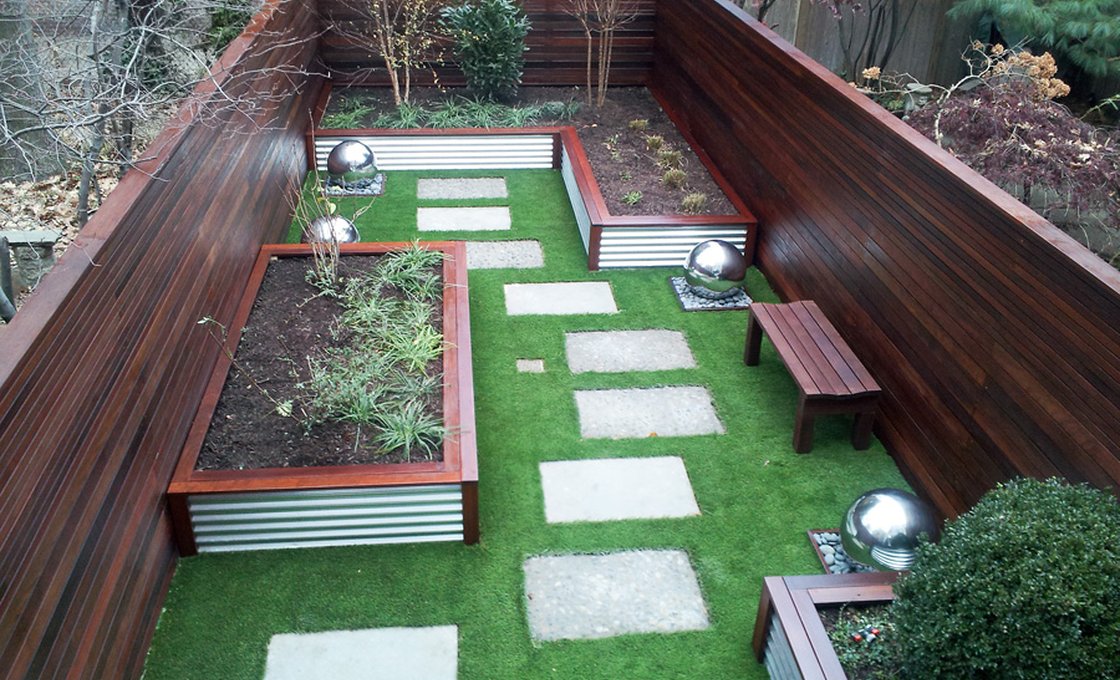
One working layout looks like this. Adjust each zone to the yard, then walk it with a ball before anything is ordered.
| Zone | Role | Footprint guide |
|---|---|---|
| Goal and shooting zone | Regulation 6 by 6 goal with 7 ft depth, plus a shooting arc | Depth of the frame plus room to shoot from varied angles |
| Rebounder lane | Adjustable rebound net set at varied angles for pass-and-catch rhythm | Representative strike zones run 7 by 4 feet with multi-angle settings |
| Agility and footwork lane | Marked lane for shuffles, ladders and short sprints | Runs the long side of the area |
| Containment margin | Netting or cleared margin so balls stay in play | Full perimeter of the training area |
| Whole-area floor | All of the above together | About 20 yd by 15 yd, roughly 18.3 m by 13.7 m |
Specifying Turf That Survives Lacrosse Play
Modern surfaces descend from third-generation systems: longer fibres, sand infill and, in many builds, recycled crumb rubber on top. That architecture exists because a face without support flattens and plays dead. For lacrosse, published specs for artificial turf installations point to a pile height of 1.75 to 2.0 inches. That band, roughly 45 to 50 mm, balances firm feedback with cushioning.
Blade shape, infill and markings follow the same logic. Diamond, V-shape or W-shape profiles hold up under pivots and sprints, and a sand-and-rubber infill mix supports the fibres while cooling infill options take the edge off hot climates. Boundary and crease markings can be inlaid in contrasting colours. Roll widths of 2, 4 or 5 metres by 25 metres let most layouts run seams only at the edges. Review the roll widths and roll construction before you fix a layout, and match the face to a sports artificial grass systems brief rather than a landscaping one.