

Most homeowners picture a backyard putting course as one larger green. We see the same mistake on the factory floor: a single sheet of turf, one cup, and practice that goes stale after two rounds.
A real course is three connected surfaces, not a bigger green. Our line builds turf by the roll, so we watch how pile height, grain and routing turn a flat yard into a training route.
Split the Yard Into Three Surfaces
A putting course is a route made of three ground types: a smooth green, a slightly longer fringe, and an approach that plays longer. Treat it as one big green and every hole feels identical.
The fringe stops the ball at the edge of the green and gives you a chipping surface. The approach adds a longer shot in, so a single backyard putting course holds far more practice than one open sheet.
Real courses separate these zones on purpose. We design each one as a separate roll, because one pile height cannot give you a true putt, a checked chip and a running approach at the same time. Most first builds start as a single green and grow into a course.
Routing a Course That Flows
Routing is how players move from one cup to the next without walking back over the same grass. Good routing is the difference between a course and a scattered set of holes.
Use the awkward parts of the yard. Narrow side strips become approach corridors, and a corner can hide a dogleg that makes a short hole feel long. A single green can hold one hole well; a course needs several joined by routing.
Give each hole its own character. Vary the length and shape, and route around existing contours instead of spacing cups in a neat row.
Start the route at the widest point and finish near the door. Walk the plan once and count the turns. A course that returns players to the start without retracing a putt line is working as intended.
Three checks keep a route honest. First, place each green so the walk to the next tee is shorter than the walk back to the first cup. Second, keep cups at least 6-8 feet apart and away from the collar. Third, keep the narrow side strips as approach corridors instead of cutting extra green turf into them.

Variety is the second half of routing. Use three or four distinct putting stations on the plan, such as a flat approach, a right-to-left breaker, a downhill slider and a subtle uphill putt. Repetition trains nothing; pattern recognition needs contrast.
After ball speed, routing is where backyard layouts most often go wrong. A course that flows rewards a small yard more than a large flat one with evenly spaced cups.
The Three-Zone Turf Ladder Explained
The turf ladder sets a different pile height for each zone. The putting green gets the shortest, densest pile, while the fringe and the approach each get a longer band of their own.
One artificial turf installation that mixes zones will not roll true. We cut each zone as its own roll so the ball reads a firm green, a checked fringe and a running approach.
| Zone | Pile height | Role on the course | Typical use | Published source |
|---|---|---|---|---|
| Putting green | 10-16 mm | Short, dense pile for a firm, consistent roll and controlled speed | The cup and the final few feet of every putt | SGW, Perth, GreenSweep |
| Fringe (chipping band) | 19-32 mm | The longer-than-green band that holds a checked chip and a flop shot | The band between the green and the approach | MightyGrass |
| Approach or tee line | 25-28 mm | A pile inside the fringe band’s range, specced for a running carry into the green | The entry corridor that leads players to each hole | MightyGrass |
The fringe band is the wider of the two: its 19-32 mm range contains the approach’s 25-28 mm. So the approach is a narrower slice of the same family, not a longer surface.
Two related products sit outside this ladder. A deeper pile at 25-35 mm runs almost double the putting turf, stopping the ball faster near the edge and taking chipping and flop-shot practice (Perth Artificial Grass). An indoor practice lane uses a 10-12 mm roll that keeps the stroke sharp through winter (MightyGrass). Neither is a fourth zone; both are add-ons to the three-zone build, where the fringe is the collar-like band between green and approach.
| Feature or measure | Figure and unit | Role on the course | Typical use | Published source |
|---|---|---|---|---|
| Green-to-fringe border | 2-4 ft wide | A visible step between surfaces that reads as a real collar | A chipping band placed around the putting surface | Turf Factory Direct |
| Resort short-game zone | 125 m² rolls | High-traffic approach built from wider rolls | A hotel or clubhouse course at the top of the size band | Derived from a 5 m x 25 m roll |
A multi-hole build needs more than one speed. A green at 10-16 mm gives the shortest, truest roll, while the fringe at 19-32 mm and the approach at 25-28 mm roll slower and hold a chip. That spread is the core of the build, not a finishing touch.
Fiber choice matters as much as height. For a tour-grade surface, nylon holds its shape under a rolling ball. Polyethylene monofil is the common residential choice and is cheaper, though it crushes and drifts out of true faster. A green built for daily practice usually carries a face weight of 30-40 oz per square yard with an embossed or diamond yarn.
A ladder is not a menu. One turf type cannot cover putting, chipping, approach shots and edge control at once, so a green-plus-fringe pair is the practical minimum. Everything above that pair adds shot types rather than replacing them.
See the putting turf in our roll range for widths, or ask about custom pile heights for each zone when your holes call for a non-standard build.
Why One Ball Speed Flattens the Course
The number one design error is one ball speed across the whole property. Different pile heights already roll differently, so forcing a single speed erases the realism a course should deliver.
The Stimpmeter, how putting surfaces and green speeds are described, is a neutral speed metric widely used across the industry. Match the meter to what you are building instead of flattening every surface to one number.
One ball speed is the mistake we see most. Match the pile height to the zone, and let the fringe and approach roll slower than the green on purpose.
Two levers set the roll. Pile height is the first, because a green at 10-16 mm rolls faster than a fringe at 19-32 mm before any infill goes in. Infill is the second, and a published system for a stimp target of 10 uses 2 to 3 pounds of silica per square foot on a 0.5-inch pile.
Published figures differ here: one source puts home greens at 10-12, another puts backyard greens at 8-10 (Fenix; Mighty Grass). Putting turf as a class spans 9-12.5, with entry-level turf at 9-10 and tour-grade nylon at 10-12.5. For a backyard build we would target 9-10. A 9-speed green that holds a true line teaches more than a 12-speed surface the player cannot read.
Keep the green fast, the fringe checked and the approach slower. That spread is what makes the course feel like a real one rather than a stretched practice mat.
Slope, Break and Cup Placement
Slope builds the break, and break is what makes a putt worth practicing. Evidence-based guidance puts the putting surface at 1-1.5% slope, the fringe at 1.5-2%, and the cup area below 0.5%.
Surface slope is the practical control. Residential greens use slopes of 1% to 3% to produce the most useful practice, which is roughly 1/8 to 3/8 inch of drop per foot of run. A 2% slope across a 10-foot section creates 2.4 inches of total break.
Set the cup lip about 1/8 inch below the turf, and hold the slope at the hole under 2.5% within a foot so putts do not lip out. Before any artificial turf installation, agree the slope plan with your base contractor.
Place cups where two slopes meet. A cup at a convergence can offer six or seven different practice putts from one spot, which is far more useful than a flat, central pin.
Read these figures as separate guides, not one blend. The 1-1.5% surface number and the 1% to 3% practice range come from different published sources, and the contour rise is a third. Merging them into a single typical value hides the trade-offs a designer has to choose between.
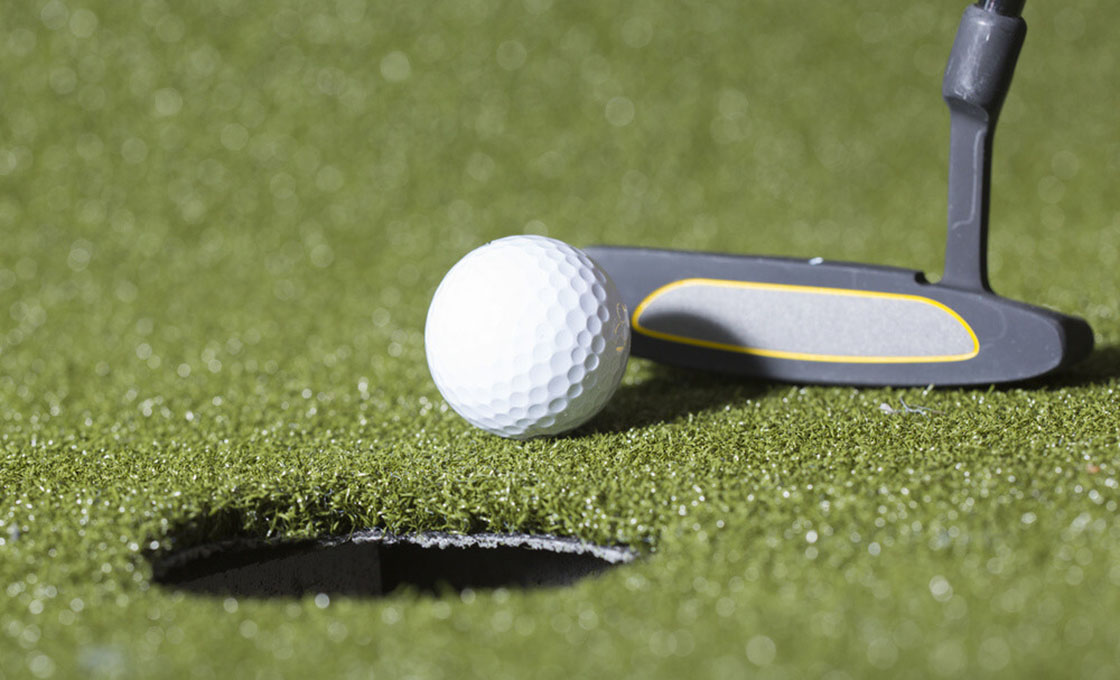
A contour rise of 2 to 4 inches across 12 feet reads as movement without chaos. Save the bigger breaks for a chipping bowl well away from the greens so the putting surface stays fair.
How Many Holes Your Space Supports
Size the hole count to the yard, not the other way around. Yards of 100-250 sq ft suit two to three holes; 250-600 sq ft suit three to four; 600-1,500+ sq ft suit four to six.
For most homes, three to five cups is the sweet spot, and quality beats quantity every time. A single green instead of a course caps you at one putt type and one speed.
Think in roll multiples, not square feet alone. A 10 m by 20 m course needs two 5 m rolls or five 2 m rolls, and the width choice trades seams against transport weight.
Elevation buys holes without buying area. Medium yards can build in 6 to 12 inches of elevation change. A large yard can carry a chipping area 10 to 15 yards from the green, with its own fringe cut.
Seams, Grain and Roll Width
At course scale, roll width decides seam count. A 5 m roll laid across a 20 m run needs four rolls side by side, which makes three seams. Laid along the 10 m dimension, the same width needs two rolls and makes just one seam.
Fewer seams mean a cleaner roll. Every piece in an artificial turf installation has to share one grain direction so the ball never drifts.
Published guides split on which way that grain should point, so read the two positions here as separate sources rather than one blend. One guide runs the pile toward the primary putting direction. Another runs the fibre grain across the intended primary putt lines, not with them, so downhill putts do not pick up extra pace. Both agree on the rest: keep seams away from the hole cluster and away from straight putt lines.
Seam quality decides whether the joins stay invisible at course scale. A published professional standard calls for double-layer seam tape and a high-grade outdoor adhesive. PU glue is preferred in hot climates, and compression rolling should close the gap to 1-2 mm.
Backing sits under all of it. PU backing is strongly recommended, because a single-layer or thin backing tends to delaminate or crack within 6 to 12 months, especially at the seams. In wide temperature swings, a perimeter nailer board anchored every 6 to 8 inches also limits turf movement.

Review the quality factors that keep turf true before you fix a roll width for a multi-hole layout, because backing and yarn decide how the seams age.
Scaling Up for Hotels and Resorts
A hotel or resort backyard putting course is the same idea at a larger scale. The size is set by guest traffic rather than by a lawn. Footprint converts roughly, since 100 sq ft is about 9.3 m², so a large yard of 600-1,500+ sq ft becomes 56-139+ m².
Size the order in rolls, zone by zone. Our rolls run 2 m, 4 m and 5 m wide by 25 m long. A 2 m roll covers 50 m² and a 4 m roll covers 100 m², while a 5 m roll covers 125 m². That is enough to size a 200 m² course from the roll count alone.
A resort wears the approach harder than the green. Guests cross the same tee-line and approach corridors all day, while the cups see far fewer passes. Specify those corridors with a longer pile, keep the green short, and plan a matched spare roll per zone for section swaps inside a busy season.
The questions that reach our line differ from a backyard brief. A resort buyer usually asks about guest turns per day, total hole count, and whether the property wants a chipping green beside the main course.
Keep the zones separate at this scale. One roll size across the whole property forces one ball speed and one wear pattern, which is the same mistake as one big green.
Specify Turf Zone by Zone
Ordering a backyard putting course by zone keeps the spec honest. Request samples for each zone so the green, fringe and approach read true side by side before you commit.
Not sure which turf each zone needs?
Send your site plan and hole count. We specify green, fringe and approach turf as three separate builds, and sample each one before you order.
Where Base and Drainage Boundaries Sit
Our supply boundary is the turf roll. Excavation, crushed stone, drainage pipe and cup setting are base-contractor work that sits beneath the carpet we ship.
The base contractor owns excavation, aggregate, the contour layer and any drain pipe. Our line owns the roll: pile height per zone, backing, grain direction and roll width. Agree the finish grade before the turf ships, because a late slope change means recutting rolls.
Specify the base by published numbers, not by feel. Site drainage needs at least a 1% fall away from structures, and the playing contours are a separate layer that a published guide puts at a subtle 1-2% slope. Every artificial turf installation we ship leaves roll width and grain to your layout.
You buy the rolls; the base is built on site. Confirm pile, density and grain per zone, then let your contractor match the sub-base to the slope you want.
Read how drainage bases are specified so the sub-grade, fall and pipe line up with the turf you order.
Costly Design Mistakes to Avoid
A few errors show up in almost every first multi-hole build. Each one is easy to avoid if you plan the zones before you order the turf.
One Pile Height for Every Zone
A single height makes the green, fringe and approach roll the same. Cut each zone from its own roll so the ball speed changes the way a real course does from hole to hole. The consequence is a course that plays like one long putt.
Evenly Spaced Cups in a Row
A neat row of cups invites backtracking and kills flow. Route holes around corners and contours so each walk between putts feels different and the course stays compact. Even spacing also wastes the narrow side strips that make the best corridors.
Ignoring Grain Direction at Scale
Mixed grain makes the ball drift sideways. Set one grain direction for the whole artificial turf installation so every zone reads true.

Fix these three and the course plays harder than its size suggests. The cost is in the plan, not in the turf, and a zone-by-zone spec pays back on the first round.
Keeping a Putting Course Playable
A backyard putting course stays playable when each zone is cared for lightly. The green needs brushing and debris clearing most often; the fringe and approach take less traffic and less care.
A portable option helps through the cold months. A portable green for winter practice keeps the stroke sharp when the outdoor course is under snow.
Check seams and edges each season, and confirm grain has not shifted after a hard winter. The roll side of care is short; the base side remains your contractor’s remit to maintain.
Frequently Asked Questions
How many holes fit in a backyard putting course?
Most backyards fit three to five cups. A 100-250 sq ft yard suits two to three holes, 250-600 sq ft suits three to four, and 600-1,500+ sq ft suits four to six (Fenix).
What pile height does a putting green need?
The green runs 10-16 mm, the fringe 19-32 mm, and the approach or tee line 25-28 mm. The green gives the shortest, truest roll, and the longer bands roll slower (MightyGrass, Perth).
How do you route a multi-hole putting course?
Route holes around corners and contours instead of spacing cups evenly. Let narrow side yards become approach corridors so players never walk back over the same grass (SGW).
What slope should a putting green have?
Keep the putting surface at 1-1.5% slope, the fringe at 1.5-2%, and the cup area below 0.5% so every putt stays fair (MightyGrass).
Can I build a putting course myself?
You can plan the routing and order turf by zone, then hire a base contractor for excavation, drainage and cup setting. Our supply boundary is the turf roll itself.


 English
  Arabic
  French
  German
  Portuguese
  Russian
  Spanish