

Ball bounce rarely lies about what sits underneath. A cricket carpet laid over soft fill, flat spots or loose stone telegraphs every shortcut in its first wet week. None of those faults can be fixed from the surface afterwards.
We build artificial grass rolls and read most early complaints from the ground up. Turf cricket pitch preparation decides whether a lane stays true through a season. It comes down to five measurable gates: set-out, base build-up, drainage falls, compaction and a final straightedge check.
Why Preparation Decides How the Ball Bounces
Every artificial turf installation is the visible top of a much taller system. Under a 10 to 15 mm cricket carpet sits stone, membranes and soil that nobody sees once the roll is down.
The classic failures are all buried ones. TurfCareBlog’s construction guide lists root breaks and layering that affect performance for years, ponding where water cannot escape, and long-term settlement from poor consolidation. None of them show at handover; all of them show in play.

That is why preparation is judged with numbers rather than opinions: a straightedge, a level and a compaction pass you can prove.
None of this is exotic work, but it is sequence-dependent work. A base that fails one gate sends the whole job backwards: stone comes up, levels come back, and the season does the waiting.
Setting Out Dimensions and Finished Levels
Set-out starts from the game, not the carpet. The stump-to-stump distance is always 20.12 m (22 yards), and an overall length near 30 m leaves roughly 5 m of run-up at each end.
A match-pitch excavation runs at least 29.50 m long by 2.50 m wide. For a practice lane the dig is commonly 22 to 24 m long, 2 to 3 m wide and 150 to 300 mm deep. The depth follows the base build-up you choose, not guesswork.
Levels come next, and the governing numbers are gradients. The maximum recommended gradients are 1:80 along the pitch and 1:50 across it, so water always has somewhere to go without the surface reading as a ramp.
Turf cricket pitch preparation stands or falls on this line-and-level stage, because every later tolerance is measured against the marks set here.
Choosing Between Aggregate and Concrete Bases
Most artificial turf installations on cricket pitches sit on one of two base types, and the choice shapes bounce, drainage and timing. An aggregate base drains through its own profile; a concrete base sheds water and dries as one slab.
| Criterion | Aggregate base | Concrete base |
|---|---|---|
| Typical build-up | 50 mm MOT Type 1 stone, geotextile, 6 mm granite dust or sand topping | 125 mm excavation: 25 mm sand, polythene membrane, 100 mm ST4 slab |
| Water handling | Drains through the profile; rated more efficient than concrete | Needs a cross fall of up to 12 mm over 2.74 m to shed rain |
| Ball bounce | Superior, more natural bounce; the profile the ECB prefers | Harder, higher bounce; a fit for school and club practice lanes |
| Time before play | Ready once compaction and levels pass | 7 days covered to cure, then 4 to 6 weeks drying before bonding |
Whichever profile you pick, separation matters as much as strength. Geotextile between stone layers stops aggregates mixing and improves load bearing, and the NottsBase specification demands clean, angular, non-frost-susceptible 10 to 6 mm stone for its sub-base.

Edge restraint completes the base. A timber frame border holds the layers in place and gives the finished lane a clean line to trim against.
Drainage Falls That Keep Water Moving
Water that cannot leave an artificial turf installation finds the low spot and sits there, and a pitch that holds water loses playing days. Drainage on a prepared base works two ways: fall across the surface, and a path for what soaks in.
The concrete route relies on fall. Standard dense-concrete guidance allows a slight cross fall of no more than 12 mm over 2.74 m, set into the shuttering before the slab is poured. The aggregate route is simpler: water passes through the profile, which is why the trade regards it as more efficient than concrete.
One lesson from natural squares transfers directly: keep pipework out from under the playing area. Sport England’s guidance bans pipe drainage under a cricket square because it dries unevenly, shrinks and cracks the surface; perimeter drainage does that job instead.
Compaction and Level Acceptance Before Turf
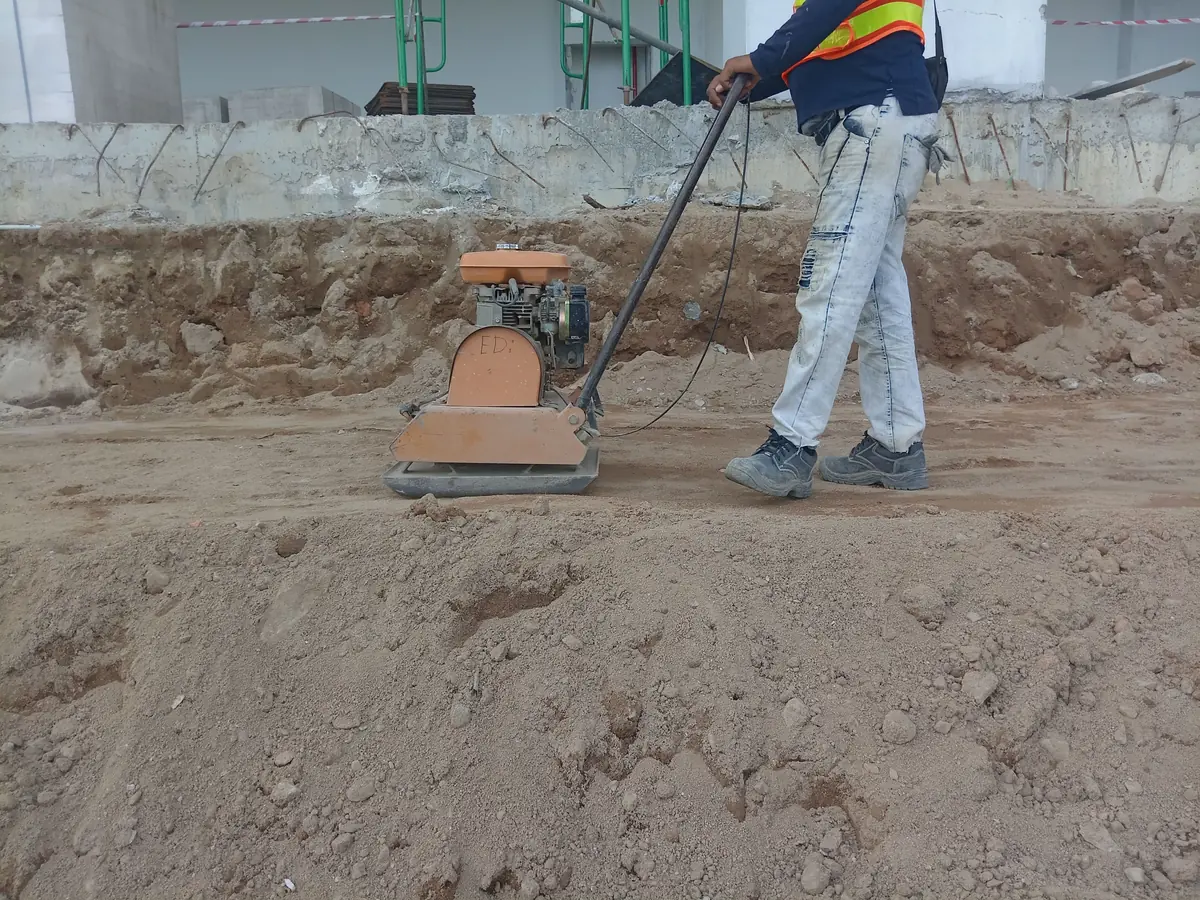
Compaction is where turf cricket pitch preparation is won or lost. The NottsBase specification consolidates every layer with a roller or compactor plate, using water to increase compaction, and dampening aggregate before a plate pass helps it lock.
Build in thin layers rather than one deep fill. Sport England calls consolidation the most important element of square construction, with material placed no deeper than 50 mm at a time and keyed in before the next layer follows. Small lanes make it easy to shortcut: compact in halves, dampen the aggregate before each plate pass, and let the surface tell you when the dust stops moving.
| Check | Acceptance criterion |
|---|---|
| Match-pitch set-out | At least 29.50 m long by 2.50 m wide excavated |
| Gradients | Within 1:80 along the length and 1:50 across the width |
| Base levels | No hollow over 6 mm under a 2 m straight edge between the creases; 10 mm under a 1 m edge elsewhere |
| Finished hard-porous surface | No hollow over 6 mm under a 2 m straight edge, or 4 mm under a 0.03 m straight edge |
| Compaction | Every layer consolidated by roller or compactor plate, with water where the material takes it |
| Concrete curing | 7 days covered, then 4 to 6 weeks drying before bonding |
Concrete adds a clock as well as a criterion. Cover the slab for at least 7 days to cure, and pull the shuttering after 24 to 36 hours. Leave the slab another 4 to 6 weeks to dry before anything is bonded down.
The finish matters as much as the date. A concrete slab should be floated to a sandpaper texture, because a polished face can stop adhesive keying properly when the carpet eventually goes down.
Common Preparation Mistakes on Cricket Pitches
Four faults account for most of the grief we hear about from crews who inherited someone else’s ground.
Skipping Layer-By-Layer Consolidation
A single deep fill settles unevenly for years. TurfCareBlog names root breaks, layering and long-term settlement as the classic costs of rushing this stage, and they surface once the carpet hides them.
Building Flat Instead of Building a Fall
A dead-level slab is not the target. Rain needs a cross fall of up to 12 mm over 2.74 m on concrete, and gradients held within 1:80 and 1:50, so water leaves instead of ponding. Left alone, the same low patch becomes the ponding TurfCareBlog lists among the costs of getting it wrong.
Bonding Carpet to a Green Slab
Adhesive needs a dry, keyed surface. A slab cured but not dried will not hold a bond, and an over-polished finish gives the adhesive less to grip.
Leaving the Edges Unrestrained
Unrestrained edges let stone creep and levels drift at exactly the creases where bounce is judged. A timber border, set before the stone goes in, keeps every layer where the level put it.
From Prepared Base to Playing Surface
An artificial turf installation is the last 15 millimetres of everything above, and in practice artificial turf installations succeed or fail long before delivery day. Get the base through its gates and the roll itself becomes the easy part.
Do Soft Spots Keep Undoing Your Pitch Prep?
Hollows and standing water telegraph every shortcut under a carpet. We cut cricket rolls to your width, pile and backing spec, factory-direct, typically 30–50% below market on like-for-like specifications.
Running the Pre-Turf Acceptance Checklist
Run these checks in order and sign them off before the first roll is booked.
Levels and Falls
Check hollows with a 2 m straight edge between the creases, where 6 mm is the ceiling. Confirm the 1:80 and 1:50 gradients with a level while correction is still cheap.
Compaction You Can Prove
Every layer should have seen its roller or plate pass, with water where the material takes it. If a heel leaves an impression, the base is not ready.
Separation Intact
Geotextile should sit where the design put it, unbroken, with no fine material washing down into the coarse layers below. A torn or skipped layer shows up later as mixed stone that will not compact to a single plane.
A Clear Water Path
Perimeter drainage open, outlets running, and no standing water left on an aggregate base after the last pass.
Cure and Finish Complete
On concrete, that means 7 days covered, 4 to 6 weeks drying, a sandpaper float texture and edges trimmed clean of the shuttering.
Matching the Turf Roll to the Base
Turf cricket pitch preparation ends where the first roll begins. Once the base passes, the carpet choices narrow quickly: cricket surfaces commonly run a 10 to 15 mm pile, dense enough to stand up to a hard ball.
Roll width is the quiet cost-saver. Rolls of 2, 4 and 5 metres by 25 metres long cover most lane layouts, and one wide roll across the prepared base keeps seams out of the bounce zone. Review the sports artificial grass systems for pitch-grade specifications.

Where a lane has to fit an odd length or a shared field, custom widths avoid seams altogether. Our team cuts pile, density, colour and backing to a stated brief, and the customization page shows how far that brief can run.
A sample square laid over your finished base tells you more than any datasheet. Check the roll construction and widths, then confirm pile and backing on the ground, in daylight.
Construction counts too. In Labosport testing to the ECB’s TS6 standard, tufted cricket surfaces endured nearly twice as much use as woven ones. That gap is worth asking about before a busy lane commits.
Frequently Asked Questions
How deep should the excavation be for an artificial cricket pitch?
Commonly 150 to 300 mm deep and around 22 to 24 m long for a practice pitch, with the exact depth set by the base build-up you choose.
Which base gives more consistent bounce, aggregate or concrete?
Aggregate. It drains through the profile and is the base the ECB prefers for truer ball bounce, while concrete tends to produce a harder, higher bounce.
How flat does the base need to be?
Within 6 mm under a 2 m straight edge between the popping creases, and within 10 mm under a 1 m straight edge elsewhere on the base.
How long must concrete cure before the turf is bonded down?
Cover the slab for at least 7 days to cure, then leave it 4 to 6 weeks to dry before any adhesive is applied.
What gradient should a turf cricket pitch follow?
No more than 1:80 along its length and 1:50 across its width, the maximum gradients recommended for non-turf cricket pitches.
What roll widths suit a prepared cricket pitch base?
Rolls of 2, 4 and 5 metres by 25 metres long cover most layouts, and one wide roll across the prepared base keeps seam count down.


 English
  Arabic
  French
  German
  Portuguese
  Russian
  Spanish