
A competitive field is not a carpet purchase. Synthetic turf systems stack fibre and backing, infill, an elastic layer in many builds, a stone base, drainage and a compacted subgrade. Each layer answers a different demand from match play, and a shortcut in any one of them shows up underfoot.
We build the surface layer itself, so our team sees where a specification holds and where it fails. On our line, the same pile tufted at two densities leaves the coating stage behaving like two different products. That is why this guide ranks decisions by what a player can feel, not by what a brochure promises.
How a Synthetic Turf System Is Layered
Start from the bottom and the logic becomes obvious. The subgrade carries load, the base spreads it and moves water, the elastic layer controls impact, infill supports the fibres, and the carpet presents the playing face. A strong carpet above a weak base still plays badly.

Buyers usually control five observable parameters: pile height, stitch density, yarn weight, infill type and load, and backing construction. Those five decide ball speed, grip under studs, surface hardness and how quickly the field recovers after rain.
Synthetic turf systems differ mainly in how those layers are matched to each other. A tall pile over shallow infill fights itself, while a dense carpet over a soft base wastes both.
The layers above the base are the ones our line controls. Compounding, extruding, twisting, tufting, coating, drying, perforating and rolling up run in sequence, so drainage perforation is punched before a roll is wound.
Speed and behaviour are not properties of the carpet alone. Two fields can share one carpet and play completely differently once the infill load, the elastic layer and the base change. That is why synthetic turf systems are specified layer by layer, with each decision written down before the surface is ordered.
Pile Height and Density for Match Play
Pile height splits the market into three working bands. Long pile runs about 40 to 70 millimetres for football, Australian rules and rugby. Short pile sits near 13 to 19 millimetres for tennis, hockey and multi-use courts. Below 13 millimetres, unfilled surfaces suit cricket wickets and wet hockey.
| Sport | Pile band | Infill approach | What play demands |
|---|---|---|---|
| Senior football | Long pile, 40–70 mm | Sand plus rubber | True ball roll and clean stud release |
| Rugby | Long pile, 40–70 mm | Deeper rubber share | Landing cushion under contact |
| Hockey | Short pile, 13–19 mm | Sand dressed or water-based | Fast, low-friction ball travel |
| Tennis | Short pile, 13–19 mm | Sand filled | Predictable bounce and grip |
| Multi-sport | Short pile, 13–19 mm | Sand plus rubber, moderate | Durability across several codes |
Density is the number buyers underweight. Stitch rate counts tufts packed into each square metre. On our line, a 50 millimetre pile tufted at a recreational rate and at a match rate leaves coating with visibly different fibre support.
Yarn weight, usually quoted as dtex, grades the filament itself. Heavier yarn resists wear for longer, and it only pays off when the density behind it can hold that fibre upright. Our own dtex figures are quoted on request, because the right band depends on your density target.

Fibre form completes the picture. Monofilament blades hold their memory and return upright, curly support fibre stabilises the infill, and a dual-fibre build combines both so the surface stays consistent through a long season.
Choosing Infill for Competitive Surfaces
Infill does two jobs at once. Sand holds fibres upright and adds ballast so the carpet does not creep sideways. Rubber or elastic granules absorb landing energy and set how far a stud sinks before it grips.
A full football build commonly brushes in about 10 kilograms of silica sand and about 15 kilograms of rubber granules per square metre. Those loads vary between systems, so treat them as a starting point for your own calculation.
Synthetic turf systems also differ in what the granules are made of. Silica sand is the economical baseline. Coated sand cuts abrasion and surface heat. Cork and coconut run cooler but need topping up. Rubber crumb remains the durable default.
Infill is not a permanent part of the field. Fill settles, migrates and compacts, and uneven fill crushes fibre until the surface turns slick. Plan a topping-up line in the maintenance budget from the first season, not from the season the pitch starts to feel thin.
Infilling is also where a budget is most often misread. Carpet is counted in square metres while fill is counted by weight, and the two lines sit in different parts of the same bid. A shortfall in one is not covered by overspending on the other, so the fill volume belongs in the same conversation as the carpet specification.
The Base and Drainage That Hold Up
Under the carpet, a typical build runs infill, an elastic pad in many designs, a compacted crushed-stone base, a drainage network and a compacted subgrade. Geotextile fabric sometimes separates stone from soil, and cold-climate venues add heating coils.
Water leaves the field by gravity. It seeps through the carpet and infill, reaches the stone base, then travels through perforated pipes, vertical drains or a sloped porous sub-base. Large venues combine those routes in a single network.
Designers often size drainage at 60 litres per minute per square metre or more for match surfaces. That number matters because a competitive fixture is cancelled by standing water, not by a slow pitch.
Perforation sits in the carpet as well as in the ground. Our production sequence punches the drainage holes during coating and drying, before the roll is wound, so the carpet arrives with its drainage pattern already formed.
A base that looks correct on delivery day can still fail in its second winter. Compaction, stone grading and the fall across the surface decide whether water travels to the drains or sits in the low spots. When you compare synthetic turf systems for a wet site, ask for the drainage design in writing and for the slope across the field.
Shock Absorption and Energy Return Explained
An elastic layer under the carpet changes how the field feels to land on. Cushioning through infill alone is fragile, because infill compacts, contaminates and shifts. A pad keeps its behaviour because it is protected from weather and from studs.
Synthetic turf systems treat that layer as a selection question rather than a default. A pad does not upgrade a thin practice carpet into a match surface, because the fibre above still decides ball behaviour.
What the pad changes is the landing. Landings matter in proportion to hours played and to the size of the players on the field. A school with heavy multi-use bookings therefore needs a different answer from a club with two match days a week.
Hours are the honest input here. A field used for four hours a week and a field used for twenty can share one carpet. They still need different cushioning targets, because the elastic layer is worked through thousands of landings. Write your weekly hours into the specification instead of leaving the layer to a default.
Ball Roll, Bounce and Footing Consistency
Ball behaviour on a competitive field is measured rather than judged by eye. Designers check rebound height by dropping a ball, roll distance across a set line, and rotational resistance under a studded boot. Each check turns a player complaint into a number.
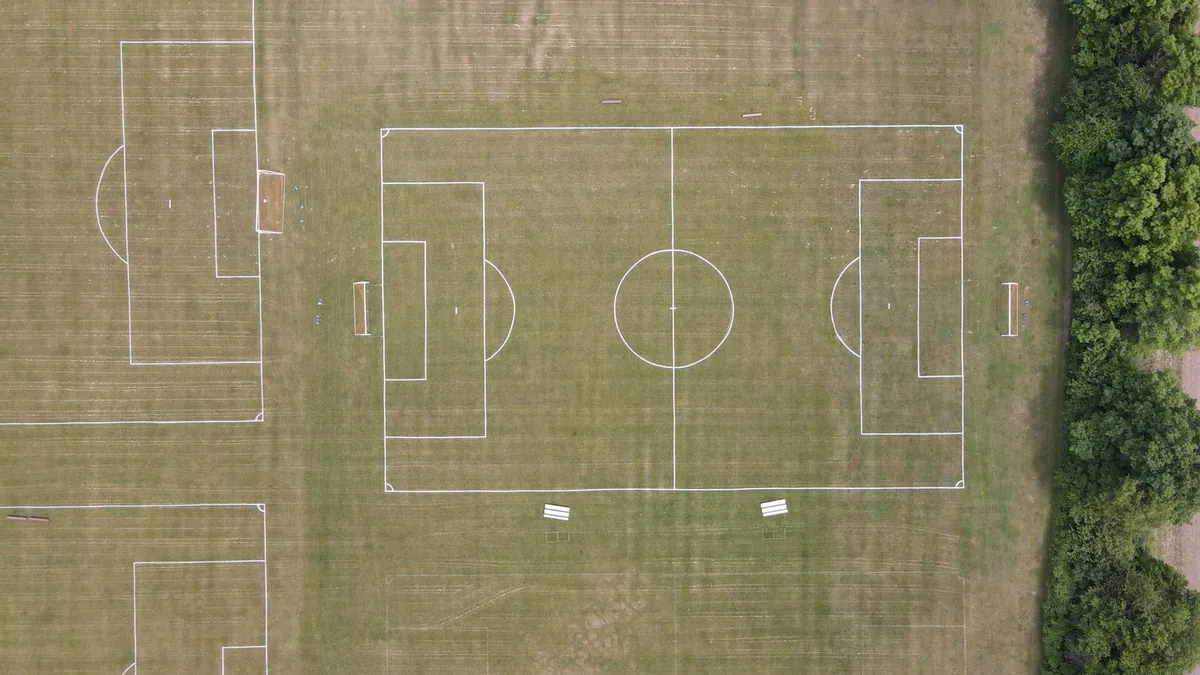
Consistency across the whole field matters more than any single reading. Wear concentrates in the penalty spots, the corner arcs and the centre of the pitch, and those zones decide when a surface stops feeling the same in every area.
When you shortlist synthetic turf systems, ask what the supplier expects those three checks to return on your layout. Then ask how the answer changes between a dry week and a wet one.
Readings also drift with weather and with fill level. A surface that tests clean in May can feel slow in November once the fill has compacted and the fibre has flattened. Repeating the same three checks each season keeps synthetic turf systems performing close to how they tested on day one.
Matching the System to Your Competition Level
The table below reads a build from the top layer down and across three competition levels. Use it to find the row where your weekly hours and your fixture list actually sit.
| Building block | Grassroots club or school | League and academy | Showcase and elite |
|---|---|---|---|
| Stitch density | Open, hard-wearing stitch | Medium stitch, denser face | High stitch, tight face |
| Infill load | Light sand, minimal rubber | Sand plus rubber at full depth | Deep sand plus rubber, scheduled top-ups |
| Elastic layer | Optional | Common | Expected |
| Base and drainage | Simple permeable base | Engineered base with pipe drains | Engineered base, tuned drainage |
| What it buys | Durability per unit of cost | Balanced roll and grip | Repeatable match conditions |
Stitch density is set by gauge and rows per metre, so ask a supplier for those two figures rather than a density claim on its own.
Read the table as a chain rather than a menu. A showcase pitch needs the deep infill and the engineered base together, because buying only the deep infill gives you a soft surface that still floods.
One sport or several changes the answer too. A single-code field can be tuned hard for ball roll, while a shared school field has to stay acceptable for hockey, tennis and rugby inside the same week. If your schedule spans codes, start from sports turf built for shared field schedules and tune the infill to the sport that dominates.
Field Size, Run-Off and Wear Zones
Size drives both quantity and seam layout. Senior football commonly references a pitch of 105 by 68 metres, inside a permitted range of 90 to 120 metres long and 45 to 90 metres wide. International fixtures narrow that band to 100-110 metres by 64-75 metres.
Markings inside that rectangle are fixed. The goal opening is 7.32 metres wide and 2.44 metres high, and the goal area reaches 5.5 metres. The penalty area extends 16.5 metres, while the centre circle and penalty arc each use a 9.15 metre radius.
Leave room outside the lines as well. A run-off of at least 3 metres is standard practice, rising to 6 metres between neighbouring pitches, and the run-off is usually surfaced exactly like the playing area.
Zoning tells you where the carpet will surrender first. Corner arcs, penalty spots and the centre circle take the highest traffic per square metre, so seam placement and pile direction should be planned around them.
Seam direction is worth deciding alongside the markings, not after them. Where a seam crosses a high-traffic zone, it becomes the first place the surface moves. Seams are therefore run away from the main playing lines and out of the penalty areas. On a shared school field, the line set for every sport should be planned at the same time.
Turning a Shortlist into a Spec Sheet
Everything above compresses into one checkable list: pile height, stitch density, yarn weight, infill type and load, elastic layer, base build, drainage capacity and roll width. Send that list with your field dimensions, and every line can be priced against a real surface.
Shortlisting a System Without a Full Spec?
Bids stall when each layer is priced apart. Our line matches pile, backing and roll width to your drawings. Factory-direct pricing, typically 30–50% below market on like-for-like specifications.
Sizing Rolls to Your Field Layout
Standard rolls come 2, 4 and 5 metres wide, each 25 metres long. The 2 metre roll is the most economical and the easiest to handle in tight areas. The 4 metre roll covers most layouts with few awkward cuts. The 5 metre roll suits large spaces and lays with the fewest cross seams.
| Roll width | Coverage per roll | Seam pattern | Best fit |
|---|---|---|---|
| 2 m | 50 m² | Most seams, easiest handling | Training zones and small courts |
| 4 m | 100 m² | Moderate seams | Most club and school layouts |
| 5 m | 125 m² | Fewest seams | Full-size competitive fields |
| Custom width | Tailor-made | Seam placed to your drawing | Layouts that cannot accept a seam |
Fewer seams means fewer weak points, as long as the panel size stays practical to move and fit. Custom widths are produced tailor-made for layouts that cannot accept a seam, which is worth raising before the base is finished rather than after.
Review the standard roll formats before you commit to a seam plan. Where a layout cannot take a seam, custom pile heights, densities and colours can be locked in before production starts.
Maintenance Cycles That Protect Play Quality
Infill level is the maintenance number that decides playability. When fill sits unevenly, fibre gets crushed and the surface turns slippery, so grooming and topping up protect the carpet as much as they protect ball roll.
Set the cycle from weekly hours rather than from the calendar. A field carrying twenty hours a week needs a different grooming rhythm from one carrying four, and the wear zones should be walked every visit.
Our commercial sports turf is built for a service life of up to 10 to 15 years. Published field guidance lands in a similar 8 to 15 year window, depending on system and use. Traffic, installation quality, drainage and routine inspection decide where a field lands inside that range.
Common System Spec Mistakes to Avoid
Comparing carpet prices alone
Two quotes that both say 50 millimetres can differ by thousands of stitches per square metre. They can also differ on backing grade and drainage design, and the cheaper one is usually cheaper for a reason.
Treating the base as a contractor detail
Water that cannot leave a field cancels fixtures, and rebuilding a base under a finished surface costs far more than building it properly once.
Assuming the infill is permanent
Fill settles, migrates and compacts, so the maintenance budget needs a topping-up line from year one, not from the season the surface starts to feel thin.
Buying from a specification sheet alone
A sheet cannot show how a blade springs back underfoot or how the surface sheds a downpour, so physical verification stays the cheapest line in the whole project. Free 20 by 20 centimetre samples travel by courier for the cost of the freight, which makes checking turf samples by hand the fastest way to settle a shortlist.
Changing the specification after the base is built
Layering a heavier fill onto a base designed for a light one, or padding a carpet that was bought for a firm surface, undoes the balance the design started with. It also makes synthetic turf systems impossible to compare fairly, because two bidders end up pricing two different surfaces.
Frequently Asked Questions
How thick is a competitive synthetic turf system?
Depth is the sum of the layers, not one number. The carpet runs 40 to 60 millimetres for football, the infill fills roughly the lower two-thirds of that pile, and base and drainage sit below that.
Does a competitive field need an elastic layer under the carpet?
Not always, but the higher the weekly hours, the stronger the case. A pad holds its shock absorption better than infill, which compacts and shifts with play.
How much infill goes into each square metre?
A common football build uses about 10 kilograms of silica sand and about 15 kilograms of rubber granules per square metre. System designs vary, so confirm loads against your own base and drainage.
How fast should a pitch drain after heavy rain?
Match surfaces are usually designed for at least 60 litres per minute per square metre. The drainage network below the carpet, not the carpet alone, decides whether that figure holds.
Can one pitch host several sports competitively?
Yes, with care. Football and rugby suit a long-pile build, while hockey and tennis need a short-pile one, so a shared pitch has to choose which sport it serves best.
Which roll width suits a full-size competitive field?
A 5 metre roll lays a large field with the fewest cross seams, while 4 metre rolls cover most club layouts. Compare both against your own marked dimensions before ordering.
 English
  Arabic
  French
  German
  Portuguese
  Russian
  Spanish