

Two quotes land on the same desk for the same sports hall. One reads like a bargain and the other looks like a misprint, yet neither explains what the number actually contains. That is the everyday problem behind indoor sports turf cost per square meter: the phrase sounds like a single price, but sellers pack different things into it.
We tuft artificial grass rolls on our own line, so we read quotes the way a buyer should: line by line. Published industry guides put multi-purpose sports-grade turf at US$8–22 per square meter before installation, while full-field projects run to seven figures once structure and labor join the bill. The bands below sort those numbers into layers, so the next quote you receive can be judged on like-for-like terms at every stage of an artificial turf installation.
What Indoor Sports Turf Cost Per Square Meter Includes
An artificial turf installation is priced in layers, and the indoor sports turf cost per square meter headline usually covers only the first one. Material is the carpet itself: yarn type, tufting density, pile height and backing. Backing provides tuft stability, padding adds shock absorption, and installation covers surface preparation, seam joining and edge finishing.
A published US cost guide splits the total the same way: material, backing, padding, installation and ongoing maintenance. When a seller quotes only the carpet, the remaining layers still land on your budget later. Asking which layers sit inside the number is the first question to put to any quote.
The per-meter framing matters most in cross-border buying, where the carpet travels but the labor does not. An importer comparing indoor sports turf cost per square meter across factories is comparing one layer, while a facility manager comparing local bids is comparing all of them. Both are valid exercises; they just cannot share a spreadsheet column. Name which buyer you are before you collect a single number, and half the quote confusion disappears before it starts.
Material Prices Versus Installed System Costs
Installers usually quote artificial turf installation in two lines: what the carpet costs and what it costs to put down. The spread between those lines is wide. In one published US guide, economy indoor systems price at $2–4 per square foot for materials, with installation at $3–6. Premium athletic systems run $7–12 for materials and $6–12 for installation.
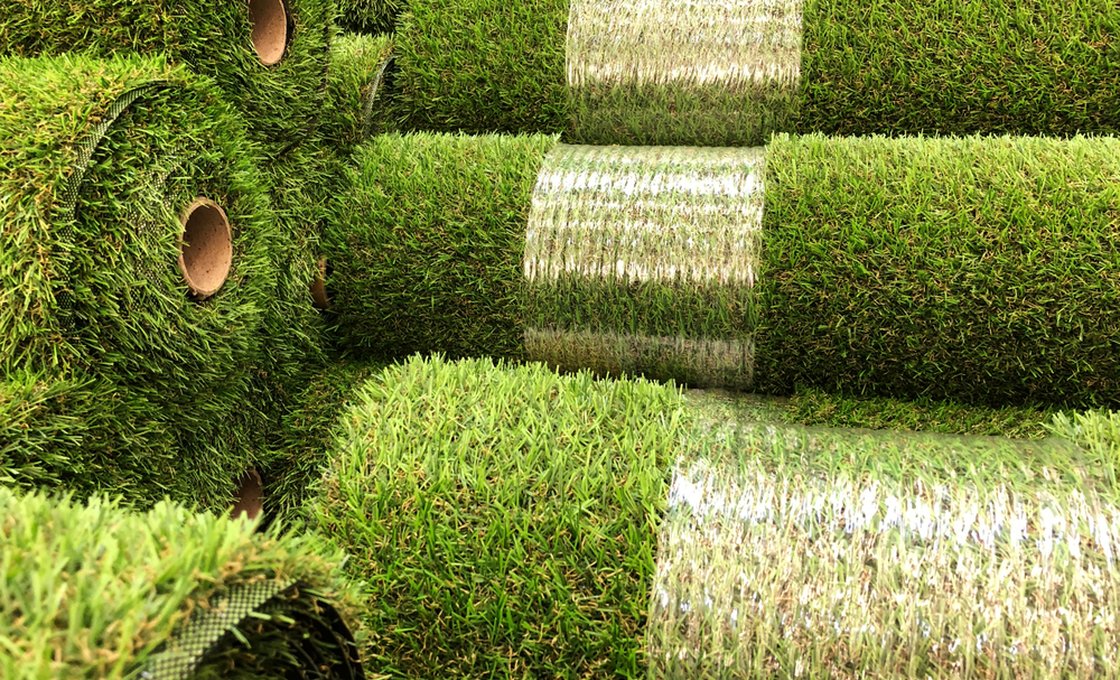
The same guide puts total installed cost at $8–20 per square foot for most commercial projects. Material-only prices flatter a budget because the installation line often equals or exceeds the carpet. Roll width feeds this math too, since wider rolls cut seam count, so review the standard roll formats and product ranges before fixing a layout.
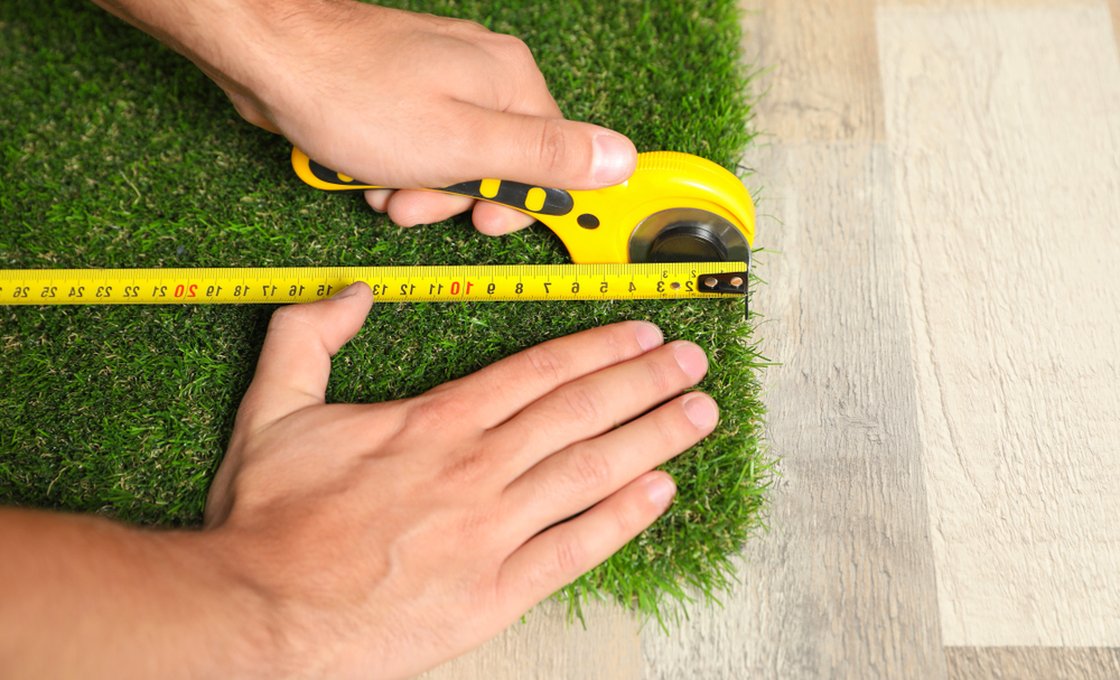
What sits inside that installation line varies more than buyers expect. Crews price surface preparation, seam joining and edge finishing together, and awkward sites add cost: crane access for large rolls, tight corridors, and column grids that break clean roll runs. A hall with clean 4-meter or 5-meter roll paths installs faster than one that forces narrow strips and extra seams. Two identical carpet prices can therefore produce two very different installed totals.
Judge every per-meter figure by asking which of the two lines it represents. A carpet price and an installed price are both real numbers, but they answer different questions.
Published Price Bands By Grade And Material
Independent guides give per-meter buyers usable anchors. A published non-infill industry guide grades turf in square meters directly. It puts residential and landscape grades at US$3–8 per m². The multi-purpose sports grade, which covers indoor sports facilities, sits at US$8–22 per m². Professional sports grades run US$18–35+ per m².
Suppliers reporting in square feet sit on the same shelf, one unit over. The table below sets both units side by side, with converted figures derived at about 10.76 square feet per square meter. For artificial turf installation quotes from US suppliers, treat the converted column as the comparable number.
Yarn material explains much of the spread inside each grade. Published material pricing puts polypropylene at $3–5 per square foot and polyethylene at $4–7, while nylon runs $6–9+ per square foot. Polyethylene is preferred indoors for softness and fiber recovery.
Fiber construction shifts the same bands again. One published US facility guide lists monofilament turf at $3–5 per square foot, with a named model at $3.83. Slit-film starts at $0.84 per square foot for leftover rolls and reaches $4–7 for quality systems. Hybrid dual-fiber blends span from about $1.15 to $7–9. Padded training turf lists at $2.49–$2.99 per square foot.
| Published grade or band | Price as published | Per m² equivalent |
|---|---|---|
| Residential and landscape grade (industry guide) | US$3–8 per m² | As published |
| Multi-purpose sports grade, incl. indoor facilities (industry guide) | US$8–22 per m² | As published |
| Professional sports grade (industry guide) | US$18–35+ per m² | As published |
| Economy indoor systems, materials only (US guide) | $2–4 per sq ft | About $22–43 per m² |
| Mid-range indoor systems, materials only (US guide) | $4–7 per sq ft | About $43–75 per m² |
| Premium athletic systems, materials only (US guide) | $7–12 per sq ft | About $75–129 per m² |
Read the table as material-only pricing. None of these bands include pads, infill, freight or labor, which is why installed bands run several times higher. The roll construction and widths behind each band decide where a product sits in it.
Converting Square-Foot Quotes Into Square Meters
Most US sources publish per square foot, while international procurement works in square meters. The conversion is fixed: one square foot equals 0.0929 square meters, so a square-foot price multiplies by about 10.76. A $4 per square foot material quote is therefore about $43 per square meter. Indoor sports turf cost per square meter is also the unit most international tenders are written in.
An artificial turf installation over concrete adds several layers beneath the carpet. One published indoor soccer stack separates those layers as follows.
| System layer | Published range (per sq ft) | Converted (per m²) |
|---|---|---|
| Turf carpet | $3–8 | About $32–86 |
| Shock pad | $1–3 | About $11–32 |
| Infill materials | $0.50–3 | About $5–32 |
| Installation labor | $2–5 | About $22–54 |
| Total installed system | $6–15+ | About $65–161 |
The same source documents how fast full projects scale once those layers compound. A published worked example for a standard field of about 57,600 square feet lands at $1,226,400 to $1,716,000 all-in. Broader published estimates put a complete indoor turf field between $700,000 and $1,500,000. Those totals count structure, base, infill, drainage and labor together.
Run the same example layer by layer and the scale problem becomes obvious. The published component stack for that field — carpet, base, infill, drainage and labor — accounts for most of the total before the structural line is even added. That is why per-meter comparisons only hold within the same layer. A $43 per square meter carpet quote and a $65–161 per square meter installed quote can both be correct. They are answers to different questions.
Published ROI examples sharpen the point for smaller footprints, too. Four indoor batting cages totalling 4,200 square feet came to about $12,558 at $2.99 per square foot in one published case. A 10,000 square foot training field at $5 per square foot came to $50,000.
How Infill And Shock Pads Move Prices
Infill and padding are the two lines buyers forget to price. Indoors, loose infill gets messy, so most facilities choose non-infill turf or minimal infill. That is one reason published indoor soccer ranges put non-infill systems at $6–12 per square foot installed. Infill systems run $7–15 by the same ranges.
Where infill is used, type moves the number. Published figures put SBR rubber at $0.50–1.00 per square foot and EPDM at $1.50–2.50. TPE runs $2.00–3.00 and organic fills $2.00–4.00. Typical depth adds 4–8 pounds per square foot. A 10–15 mm athletic shock pad adds roughly $1.50–3.00 per square foot where youth training needs the extra cushioning.
Engineered systems publish performance alongside price. Roughly 40–55% shock absorption and 5–8 mm of vertical deformation are the published targets for non-infill sports systems, and both figures move with the pad you choose. Our sports turf systems are built to a stated pile, density and backing spec, so the quote matches the roll.
Pile height is the last spec lever, and indoors it runs shorter than outdoor instinct suggests. Published indoor soccer guidance puts futsal and multi-sport surfaces at 20–35 mm, standard indoor soccer at 35–45 mm, and higher-cushioning systems at 45–50 mm. Lower pile plays faster, sheds less fiber and cleans easier, which is why indoor facilities rarely copy the tall, heavily infilled surfaces built for outdoor stadiums. When a seller quotes a carpet far above those bands for an ordinary hall, ask what the extra millimeters are actually for.
Budget Bands By Facility Type
Whole-project budgets scale with footprint and booking intensity. Published project budgets for 5-a-side indoor soccer facilities run from $120,000–$180,000 at community level. Premium arenas reach $250,000–$350,000+. Complete indoor turf fields span $700,000–$1,500,000 per published Sports Venue Calculator figures.
Structure explains most of that gap. Ground-level structural costs start near $420,000 in published figures. The turf itself, at $2–5 per square foot by the same source, is a small share of a seven-figure quote.
| Facility type | Published budget band | Basis |
|---|---|---|
| Community 5-a-side facility | $120,000–$180,000 | Published project budgets |
| Commercial training center | $180,000–$250,000 | Published project budgets |
| Premium indoor arena | $250,000–$350,000+ | Published project budgets |
| Complete indoor turf field, all-in | $700,000–$1,500,000 | Published Sports Venue Calculator figures |
| Ground-level structure | From about $420,000 | Published structural figure |
Match the band to your footprint before comparing sellers. A futsal hall and a full field are different conversations, even at the same indoor sports turf cost per square meter.
There is a payback argument hiding in the same numbers. Published comparisons credit indoor fields with up to 2,800 usable hours a year against about 1,500 outdoors, because weather never cancels a session inside. The same sources put indoor maintenance near $5,000 a year against $6,000–$10,000 outdoors, since irrigation, UV wear and storm cleanup never enter the picture. A higher structure-driven up-front budget therefore buys more bookable hours per dollar than the raw quote suggests, which is the argument facility managers take to their boards.
Hidden Costs That Quietly Move Totals
Three lines sit outside most headline numbers. Installation labor can represent 20–30% of the total system cost on large indoor projects, per published figures. International freight fluctuates with container availability, fuel and port fees, and can add tens of thousands of dollars on its own.
Base condition is the third lever. Any artificial turf installation over a worn or damp slab inherits leveling, moisture barriers and subfloor repairs first. A US cost guide notes that a well-prepared substrate reduces installation time and future repairs. That work is priced before the carpet is ever unrolled.
Ask each seller to state which of these lines sit inside their number. The cheapest quote is sometimes the one that simply forgot the most.
Lifecycle items hide in the same shadow. Where infill is used, it compacts and needs topping up every 5–10 years in published guidance, and that line was never in the carpet price. Cleaning, grooming and periodic seam checks recur on every facility calendar regardless of grade. None of these are tricks, just the parts of an artificial turf installation that arrive after the invoice is paid. A budget that names them early absorbs them easily.
Five Mistakes That Inflate Indoor Turf Budgets
These five errors appear repeatedly in published buyer guidance, and each one is avoidable on paper before it costs money on site.
Buying On Price Alone
Published buyer guidance warns that the cheapest turf may need replacing in two years. A budget roll that mats under nightly league play is not a saving; it is a deferred re-purchase. Judge the price against the service life you actually need.
Over-Specifying Against Real Usage
A community hall does not need a professional-grade carpet, and published guidance notes that overspecifying simply increases construction cost. Match the grade to booked hours and player level, then stop paying above it.
Forgetting The Pad And Infill Lines
Carpet-only quotes hide the two lines that change both budget and play quality. An artificial turf installation budget that ignores a $1–3 per square foot shock pad resurfaces later as a change order. Ask for the pad and infill lines in writing.
Leaving Freight Out Of The Comparison
For imported rolls, freight can add tens of thousands of dollars depending on containers, fuel and port fees. Two quotes written on different freight terms are not the same price.
Skipping Subfloor Preparation
Leveling, moisture testing and slab repairs sit ahead of the carpet in every sensible schedule. Published guidance links poor surface preparation to longer installs and later repairs, so budget the slab first.
Turning Benchmarks Into A Firm Budget
Bands tell you whether a quote is sane; they cannot price your hall. Turning an indoor sports turf cost per square meter benchmark into a firm budget takes your dimensions, your booked hours and a specification attached to every number. We quote against those details on our own line, before an artificial turf installation is ever scheduled, so the figure you receive is bindable rather than indicative.
Tired Of Quotes That Never Compare?
Mismatched specs turn a cheap quote into a re-turfing bill. We price rolls factory-direct, typically 30–50% below market prices on like-for-like specifications. Request an exact quote.
A Pre-Purchase Checklist For Comparing Quotes
Before you send anything to a supplier, put your own numbers in order. The six checks below turn a vague enquiry into a comparable request, and they take an hour with a tape measure and your booking sheet.
Fix The Dimensions In Meters
Measure length and width in meters and net out storage rooms, corridors and run-off zones. A floor area stated once, in one unit, removes the most common source of quote confusion.
State The Sport And Weekly Hours
A futsal hall running league nights needs a different carpet from a batting cage lane. Published pile guidance runs shorter and denser indoors, so name the sport and the weekly booked hours up front.
Name The Pricing Context
Ask each seller whether the number is material-only, installed, or turnkey. Three contexts can differ by a factor of ten, and mixing them is how budgets break.
Convert Every Quote To One Unit
Multiply any square-foot figure by 10.76 and compare per m² against per m². Do the same for freight terms, so every line lands on the same basis.
Demand The Spec Behind The Number
Pile height, density, yarn type, backing and roll width belong on the quote itself. Our custom pile heights, densities and colours are quoted against a written brief for exactly this reason: a spec-bound number can be verified on delivery.
Confirm On A Sample, Not A Brochure
Order a swatch and check pile, colour and backing in your own light before committing. Free 20 x 20 cm samples ship by DHL or FedEx in 4 to 6 days, which is short against a facility budget.
Maintenance Spending Across The Service Life
Service life depends on booked hours more than on the calendar. Published lifespan bands for indoor soccer turf run 3–5 years under heavy daily use. Moderate commercial use reaches 5–8 years, and light recreational use reaches 8–10 years. Well-kept indoor athletic turf can reach 15–20 years by another published estimate.
Budget the upkeep line from day one. Commercial indoor facilities commonly set aside $3,000–$15,000 a year for turf maintenance, and infill top-ups fall due every 5–10 years where infill is used. Across artificial turf installations, brushing, cleaning and seam checks are the recurring tasks that keep those bands reachable.
Cheaper carpets shift the curve: thinner yarns compact sooner, so the maintenance line grows as the surface ages. We read maintenance as part of the purchase price, not as an afterthought. Treat the indoor sports turf cost per square meter you accept today as a down payment on those annual lines. The cheapest quote rarely stays the cheapest for long.

Frequently Asked Questions
What does indoor sports turf cost per square meter?
Published industry guides put multi-purpose sports-grade turf at US$8–22 per m² before installation. Converted from published square-foot guides, economy materials run about $22–43 per m² and premium athletic systems $75–129.
How do I convert a square-foot quote into square meters?
Multiply the square-foot figure by 10.76. A $4 per square foot material quote equals roughly $43 per square meter, before padding, installation or freight.
Why do indoor field quotes reach seven figures?
Structure, not turf, drives seven-figure quotes. Published figures put ground-level structural costs from about $420,000. A complete indoor field project runs $700,000–$1,500,000 all-in.
Does non-infill turf cost less to run indoors?
Yes. Published ranges put non-infill systems at $6–12 per square foot installed against $7–15 for infill systems, with lower upkeep and a cleaner hall.
How long does indoor sports turf last?
Published lifespan bands run 3–5 years under heavy daily use, 5–8 years in moderate commercial use, and 8–10 years in light recreational use.
What should I send a supplier before asking for pricing?
Send hall dimensions, court format, weekly playing hours and target pile height. Those four details turn a generic band into a specification-bound number you can compare.


 English
  Arabic
  French
  German
  Portuguese
  Russian
  Spanish