

Kneel at the end of a sled lane, part the fibres with two fingers, and let go. What happens in the next few seconds tells a facility manager more about the remaining life of that gym turf than any installation date on a maintenance file.
That test sits at the centre of a question every operator asks sooner or later. How long does gym turf last, and what turns a repairable lane into a whole-zone replacement? The answer moves with two variables, not one. We tuft artificial grass rolls on our own line, so we read that question through yarn weight, backing weight and weekly training hours rather than through a calendar. Seven signals, measured rather than guessed, decide when a gym turf zone has reached the end of its working life and when it still has years left in it.
How Long Gym Turf Actually Lasts
How long does gym turf last? Not until a date, but until a curve. That curve is set by how many hours of training land on each square metre every week. A CrossFit box running six sessions a day presses the same lane thousands of times more often than a hotel fitness room.
So how long does gym turf last in practice? Vendors quote very different numbers, and that spread tracks how old the artificial turf installation is. The spread is honest rather than contradictory, because each figure assumes a different traffic load. Read them side by side and the pattern is clear: the denser the daily timetable, the shorter the working life.
| Source | Turf grade or setting | Stated lifespan | Assumed traffic load |
|---|---|---|---|
| YeeGrass | Standard grade | 2 to 4 years | Normal use |
| YeeGrass | Commercial use | 4 to 6 years | Normal use |
| YeeGrass | High performance | 6 to 8 years | 4 to 6 training hours daily |
| MF Floor | 24-hour facility | 6 to 8 years | Round-the-clock access |
| MF Floor | Commercial gym | 7 to 10 years | Heavy daily traffic |
| MF Floor | Boutique studio | 9 to 12 years | Moderate scheduled classes |
| Keystone Sports | General artificial turf | 8 to 10 years | Not specified |
| AE Sports Design | Synthetic turf fields | 8 to 12 years | Usage and maintenance dependent |
| Unigrass | High-quality gym turf | 8 to 15 years | Use frequency dependent |
| The Motz Group | Fields with maintenance programmes | 10 to 12 years | Annual maintenance applied |
| Artificial Turf Supply | Gym flooring, well maintained | At least 15 years | Light to moderate foot traffic |
The narrowest band is the one that matters most. A standard-grade roll under a commercial timetable lands between two and four years, while a high-performance roll under the same load reaches six to eight. The gap between those two rows is the whole argument for specifying the roll against the room rather than against the budget alone.

How long does gym turf last under a light timetable? Sometimes less than expected. Equipment that never moves leaves a footprint on the same patch. That is why a quiet studio sometimes fails earlier than a busy box that rotates its sled lane.
How Materials and Traffic Load Wear Turf
Two axes decide how fast a gym turf zone ages, and they multiply rather than add. Material sets the baseline; traffic decides how quickly that baseline is spent.
On the material axis, three manufacturing numbers carry most of the weight. A yarn weight of 1,660 g per square metre is specified as a minimum for commercial durability. A backing weight of 1,300 g per square metre keeps the carpet dimensionally stable. Backing adhesion above 15 N per centimetre reduces the risk of premature delamination. Roll gauge matters here too, since yarn and backing wear resistance decides which layer surrenders first.
On the traffic axis, the number to know is weekly hours, not annual membership. Declared use assumptions sit at four to six training hours per day for the higher performance bands, which is exactly what a functional training floor looks like on a weekday.
Why Indoor Wear Looks Different From Outdoor Wear
An indoor gym turf zone escapes two of the outdoor killers: rainfall and direct sunlight. It inherits two others instead. Sweat, chalk and cleaning residue travel down into the pile, and heavy equipment presses static load onto a handful of footprints instead of spreading across a field.
That combination produces a wear map that looks almost nothing like an outdoor pitch. The failure points are islands, not gradients. A jump box corner, a squat rack base and a sled turnaround can be finished while the middle of the floor is barely touched.
Zoning the Floor by Training Load
Floor layout is the cheapest lifespan lever available. A zoned configuration divides training areas by function and pairs short grass with the free-weight area and medium-short grass with the strength and conditioning area. Short turf of 8 to 15 mm gives a firm flat surface that keeps barbells and kettlebells from wobbling, and it is the mainstream choice under cardio equipment.
Medium turf of 16 to 25 mm adds cushioning and suits HIIT, core work and burpee zones. Turf longer than 25 mm is generally not recommended for a gym floor because it is too loose for stability and traps dirt. This is where matching gym turf to each training zone pays for itself twice, first in performance and again at replacement time.
Seven Signs the Gym Turf Needs Replacing
Ask how long does gym turf last and most advice stops at naming the symptom. What a facility actually needs is a reading: what to do with your hands, what to compare against, and what result means the zone is finished. Each of the seven signs below comes with that reading.
Sign One: Matted Fibres That Stay Flat
Press a pinch of fibres down with your thumb and release. Watch for four or five seconds. Fibres that do not rebound and look permanently flat, especially in high-traffic areas, are the clearest early signal that a zone needs assessment. This is the first thing we look at on a returned sample.
Fibre height gives any artificial turf installation a scale to measure against. Turf often starts at 2 to 2.5 inches at installation, and fibres shorter than 1 inch in heavily trafficked areas sit in the concern band. Measure in the lane, not in the corner nobody uses.
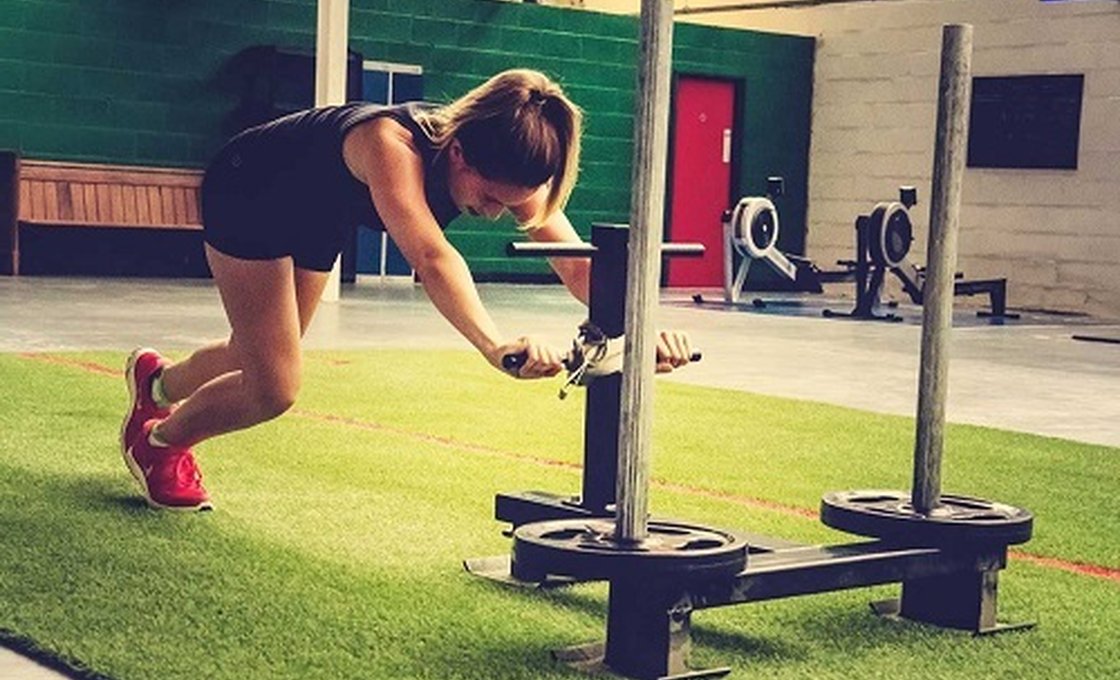
The gym-specific cause is unidirectional friction. Sled pushes, prowler drags and bear crawls all rake the pile the same direction, session after session. Gentle brushing can lift part of that back, but a zone pressed into a permanent plane will not recover, because the yarn has yielded rather than simply leaned over.
Sign Two: The Surface Feels Harder Underfoot
Drop a solid ball from shoulder height onto an old lane and a new lane, and compare the rebound. The lane that answers with a dead thud has lost its cushioning, and that is the sign to take most seriously of the seven.
Gmax testing puts numbers on the same thing. Scores should typically range between 100 and 165, with 200 the maximum allowable, and readings above 165 indicate a harder surface with raised injury risk. Fields become compact and hard after hours of play, and a high Gmax reading means the surface is no longer providing a soft landing.
Note how many layers contribute. Compaction and fibre matting compound each other, so a zone that feels hard is usually losing both cushioning and support at once. Where infill is used, bald spots, compacted infill and exposed backing belong in the same inspection pass. Readers comparing gym turf with a full pitch can check the field-level replacement assessment for the outdoor version of this test.
Sign Three: Seams Split and Edges Curl
Run your palm along a seam and push sideways. If the roll lifts and you can see the base layer underneath, that seam has already let go. Turf seams disconnect when the joining glue dries up or falls off, and loose seams allow rolls to be pulled up by hand.
Age is not the trigger here, which makes a young artificial turf installation just as likely to fail. Loosening can occur in fields of any age, so a two-year-old installation deserves the same seam check as a ten-year-old one.

The safety case is why this sign ranks high. A lifted seam becomes a trip edge on a floor where members run, drag loads and change direction at speed. One split seam is a repair job. Three or more at once, with edges curling, points to a backing that has lost stability. Frequent use and UV degradation weaken inseams on a floor of any age.
Sign Four: Water Pools Instead of Draining
Wait thirty minutes after a wash-down or a heavy spill, then walk the floor looking for standing water. Ponding or slow drainage indicates the surface needs attention and the subbase needs fixing too. Gym floors are usually indoors, but wash-downs, plumbing leaks and roof ingress deliver the same test.
Two separate failures produce one puddle in an artificial turf installation, and they call for different responses. The surface can be blinding over, with sweat residue and fine dust sealing the pile. Or the layers beneath have settled and lost their fall. What sits under the carpet is exactly what the base layers under the turf are there to control.
Read the pattern before you spend. A puddle pinned to one low corner suggests a local dip. Water sheeting across a wide area and staying put suggests the whole floor has lost its gradient, which is not a maintenance fix.
Sign Five: Colour Fading in Traffic Lanes
Tape a strip of masking tape on the floor and compare it with an unfaded offcut in the same light. Turf exposed to UV ages as the UV stabilisers are consumed, and once they are gone the infill and fibres loosen and the colour goes with them.
On any artificial turf installation, treat fading as a countdown rather than a cosmetic complaint. Faded areas are cosmetic at first, but they often develop structural problems within 6 to 12 months. That window is long enough to budget and short enough to matter.
Graphite-grey and yellow-green patches that appear faster in one lane are telling you where the load concentrates, not just where the light falls. Compare the fading map with the traffic map before you decide the scope of a replacement.
Sign Six: Equipment Marks and Faded Lines
Move the rig, the box or the sled on the artificial turf installation and look at what it was standing on. Permanent compression footprints mark static load, which behaves differently from the moving friction behind matted fibres.
Training markings fail on their own schedule. Training guides such as metre lines, hash marks and printed logos wear off with frequent use, and their loss is functional rather than decorative. Once the metre line fades out, every sled session on that lane loses its reference point.
Separate the two problems before pricing anything. Compression marks from a fixed rack can be spread by rotating equipment placement and varying activity zones, which distributes wear more evenly across the floor. Worn-in markings cannot be restored in place, because the line travels through the full pile depth.
Sign Seven: Odour That Cleaning Cannot Shift
Clean the zone as you normally would, then close the doors overnight and walk in the next morning before the air handling has run. Lingering smells after cleaning can indicate deep sweat, bacteria and moisture buildup beyond surface-level cleaning.
Gym floors reach this point faster than outdoor surfaces, for a plain reason. The sweat load per square metre is far higher, and chalk dust carries it deeper into the pile. The fibres may still look acceptable while the smell says otherwise.

Odour rarely travels alone. In practice it arrives with compaction and matting, because all three share the same root cause: material working its way into spaces the routine cleaning round cannot reach. Cleaning means brushing off debris and rinsing high-traffic areas with water. Once that routine stops restoring the surface, habit alone will not save the zone.
A zone carrying odour plus one other sign from this list is usually a replacement, not a deep clean. Plan the changeover before the busy season, never inside it.
Repair or Replace: Reading the Crossover
How long does gym turf last before the answer flips to replacement? The decision is never a single symptom. It is the count, the safety weight and the pattern. One split seam on an otherwise sound floor is a seam job. The same split seam beside a hard lane and a persistent smell describes a floor that is finished.
| What you found | Still a repair? | Action to take |
|---|---|---|
| One split seam, backing intact | Yes | Re-glue the seam and re-inspect within a month |
| Three or more seam failures with curling edges | No | Plan a zone replacement; the backing has lost stability |
| Localised compression mark from a fixed rack | Yes | Rotate equipment placement and vary activity zones |
| Whole-lane matting with no rebound | No | Replace the lane; the yarn has yielded, not leaned |
| Puddle confined to one low corner | Yes | Correct the local dip and recheck drainage |
| Water sheeting across the floor with no fall | No | Rebuild the base, not just the surface |
| Fading alone, structure sound | Yes | Monitor and re-inspect within the 6 to 12 month window |
| Odour plus any second sign | No | Replace the zone and review the cleaning routine |
Add downtime to the ledger before you choose. Replacement planning should account for 1 to 3 days of downtime depending on turf size and curing time. On a training floor those are lost sessions, not just lost hours. A repair that protects a season of bookings is often worth more than the cheaper square-metre comparison suggests.
Annual assessments belong in the same decision file. A comprehensive assessment every 1 to 2 years keeps the crossover point visible. An annual professional evaluation adds an objective read on condition and remaining life.
Replacing Turf Before It Fails an Impact Check?
A hard, compacted lane injures members and drains bookings. We build gym rolls to your pile, density and backing, factory-direct at typically 30–50% below market on like-for-like specs.
Habits That Extend Gym Turf Life
Maintenance does not stop wear on an artificial turf installation, but it moves the floor along the lifespan curve. Four cadences cover almost everything a gym floor needs, and each one costs less than the zone it protects.
Daily: Sweep and Lift the Pile
Brush the pile upright and clear chalk dust and debris before the next session. Sweeping or brushing the surface and rinsing high-traffic areas with water is the whole routine, and it keeps fine material from working down into the pile.
Weekly: Rotate Equipment and Change Zones
Move boxes, rigs and sleds a few metres. Rotating equipment placement and varying activity zones distributes wear more evenly, and it is the single cheapest way to slow the compression marks described above.
Quarterly: Check Seams, Backing and Infill
Quarterly inspections should test shock absorption, measure infill levels and assess overall condition. Monthly inspections should focus on high-wear areas, checking for loose seams, developing odours and unusual wear patterns.
Annually: Measure Against the Original Numbers
Annual professional evaluations give an objective assessment of condition and remaining life. Record fibre height, rebound and seam status in the same units each year, so the trend line carries the argument instead of an opinion. Custom pile heights, densities and colours can be matched to a zone when the replacement does arrive.
Checking a Gym Turf Spec Before You Buy
Buying the next roll badly is how an artificial turf installation repeats the same failure in three years. Five checks, done in this order, prevent most of that.
Match Pile Height to the Zone, Not the Whole Floor
Short turf of 8 to 15 mm belongs under free weights and cardio equipment. Medium turf of 16 to 25 mm belongs in HIIT and core zones. Anything above 25 mm is generally not recommended for a gym floor. One specification for the entire room guarantees that half the room is wrong.
Read Yarn Weight and Backing Weight Together
Ask for both figures. Yarn weight at 1,660 g per square metre is the commercial durability floor, and backing weight of 1,300 g per square metre is what keeps the carpet from creeping. A high yarn number on a light backing fails at the seam first.
Check Adhesion Strength Before Seal Quality
Backing adhesion above 15 N per centimetre reduces the risk of premature delamination. Since delaminated backing is the one failure that cannot be repaired, this figure deserves more attention than the coating finish.
Choose Roll Width to Control Seam Count
Every seam is a future failure point, so fewer seams means fewer places to fail. Standard roll widths and backing construction run 2 m, 4 m and 5 m by 25 m, with custom widths available. A 4 m roll covers 100 square metres and a 5 m roll covers 125 square metres, which usually settles a lane layout in one pass.
Confirm Colour and Pile on a Physical Sample
Photographs lie about colour under gym lighting. Compare an offcut against the existing floor in the same room before committing, because a shade mismatch on a partially replaced floor is visible from the entrance.
Frequently Asked Questions
How long does gym turf usually last?
It depends on grade and traffic. Standard grade runs 2 to 4 years, commercial grade 4 to 6, and high-performance turf 6 to 8 years under four to six training hours a day.
When should gym turf be replaced rather than repaired?
Repair a single split seam, a local compression mark or a one-corner puddle. Replace when three or more seams fail, a whole lane mats flat, or odour arrives with a second sign.
Does indoor gym turf last longer than an outdoor field?
Not automatically. Indoors escapes rain and direct sun but concentrates sweat, chalk and static load on fixed patches, so the wear map is patchy rather than gradual.
Can matted turf fibres be restored once they lie flat?
Partly. Brushing lifts fibres that have leaned over, but a lane pressed into a permanent plane has yielded at the yarn level and will not come back.
How often should a gym turf zone be inspected?
Check high-wear areas monthly, run a fuller quarterly check of shock absorption, infill levels and seams, and take an annual professional reading against the original specification.
How do I verify a gym turf roll before a bulk order?
Request free 20 by 20 cm samples, usually three to four pieces, shipped by DHL or FedEx in 4 to 6 days. Check pile, density, backing and colour against the room.


 English
  Arabic
  French
  German
  Portuguese
  Russian
  Spanish