

Sand used to do a quiet structural job on every synthetic pitch, its weight pressing between the blades and holding them vertical. Remove that ballast and one question decides whether the product survives: how does non-infill turf stay upright on its own?
We run the full line ourselves, from extrusion through tufting to coating, so we watch closely where uprightness is won and lost. It is won in four places: the shape of each blade, the bracing between blades, the density of the carpet and the grip of the backing. Every non-infill artificial turf installation lives or dies by that quartet, and a weak link shows within a season.
Why Infill Used to Do This Job
Quartz sand and rubber granules were never cosmetic in a conventional artificial turf installation. The ballast braced each blade, added weight that stopped the carpet shifting, and helped the surface play consistently under ball sports. One installer notes that infill generally covers around three quarters of the blade length, which is how much of the standing support used to be borrowed rather than built in.
That borrowed support had costs. Infill was kicked, blown or washed away over time and needed topping up, and buried blades could still fracture in traffic areas. A fractured blade never stands back up, so flat spots became permanent.
The industry’s answer dates to 2008, when a crimped, curled fibre began to be tufted into the carpet so the straight blades carried permanent support and the sand could go. Early no-fill products still struggled: fibres collapsed, recovery weakened and surfaces matted flat after short use cycles. Getting the mechanism right is what separates a stable non-infill surface from a failed one.
Fibre Cross-Section Sets the Bending Stiffness
A blade without ballast leans on its own geometry. In engineering terms, a profile’s resistance to bending is set by its second moment of area, which rises as material is spread away from the neutral axis. Fibre makers exploit exactly that: ribbed, grooved and hollow profiles turn the same gram of polymer into a stiffer column.
Published manufacturer data shows how large the gap is. One non-infill specialist reports that hollow diamond fibres, with a diamond-shaped hollow core, raise bending stiffness by over 60% compared with round fibres. The same figures give U-shaped profiles about 45% more lateral bending resistance than circular ones. The same specialist’s football-grade hollow diamond fibre shows a flattening rate of no more than 8% after 10,000 simulated footsteps, against 30% for standard round fibres.

Cross-sections also shape how a blade fails. A recessed C or U profile gives the fibre room to deform and spring back, which suits courts and multi-use areas. An asymmetric S profile trades a little flexibility for better upright retention. Filament diameters in one published breakdown run 0.8 to 1.0 mm for C-shaped filaments and 1.0 to 1.2 mm for U-shaped ones. The differences are measured in fractions of a millimetre.
That geometry is the first half of what lets non-infill turf stay upright: each blade arrives from the extruder as a stiff column rather than a flat ribbon.
Curled Fibres Brace the Straight Structural Blades
Stiffness alone makes a carpet feel like a brush. The second mechanism is softer: curled fibres tufted between the straight ones. The library that documented the 2008 shift describes the idea plainly, in that the crimped fibre supports the straight fibre. Curled yarns lock sideways against their straight neighbours, distribute loads and add the cushioning a pure column field lacks.
Polymer choice gives some curled fibres a helping action of their own. Polyamide, a nylon, absorbs moisture from weather exposure and swells slightly, pushing adjacent fibres straight as it does. Others rely on elastic recovery. One specialist builds a 7:3 straight-to-curled matrix, with roughly 70% structural straight fibres braced by 30% high-recovery curled yarns. A wider design review calls 60:40 or 70:30 a common concept rather than a universal rule.
What makes non-infill turf stay upright after compression is this recovery as much as rigidity. A braced field shares every footstep across dozens of neighbours, so no single blade carries the load long enough to take a permanent set.
Dense Tufting Turns Blades Into a Support Network
Between blades, support becomes a numbers game. Raising tuft density shortens the distance between neighbours until the field behaves like a mutual support network instead of millions of separate columns. For high-impact sports, one specialist raises tufting density to 12,000 to 15,000 tufts per square metre, described as 20 to 50% above infilled turf. Landscape products sit lower, at 8,000 to 10,000 tufts per square metre.

A published non-infill specification illustrates the balance: about 10,500 tufts per square metre overall, with roughly 7,350 of them high-modulus straight fibres. Stitch density is the tufting-side twin of that figure. One design guide puts a practical sports range at about 18,000 to 25,000 stitches per square metre, and warns that excessive density adds material. Crowded fibres also lose the room they need to move.
Density also has a ceiling. Push the stitches too high and the carpet hardens, the fibres crowd and the budget swells for no gain in standing height. The pairing to check is yarn linear mass against stitch count. A heavy yarn at low density leaves gaps, while a light yarn at extreme density produces a soft, crowded surface.
Three mechanisms in, the answer to how does non-infill turf stay upright is already layered: geometry, bracing and mutual support. What anchors all three to the ground comes next.
Backing and Tuft Bind Lock the Root
A perfectly stiff blade still fails if its root shifts, and backing is what stops that. The coating stage locks every tuft into the primary backing, and the secondary layer sets how well the root resists pull-out and shear. Where the anchoring zone is unstable, blades lean or collapse even when the yarn itself has excellent modulus, as one specialist’s published comparison notes.
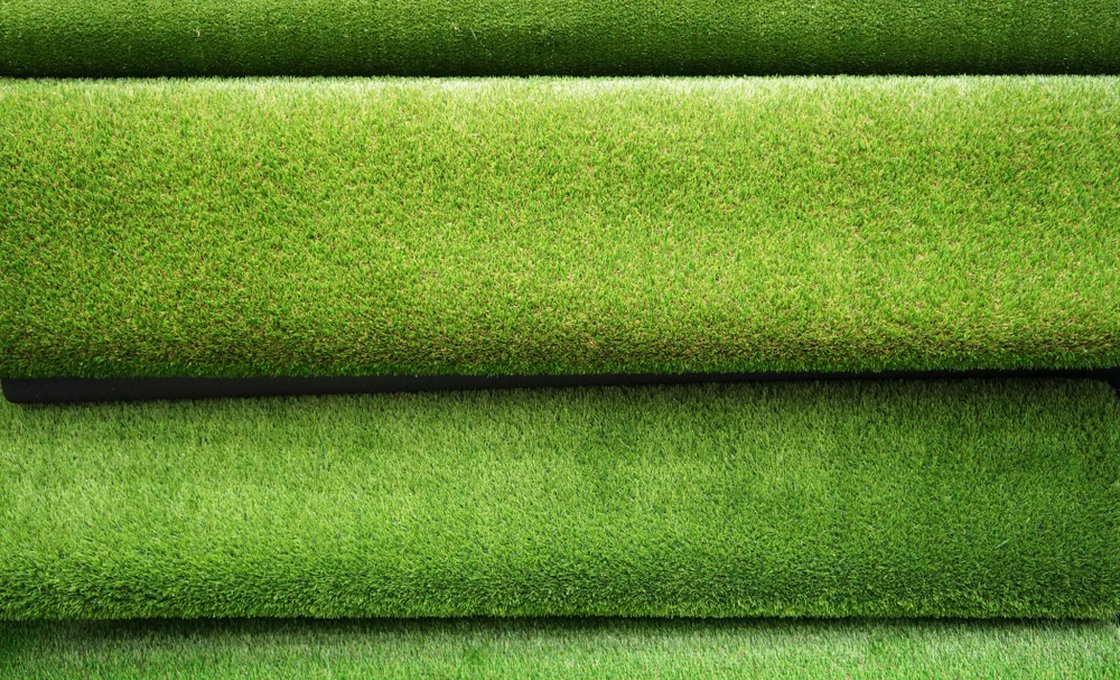
Pull-out force is the number to ask for. That comparison reaches approximately 35 N of tuft bind against roughly 20 N for many standard products, and credits the margin with keeping tufts fixed under repeated use. Coating quality, cure and penetration decide whether a roll keeps the figure after years of weathering. The roll construction and backing layers show where each element sits in a finished carpet.
Our own line treats this as the quiet half of uprightness: extrusion and tufting decide how a blade starts, but coating and drying decide how it finishes.
Structural Parameters That Decide Uprightness Compared
The four mechanisms translate into a short list of parameters you can compare between quotes for any artificial turf installation. The values below are published indicative ranges from the non-infill literature, not universal standards, and every row interacts with the others.
| Structural parameter | What it controls | Published indicative values |
|---|---|---|
| Fibre cross-section | Bending stiffness of each blade | Hollow diamond raises bending stiffness over 60% versus round fibres; U-shaped profiles about 45% higher lateral resistance |
| Straight-to-curled mix | Skeleton versus bracing and recovery | Common design concept 60:40 or 70:30; one published system runs 7:3 |
| Tuft density | Collective support between blades | Sports 12,000–15,000 tufts/m²; landscape 8,000–10,000 tufts/m²; one published spec about 10,500 tufts/m² |
| Yarn linear mass (Dtex) | Material per unit length behind the blade | 6,000–9,000 Dtex landscaping; 9,000–13,000 Dtex general sport; 12,000–16,000+ Dtex higher-use sport |
| Stitch density | Gap size and load spread | About 18,000–25,000 stitches/m² for many sports-oriented systems |
| Pile height | Lever arm working on the root | 35–50 mm football; 25–35 mm school multi-use; 20–30 mm recreational courts |
| Filament diameter | Rigidity of the blade at the same profile | C-shaped 0.8–1.0 mm; U-shaped 1.0–1.2 mm; diamond 0.7–0.9 mm, typically over 15,000 Dtex |
| Tuft bind | How firmly the root stays anchored | One published comparison: approximately 35 N versus roughly 20 N for standard products |
Read the table as a system, not a scorecard. A heavy yarn with a thin stitch rate leaves visible gaps, and an aggressive pile height with weak tuft bind invites leaning. The right answer for a school field rarely matches a stadium brief.
The Polymer Behind the Blade Stiffness
Three polymers dominate the yarn market, and each bends the uprightness equation differently. Polyethylene is the most common blade material for landscaping and residential work and pairs naturally with polypropylene thatch. Polypropylene is cheaper and stiffer but appears more in budget lines. Polyamide, the nylon of the group, resists wear and pulls double duty in curled fibres by swelling slightly in damp weather to push neighbours upright.
Formulation matters as much as family. UV stabilisers blended into the pellets before extrusion decide how well stiffness survives sunlight. That matters more without infill, because a ballasted blade hides fade and brittleness longer than a bare one. When a supplier quotes a fibre, the polymer and its stabilisation package belong in the same sentence as the cross-section.
We compound and extrude in-house, which is why polymer questions get answered at the pellet stage rather than in a brochure.
How Uprightness Fails on a Working Field
No field stays new, and the failure modes are specific. Compression matting arrives first where traffic concentrates: every artificial turf installation flattens under repeated footsteps, and a low-density or all-straight carpet shows it fastest. Published wear data gives a sense of scale. One specialist’s non-infill surface still holds about 92% upright retention after 10,000 simulated cycles, which is the kind of figure worth requesting rather than assuming.
Fracture is the second mode, and it is permanent. A blade that snaps at the bend line never stands again, leaving a flat spot no brushing repairs. Root shift is the third: weak tuft bind lets whole tufts lean under shear, and the lean spreads along wear lines.
Ageing runs quietly underneath all of it. UV exposure and abrasion thin the fibre over the years, and a blade that lost its stiffness recovers more slowly each season. None of these modes is unique to non-infill systems, but without ballast hiding the early symptoms, the surface shows them sooner, which is arguably useful.
What Recovers and What Never Does
Recovery splits into two categories, and buyers should name them separately. Temporary flattening, the carpet pressed down by an afternoon of training, springs back on its own. Published recovery figures run from a specialist’s 95% fibre recovery rate to landscape fibres rebounding within 1 to 2 seconds of pedestrian traffic. Hollow diamond profiles are credited with rebounding within 2 seconds of compression.
Brushing speeds the visible part of that recovery by lifting fibres back into the canopy, which is why light maintenance still matters even though the sand calendar is gone. For how these surfaces are specified indoors, see the complete indoor turf buying guide.
Permanent loss is different. Fractured blades stay flat, shifted roots keep leaning and UV-brittled fibres lose their spring for good. Those failures are specification problems rather than maintenance problems, and they are the reason the checking happens before the order, not after.
Testing Uprightness Before You Commit
Most of the verification fits on a desk. Bend a sample square flat, release it and time the recovery. Brush it a dozen times and look for shine or split ends. Compare the quoted tuft bind and simulated-wear figures against published comparables. A design guide for non-infill buyers makes the same point from the other direction: ask for laboratory evidence, because cross-section claims without test data are just geometry drawings.
A sample swatch costs little to examine and tells you more about uprightness than any brochure. Put it through the same bend-and-release routine on your desk, under the same daylight the field will see. Repeat it with a second candidate roll and compare how quickly each canopy springs back. Whichever sample recovers cleanest is the one worth quoting.
Worried the Pile Will Flatten Within Months?
Custom runs start from your drawing, not our stock list. Send the dimensions and the duty cycle, and we quote the yarn, backing and roll width that answer them.
Matching Structure to Workload and Budget
Matching the structure to the workload starts with hours, not looks. A published application guide layers its recommendations by use. Football systems run around 35 to 50 mm of pile, school multi-purpose areas at 25 to 35 mm, and recreational courts at 20 to 30 mm. Yarn linear mass climbs toward the 12,000 to 16,000+ Dtex band as usage intensifies.
The same layering applies to the mechanisms in this piece. Heavy-use fields earn their cost from reinforced profiles and deeper bracing, while a decorative lawn needs neither. Over-specifying is its own failure mode, because a surface too stiff for its sport plays badly and ages in the wrong places.
Our spec sheets are built to order rather than picked from a shelf. That means the custom yarn shape, density and pile height can be set against the workload instead of the catalogue.
Where Non-Infill Systems Fit Best
None of this makes no-fill systems universal. They shine where the old ballast created problems: schools and community fields that cannot schedule infill top-ups, indoor halls where loose granules are a nuisance, and landscapes where cleanliness matters. Sports with modest surface loads suit them best, which is why the sports artificial grass systems are split by sport and usage rather than by pile height alone.
For a buyer, the practical test is the one this piece has been running: hold every mechanism against the field’s real workload. Watching non-infill turf stay upright through a full training week on a sample board settles more debates than a spreadsheet of specifications.
Installed well, on a flat base with tight seams and drainage that clears, a non-infill artificial turf installation keeps that uprightness for years. The checking above is what separates the systems that last from the ones that fade.
Frequently Asked Questions
How does non-infill turf stay upright without infill?
Through structure instead of ballast. Stiff straight blades carry the load, curled fibres brace them, dense tufting makes blades lean on each other and the backing locks every root.
What makes non-infill turf stay upright after years of traffic?
Sustained stiffness plus recovery. One specialist publishes a 95% fibre recovery rate and about 92% upright retention after 10,000 simulated footsteps on its non-infill surface.
Can flattened non-infill turf recover?
Temporary compression recovers, sometimes within seconds, and brushing lifts the pile again. Fractured blades never stand back up, and shifted roots keep leaning.
Does non-infill turf need a thin layer of sand anyway?
No. A true non-infill artificial turf installation is engineered to stand without ballast; the crimped support fibre replaces what sand used to do.
Is non-infill turf suitable for sports pitches?
Yes, where the design matches the sport. Published school and recreational builds run 25–35 mm and 20–30 mm piles with sports-grade stitch densities.
How do I verify uprightness before ordering?
Bend a sample flat and time the recovery, then ask for tuft bind and simulated-wear data. Free 20 cm samples ship by DHL or FedEx in 4 to 6 days.


 English
  Arabic
  French
  German
  Portuguese
  Russian
  Spanish