

Three quotations land on the desk of a club developer in southern Spain, all for the same 20 × 10 m court. One quotes a 12 mm pile, one quotes density in fibres per square metre, and one quotes only a roll width. Searching padel court turf manufacturers China produces a short list in an afternoon; putting the three spec sheets on one table is where the project is actually won or lost.
We tuft padel rolls on our own line, and we read competing spec sheets for buyers every week. The gap between suppliers rarely sits in the grass itself. It sits in who controls extrusion, tufting and coating, how numbers are written down, and what gets checked before an artificial turf installation begins. Read a quote like a factory audit and the market sorts itself.
What Chinese Padel Turf Manufacturers Actually Supply
A padel court is a 10 × 20 m rectangle boxed in by 3 to 4 m of glass and mesh, with the net at 0.88 m. The carpet is one purchase inside a bigger system. Court builders buy steel, glass and fencing from separate supply chains. The turf line controls the surface, and the surface is where bounce, traction and colour live.
The sport behind the search is not small. Over 25 million people play padel across Europe, Latin America, the Middle East and Asia, and each new court starts with a carpet order. Padel court turf manufacturers China sell into that demand with pages that look interchangeable. They are not, because what separates a factory from a reseller is invisible on a product page.
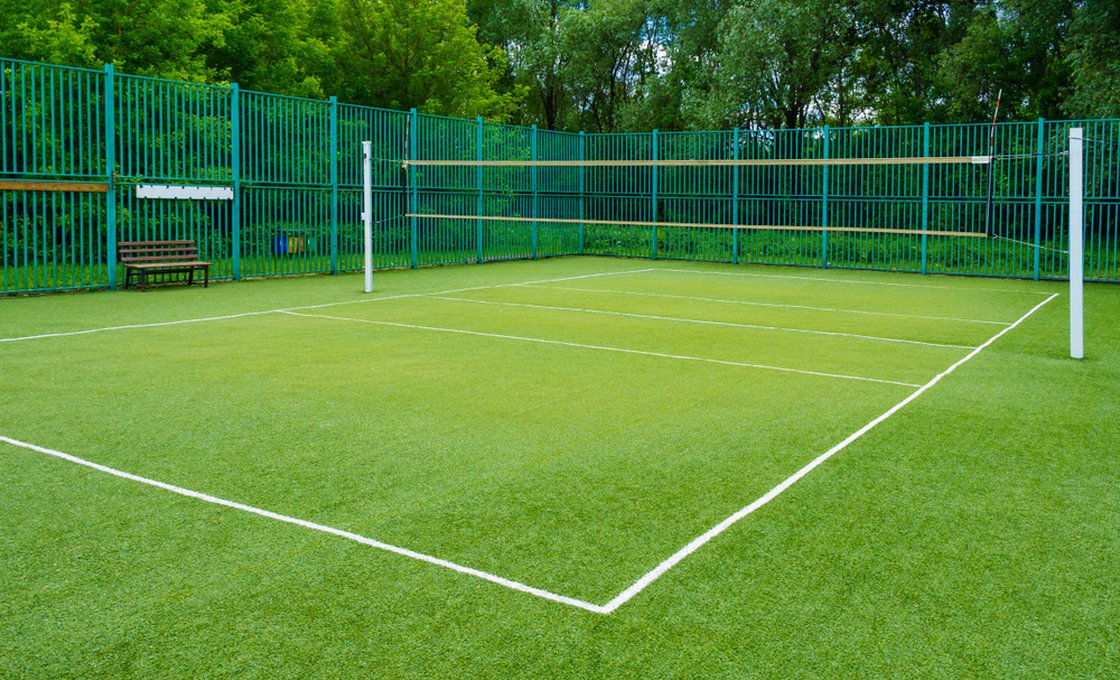
Capacity numbers give the first signal. One supplier advertises 10 production lines and over 1.5 million square metres of monthly capacity, and another has run a dedicated padel grass line since 2021. Advertised figures are marketing claims, yet a factory that states its line count is easier to audit than one that hides it.
Specifications That Define a Padel Court Turf Quote
Most padel court turf manufacturers China quote pile height and density first, because those two lines decide ball response. Professional courts run short pile, commonly 10 to 12 mm, filled with silica sand. A deeper 25 mm system, sand-filled to a similar loading, trades pace for cushioning and suits club play, as our padel court turf range shows.
Yarn type is the second axis. Curly monofilament is the common club standard, while texturized yarn trades some durability for bounce consistency. Read the two public spec blocks below and notice how every line carries a unit. That is the format a comparable quote should follow.
| Quote line | Curly monofilament | Texturized |
|---|---|---|
| Pile height | 12 mm | 12 mm |
| Yarn weight | 9,500 Dtex | 9,000 Dtex |
| Stitch rate | 30 per 10 cm | 26 per 10 cm |
| Density | 65,200 tufts/m² | 54,600 tufts/m² |
| Backing | PP + Net + SBR latex | PP + Net + PU latex |
| White line | Integrated into backing | Integrated into backing |

Backings deserve their own line in any comparison. PP + Net with an SBR latex coating is the workhorse build, while a PU coating holds the carpet flatter around the glass base rail. Whether the white line is tufted in or cut in later changes both price and fitting time.
Where Padel Turf Quotes Quietly Diverge
Quotes from padel court turf manufacturers China diverge in four places, and each one hides real money.
Density quoted in different units
One supplier counts tufts per square metre, another counts fibres, and a third prints a bare density figure with no unit at all. Public listings put the same idea at 65,200 tufts/m², 8,500+ fibres/m² and 31,500 density. Unless every quote is restated in tufts per square metre, the numbers cannot be ranked.
Pile height without the sand assumption
A 12 mm pile quote means little until the infill line appears beside it. Professional surfaces carry 15 to 25 kg/m² of silica sand. A quote that skips the sand loading is not cheaper; it is missing a line you will pay for later.

Backing and markings skipped
Some quotes name the backing, and some print a code nobody outside the factory can decode. Ask which build sits under the carpet and whether the white line is tufted in. Retrofitting markings after delivery costs more than tufting them in from the start.
Lead times without batch size
One manufacturer advertises 20-day lead times. The same page states a 3,000 square metre minimum for custom density, and both claims can be true. Lead times bind to batch size, colour changes and lot matching. A timeline quoted without the order details behind it is a wish.
Verifying a Manufacturer Before You Commit
Four checks separate a factory from a storefront, and all four happen before money moves.
Ask which production steps run in-house
Extrusion, twisting, tufting, coating and finishing are the steps that make a turf roll. A factory names the steps it runs and the ones it buys in. A trading company talks markets and margins instead. Vagueness here predicts every later dispute.
Demand a datasheet with every number
Ask for tufts per square metre, Dtex, stitch rate, backing build, sand loading and colour batch reference on one sheet. Matched-lot supply for multi-court projects should be written there, not promised on a call. Full datasheets shipped with the quotation are the norm, not a favour.
Order samples before the container quote
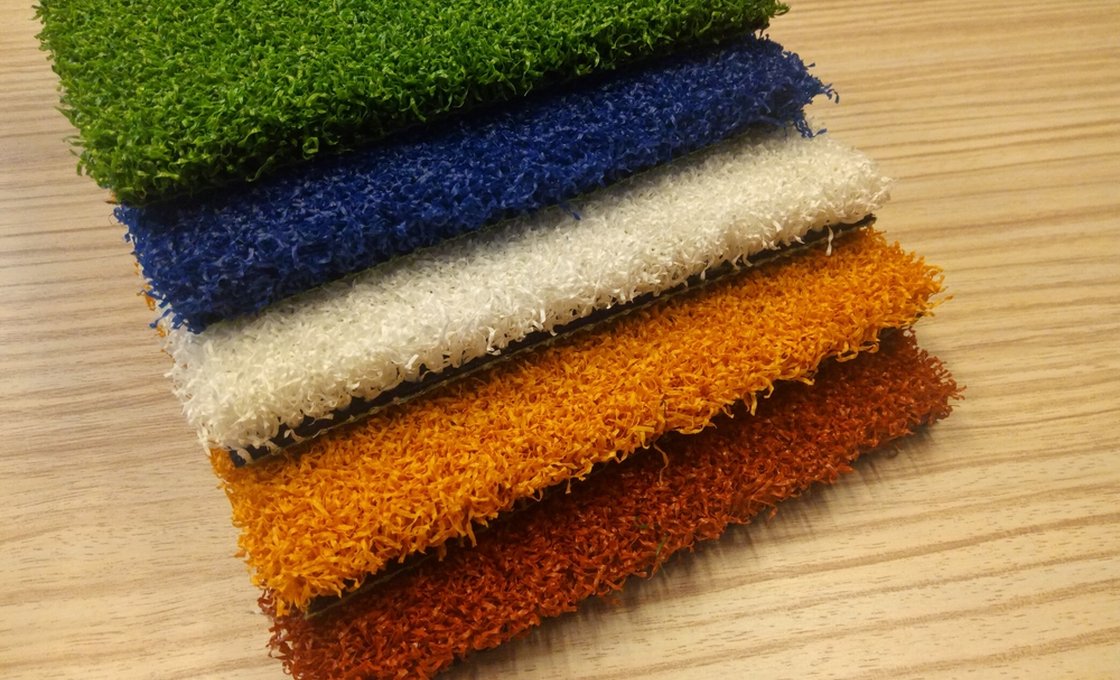
Free 20 × 20 cm samples, usually three to four pieces, travel by DHL or FedEx in 4 to 6 days. Courier freight is covered by the buyer. Hands confirm what pages cannot: colour in daylight, density under a thumb, backing flexibility. Order a sample swatch before any container talk.
Check wear evidence, not slogans
Suppliers who test publish numbers. One padel producer lists a laboratory report against a published Spanish surface standard, and another quotes 5,000 hours of UVA exposure testing. Ask for the report, not the adjective. Colour fastness matters most on uncovered outdoor courts, which is most of them, and an artificial turf installation that fades early cannot be repaired after the fact.
How Rolls Move Into an Artificial Turf Installation
One court takes roughly 200 m² of turf. Roll width decides how that area splits, and how many seams the fitter closes against the glass base rail. Standard factory widths run 2 m and 4 m with 25 m lengths and a 5 m maximum. See standard roll widths and formats for the factory-side view.
| Roll format | Area per roll | Rolls for one 200 m² court |
|---|---|---|
| 2 m × 25 m | 50 m² | 4 |
| 4 m × 25 m | 100 m² | 2 |
| 5 m × 25 m | 125 m² | 2, with offcuts |
Wider rolls cost more per roll and move less easily through narrow gates, which is why 2 m rolls suit tight urban sites. Multi-court projects should ask for matched lots, so every court reads the same colour under floodlights. One producer states 3,600+ padel courts delivered and 4,000+ turf replacements completed, which is batch discipline at scale. That record only holds if the same yarn and the same line back every artificial turf installation the buyer orders.
Once the rolls land, an artificial turf installation moves quickly: unroll, seam, secure the perimeter and fill the sand in passes. Planning the roll map before the container leaves prevents offcuts nobody ordered.
Pricing Signals in the Chinese Padel Turf Market
Prices in this market follow structure, not stickers. Yarn weight, density, backing build, order size and lot matching move the number far more than negotiation does. That is why suppliers who skip spec lines and lead with a bare per-square-metre figure are usually pricing a different product. The number looks lower until the missing lines reappear as extras.
Factory-direct supply removes a reseller margin, but the stronger signal is accountability: the line that tufted the roll also answers for it. Ask what the quoted price assumes, from pile and density to backing, sand loading and delivery term. Every assumption a supplier writes down is one fewer dispute at customs.
Comparing Padel Turf Quotes That Never Match?
Inconsistent specs across suppliers waste months and margin. We quote sand-filled padel turf against your exact sheet, typically 30–50% below market prices on like-for-like specifications.
Where Padel Court Projects Go Wrong
Sunlight is the first place projects go wrong. Uncovered courts fade fastest when colour fastness evidence is missing from the quote, and a faded court reads old long before it wears out. Ask for the test report, then keep the sample from the approved batch as the reference.
Maintenance is the second. Sand-filled surfaces need brushing and top-ups to hold their bounce, and clubs that budget the fill but not the grooming end up with compacted lanes. Freight terms come third: agree where the seller’s responsibility ends, at a destination port or at handover to your forwarder, before the deposit moves.
The last failure is a spec mismatch. A club that bought professional 10 to 12 mm pace while its players needed the cushioned 25 mm build will feel it every session. Match the surface to the programme, not to the brochure.
Matching Samples and Lot Control Before Shipment
Approve the sample, then make the batch follow the sample. Custom pile heights, densities and colours are routine factory work, and blue or green court colours are available on request. Write the approved sample reference into the purchase contract so production has a target, not a mood board.
For multi-court builds, matched lots are the difference between one venue and four slightly different ones. Colour and density changes are made to your specification against a written brief. For a wider view of surface choice, our court-level selection guide covers pile, yarn cut and backing in depth.
Frequently Asked Questions
How much turf does one padel court need?
About 200 square metres for a standard 20 by 10 metre court. Two 4 m rolls of 25 m cover it, with offcuts trimmed at the glass base rail and perimeter mesh.
What pile height do professional padel courts use?
Most professional padel courts specify 10 to 12 mm pile, sand-filled for a low, controlled bounce. Deeper 25 mm systems suit club and recreational courts that want a slightly cushioned surface.
Should I buy monofilament or texturized padel turf?
Both appear in professional quotes. Curly monofilament at around 12 mm is the common club standard, while texturized yarn trades some durability for bounce consistency. Compare them in the same density units first.
How do I compare quotes from padel court turf manufacturers China?
Put every line in the same units: tufts per square metre, Dtex, stitch rate, backing build and sand loading. Quotes that hide any of those lines are not comparable on a like-for-like basis.
Can padel turf be made in custom colours or densities?
Yes. Yarn colour, shape, density, pile height, backing and roll dimensions can all be made to a stated specification. Custom densities, however, can carry minimum order quantities that small projects cannot reach.
How are samples shipped before a bulk order?
Free 20 by 20 cm samples, usually three to four pieces, ship by DHL or FedEx in 4 to 6 days. Courier freight is covered by the buyer, and custom samples need extra production time.


 English
  Arabic
  French
  German
  Portuguese
  Russian
  Spanish