








Crews who come back for replacement rolls after a failed first season tell the same story. The lawn has sunk in patches, puddles sit where water used to run off, and weeds push through the seams. The grass itself is almost never the failure point. The fault was decided months earlier, in the ground works – in an unaligned dig depth, compaction claimed but never proven, and a fall guessed instead of tested.
We see the same pattern from the spec desk: the roll was made to spec, but the ground under it never met a checkable standard. So we run the build as an acceptance flow: seven stages, each ending in a verdict – a number hit or a test passed – before the next stage starts. That is how we prepare ground for artificial grass on soil sites: set the level, hit the number, prove the stage done.
Survey the Site and Set Finished Levels
Prepare ground for artificial grass by starting at the top, not the bottom: finished levels come before dig depth. Mark exactly where the new lawn meets patios, paths, steps and thresholds, because those fixed points decide the finished level the whole build-up has to land on. Per one UK groundwork specialist guide, never raise the ground over a damp-proof course or cover air bricks, and check for buried services before excavation or driving stakes.

Next, read the soil before you commit to a depth. Clay holds water and can swell or stay waterlogged for hours after rain, while sandy ground drains freely but shifts under load. The read decides how deep you dig and which drainage measures follow, so write it into the site notes before anything is ordered. One UK installer guide adds a simple rule: where soil is clay-heavy or prone to waterlogging, dig a bit deeper.
Logistics belong in the survey too. A turf cutter strips the root mat at one precise, adjustable depth where spade digging runs shallow-deep-shallow. Waste is the hidden line item: per one installer DIY guide, a standard 40 sqm garden can fill a 4-yard skip, so plan the route before the crew arrives. Treat total dig depth as a budget of layers – grass roll, structural layer, laying course – with roll width and pile height made to spec. The full installation prep walkthrough that covers ordering and staging picks up from there.
Strip Topsoil and Dig to the Right Depth
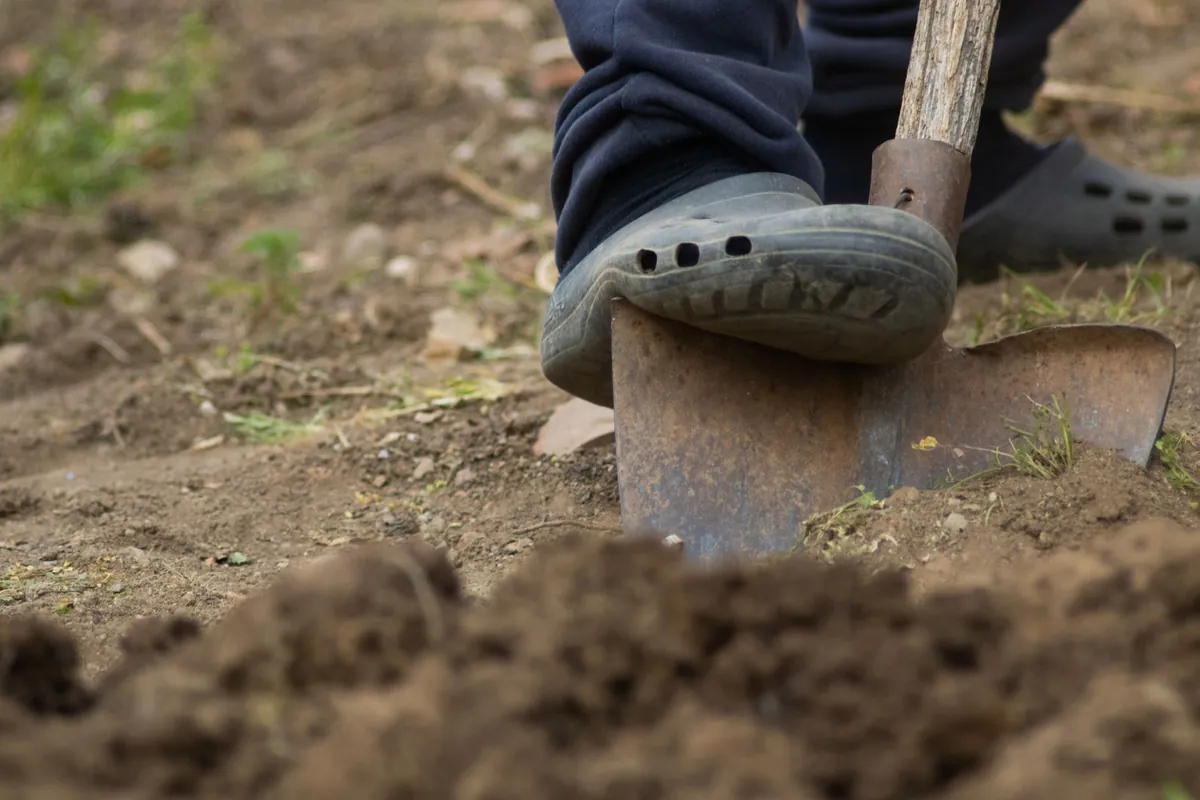
Stripping is where specification discipline starts, and it rewards a clean machine pass over heroic shovel work. Mow the existing grass as low as the machine allows first; the root mat then lifts in one readable layer instead of a torn mix of blades and soil.
Remove the Existing Lawn Cleanly
Per one manufacturer install guide, mow low, then remove 50-100 mm of topsoil with a sod cutter or spade, raking out roots, rocks and debris as you go. A hired turf cutter wins for the same reason as in the survey: it slices the root network at one precise, adjustable depth. Hand digging runs shallow-deep-shallow and leaves a ragged horizon that complicates every later depth check. Depth is a design decision, not a fixed rule – never bury unsuitable material to save a skip load.
How Deep to Dig for Artificial Grass
Published depth figures disagree until you read them as one spread. Total dig depth runs about 75-100 mm per UK installer guid