








A facility manager can prune, torque, and log every inspection on schedule, and the next incident report will still point at the surface first. That is not bad luck. Falls dominate the profile of playground injuries artificial grass surfacing was engineered to influence, and the CPSC handbook treats the surface as a decisive factor in how a fall ends.
We spec playground systems for schools, parks, and childcare operators, and the reading order never changes: injury data first, attenuation thresholds second, field verification third. Get those three in line, and the surface becomes an engineering decision instead of an after-the-fact finding.
The Injury Profile: Where Playground Injuries Actually Come From
The injury data gives facility buyers a clear starting point. Per the CPSC handbook, almost 200,000 playground-equipment injuries were treated in US emergency departments annually in recent years. Most begin with a fall from equipment onto the ground, the mechanism behind most playground injuries artificial grass surfacing is specified to manage.
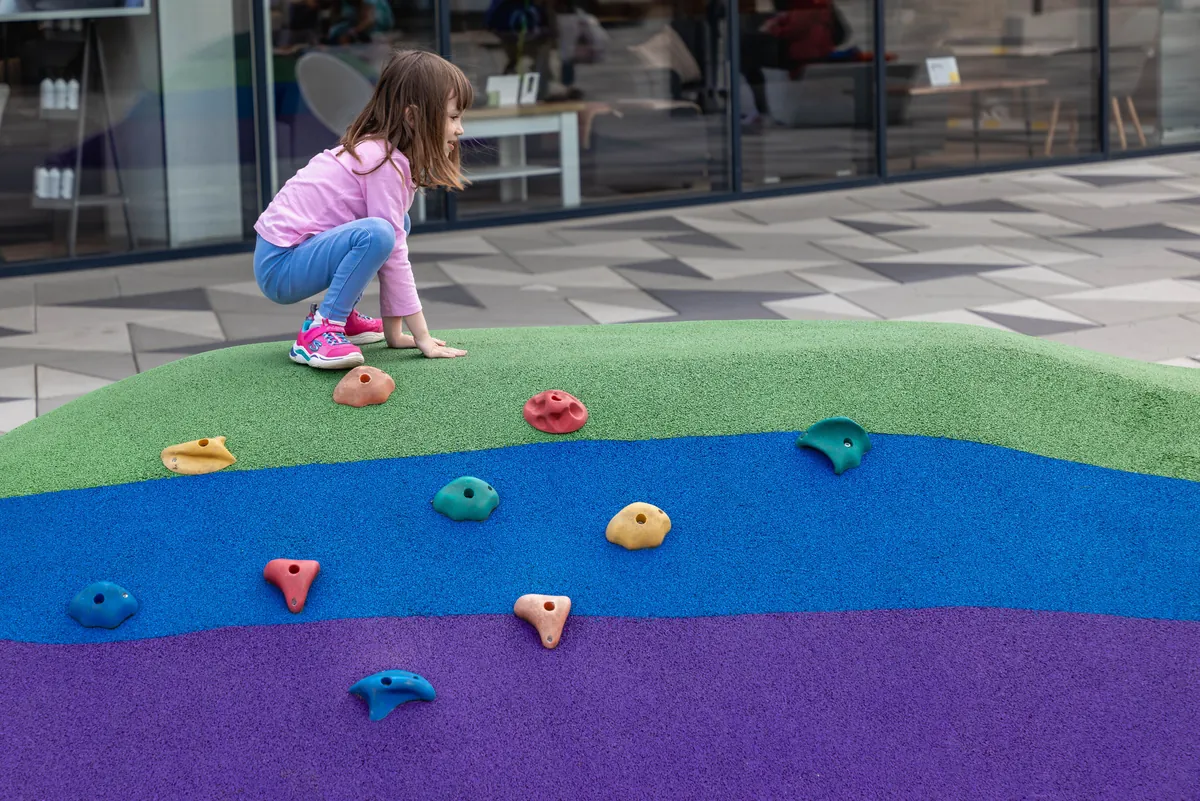
In a CPSC-cited study of 1,775 incidents reported from 2009 to 2014, equipment-related hazards accounted for 38% and falls for 29% of the sample. Percentages from a reported-incident sample describe what gets reported, not everything treated, so read them as a pattern map rather than a census.
The handbook’s preface states it plainly: most injuries occur when children fall from equipment onto the ground. That qualitative framing appears in the CPSC Public Playground Safety Handbook, alongside the surfacing guidance this article applies.
Head injuries carry their own line item. CDC surveillance for 2010 to 2016 estimated 283,000 emergency-department visits per year for sport- and recreation-related traumatic brain injuries among children, with playground activities among the five highest categories. That ranking reads as engineering direction: the head is the organ the surface is asked to protect. Scrapes and trips are the consistency failures it is asked to limit.
When Hard Ground Turns a Fall Into an Injury
What the ground is made of decides how much of a fall the body absorbs. The CPSC handbook is blunt about the options that fail that test.
The Hard-Surface Problem
Asphalt and concrete are not acceptable under and around playground equipment, per the handbook, and soil or hard-packed earth is not recommended because its impact absorption is poor. A fall onto a shock absorbing surface is less likely to cause a severe head injury than the same fall onto a hard surface. That is the handbook’s conditional wording, and it is why surface choice is an engineering decision at all.
Hard surfaces rarely announce themselves as a choice. They arrive as the ground that was already there. A compacted base under old equipment, a paved path children cut across, or earth packed to concrete density by years of foot traffic. The handbook’s rejection list targets these defaults, because a fall outcome depends on absorption the surface cannot supply.
What Wear Does to Natural Grass
Natural grass and natural turf start out softer and lose that property in use. The handbook does not recommend them for protective surfacing because wear and environmental conditions reduce their fall absorption. Traffic lanes compact first, then go bare, then harden.
Loose-fill materials bring a related failure. They compress at least 25% over time, per the handbook, and should be inspected for displacement in high-traffic areas such as under swings and at slide exits. This is the failure mode playground injuries artificial grass systems are engineered to remove: attenuation that does not depend on how last week’s weather treated the ground.
Critical Fall Height, HIC and g-max Explained
Every number attached to playground injuries artificial grass ratings traces back to two scoring terms. g-max is a measure of the maximum acceleration, or shock, p