
We tuft carpet for sports fields, and school football field artificial turf projects now fill more of our inbox than any other athletics question. Athletic directors arrive with three quotes, a board meeting date and a field that closes every time it rains. The quotes rarely match line for line, and that is exactly where the trouble starts.
Two things decide whether the project succeeds: how honestly the budget is broken into line items, and how the install fits the school calendar. Get those right and the surface pays you back in playable hours for a decade. Get them wrong and the field becomes the most expensive patch of ground on campus.
What a School Football Field Conversion Really Costs
A full-size high school project lands between $500,000 and $1.2 million installed, and most schools spend around $800,000 once demolition and basic fencing are included. District facility planners often work from a simpler rule of thumb: roughly $15 per square foot for the turf system, excluding underground soil fixes. Treat any single quote as one point on that spread rather than the answer.
The spread exists because bids omit different things. Demolition and haul-away of the old field, grading on poor ground, lighting, bleachers and scoreboards frequently sit outside the base number. One contractor’s guide names surprise costs first among the reasons school budgets overrun. Ask every bidder for a written line that runs from demolition to final inspection.
Schools that bridge the gap well tend to phase the work, installing the field now and adding lights or bleachers when the next funding cycle opens. The point is to see every omitted line before you sign, not after.
The Playable Hours That Justify the Budget
Usage is the argument that survives a board meeting. San Angelo Independent School District published a ten year comparison for one football and soccer field. Natural grass cost $607,500 to establish plus $63,000 a year, totaling $1,237,500 for 4,800 usable hours. Their synthetic field cost $900,000 plus $12,500 a year, totaling $1,025,000 for 16,000 hours.
That works out to $257.81 per playable hour on grass against $64.06 on turf. Grass fields also need rest days after rain, which squeezes band practice, physical education and youth leagues into a shrinking window. A turf field takes bookings back to back, and rentals to community groups can return $10,000 to $40,000 a year.
When you price a school football field artificial turf proposal, price it in dollars per playable hour rather than sticker price. That single reframe is what moves most boards.
How the Budget Breaks Down Line by Line
Read every bid line by line, because the carpet is one layer of a system, not the system itself. Recent regional ranges from sports construction contractors look like this.
| Component | Typical unit cost | What it buys |
|---|---|---|
| Turf carpet, standard monofilament | $2.50 – $4.00 per sq ft | The visible playing surface |
| Turf carpet, premium blend | $4.00 – $6.50 per sq ft | Higher durability under heavy use |
| Aggregate base | $0.90 – $2.00 per sq ft | Compacted crushed stone layer |
| Drainage system | $0.75 – $2.00 per sq ft | Pipes, basins and outlets |
| Shock pad | $0.75 – $1.50 per sq ft | Impact layer beneath the carpet |
| G-max testing | $800 – $2,000 per test | Independent hardness verification |
| Demolition and grading | $30,000 – $100,000 per field | Only when replacing an old field |
| Installation labor | $100,000 – $200,000 per field | Seaming, stretching and painting |
| Site amenities | $150,000 – $400,000 per field | Lights, fencing and bleachers |
Two rows deserve a second look. The shock pad adds $0.75 to $1.50 per square foot, about $43,000 to $87,000 on a full field, yet it improves impact performance and survives multiple carpet cycles. Independent hardness testing runs $800 to $2,000 per visit and continues for the life of the field.
From the factory side, the carpet itself typically represents a substantial share of a school project’s total. Factory-direct turf runs $7-60 per square meter depending on pile specification, grade and type, indicative until specification and quantity are fixed, so request exact quotes against your field drawings. Set that line against installer system quotes and the carpet’s true share of the budget becomes visible. We list roll formats and specifications on our artificial grass products page. Replacement planning belongs in the same spreadsheet: carpet is replaced every 8 to 12 years at $750,000 to $850,000 while the base beneath is reused.
Drainage and the Base Beneath the Carpet
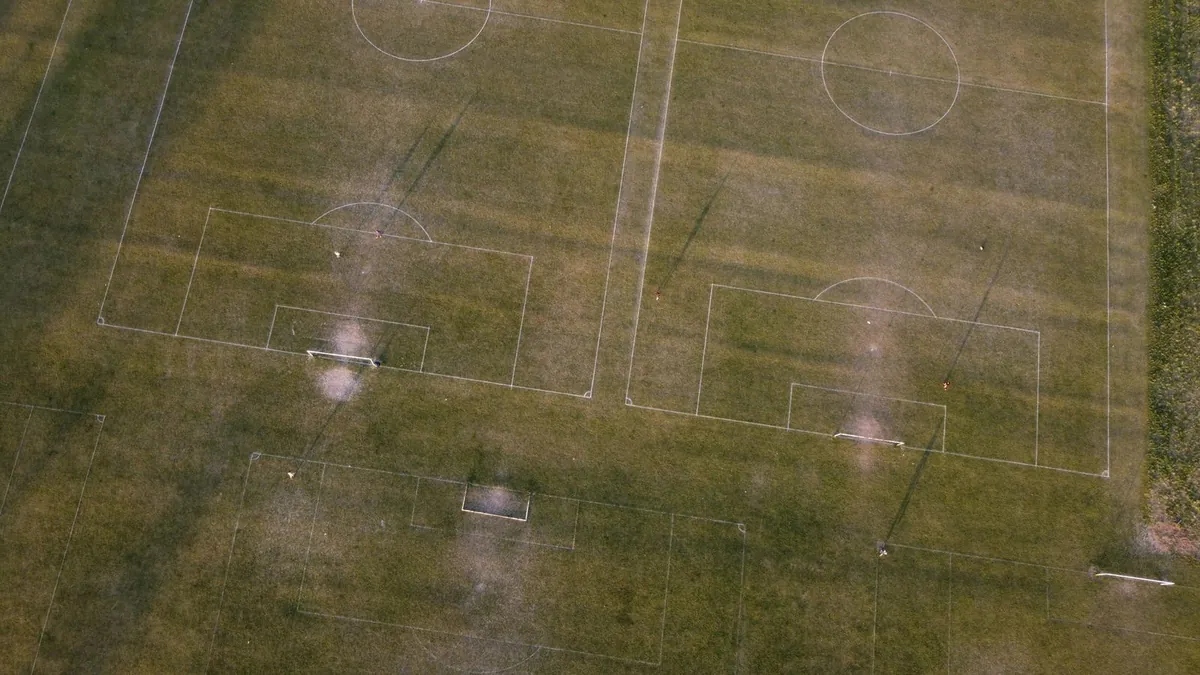
What sits under the carpet decides how long the field lasts. A typical build stacks a compacted subgrade, perforated drainage pipe in a grid pattern, and a thick course of crushed stone compacted to a 95 percent standard. A laser-graded finish layer follows, and many school specs add a shock pad before the carpet goes down.
Water is the design brief. Contractors grade the base to a one percent cross-slope so water sheets off, and district specs often demand the system drain at 20 inches per hour or better. Done right, a storm passes and the field plays the same day.
Poorly compacted bases are the leading cause of early field failures, which is why the paper trail matters as much as the stone. Before the carpet goes down, ask for compaction test results, and insist the crew flood-test the drainage outlets on the graded base. A base that drains on paper but not in a rainstorm is the expensive kind of surprise.
Maintenance Costs Compared Over Ten Years
Turf is cheaper to run, but not free. Contractor estimates put natural grass upkeep at $20,000 to $50,000 a year for mowing, watering, fertilizing and reseeding, while turf maintenance runs $5,000 to $15,000. District planning ranges run wider, from $12,000 to $30,000 for turf against $20,000 to $55,000 for grass.
The turf routine is real: sweeping and brushing to keep blades upright, infill top-ups in high-wear zones such as goal mouths, decompaction, and occasional disinfecting. Districts schedule hardness testing alongside this work so the surface stays within its certified range. A caretaker with a drag brush handles the weekly rhythm; the annual deep work is usually contracted.
Be skeptical of anyone selling a maintenance-free field. The honest comparison is a caretaker’s calendar against a grounds crew’s, and the difference compounds every year.
Scheduling Installation Around the School Calendar
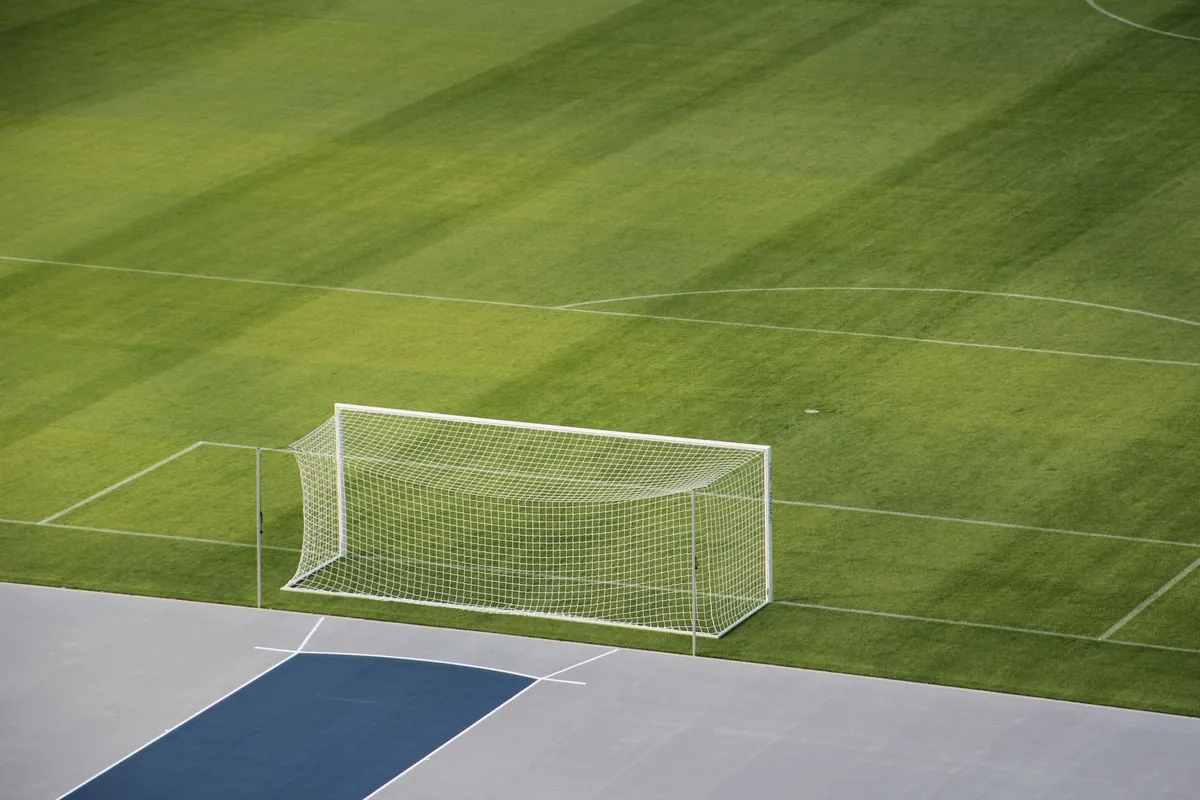
On stable, well-draining ground, contractors can move from demolition to first game in 8 to 10 weeks, which is why the summer break is the natural window. Expansive clay soils need lime stabilization and extra stone first, so ask your bidder which case describes your site. The soil answer changes the calendar more than the carpet choice does.
Work backwards from the first whistle. Collect bids in winter, award in early spring, finish groundworks and drainage after spring sports end, and lay carpet in mid summer. That leaves August for infill, line marking and hardness testing before scrimmages start.
A school football field artificial turf install scheduled this way hands the field back before the first practice, and the old grass never has to survive another season of waiting.
Surface Safety and the G-Max Standard
Surface hardness is measured as G-max, and school fields are commonly tested against the ASTM F1936 method with readings required below 200. Districts bring in an independent lab, often every other year, at $800 to $2,000 per test. When a field fails, it stays closed until corrective work passes a retest.
The question parents ask most is about crumb rubber infill. Federal research on recycled tire crumb, led by the Environmental Protection Agency and the CDC, ran from 2016 through 2024 at outdoor and indoor fields. The final exposure report found limited exposure on every measure used. Metals barely transferred in biological testing, blood levels matched the general population, and PAH markers showed no difference between turf and grass users.
Every school football field artificial turf project deserves the same paper trail: the install test report, the retesting schedule and the maintenance log that shows the surface stayed in range. Files like that answer questions before they are asked.
Heat, Infill and Honest Trade-Offs
Synthetic fields run hotter than grass in direct sun, and surface readings above 150 degrees Fahrenheit are documented on summer afternoons. Schools manage it with lighter colored infill, watering before events, scheduled hydration breaks and practice times moved away from peak heat. Grass stays cooler, and that remains one of its genuine advantages.
The infill decision drives both temperature and hardness, which is why it deserves its own line in the bid rather than a footnote. Ask what the infill is, where it comes from and how it ages.
Matching the Carpet to a School Brief
Start the specification from the schedule rather than the brochure. Count the weekly hours your field must host across football, soccer, band and community rentals, then match pile height, density and backing to that number. District spec sheets commonly settle on pile heights near two and a half inches for football, with infill depths specified to match.
Multi-sport sharing is where school budgets find their leverage. A school football field artificial turf surface can carry stitched lines for football, soccer and lacrosse in one carpet. The same material family covers shared campus spaces, from sidelines to artificial grass for playgrounds. On the sport-specific side, our football turf range shows the football-tuned builds side by side.
Field Project Slipping Past the School Year?
Late rolls and wrong widths push opening back a term. We cut field rolls to plan. Buying direct from the maker usually lands 30–50% below like-for-like market pricing.
How We Would Spec the Rolls
We would start from the yarn, not the label. Most football-grade carpet pairs polyethylene monofilament blades with a polypropylene thatch layer beneath, tuned to the pile height the usage plan demands. The backing comes next: a PP and net construction as standard, with a PU coating added where the site needs extra hold.
Perforating happens on our line before the carpet is rolled up, so drain holes arrive punched at the factory rather than improvised on site. Roll width is the quiet cost lever. Five meter rolls cross a field in the fewest passes, four meter rolls cover about 100 square meters each and suit most layouts, and two meter rolls fit tight sites. For nonstandard fields, we cut custom roll widths and pile specs to the drawing.
Questions to Ask Before You Sign
Five questions separate serious bidders from smooth ones. What does the base price include, line by line? Which compaction and drainage test reports come with the base? How is hardness retesting scheduled and who pays for it? What happens at year ten, and what does carpet replacement cost then?
Bring the district spec sheet if you have one, because numbers invite numbers. Specifications for drainage rate, pile height and infill depth turn a sales conversation into a compliance check. Walk the table above against every bid, and the missing lines will surface on their own.
Suppliers who answer with documents are worth shortlisting. Suppliers who answer with adjectives are selling the meeting.
Frequently Asked Questions
How long does artificial turf last on a school field?
Expect 8 to 12 years from the carpet, set by usage hours and fiber quality. The base and usually the shock pad outlive it, so replacement costs far less than the first build. Usage discipline decides where you land in the range.
Is crumb rubber infill safe for students?
Federal research through 2024 found exposures from tire crumb infill are likely limited, with blood metal levels matching the general population. Schools add diligence with sanitation records and regular testing. Review the EPA findings directly with your district’s environmental health staff.
Can one turf field host football, soccer and lacrosse?
Yes. Stitched line markings for several sports go into the carpet at production, and multi-sport scheduling is exactly where turf beats grass. Confirm line colors and layouts with suppliers before production starts.
How hot does artificial turf get in summer?
Surface temperatures above 150 degrees Fahrenheit are documented on sunny afternoons. Light colored infill, pre-event watering, hydration breaks and shifted practice times keep play safe. Natural grass stays cooler, which is the honest trade-off.
What maintenance does a school turf field still need?
Weekly brushing and debris removal, infill top-ups in goal mouths and hash marks, periodic decompaction and scheduled G-max testing. A school football field artificial turf routine runs on a caretaker’s calendar, not a grounds crew’s.
Will a turf field drain in heavy rain?
Engineered school systems are specified to drain 20 inches per hour or better, so play resumes the same day. If a field ever holds water, the fault sits in the base or its outlets, not the carpet.
 English
  Arabic
  French
  German
  Portuguese
  Russian
  Spanish