
B2B buyers asking how to secure artificial turf perimeter edges galvanized nails or sod staples arrive after the turf choice is locked. They carry the roll spec, the backing, and the infill plan. Before the crew walks on day one, they need the fastener count, the spacing, and the soil-fit decision. The wrong fastener does not fail the handover. It fails three to six months later.
On our bench the answer to how to secure artificial turf perimeter edges galvanized nails or sod staples is a four-question decision tree. Soil class, edge border, backing density, and project climate decide the fastener, the spacing, and the purchase count. The contractor who knows those four answers can lock the fastener list before the turf order is placed.
Why Perimeter Edges Lift First
Perimeter edges fail first because four mechanical loads land on the same one-meter strip. Wind uplift, thermal growth, infill loss, and soft-soil pull-out all attack that band together. The centre of the lawn carries none of those stresses.
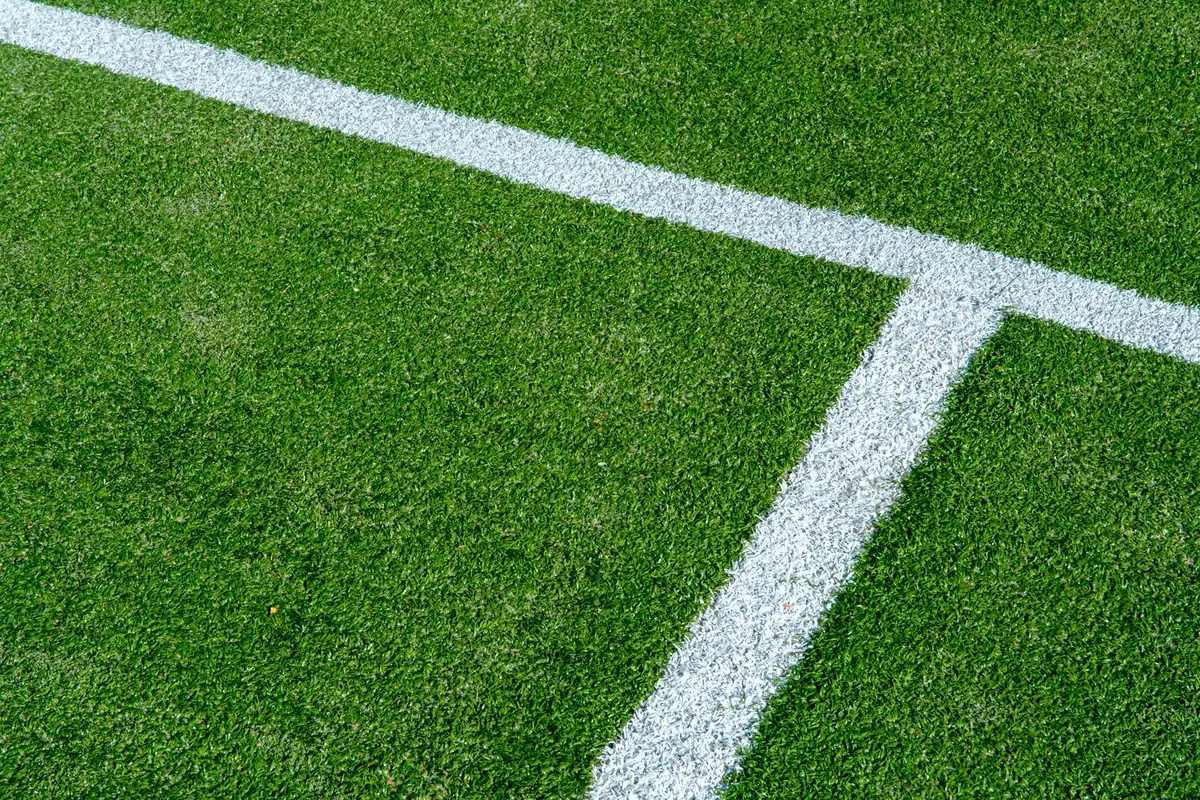
Wind uplift is the first load. Even a light breeze can begin to lift a loose edge and peel the strip like a flap. Thermal expansion is the second. Polyethylene and polypropylene blades grow in summer sun, and a closed perimeter turns that growth into a buckle.
Infill loss is the third. Heavy rain and leaf blowers sweep silica out of the edge band, and the missing infill lets the backing curl upward. Soft-soil pull-out is the fourth. A short fastener in sandy soil walks out under freeze-thaw and the edge lifts the following spring.
Our installers see the same pattern almost every week. The fix is not more fasteners at random. It is matching fastener type and length to the soil and border, then re-checking every quarter. We treat this section as the reference frame for every choice that follows.
Galvanized Nails Versus Sod Staples
The fastener decision rests on three site variables. Soil hardness, traffic or pet load, and proximity to salt spray each push toward a different tool. The question of how to secure artificial turf perimeter edges galvanized nails or sod staples in procurement usually comes down to which of those three dominates the site survey.
| Fastener | Best soil fit | Best edge type | Notes |
|---|---|---|---|
| 6 in galvanized turf nail | Hard, compacted soil | Open soil-to-lawn border | Highest single-point pull-out resistance |
| 11-gauge 4 to 6 in sod staple | Standard residential clay | Soft to medium border | Two prongs spread the load |
| 12 in landscape staple | Soft, sandy, mulched | Open border near frost zone | Longer shank reaches firmer sub-layer |
| Stainless steel staple | Coastal or salt-spray | Any border within 1 km of sea | Zinc fails in chloride zones within 1 to 2 years |
| PU adhesive plus trench | Concrete, pool deck, paver | Hard border with no soil to pin | Adhesive plus tucked edge, no fastener |
Our installers reach for a galvanized turf nail on hard, compacted soil where the shank bites and stays. They reach for a U-shaped sod staple on softer border, because two prongs spread the load and survive frost heave better than one shank.
The key perception to correct: nails and staples are not interchangeable. A short staple driven into rocky soil bends during install and sits proud. A long nail in loose soil does not grip better than a long staple. Match the tool to the soil first, then confirm with the edge type.
Soil Type Picks the Fastener
Soil class is the upstream filter that decides the fastener before any other factor enters the picture. Five classes cover almost every B2B residential and light commercial site.
| Soil class | Fastener | Spacing along edge | Buy list scale |
|---|---|---|---|
| Hard compacted with rock | 6 in galvanized turf nail | Every 4 to 6 in | Count by perimeter |
| Standard clay or loam | 11-gauge 6 in sod staple | Every 4 to 6 in | Count by perimeter |
| Soft, sandy, mulched | 12 in landscape staple | Every 4 to 6 in | Count by perimeter plus 10 percent spare |
| Coastal or salt-spray | Stainless staple, same gauge | Every 4 to 6 in | Count by perimeter plus 10 percent spare |
| Concrete or pool deck | PU adhesive plus 1 in trench | Continuous bead | Tubes counted by linear metre |
A 100 m² site running a 4 m by 25 m roll carries a perimeter close to 58 m. That edge takes roughly 7 to 10 fasteners per metre. At a 4 to 6 inch rhythm that is near 400 to 570 perimeter fasteners, plus a handful at any internal seam. The count scales with perimeter, not with area.
Specific shank length and gauge sit outside what we publish here because they shift with the soil sample on the day. Match the roll width and backing to the fastener plan the site requires.
Edge Types and Fastener Fit
Three edge families cover B2B residential and light commercial builds. Each carries its own fix.
| Edge family | Typical border | Primary fix | Secondary fix |
|---|---|---|---|
| Hard border | Concrete, pool deck, paver | PU adhesive plus 1 in trench | No fastener, adhesive carries the load |
| Soft border | Soil-to-lawn transition | Sod staple every 4 to 6 in | 12 in stake every 2 ft behind bender board |
| Open border | Two rolls meeting, roll to fence | 2×4 nailer board plus 3 to 5 in staple | Weed barrier membrane half-buried |
Hard borders do not take a fastener. Our installers score a 1 in trench along the concrete, tuck the edge into the gap with polyurethane adhesive, and weight it for the cure window.
Soft borders take a sod staple every 4 to 6 in along the edge. Behind the edge a 2 ft rhythm of 12 in stakes anchors a bender board whose top sits half an inch below the pile. The half-inch gap hides the board and leaves room for thermal growth.
Open borders carry the heaviest load because two rolls meet. A nailer board plus 3 to 5 in staples and a weed barrier strip give the seam a foundation that holds through years of typical foot traffic.
Spacing Rules and Walk Tests
Spacing lives on three rhythms at once. Edge rhythm, internal seam rhythm, and walk-test rhythm each answer a separate question.
The edge rhythm runs 4 to 6 in along the perimeter. This band takes wind and foot traffic. Any wider and the edge reads loose to a footfall within a season. Any tighter and the crew is over-stapling: heads stack, the pile lifts, and the surface reads as a stripe of micro-bumps.
The internal seam rhythm runs 12 to 16 in along any seam that is not on the perimeter. Seams are not stressed the same way and do not need the same density.
The walk-test rhythm separates a clean handover from a callback. After every three to five fasteners the installer steps on the edge with full weight. They brush the pile back over the head and check the head sits below the thatch line. A head that shows goes deeper. A pile that lifts means spacing is too wide.
Our installers run this rhythm without thinking. The over-staple trap is the failure crews slip into when they over-correct. Six staples in four inches hold the same as four well-spaced staples and read worse.
Match Roll Width to Seam Math
Roll width is the upstream variable that decides seam count, and seam count decides how much fastening work sits ahead of the crew. Our line runs three standard widths on a 25 m length: 2 m, 4 m, and 5 m. Each extra seam adds to the fastener count, so the width choice reaches the fastener budget before the first roll is cut.
Take a 12 m wide residential courtyard 8 m deep. A 2 m roll gives six strips and five seams. A 4 m roll gives three strips and two seams. A 5 m roll gives three strips, two seams, and roughly 1 m of offcut per strip.
Wider rolls cut seam count. The 2 m roll is cheaper per metre and easier to handle on tight sites.
The seam maths feeds straight into the perimeter fastening total. Each seam needs a nailer board, a row of 3 to 5 in staples, and seam tape with adhesive. Two seams carry about half the fastening count of five seams.
Backing Density and Nail Selection
Backing density changes what the fastener has to push through before it bites soil. Four backing families ship on our line, and each asks a different thing of the nail head.
| Backing family | Density profile | Fastener adjustment | Where it sits |
|---|---|---|---|
| PP plus Net | Standard landscape weight | Standard nail head works | Most residential projects |
| PP plus non-woven | Heavier, more stable | Slightly sharper point | Medium traffic, slopes |
| PP plus Grid cloth | Sport-grade, highest PP mass | Sharper point or pre-punch | Sport and high-traffic sites |
| PU optional | Densest, water-friendly | Sharpest point, slower drive | Pet, pool, water-heavy sites |
Standard PP plus Net accepts a regular nail head with no prep. PP plus non-woven and PP plus Grid cloth reward a sharper point because the extra mass resists entry. PU optional asks for the sharpest point on the rack. A blunt point on PU glazing the surface and leaves the head proud, which the walk-test catches.
Backing density is also a variable the buyer can move at the order stage. Our team switches a project between the four options on the same production slot. A change in backing should re-run the perimeter row. It is the last lever the buyer controls before the order is cut, and it directly affects how to secure artificial turf perimeter edges galvanized nails or sod staples.
From Roll Count to Fastener Pack
The roll-to-pack math is the one piece of the perimeter question that almost every project gets wrong, and it is also the easiest to fix with a simple conversion. Fasteners count by perimeter, not by roll, but the budget lives on the roll.

A 4 m by 25 m roll covers 100 m² with a perimeter close to 58 m. That perimeter takes roughly 7 to 10 fasteners per metre. At a 4 to 6 inch rhythm the perimeter carries close to 400 to 570 fasteners. Add 10 to 15 percent spare for cuts and rework, and the order lands near 440 to 655 fasteners per roll.
A 2 m by 25 m roll covers 50 m² with a heavier fastener share because it carries more seams per square metre. That count scales with perimeter, never with area.
Treat that count as the ordering list for the perimeter. A ten-roll project sets ten rounds of fasteners, matched to soil class, backing choice, and edge family. Roll width and backing then follow the perimeter the fastener plan defines.
For B2B buyers, knowing how to secure artificial turf perimeter edges galvanized nails or sod staples at scale is really a counting question. Work the total out early and lock the list before the rolls are cut.
Coastal and Sloped Site Upgrades
Two site conditions break the standard fastener rule and ask the buyer to upgrade hardware that looks like overkill on paper. Both cost less than a return visit.
The first condition is coastal or salt-spray exposure. Standard zinc fails in chloride zones. The first pitting shows inside twelve months on a beachfront install and the head starts bleeding rust into the pile by month eighteen. The upgrade is a stainless steel staple in the same gauge and shank length. Unit cost is higher, lifecycle cost is lower, and the visual stays clean.
The second condition is slope or strong lateral pull. A lawn on a gradient carries constant shear load toward the downhill edge. Standard staples walk under that load. The upgrade is a spiral-shank galvanized staple that locks through rotational resistance rather than friction. The same upgrade covers pet runs and high-traffic commercial entries.
Our opinion on perimeter fasteners is settled. On sites with both conditions we use stainless plus spiral. An upgrade is cheap insurance on the day of install and expensive rework six months later. The lifecycle math always favours the upgrade.
Year-Round Checks That Hold Edges
Perimeter edges do not hold themselves. They need a quarterly check that catches small failures before they become return visits. Four checks cover the year.
Spring is the frost-thaw check. Walk the perimeter, focus on bender board sections, and look for staples that have walked up under freeze action. Reset them with a single hammer blow and brush the pile back over the head.
Summer is the infill check. The last six inches lose infill fastest under heavy use. Top up to the standard infill rate and check that the thermal expansion gap at the corner has not closed.
Autumn is the wind check. After the first storm, walk the perimeter on the windward side and look for lifted staples. Replace lifted hardware rather than resetting it.
Winter is the deep check. Pull one or two staples and inspect the shank for rust. On coastal sites this check is non-optional. The annual perimeter log gives the B2B buyer the maintenance trail to put in front of any warranty conversation.
Match the Roll Spec to Your Fastener Plan
The cleanest way to settle how to secure artificial turf perimeter edges galvanized nails or sod staples is to freeze the fastener plan first. Match the roll width, backing and pile height to the plan the site requires. That removes the weekday the project otherwise loses to a missing fastener run.
Our line covers standard roll widths at 2 m, 4 m, and 5 m on a 25 m length, with custom widths on request. Backing options include PP plus Net, PP plus non-woven, PP plus Grid cloth, and PU. A 20 cm by 20 cm sample dispatches in four to six days on a standard SKU. The buyer who settles how to secure artificial turf perimeter edges galvanized nails or sod staples before the rolls are cut keeps the crew moving.
Edges Lifting Along the Perimeter?
Loose edges are usually a roll-width problem, not a fixing one. We cut to fit. Priced at the factory gate, typically 30–50% under market on comparable specifications.
Common Mistakes When Securing Edges
Five mistakes cover most of the perimeter callbacks we see. Each has a one-line fix the crew can run on the day of install.
The first mistake is picking a fastener from habit rather than from the soil. Short staples in soft soil walk out within a season. Match shank length to soil class.
The second mistake is over-stapling a section that looks loose. Six staples inside a four-inch span hold the same as four well-spaced staples. Hold the rhythm and trust the spacing.
The third mistake is adhesive on hard borders without a pre-applied tack coat. The bond fails at the first thermal cycle. Run a primer pass before the bead.
The fourth mistake is a closed thermal expansion gap on a hard border. Cut a relief at every corner and leave a 1 in trench at the wall.
The fifth mistake is a nail head that sits proud of the thatch line. The walk test catches it: brush the pile back into place every three to five fasteners.
For B2B contractors, the mistake list prints to a wallet card the install van keeps. Five lines, five fixes, and the callback rate drops.
Residential Site Fastener Decision Snapshot
Three residential scenes cover the bulk of B2B residential perimeter work. Each carries a one-line fastener decision the crew can run from a table on the van.
| Site scene | Fastener | Spacing | Secondary fix |
|---|---|---|---|
| Standard rear yard | 6 in galvanized turf nail | 4 to 6 in along edge | Double infill in the last 6 in band |
| Pool surround or hard border | Stainless staple plus PU adhesive | 4 to 6 in plus continuous bead | 1 in trench tuck along hard border |
| Pet run or dog zone | 5 to 6 in spiral turf nail | 4 to 6 in along edge | 2×4 nailer board at any open border |
Standard rear yards take the basic fastener and the basic rhythm. Pool surrounds add stainless because the chloride load is constant and the visual streak from a rusting head is a brand risk.
Pet runs and dog zones take the spiral nail because the lateral load from paws and claws walks a standard staple inside a season.
The snapshot ends at the same procurement question B2B buyers open the next ten rolls with: how to secure artificial turf perimeter edges galvanized nails or sod staples. The answer lives on the roll spec, not on the van. Buyers who fix the fastener count before they order the rolls land a project that installs clean and holds its edges through the seasonal checks.
Frequently Asked Questions
How long does an unsecured artificial turf perimeter last?
An unanchored perimeter can lift inside one season on a windy site and inside twelve months on a sloped or freeze-thaw site. The failure shows as a curled edge, an exposed backing strip, and missing infill along the last six inches.
Can nails and sod staples be mixed on the same perimeter?
Yes, but treat each edge family as one decision. Hard borders take adhesive, soft borders take staples, open borders take a nailer board. Mixing within one edge family adds complexity with no extra holding power.
What fastener holds best on a coastal salt-spray site?
Stainless steel staples in the same gauge as a standard landscape staple hold best. Standard zinc fails in chloride zones within twelve to eighteen months and the rust streaks the pile brown at the edge.
Should the nail head sit below the thatch line?
Yes. The head must sit below the thatch line so foot traffic does not catch it and so UV does not hit bare metal. Brush the pile back over the head after every three to five fasteners during the walk test.
How do I convert roll width to fastener count?
Count by perimeter, not area. A 4 m by 25 m roll carries close to 58 m of edge. At 4 to 6 inch spacing plan for 400 to 570 fasteners per roll, plus 10 to 15 percent spare.
How many fasteners does a 100 m² perimeter need?
A 4 m by 25 m roll covers 100 m² with a perimeter near 58 m. Plan 4 to 6 inch spacing for roughly 400 to 570 fasteners, plus 10 to 15 percent spare for cuts.



 English
  Arabic
  French
  German
  Portuguese
  Russian
  Spanish