

A hard, true surface is the whole promise of a non-turf square, and that promise is won or lost before the first ball is bowled. Get the base, seams and fixings right, and the carpet plays the same in week one and year five. Get them wrong, and no amount of rolling brings the bounce back.
Artificial cricket pitch installation rewards preparation more than speed. We manufacture the carpet side of that equation and watch closely how specified rolls behave once they are laid out. The sequence here follows the order the work actually happens in. Seven stages matter, and each one carries a pass or fail.
What An Artificial Cricket Pitch Actually Is
The Laws of Cricket define the pitch as a rectangle 22 yards, or 20.12 m, long and 10 feet, or 3.05 m, wide. Where a non-turf surface is used, the same Law sets a minimum of 17.68 m by 1.83 m for the artificial strip. Those two pairs of numbers frame every layout decision that follows.
An artificial pitch is a short, dense carpet laid over a prepared base, and an artificial turf installation is only ever as true as what sits under it. Clubs choose them because the surface plays consistently and stays usable year round, especially where natural grass struggles to survive.
The pitch definitions in the Laws are stable reading, and they are worth having open while the site is measured. Widths, run-ups and safety margins all hang off the same 3.05 m strip.
Plan The Square: Size, Siting And Drainage
Start on paper. Mark out the batting strip at roughly 10 to 11 m long by 2.75 m wide, the layout one installer guide uses for club squares. Then add the run-up length your bowlers actually use. A strip drawn to the true dimensions needs less trimming and fewer joins.
Siting comes next. Pick ground that is as level as possible and watch how water moves across it after rain, because low spots collect both water and silt. Drainage pipe runs are laid and covered with gravel before the sub-base goes in, so mark those lines now, not after excavation.
Temporary pegs and string lines set the levels for everything above them. Shoot the levels across the whole footprint at this stage. An artificial turf installation can be trimmed at the edges later, but the fall of the ground cannot be argued with once aggregate is ordered.

Build A Base That Stays Firm And Level
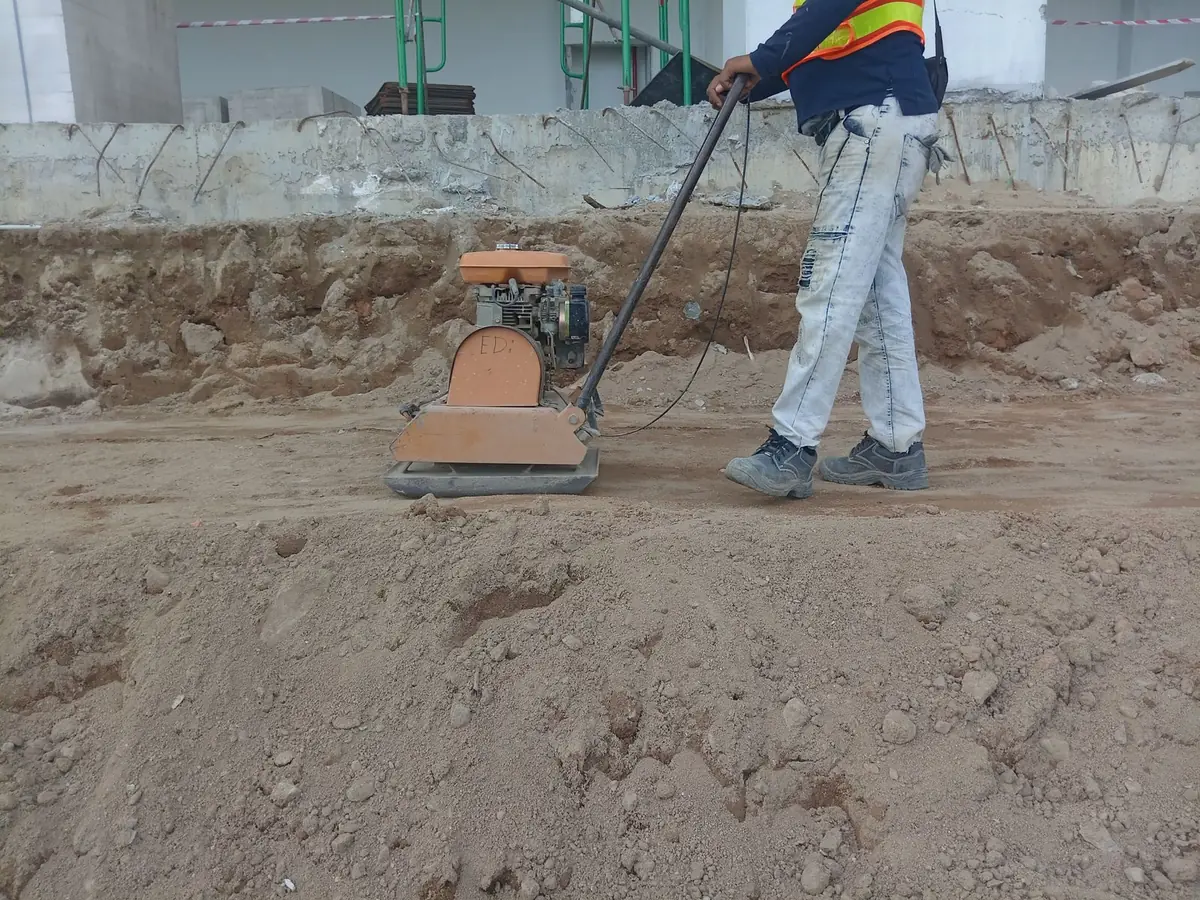
Artificial cricket pitch installation stands or falls on the base. A hard, level under-surface is what lets the carpet produce a consistent, true wicket, which is why every pass of the plate compactor is an investment in bounce.
One documented batting-end build excavates 100 to 150 mm, depending on soil. A 100 by 50 mm timber frame is set to accurate levels. Fill it with MOT type 1 or 20 to 5 mm granite or limestone up to 40 mm below the frame top.
| Base layer | Depth or spec | Purpose |
|---|---|---|
| Excavation | 100 to 150 mm, soil dependent | Room for the full build-up |
| Frame | 100 x 50 mm treated timber, set to level | Edge stability and level reference |
| Coarse base | MOT type 1 or 20 to 5 mm granite or limestone, to 40 mm below frame top | Structural strength and drainage voids |
| Finishing layer | Remaining 40 mm of 6 mm-to-dust limestone, wetted then compacted | Tight, smooth riding surface |
The finishing layer is the remaining 40 mm of 6 mm-to-dust limestone. Dampen the aggregate before compaction and work in halves, so each section is compacted all the way through rather than only at the surface.
Acceptance is simple. The finished base passes a laser or string level check with no bumps, the plate compactor leaves no fresh indentations, and a slight fall moves standing water toward the outlets. That finish is the part every artificial turf installation downstream inherits.
Lay The Carpet Without Wrinkles Or Bumps
Roll the carpet out over the prepared base and leave it to relax before fixing. Alignment matters from the first metre, because a carpet laid off-line telegraphs the error into ball roll and into how the square looks from the pavilion.
Stretch, do not drape. Fix one end first, pull gentle tension along the length, and walk the pleats out as you go. An artificial turf installation that is simply draped over dips will ripple in the first hot week. Tack the loose end while you sight the surface from each end for high spots.

Seam, Fix And Mark The Creases
Where one roll cannot cover the strip, seams are joined with the tapes and adhesives specified for the surface. Press the joint flush so it cannot catch a boot or deflect a ball. Joints left proud or open are the classic trip hazard on otherwise good work.
Fixings close the system. Flat-head nails at roughly 150 mm spacings, set about 25 mm in from the grass edges, hold the carpet under gentle tension. Adjust and re-tension to remove any remaining pleats before the nails are driven home flush.
Edging completes the frame. A surround fixed around the perimeter holds the carpet in place, keeps the boundary line clean and stops the outer strip lifting where boots pivot hardest. It is also the last chance to correct a level that has drifted, because every repair after handover shows in the surface.
Finishing is marking. Masking tape and white spray paint set the bowling, popping and return creases to the Laws’ measurements. The batting end takes no dried infill sand, because sand on that section reduces ball bounce. At this point artificial cricket pitch installation is complete; what follows decides whether it stays complete.
Struggling With Bounce That Never Plays True?
Unreliable bounce costs clubs fixtures and repeat orders. We build cricket rolls to your pile, density and backing spec, factory-direct, typically 30–50% below market on like-for-like specifications.
Installation Mistakes That Ruin Ball Bounce
Most failures in artificial cricket pitch installation trace back to a handful of repeat habits. Each one below looks minor on the day and shows up in the bounce within a season. None of them is unique to cricket; they are the standard failure set for an artificial turf installation of any size.
Rushing The Compaction Passes
A single compactor pass over thick aggregate leaves soft pockets that settle later as dips. Dampening the material and compacting in halves lets each layer lock, and a finished base should refuse a fresh indentation.
Trapping Wrinkles Under The Carpet
A crease left under tensionless carpet becomes a hard line that changes bounce along its length. Fix one end, stretch gently, and walk the pleats out before the nails go in.
Leaving Seams Proud Or Open
A proud seam trips a runner; an open one lets the edges lift and fray. Joints pressed flush with the specified tape and adhesive stay invisible to both boot and ball.
Forgetting Where The Water Goes
Gravel-covered pipe runs and a slight fall on the sub-base move rain off the square. Block the outlets or flatten the fall, and the carpet above them stays wet, heavy and slow to dry.
A Pre-Handover Checklist For Clubs And Schools
Handover is a measurement exercise, not a walk-past. Four checks catch almost every defect while it is still cheap to fix.
Level And Bounce Across The Strip
Run a straightedge or laser level over the whole footprint, then bowl a handful of balls down the length. Bounce should read the same at both ends and on both sides of the strip.
Seams, Edges And Fixings
Press along every seam and the perimeter looking for lift, proud joints or loose edges. Fixings should sit flush at their set spacing, with nothing that catches a boot.
Crease Markings
Check every line against the Laws. Bowling, popping and return creases should be straight, square to the strip and crisp enough to read from the pavilion.
The First Full Session
Book a full net session before final sign-off. Soft spots, wear points and drainage problems show themselves in the first hour of real bowling, not in a visual inspection.
Everyday Care That Keeps Bounce Consistent
Care is light but not absent. Clear leaves and debris with a leaf blower or a light brush, and walk the edges and seams after storms so a small lift never becomes a large repair.
Commercial artificial grass runs a service life of up to 10 to 15 years. The pitches that reach the top of that band are the ones brushed, inspected and kept draining. The carpet itself asks for no herbicides, pesticides or fertilisers.

Choosing Roll Widths For Your Layout
Roll width decides seam count, and seam count decides how many places an artificial turf installation can misbehave. Match the carpet to the 3.05 m strip before artificial cricket pitch installation starts, not after the delivery lands.
| Roll format | Best fit | Seam profile on a 3.05 m strip |
|---|---|---|
| 2 m x 25 m | Smaller squares and tight access | Longitudinal join needed |
| 4 m x 25 m | Standard club layouts, most footprints | Trims rather than joins |
| 5 m x 25 m | Full-length strips, larger fields | Covers the strip in one run, no longitudinal seam |
| Custom width | Tailor-made layouts | Made to the drawing, seam-free |
Pile height, density, colour and backing are all specifiable against a stated brief, with PP+Net or PU options. The custom pile heights, densities and colours page takes the brief, and the roll construction and widths page shows how each format is built. The sports artificial grass range covers the wider portfolio.
Check the surface before you commit. Free 20 by 20 cm samples, usually three to four pieces, ship by DHL or FedEx in 4 to 6 days with courier freight covered by the buyer.
Frequently Asked Questions
What size is a standard cricket pitch?
A standard pitch measures 20.12 m long by 3.05 m wide. A non-turf surface must run at least 17.68 m by 1.83 m under the Laws, which sets the smallest useful strip.
How long does an artificial cricket pitch last?
Commercial artificial grass lasts up to 10 to 15 years. Where a pitch lands in that band depends on playing hours, how well the base was compacted and the upkeep of seams.
Does the batting end need infill?
No dried infill sand goes on the batting end, because sand reduces ball bounce. Keep that section unfilled and dense, and dress only run-up areas where the system calls for it.
What is the hardest part of artificial cricket pitch installation?
The base. Compaction and levelling decide every bounce that follows, which is why professionals dampen the aggregate, compact in passes and check level before the carpet is unrolled.
Can I see the turf before ordering a bulk roll?
Yes. Request free 20 by 20 cm samples, usually three to four pieces. They ship by DHL or FedEx in 4 to 6 days, with courier freight covered by the buyer.
Which roll width suits a club pitch?
A 5 m roll covers the 3.05 m strip in one run with no longitudinal seam. The 4 m format suits most layouts, and 2 m fits tight squares; custom widths are made to order.


 English
  Arabic
  French
  German
  Portuguese
  Russian
  Spanish