
Every roll of artificial grass is two products in one: the yarn you see, and the backing you don’t. That hidden layer starts as a woven polypropylene primary fabric, then gets sealed with a secondary coating — latex, polyurethane, or polyolefin. Yarn wins samples. Backing wins or loses warranty files. When the coating lets go, you get tuft loss, water pooling, and a phone call from an installer who wants credit on a job that’s already been signed off.
One number separates a defensible spec sheet from a future warranty file: tuft bind, the force required to pull a single tuft — the stitched bundle of yarn — free of the primary fabric. Industry minimums under ASTM D1335 sit near ten pounds per tuft — roughly 45 newtons, comfortably clear of the ≥30 N federation-style floor, with premium landscape and sports grades routinely running 40–60 N. Coatings rarely fail the day they ship. They chalk, crack, or peel in year two, on someone else’s job site, and the claim lands on whoever imported the container. Latex costs less; polyurethane holds its bond where moisture and UV exposure run constant. Pick wrong and the savings disappear in the first dispute.
Ahead, each material gets judged on its own merits — why polypropylene became the default primary layer, when polyester’s extra strength pays for itself, and where polyurethane or acrylic earn their premium on decks, rooftops, and wet climates. Then it maps those choices to drainage rate, tuft lock, and dimensional stability — the failures that actually generate claims — and flags the backing weights and coating specs worth demanding in writing. Learn to read the coating line and you’ll know a roll’s fate long before anyone quotes a price.
What Backing Does and Why It Matters
Defining Turf Backing in Plain Terms
Artificial grass backing is the material system on the underside of the turf — the fabric sheet the grass blades are sewn into, plus the coating that seals them in place. You never see it once the turf is installed, yet every blade above it depends on it. A simple way to picture it: the green fibers are the face of the product; the backing is its skeleton and its glue at the same time.
Showroom buyers judge turf by color and softness because that is all they can see, which is exactly why backing gets ignored until something goes wrong. In our experience analyzing failed samples sent back from the field, the failure rarely starts with the blades. It starts underneath — with a coating that has cracked apart, or tufts that have worked loose from the fabric and begun to shed.
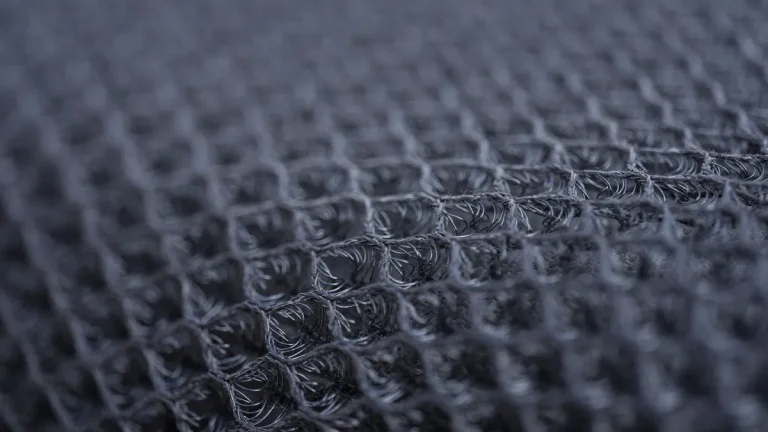
Flip any sample over. The weave you feel with your fingers is the primary backing; the smoother, sometimes rubbery film over it is the secondary coating. That two-second check is the foundation for everything else in this guide.
Two Layers: Primary Base and Secondary Coating
Standard artificial grass is built as a two-layer system, and each layer has one job. The primary backing is a sheet of woven or nonwoven fabric — polypropylene in most products — that the tufting machine stitches the yarn into, row by row. It is the carrier: it holds the blades in position, keeps the sheet from tearing, and gives the roll its handling strength. The secondary backing is a liquid coating, typically latex or polyurethane, applied over the back of that fabric and then cured. It is the lock: it grips every tuft so the blades resist pulling out, and it seals the stitch holes against fraying.
Primary catches the yarn; secondary locks it dead. If you remember one sentence about turf construction, make it this one.
The split also explains how professionals read a specification sheet: the fabric weight and the coating weight appear as separate line items, because they measure two different things. On our own production lines the two layers are built and inspected as distinct steps — tufting first, coating second — and we reinforce the primary layer as a PP+Net composite before any coating goes on. When a supplier collapses everything into one vague “backing weight” figure, that alone tells you how much visibility you will get after the sale.
The Three Core Functions of Turf Backing
Whatever the material recipe, a backing exists to do three jobs — and nearly every performance complaint about artificial grass traces back to one of them:
- Anchoring the blades: the coating’s grip — the industry calls this tuft bind — keeps fibers from pulling out under foot traffic, raking, or a dog hitting the same patch every day. Lose tuft bind and the turf sheds like an old sweater.
- Keeping the sheet stable: the woven base resists stretching and shrinking so the turf lies flat and the seams stay tight. When a lawn grows ridges and bumps a year after installation, the backing lost this fight.
- Controlling water: perforations punched through both layers during manufacturing give rain and rinse water an exit. No drainage path means standing water, trapped debris, and eventually odor.
Keep that trio — grip, stability, drainage — as your mental checklist for everything that follows. The warning signs are also visible early if you know where to look: a coating that already shows hairline cracks at a fold, or leaves powdery residue inside the bag, is aging far faster than the blades above it. A backing that fails any one of the three jobs will eventually take the whole lawn down with it, which is why the rest of this guide treats the underside as seriously as the surface.
Why Polypropylene Is the Default Backing
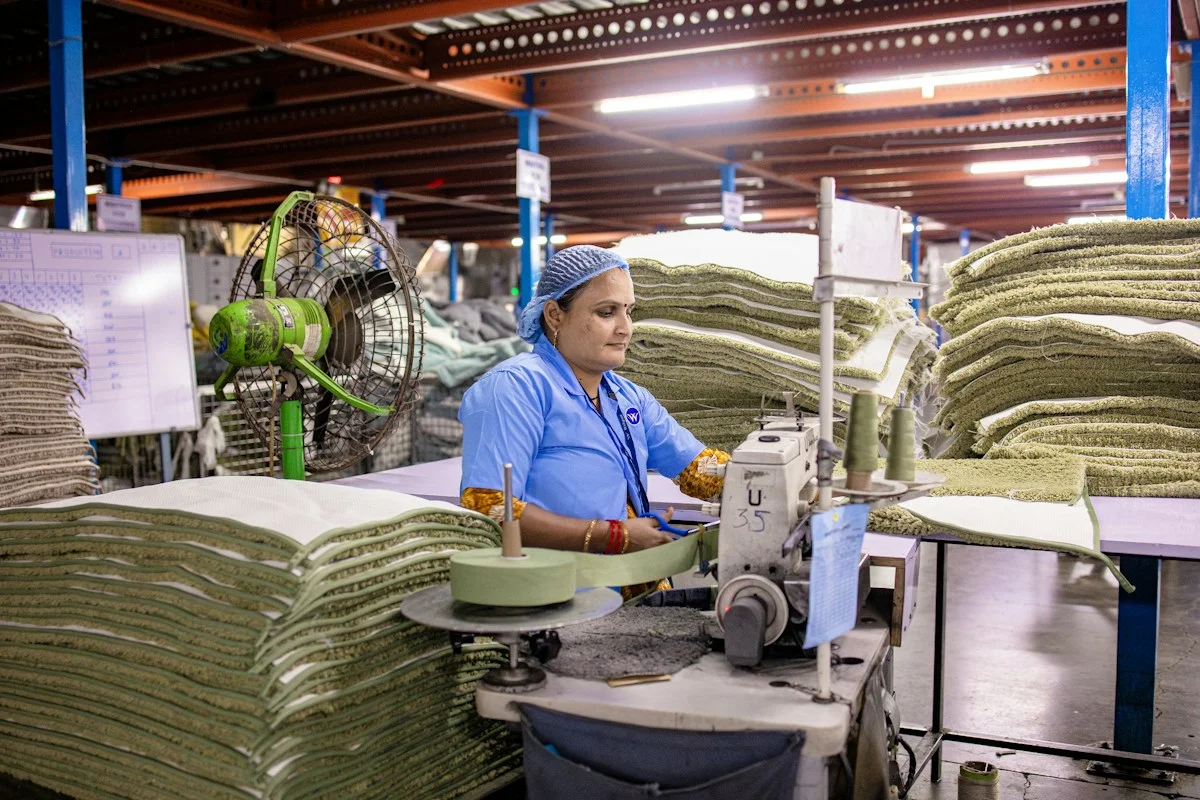
Woven polypropylene rules turf construction because it is light, waterproof, rot-proof, and easy for tufting needles to pierce — no other fabric matches that combination at its price.
Polypropylene (PP) holds the default position in artificial grass construction for one practical reason: it solves every problem a foundation fabric faces at the lowest cost per square meter. Most entry-level and mid-range turf rolls — residential, commercial, and sports alike — begin with a woven PP scrim beneath the grass fibers.
Why the Material Itself Wins
Polypropylene is a hydrophobic plastic, meaning it repels water instead of absorbing it. In standard immersion testing, PP takes on less than 0.1% of its weight in water over 24 hours — functionally zero. Anyone who has carried groceries in a woven plastic shopping bag has already handled this exact material family.
That one property triggers a chain of benefits:
- Moisture-proof: rain, flooding, and pet urine never soak into the cloth.
- Rot-resistant: with no trapped water, mold and mildew have nothing to feed on, so the fabric keeps its strength season after season.
- Lightweight: PP’s density sits around 0.90 g/cm³ — low enough that the fabric floats — keeping finished rolls easier to ship, carry, and roll out.
Easy for Grass Fibers to Anchor
Woven PP is built as a grid of flat plastic tapes. When a tufting machine punches grass yarn through it, the needles slip cleanly between the weave lines without cutting them, and the tapes spring back to hug each yarn. That clean penetration is why PP accepts fiber at high production speeds while keeping stitch rows even and the cloth intact.
The Catch: Not All PP Backing Is Built Equal
Because PP is the standard, it is also where budget manufacturers cut corners. A thin, low-grammage scrim looks acceptable on delivery but can loosen and weaken within a few seasons — and since backing cannot be repaired in place, failure means ripping out the entire lawn. The few dollars saved per square meter vanish against full replacement cost, which is why build quality matters more than the material name on the spec sheet.
Polyester: When You Need More Strength
Polyester is the primary backing fabric of choice when a turf system needs more muscle than standard polypropylene can deliver. It offers higher tensile strength and much lower elongation, meaning it stretches far less under load. If polypropylene behaves like a soft t-shirt knit, polyester works more like woven canvas—harder to stretch, harder to tear, and far better at holding tuft rows in position for the life of the installation.
Where Polyester Backing Actually Appears
You will not find polyester on entry-level landscape rolls, where polypropylene performs adequately at minimum cost. It earns its place in more demanding applications: sports fields that endure cleat shear, putting greens where even slight fabric movement shifts ball roll, high-density products, and turf carrying a heavy secondary coating. Anywhere shape-holding is non-negotiable, polyester shows up on the spec sheet.
How Its Strength Is Actually Measured
Two figures tell most of the story. The first is tuft bind—the pull force, measured in pounds, needed to yank a tuft of yarn out of the backing. Industry specifications typically call for a minimum of roughly 10 pounds, tested under the ASTM D1335 method. The second is grab tensile strength, also in pounds, which measures how much pulling force the fabric itself survives before failure. Because polyester fibers are inherently stronger, a polyester weave posts higher numbers on both tests at an equivalent weight. Fabric weight itself is listed in ounces per square yard, so always compare backings at like-for-like weights when reading competing spec sheets.
The Trade-Offs to Accept
Polyester is not free of compromise. The stronger weave carries a real price tag, and it solves problems many residential projects simply do not have.
- Cost: Runs noticeably higher than polypropylene at equivalent fabric weights.
- Availability: Fewer fabric mills produce it, so supplier options and spec sheet details vary more widely.
- Necessity: On a quiet backyard lawn, the extra strength is often paid for but never used.
A simple rule closes the decision: polypropylene suits standard lawns where cost rules, while polyester justifies its premium wherever heavy coatings, traffic loads, or strict strength ratings demand it. Checking the tuft bind and grab tensile figures on any spec sheet removes the guesswork.
Polyurethane: Durable and Water-Resistant
Polyurethane (PU) is a synthetic polymer applied as the secondary coating over a turf’s primary backing fabric, and it directly answers the two complaints buyers raise most: blades pulling loose and moisture wrecking the base. It grips fibers harder, repels water instead of absorbing it, and stays flexible through freeze-thaw cycles. That combination is why PU appears so often in premium, pet-focused, and wet-environment product descriptions.
Stronger Fiber Lock, No Water Absorption
When latex coating gets wet repeatedly, it absorbs moisture, swells, and eventually crumbles away from the fabric. Polyurethane cures into a non-porous, flexible film that bonds tightly to the backing — think epoxy around a bolt rather than dried glue. In tuft bind terms, that tighter lock means blades resist extraction far longer under foot traffic and grooming. Because the film is hydrophobic, water from rain, pool splash-out, or repeated pet washdowns never soaks into the coating, so the base will not rot or shed powder.
Cold-Weather Resilience
Freezing temperatures turn latex brittle. One hard winter of expansion and contraction can crack the coating and trigger delamination — the separation of coating from fabric behind many rejected warranty claims. Polyurethane keeps its elasticity in low temperatures, flexing instead of fracturing. This is why turf specified for northern climates, rooftops, and exposed decks almost always lists PU as the coating.
Weighing the Price Gap
Latex coats the majority of commodity turf because it costs less, and in mild, low-moisture settings it performs adequately. PU carries a higher price per square meter, but it pays back where latex fails early: pet runs, pool surrounds, decks, roofs, and frost zones with real foot traffic.
Match the coating to the site: latex for sheltered, dry installations on a tight budget; polyurethane wherever water, animals, or freezing weather are part of the picture.
Acrylic: A Lighter, Weather-Stable Option
Acrylic coating is a secondary backing option that trades coating mass for low weight and strong resistance to sunlight and moisture. Beginners most often meet it as the phrase “acrylic-coated backing” partway down a product description, usually on turf specified for balconies, rooftops, and pool surrounds — places where every kilogram of roll weight matters.
Why Acrylic Coatings Weigh Less
Acrylic is applied as a thinner, lighter layer than conventional coatings, which cuts the overall weight of the finished roll without giving up the protection a coating provides. A helpful analogy sits in plain sight: acrylic resins belong to the same chemistry family as modern water-based exterior paints. Those paints dominate house exteriors precisely because they shrug off sun and rain, and turf backing borrows the same advantage. For anyone carrying rolls up stairs or loading turf onto a deck, the weight drop is felt immediately — in handling during installation and in freight cost when ordering by the pallet.
How Acrylic Handles Sun, Rain, and Frost
The coating’s main selling point is weather stability. Because acrylic film does not readily re-absorb water, it stays flexible through repeated wet-dry cycles instead of stiffening, and it tolerates freeze-thaw conditions without turning brittle. UV stability matters just as much: turf laid in full sun punishes coatings that degrade under constant radiation, and acrylic chemistry handles that exposure better than most standard coating systems. This is why the term tends to appear on turf marketed for all-season outdoor use.
What “Acrylic” Means on a Spec Sheet
- “Acrylic-coated backing”: the secondary coating layer is an acrylic formulation rather than a conventional latex one — the phrase refers only to the back coating, not the grass blades.
- Lower weight figures: because the coating layer is thinner, total backing weight may read lower than heavier-coated rivals. The smaller number reflects the coating type, not weaker turf.
- Marketing cues: phrases like “lightweight,” “all-weather,” or “ideal for decks and roofs” often signal an acrylic or similar low-absorption coating underneath.
Acrylic coatings typically carry a modest price premium and are less common than the default options, so their presence usually signals a mid-to-premium product. For buyers weighing weather exposure against roll weight — rooftop and patio projects above all — that trade-off is often the first thing worth checking.
How Backing Shapes Drainage, Lifespan, and Grip
Backing quality decides four outcomes: how fast water drains, how firmly blades stay anchored, whether the lawn lies flat, and how long the turf survives.
Four failure modes dominate field complaints — standing water, shedding fibers, surface bumps, and premature aging — and all four originate in the layers beneath the blades.
How Backing Drainage Holes Handle Rainwater
Rainwater has only one way out of a synthetic lawn: down. Water sheds off the blades, runs between the stitch rows, and exits through perforations punched into the backing. Most quality products use holes roughly 3/16 to 1/4 inch across, laid out in a regular grid — wide enough to swallow a heavy downpour, tight enough to keep the sand infill from washing out underneath.
The simplest mental model: a perforated backing behaves like a colander, not a sponge. And a colander only drains if the surface beneath it also lets water pass. Drainage is never a backing spec alone — it is a system.
When a crew builds a free-draining crushed-rock base with a slight grade, water that clears the backing keeps traveling down and away. Lay the same turf over compacted, clay-heavy ground and the holes still pass water — but it has nowhere to go, so it pools against the underside. That trapped moisture is what produces the sour smells and mold patches homeowners blame on “bad grass.” Pet urine follows the same exit route as rain, which is why dog yards need an occasional rinse to keep the pathway open.
Tuft Lock Strength: Keeping Blades Anchored
Every grass blade is a stitched loop of yarn, and the coating on the underside is the only thing holding that loop shut. The industry measures this as tuft bind — simply, the force needed to pull one blade free. A useful comparison is staples in paper: if adhesive grips only the sheet’s surface, the staple slides out; where it soaks through and sets, the paper tears before the staple releases.
Weak anchorage shows itself gradually rather than dramatically. Blades shed along seams and traffic lanes first, the face thins season after season, and infill starts migrating because there are fewer fibers to trap it. Critically, anchorage is locked in at the factory during coating. No installer can improve it afterward, and no amount of brushing will refresh a loosely anchored face.
Dimensional Stability: Preventing Wrinkles and Bumps
The backing is also the membrane that ties turf panels together and lies flat against the base, so its shape matters as much as its strength. The sheet expands slightly when soaked and contracts as it dries, cycle after cycle, year after year. A stable sheet shrugs this off. An unstable one creeps a little further out of shape each season until ripples cross what used to be a flat lawn.
Not every bump is the backing’s fault, though. A lawn that looks lumpy on day one usually points to a soft or poorly compacted base, or panels that shifted during seaming. Wrinkles that emerge slowly, months after a smooth start, are the signature of the sheet itself moving.
Why Backing Condition Determines Turf Lifespan
The blades take the sun; the backing takes the water. A backing never sees daylight, yet it lives in permanent contact with moisture, temperature swings, and whatever chemistry leaches up from the ground below. That damp, dark environment ages the coating far faster than sunlight ages the fibers, which is why the underside is usually the first component to fail.
When it fails, everything above it goes with it. A weakened coating loses its grip, blades pull loose, and a lawn rated for a decade of service can look threadbare in a third of that time. Engineers call this the weakest-link principle: finished turf lasts exactly as long as its least durable layer — and unlike a worn face, a tired backing cannot be repaired in place.
Which chemistry survives longest depends heavily on the site. In hot, humid regions where nothing fully dries, moisture-sensitive coatings break down sooner; where pets, pools, or irrigation keep the sheet repeatedly wet, water-resistant chemistries hold their strength far longer. Matching the coating to the dampness of the installation — not just the budget — is what separates turf that lasts from turf that gets replaced.
The habit worth building: judge turf the way installers do — from the bottom up.
| Dimension | Backing Mechanism | Key Metric / Benchmark | Failure Mode to Avoid | Practical Takeaway |
|---|---|---|---|---|
| Drainage | Perforated (hole-punched) backing | Water exits through pre-punched holes; hole diameter and hole density define the flow rate | Holes gradually clog with pet hair, silt, and infill, throttling drainage | Suits moderate rainfall; plan routine rinsing in pet-heavy yards |
| Drainage | Fully permeable / moisture-porous coating | Water passes through the entire sheet surface rather than through discrete holes | Liquid pooling above the backing where the sub-base is compacted or poorly graded | Pair the backing type with a free-draining crushed-rock sub-base for full effect |
| Drainage | Dimensional stability of the backing under wet/dry cycling | A stable primary-plus-secondary sandwich resists shrink-and-expand cycling after saturation | Unstable backing wrinkles, seam gaps open, and surface ripples appear | Drainage is a system: backing + sub-base + grading, never backing alone |
| Lifespan | Latex (SBR) secondary coating | Flexible, widely used standard; secondary coating mass measured per ASTM D5848 | Hydrolysis degradation in humid, high dew-point climates weakens the coating | Performs reliably in temperate, well-drained installations |
| Lifespan | Polyurethane (PU) secondary coating | Polyurethane’s advantage lies in moisture resistance and bond strength, not coating economy: its applied weight typically runs 950–1,200 g/m², heavier than the 700–1,050 g/m² typical of latex. Superior moisture resistance and fiber lock are achieved at these heavier applied coating weights | Delamination from the primary cloth where adhesion quality is poor | Preferred where pets, pools, or frequent wetting keep the backing damp |
| Lifespan | Secondary coating weight (mass per unit area) | Spec-sheet benchmark: secondary coating weight ≥20 oz/yd² (≈680 g/m² class) | Under-coating accelerates fiber loss, backing exposure, and early aging | Longevity correlates with coating weight and penetration, not appearance |
| Grip | Tuft bind anchorage of the coating | Industry benchmark: ≥10 lbs tuft bind (ASTM D1335 pull test) | Fibers shed and pull out under foot traffic, raking, or power brushing | Ask for tuft bind test data rather than judging by look or feel |
| Grip | Coating penetration into the primary PP cloth | Adhesive must wrap and lock each stitch loop at the tufting knot | Poor penetration leaves loops loosely anchored even at heavy coating weights | Well-penetrated coating is what physically grips the fibers |
| Grip | Backing color pigmentation (black / green / gray) | Color derives from carbon black or pigments/fillers — no correlation with tuft bind strength | Assuming ‘darker = stronger grip’ leads to misjudged quality | Grip is quantified by tuft bind numbers, never by backing color |
What Beginners Should Look for in Backing
Most beginners judge artificial grass by the grass side — softness, color, blade shape. That is exactly backward. The backing underneath determines whether a lawn holds up for a decade or starts failing within three years, and three habits will protect any first-time buyer: learning to read the terminology, checking the numbers that actually matter, and stress-testing a physical sample before money changes hands.
Decoding Backing Terms in Product Descriptions
Product listings compress a lot of engineering into a few abbreviations, and almost none of them explain themselves. Six terms cover the vast majority of what a beginner will encounter on a spec sheet or in a showroom conversation:
- Primary backing: the woven fabric — usually polypropylene — that rows of yarn are stitched into. Entries like “2PP” indicate two layers of this fabric.
- Secondary coating: the latex or polyurethane (PU) layer applied underneath to lock the tufts in place. “PU coated” or “latex coated” describes this layer.
- Perforated: the coating has been punched with drainage holes — standard on most landscape turf.
- Tuft bind: the force, measured in pounds, required to pull one tuft of yarn free from the coating.
- Grab tensile strength: how much pulling force the backing fabric itself withstands before tearing.
- Red-flag phrases: “premium backing” or “heavy-duty backing” with no material named and no figures attached. Vague adjectives standing in for numbers usually signal a budget product.
Backing Weight and Coating Specs Worth Checking
Once the vocabulary makes sense, the numbers do the comparing. Backing weight, listed in ounces per square yard (oz/yd²), tells you how much fabric and coating sit underneath the yarn. More material generally means more strength, but the meaningful comparison is between products of a similar tier — a budget pet patch and a premium landscape roll are not supposed to weigh the same.
No figure on a landscape spec sheet repays a novice’s attention like tuft bind. Measured under ASTM D1335, it reports the force required to pull a single tuft free of the backing, and reputable landscape products publish a minimum of about 10 pounds. The same property appears on international spec sheets under ISO 4919, where 30 newtons or more is the accepted floor for quality backing, with premium landscape and sports turf grades running 40–60 N. A spec sheet that omits tuft bind entirely is a warning in itself.
Grab tensile strength, typically tested under ASTM D5034 for woven fabrics, commonly falls between 200 and 300 pounds on decent landscape backing. Both directions — lengthwise and crosswise — should be listed, because a fabric strong in only one direction can give trouble during installation and under heavy use.
One caution: figures only compare fairly when measured to the same standard. Before declaring one product “stronger,” confirm that both spec sheets cite the same test method.
Testing Backing Quality With a Free Sample
Nearly every supplier ships free samples, and the underside is where a few minutes of hands-on work pays off. Spec sheets can be written generously; a physical sample cannot.
📋 Actionable Steps
- Step 1 — The fold test: Bend the sample sharply with the coating facing out. A well-made coating flexes silently; cracking sounds, white stress lines, or visible splits point to a brittle formulation that will break down outdoors.
- Step 2 — The pull test: Grip a fistful of blades and pull firmly. A few stray fibers are normal; tufts releasing in clumps, or a backing that tears, is not.
- Step 3 — The light test: Hold the sample up to a window. The coating should look even edge to edge — thin, patchy, or dry-looking areas mark inconsistent application and future weak points.
- Step 4 — The weight comparison: Place two samples of similar pile height face-down in each hand. The heavier backing usually reflects more fabric and coating, then confirm against the spec sheet.
Three decoding habits convert listing language into comparable facts: read the coating line, check the tuft bind figure, fold the sample and listen. Decoding “2PP + PU coated” on a listing tells you the primary backing is woven polypropylene with a polyurethane coat. A tuft bind figure of 10 pounds or better (ASTM D1335) — the rough equivalent of the ≥30 N floor under ISO 4919 in metric listings — means the blades are anchored well enough to resist pulling out. And a sample that folds without a crack signals coating that stays flexible instead of going brittle. Run all three checks and you already understand more than most first-time buyers — which makes showroom conversations far harder to mislead.
Conclusion
Backing decides whether turf lasts five years or fifteen. The blades get the attention, but the layers underneath do the work. For most installs — dogs, decks, rooftops — woven polypropylene with a polyurethane coating is the safest bet because it shrugs off water and urine. Latex costs less up front, yet it crumbles when rain sits on it. Match the material to the site, not to the lowest price.
- Anything below 10 pounds of tuft bind predicts blade shedding in high-traffic zones, which makes the figure a hard cutoff rather than a preference. Verify tuft bind ratings per ASTM D1335 and reject anything under ~10 pounds — roughly 45 N, comfortably above the ≥30 N ISO 4919 floor.
- Confirm drainage holes are punched clean, not torn; frayed edges clog within a season.
- Check backing weight and coating weight on every spec sheet before comparing offers.
- Run early design questions past our engineering team — zero obligation, just technical backup.
Source Backing-Specified Rolls Factory-Direct
We are a factory-direct supplier with 18 years of export experience. Our line runs PP+Net and PU backed rolls in 2, 4 and 5 metre widths, and our team can match primary backing, coating type and coating weight to your spec sheet. Request an exact quote for your project volume and we will send a matching 20 x 20 cm sample.
Frequently Asked Questions
Which side of the backing faces down?
The coated side always faces the ground. The primary backing, with its visible stitch rows and mesh texture, sits face-up where the yarn is anchored, while the smooth secondary coating contacts the base. Installing turf upside down exposes the coating, blocks the drainage holes from working, and flattens the blades. Most manufacturers print branding or product codes on the underside to make orientation obvious during installation.
Why does latex backing crumble over time?
Latex is a heavily filled coating that becomes brittle with repeated wetting, drying, and UV exposure. Over several years, the filler content can break down, causing the coating to powder, crack, or flake away from the primary backing. This degradation pattern is why many manufacturers have shifted toward polyurethane coatings, which stay flexible and resist water breakdown. If long-term durability matters for your project, polyurethane is generally the more resilient secondary coating.
How does backing handle freezing temperatures?
Quality backings remain flexible in cold climates, but material choice makes a real difference. Polyurethane and acrylic coatings keep their elasticity through freeze-thaw cycles, while lower-grade filled latex can turn brittle and crack when trapped water freezes and expands. A well-formulated coating resists water absorption in the first place, which prevents ice damage within the layers. Buyers in cold regions should confirm the coating is rated for freeze-thaw stability before committing.
What causes turf backing to delaminate?
Delamination occurs when the secondary coating separates from the primary backing, usually due to poor adhesive application, inadequate curing, or low-grade coating formulations. Water infiltration through unsealed edges or poorly finished drainage holes accelerates the separation. Once delamination starts, wrinkles and loose fibers typically follow, and the affected turf often cannot be salvaged. Inspecting the bond between layers on a physical sample is one of the most reliable ways to screen out inferior products before buying.
Which backing suits high-traffic sports fields?
Sports surfaces generally rely on a polypropylene primary backing paired with a high-weight polyurethane coating, because PU maintains strong fiber anchorage under constant flexing and abrasion. Heavier backing weights, measured in ounces per square yard, correlate directly with better tuft retention when athletes stop, pivot, and slide. Perforated designs are also standard so rainwater drains quickly and play can resume fast. For stadiums and training grounds, the backing specification usually matters as much as the yarn itself.
Is artificial grass backing safe for children?
Reputable manufacturers build backings from inert plastics such as polypropylene, polyester, and polyurethane that contain no heavy metals, phthalates, or allergens. The coating is fully bonded to the base and does not shed particles under normal use, so children and pets never contact raw material directly. For added assurance, ask suppliers for test reports confirming the backing is lead-free and safe for skin contact. Established producers like Relyir Grass verify these safety properties through in-house laboratory testing before products ship.
Is polypropylene backing recyclable?
Yes, polypropylene is a thermoplastic, meaning it can be melted down and reprocessed into new products, and many recycling streams accept clean turf backing. Polyurethane and latex coatings complicate recycling somewhat because bonded layers are harder to separate, though single-polymer backing systems simplify the process considerably. Some manufacturers now offer recyclable backing constructions specifically to reduce landfill waste. If sustainability is a project requirement, ask about backing recyclability before specifying a product.
 English
  Arabic
  French
  German
  Portuguese
  Russian
  Spanish