
By the sixth week of a busy resort season, a pool surround has usually said everything it has to say. The tile at the waterline grows a film, the lawn beyond it thins into brown patches, and the deck that photographed well in May now carries a warning sign.
Artificial grass for poolside areas has to do three jobs at once: stay grippable under a wet bare foot, move water away quickly, and survive chlorine day after day. We build artificial grass rolls on our own line. The wet-zone samples that come back to our bench fail on backing and density long before they fail on colour.
Why Poolside Surfaces Fail Faster Than Lawns
A pool surround is not a lawn that happens to be damp. It carries three loads at the same time: constant wetting, pool chemicals, and foot traffic squeezed into a narrow band. Garden turf meets those pressures one at a time. A pool deck meets them together, every day of the season.
That stacking is why familiar materials fail in predictable ways. Water splashes, chlorine and foot traffic damage natural lawn near a pool, leaving brown patches and muddy spots behind. Smooth tiles, sealed concrete and polished stone become their most dangerous the moment moisture arrives, and sunscreen leaves an invisible film that cuts friction and travels with every footstep.
For a buyer, that stacking changes what a specification is for. A garden lawn is bought on looks and feel. A pool band is bought on how it behaves after a thousand wet crossings, which means drainage, backing and density move to the front of the document.
Artificial grass for poolside areas is neither a wetter lawn nor a softer tile. It is specified against a different failure list, and that list starts below the surface. Our residential artificial grass range covers the wider landscape; the strip beside the water earns its own set of numbers.
What Splash-Out Water Does to Surfaces
Splash-out is not clean water. It carries residual chlorine, salt where a pool runs on a salt system, plus sunscreen and body oils. All of it lands on the same few square metres, hundreds of times a week.
Chlorine deserves a careful answer rather than a reassuring one. Turf built with chlorine-resistant yarn handles regular exposure to treated water without fading or breaking down. Left standing and never rinsed, chlorine can still weaken fibres over time, which is why rinsing sits on every maintenance sheet we put together.
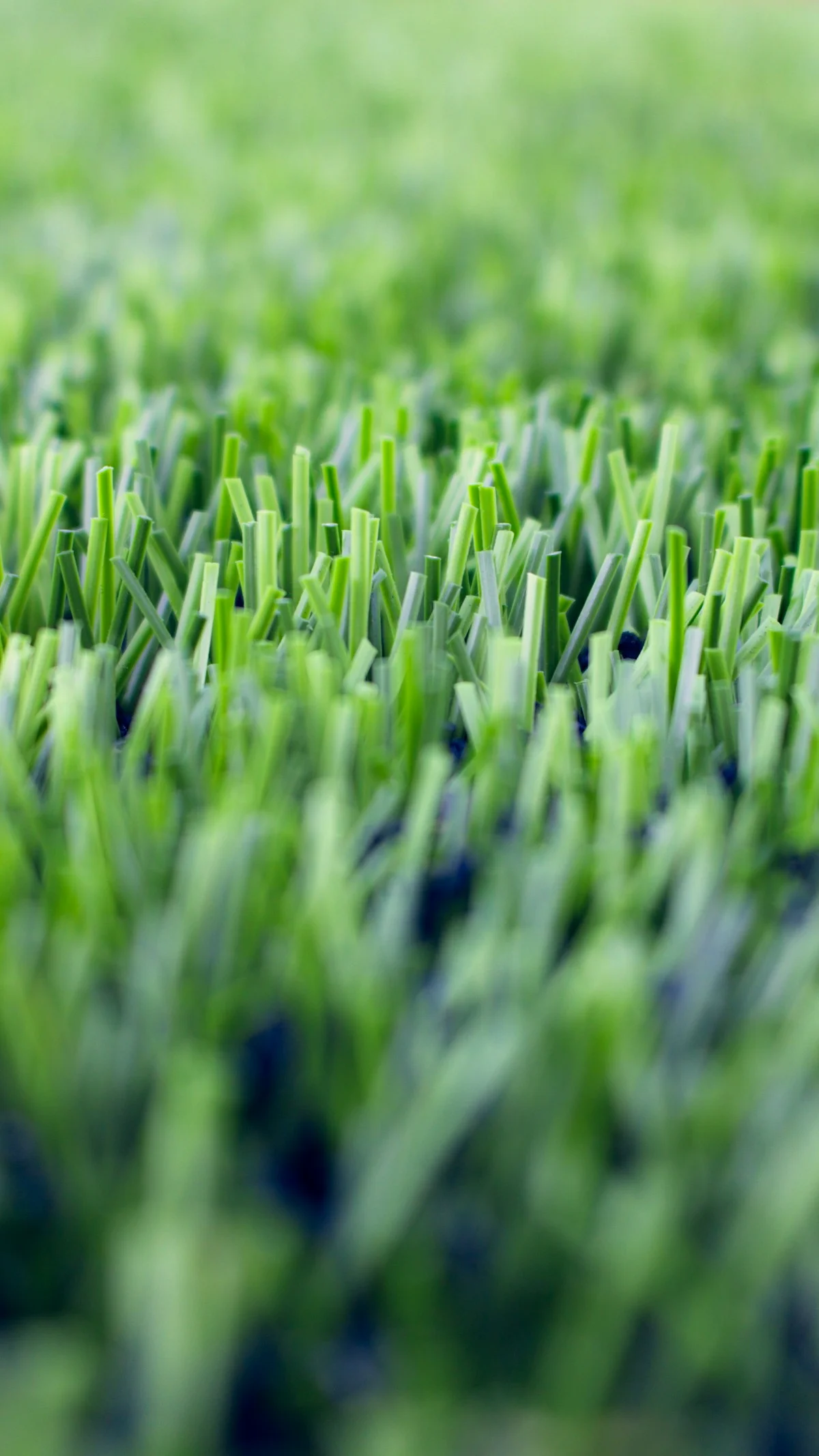
The oil film is the quieter problem. Unlike water it does not evaporate, it lowers surface friction, and routine mopping does not lift it. Algae and biofilm then add a second hazard on ground that still looks clean to the eye.
Sunscreen residue also explains a pattern we hear about often: a deck that tested fine in spring becomes the complaint line by midsummer. The surface did not change. What sits on it did.
This is why artificial grass for poolside use is specified on chemical resistance and cleanability first, and on appearance second. Artificial turf installations near chlorinated water are rinsed rather than sealed. The yarn decides whether colour survives the season. The backing decides whether residue ever leaves the system.
Drainage Comes Before Comfort Around Pools
Ask what kills wet-zone turf and the answer is rarely the grass itself. Water that cannot leave softens the base, feeds biofilm, and makes the surface slick however good the yarn is. Drainage is the first specification decision, not a detail left to the end.
Backing type comes first. Fully permeable backings outperform simple perforated ones where moisture is frequent, because water leaves through the whole face instead of through a pattern of holes. A punched backing behaves like holes in an umbrella. A permeable one behaves like filter cloth.
Rate matters once the type is fixed. Perforated backings with holes every 10 cm are commonly rated at 60 litres per minute per square metre, which is roughly the load of very heavy rain. Nothing in the carpet compensates for a sub-base with nowhere to send that water.
Artificial turf installations around pools therefore stand or fall on what sits underneath. The list is short: a compacted, permeable sub-base, a fall that leads somewhere, clear drainage paths, and edges fixed hard enough to survive repeated wetting. The base and drainage detail deserves its own sheet before anyone prices a roll.
| Check | What it decides | How to verify it |
|---|---|---|
| Backing type | Whether water leaves across the whole face or only at punched holes | Ask for the stated construction, not a trade name |
| Drainage rate | Whether splash-out and rain clear before the next session | Perforated backings at holes every 10 cm are commonly rated at 60 litres per minute per square metre |
| Sub-base | Whether water has anywhere to go once it passes the carpet | Confirm a compacted, permeable layer before the roll is laid |
| Fall and path | Whether water moves to an outlet or sits under the turf | Walk the gradient to the outlet before sign-off |
| Edges | Whether the perimeter lifts after repeated wetting | Check fixings along the pool coping first |
Read that table as a sequence rather than a menu. Type decides whether water can leave at all, rate decides how fast, and the base decides whether leaving was ever possible.
Drainage also decides hygiene. Water that lingers under the carpet carries sunscreen and chlorine residue with it, and the smell is what guests notice long before they see a stain.
Choosing Pile Height, Yarn and Backing
Three parameters decide how a pool surround feels and how long it holds up: pile height, yarn and density, and the backing behind them. Buyers specifying artificial grass for poolside areas usually start with height, because it is the easiest to picture from a photograph.
Published guidance for pool surrounds points to a moderate pile of 25-35 mm, which balances a soft barefoot feel against cleaning and drying time. Where traffic is heavy and a firmer step is wanted, shorter 20-30 mm options are specified instead. Both bands exist for a reason, and neither is a safe default.
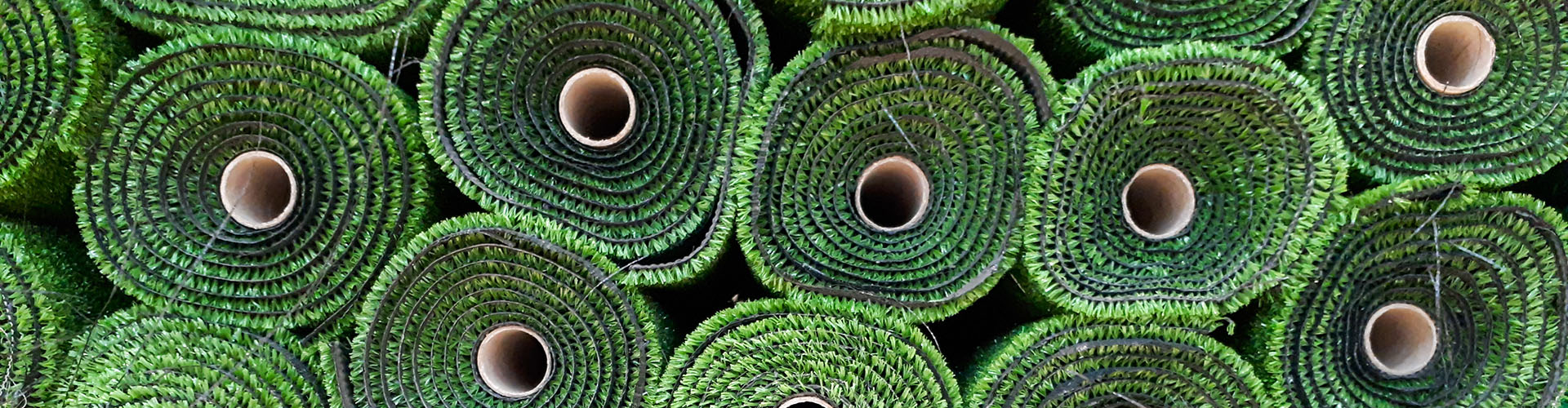
Polyethylene is the common yarn here because it stays soft while remaining durable under traffic. Blade shape changes behaviour too: C-shaped blades resist wear, V-shaped blades stand upright, and wave profiles help disperse heat. Our note on blade shapes and what they change covers the trade-offs.
UV stabilisation belongs in the same breath as chlorine resistance. Pool decks take full sun for months, and a yarn that holds its colour is a yarn a client still accepts at handover.
Density carries the traffic load. High-density pool turf is specified at 18000 stitches per square metre or more. Buyers then use face weight and density to compare two samples that look identical in a photograph. Backing runs between PP+Net and PU constructions, and wet zones push that decision towards permeability, as set out in our guide to latex-backed and PU-backed constructions.
| Poolside zone | Pile height | Backing priority | Infill | Roll width |
|---|---|---|---|---|
| Coping strip and splash edge | 20-30 mm | Fully permeable | Minimal or none | 2 m |
| Barefoot lounging apron | 25-35 mm | Fully permeable | Light silica sand, brushed in | 4 m |
| Walkway to plant and service areas | 25-35 mm | Permeable | Light silica sand | 4 m |
| Large resort deck | 25-35 mm | Fully permeable | Light silica sand | 5 m |
Custom widths exist for the same reason wider rolls do. A curved coping line is where seams end up, and seams are where a wet-zone surface starts to fail first.
Infill is the last decision, and around a pool it is a light one. A controlled amount of silica sand is brushed into the base of the pile to support the fibres. Barefoot residential decks often run with minimal infill or none at all, because loose grains and wet feet are a poor combination.
Artificial turf installations in wet zones are specified by three numbers that belong together: height, density and backing type. Ordering them one at a time is how a sample that felt right in a showroom arrives wrong on site.
Slip Resistance Where Feet Are Wet
Grip is the reason most pool projects look at turf at all. On wet pendulum testing, a reading of 36 or above is accepted as low slip risk, and below 36 the risk climbs; many untreated pool surrounds sit under that line. For wet barefoot traffic the usual minimum dynamic friction figure is 0.42, with 0.50 preferred on pool decks.
The mechanism is not complicated. Textured fibres give a wet foot something to bite against, and a permeable backing removes the water film that makes smooth materials dangerous. Standing water, not the surface material itself, is what turns any deck slick.
Risk is not spread evenly across the deck. The band within 4 feet of the pool edge is treated as the critical zone, and it is where the specification should be strictest. Artificial turf installations in wet zones are judged there first, by whoever is walking out of the water.
Specify the coping band separately from the lounging apron. The two zones take different loads, and a single compromise specification usually serves neither of them well.
Heat is the honest limit in this setting. All synthetic turf warms in direct sun, a cold water spray brings the surface back down, and shaded sections near the pool are usually the first to be specified. Artificial grass for poolside areas earns its place on grip, not on coolness.
Still Replacing Poolside Surfaces Every Season?
Wet-zone failures cost you the re-lay and the complaint. We build poolside rolls to a stated pile, density and permeable backing, factory-direct from our own line.
Three Specification Mistakes Around Pools
Three mistakes account for most of the poolside call-backs we are asked about. None of them is exotic, and all three cost far less to avoid on paper than on site.
Mistake 1: Ordering Lawn Numbers for a Wet Zone
The most common failure we see is a garden specification dropped beside a pool. Lawn density that copes with weekend footfall flattens within a season under concentrated traffic, and once the pile lies down, water stops moving across the surface. Specify the traffic band, then the height.
Mistake 2: Buying on Colour and Ignoring the Backing
Two samples can look identical in a photograph and behave completely differently once wet. The backing decides whether water leaves through the whole face or waits at punched holes, and it is the part nobody photographs. Ask for the construction in writing before the order is placed. Artificial turf installations that fail early almost always fail here first.
Mistake 3: Leaving Fall and Edges to the Installer
Drainage paths, slope and edge fixing are specification items, not workmanship assumptions. Water that reaches the sub-base but has nowhere to go will lift a perimeter and pool under the carpet. Write the fall, the outlet and the edge detail into the document you sign against.
A Four-Point Checklist for Poolside Rolls
A short checklist keeps artificial grass for poolside projects out of the re-lay queue. Every item below is something you can write on an order and then check again on delivery, without a laboratory.
Check 1: Write the Three Numbers
Put pile height, density and backing type on the order as figures, not adjectives. A phrase like equivalent product leaves too much room, and the substitution usually arrives in the parameter you cared about most.
Check 2: State the Drainage Figure
Ask for the permeability figure the backing is built to and how it was measured. Then confirm the sub-base and outlet that will receive the water, because a fast carpet over a closed base changes nothing on site.
Check 3: Fix Roll Width and Direction
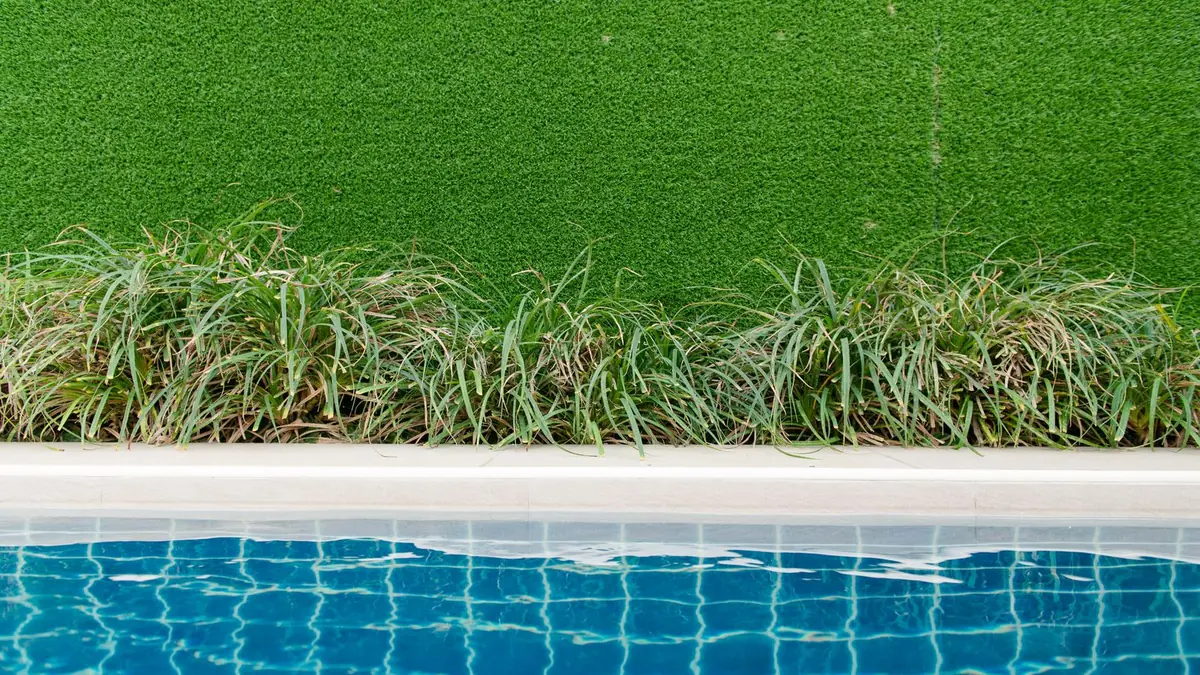
Pool edges curve, so artificial turf installations around them are planned seam by seam. Standard rolls come in 2 m, 4 m and 5 m widths at 25 m long, and wider rolls mean fewer seams across the main apron. Our page on why turf wrinkles and how to prevent it covers what goes wrong when direction is left open.
Check 4: Wet-Test the Sample in Daylight
Approve the sample outdoors, then wet it and walk on it. Colour reads differently under sun, grip only means something when the surface is wet, and dried pile tells you how quickly the area returns to use.
None of these four items needs a laboratory. They need a buyer willing to write numbers instead of adjectives, and a supplier willing to confirm them before the container is packed.
How Poolside Turf Is Maintained in Season
Maintenance is the argument that usually closes the decision. There is no irrigation, no mowing, no fertiliser and no herbicide programme, and no clippings or mud reaching the pool filters. What remains is short enough to hand to a site team on one page.
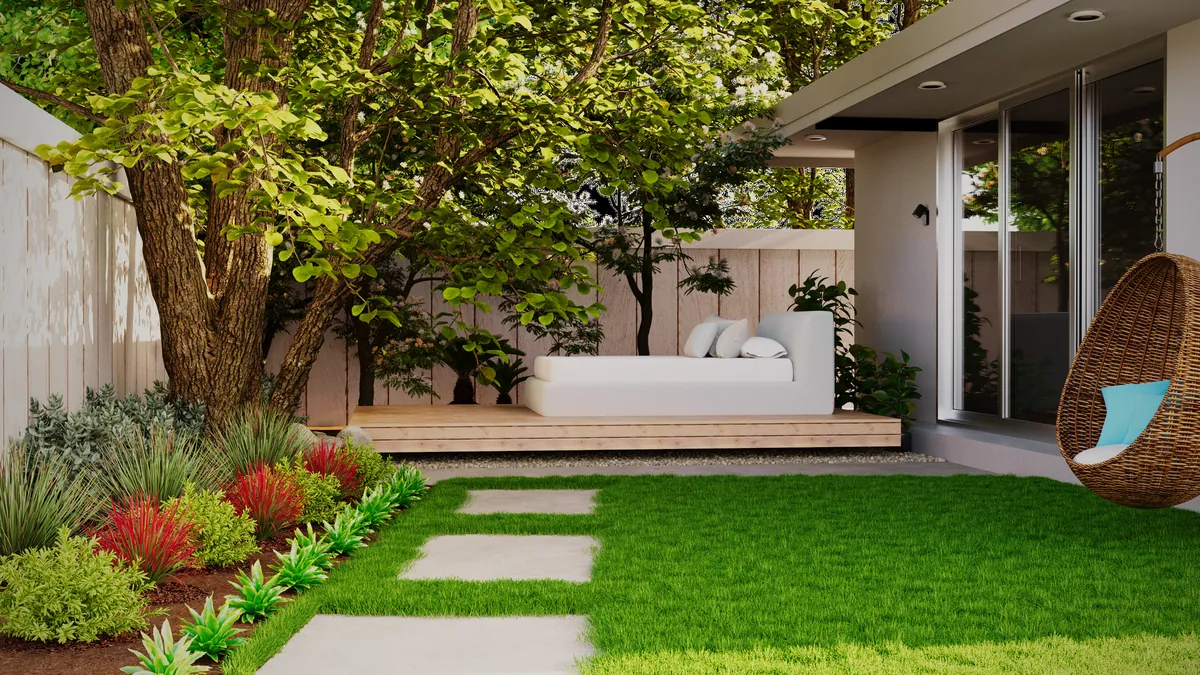
Rinsing removes chlorine residue, sunscreen and dust before they build up in the pile, and brushing lifts fibres that traffic has flattened. Drainage outlets and edges get checked on the same round. Artificial turf installations around pools that get those three things right reach the upper end of the 10 to 15 year service band we work to. Owners who specify artificial grass for poolside areas usually do it for this list, not for the photograph.
One more item belongs on the sheet: what happens at the end of the day. A surface that dries quickly can be rinsed in the evening and be back in service by breakfast. That turnaround is what a hotel operator is really buying.
Put the parameters on paper before you ask anyone for a number. A stated pile, density, backing and roll width is what makes two quotes comparable, and it is the cheapest insurance against a second season of re-laying.
Frequently Asked Questions
Does chlorine damage artificial grass around a pool?
No, not when the yarn is specified for it. Pool-rated turf uses chlorine-resistant fibres, and rinsing after heavy splash-out removes residue before it builds up in the pile.
Is artificial grass slippery when it is wet?
It grips better than smooth hard surfaces. Textured fibres give a wet foot traction, and a permeable backing stops a water film forming. Standing water, not the turf, is what turns a deck slick.
What pile height suits a pool surround?
Most poolside work sits at 25-35 mm, with firmer 20-30 mm options where traffic is heavy. Shorter pile dries faster and brushes upright again more easily after use.
How fast should poolside turf drain?
Perforated backings with holes every 10 cm are commonly rated at 60 litres per minute per square metre, roughly the load of a very heavy rain.
Can one roll spec cover a whole pool deck?
Rarely. The splash edge, the barefoot apron and the service walkway carry different loads, so pile height, backing and roll width are set zone by zone.
How do we check a bulk poolside order?
Start with free 20 by 20 cm samples, usually three to four pieces, shipped by courier in 4 to 6 days. Check pile, density and backing in daylight, then wet the sample.

 English
  Arabic
  French
  German
  Portuguese
  Russian
  Spanish