
A commercial gym floor takes a beating no lawn ever sees. Sleds scrape the same two lanes every morning, chalk dust works down into the pile, and a barbell set hard on the slab sends a thud into the shop below.
We build artificial turf for gym floors on our own tufting line, so we read specification sheets the way a buyer should: pile height first, then stitch density, then backing. The decisions that separate a durable training surface from a green carpet that mats down in a season all sit in those three lines.
Why Gyms Trade Rubber Floors for Turf
Rubber handles what drops on it. It copes far less well with what drags across it. Functional training loads a floor sideways, and sled pushes, farmers carries, rope pulls and prowler runs all generate lateral forces and friction that standard flooring was not designed to handle.
That gap is why artificial turf for gym floors moved out of the sports hall and onto the training deck. A dense, short pile gives a sled a predictable glide. It gives a sprint cut something to bite into, and it is kinder to skin than a rubber tile during floor work.
Zoning is the second reason. One surface cannot serve a lifting platform and a sprint lane equally well. Turf lets an operator split the floor by activity instead of buying one compromise product for the whole room. Most artificial turf installations in gyms now start as a zone rather than as a whole floor.
Throughput is the quiet advantage. A turf lane takes a class, a sled session and a stretch group in the same hour without a reset. It needs no drying time after a wet clean, provided the backing drains. For anyone selling time slots, that is the number that matters most.
We see the same pattern in the enquiries our team handles. Operators rarely ask for turf everywhere. They ask for one lane that survives sled work, one open strip for group classes, and a clean visual break between the two. Colour and tufted markings do that job without paint that later flakes.
Start from the sports artificial grass range if you are comparing families, then narrow by activity rather than by shade of green.
What Heavy Weights Do to a Turf Zone
Artificial turf for gym weight rooms is a compression problem before it is a comfort problem. A loaded dumbbell set down presses fibres flat, and a kettlebell shifted across the surface drags them sideways. Both show up first as matting, then as a visible track.
Face weight is the specification that answers it. Trade guidance for commercial gyms treats 40 oz as the line not to cross, and asks for more where sleds run. Dense yarn at a short pile is what lets fibres stand back up after a loaded bar has been set down on the same spot a hundred times.
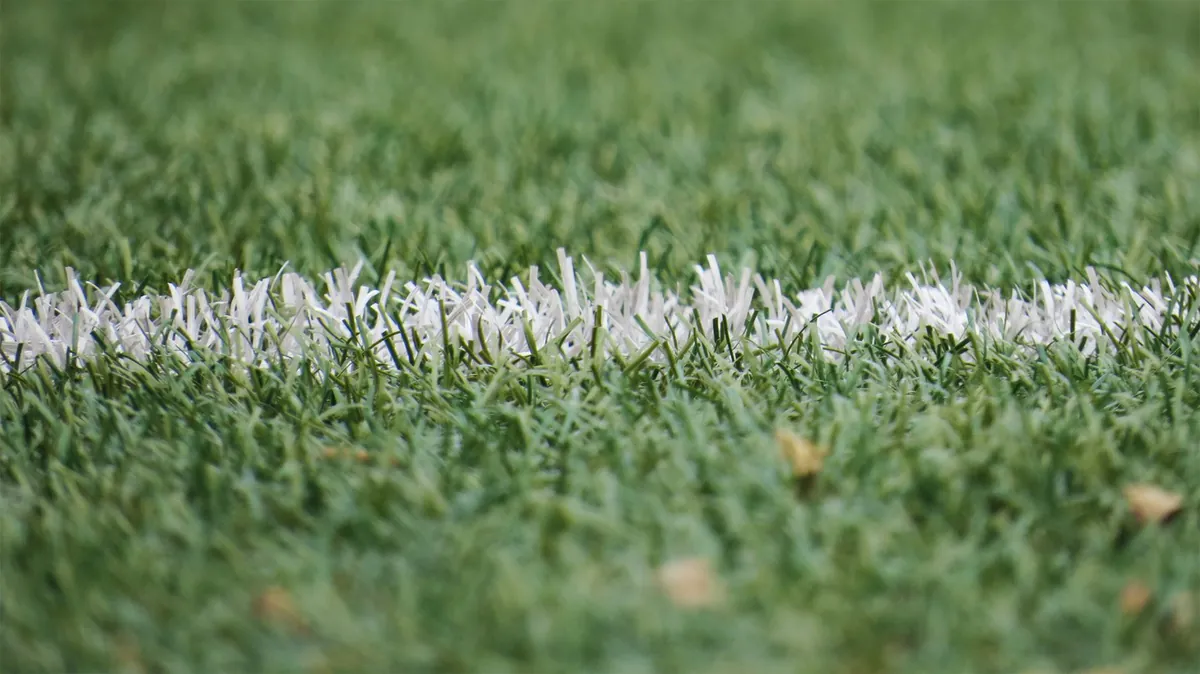
Density is the partner specification. Sled turf is commonly specified at 55,000 stitches per square metre or more, and that stitch count is what lets a short pile carry load without collapsing into the backing. An artificial turf installation in a weight room lives or dies on this number.
Material choice follows the same logic. Nylon brings resiliency and abrasion resistance where sleds run. Polyethylene and polypropylene feel softer and are kinder for floor work, but they recover less well, so a PE monofilament with a PP thatch layer is the usual compromise.
Blade profile changes how wear shows too, and it is worth reading how blade shape changes wear behaviour before you fix a yarn. None of this makes the turf the shock layer; it is the wearing surface, and the layer below it does the cushioning.
Compression recovery is worth testing before a bulk order. Press a sample square under a loaded plate overnight, then let it stand. Fibre that springs back will survive a weight room, and fibre that stays flat will not, whatever the datasheet claims.
Sled Pushes and Rope Work: Friction Rules
Artificial turf for gym sled lanes is specified short for one reason: heat. Push a loaded sled across a tall pile and the runners dig in, the surface warms, and fibres that do not break will lie down and stay down.
The failure mode is thermal rather than cosmetic. Guidance from turf producers warns that friction on a 30 mm landscape pile can generate enough heat to melt polyethylene fibre. Short fibres shed that heat, and they keep the runners on top of the pile instead of inside it.
So the lane runs short: 10 to 13 mm where sleds and prowlers work daily, and 15 to 20 mm where the same strip also carries sprint and agility drills. The short pile is also why a sled lane vacuums clean instead of trapping chalk in the nap.
Rope work is the second friction case. Battle ropes abrade in short strokes at the anchor point, and a climbing rope drops grit at the base of its station. Both concentrate wear at one fixed spot rather than spreading it across the floor.
Friction is also what makes a lane safe to run on. A surface that is too slick turns a sprint start into a slip, and one that is too grabby punishes ankles on a hard cut. The short pile sits between those two failures, which is why it is specified for sleds and sprints alike.
The fix is operational rather than material. Rotating sled starting positions by 30 to 60 cm each month spreads the load across the width, and moving the rope anchor does the same at its station. Wear that would have cut one trench becomes a light, even nap.
Matching Pile Height to Each Training Zone
Pile height is the first number on the sheet and the one most often chosen for the wrong reason. It sets drag, foot stability, cleaning effort and how quickly fibres mat, and it should follow the activity rather than the showroom.
| Training zone | Pile height | What that height buys you |
|---|---|---|
| Sled lane and prowler pushes | 10 to 13 mm | Lowest drag and fibres that stay upright under abrasion |
| Agility and sprint drills | 15 to 20 mm | More grip for cuts and faster direction changes |
| General functional training | 15 mm | One surface for mixed sessions without a second product |
| Stretching and floor work | 20 to 25 mm | Softer contact for knees, elbows and the spine |
Read those as bands, not as a ladder to climb. A taller pile is not an upgrade. Past roughly 25 mm it stops behaving like a training surface and starts behaving like a landscape lawn, with the drag and matting that come with that.
Stability is the second argument for keeping it short. If the foot sinks even 5 mm during a heavy squat or a sprint, ankle stability suffers, and a plush feel works against anyone lifting under load.
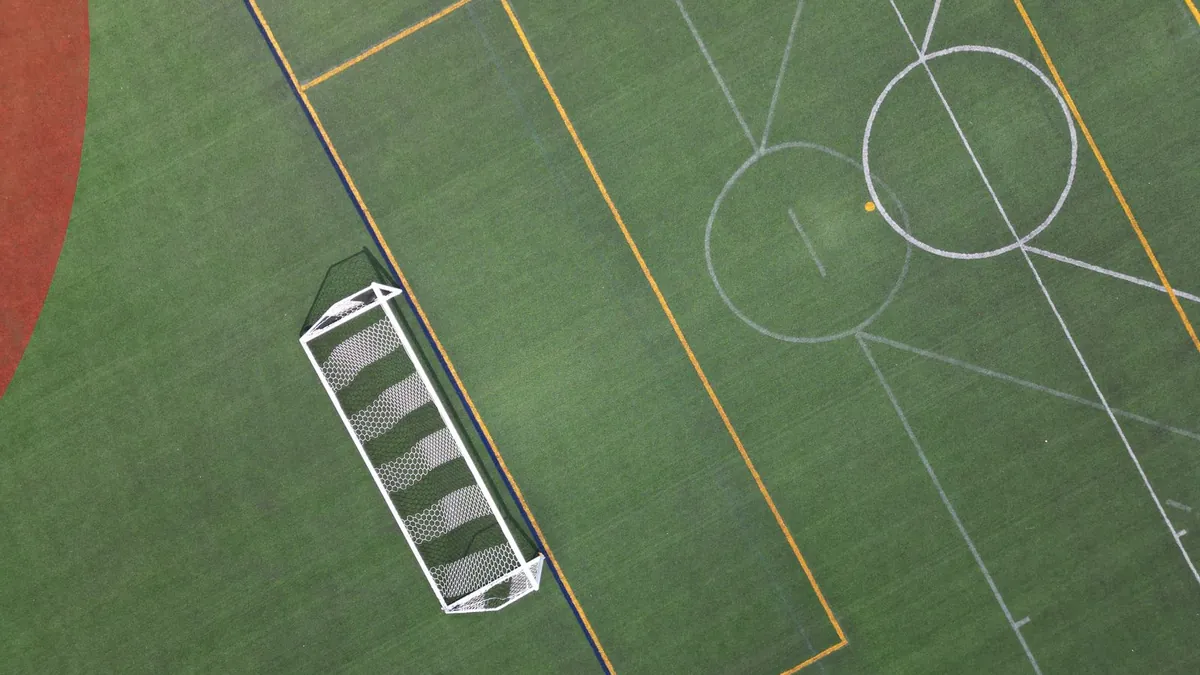
Our team cuts artificial turf for gym use to a stated pile on the tufting line. That matters when one floor has to carry a sled lane at one height and a stretching strip at another.
Width follows the layout. A full sled track commonly runs 2 m wide by 20 to 25 m long. A half track runs 2 m by 10 to 15 m, and a corner station 4 m by 4 m.
Mixed-height artificial turf installations are common now, with a short sled lane and a taller stretching strip running side by side in one floor. Order both heights in the same production run so the yarn and the colour match.
Where Impact and Sound Really Get Absorbed
Owners buy turf expecting cushioning, then blame the pile when a barbell still thuds. Cushioning is a system property, and fibre, backing, underlay and slab all share the load.
Padded products put a 5 mm or 8 mm foam layer in the backing. A separate rubber layer under the roll does the heavier work. Published specification tables for training facilities call for 10 mm of rubber under a heavy-duty turf, and 10 to 15 mm under a dedicated sled track.
Sound behaves the same way. The base layer is what absorbs the noise of a weight set down. A floor that still thuds after the turf has been laid almost always has an underlay problem rather than a pile problem.
Backing chemistry matters as much as thickness, because it decides how the carpet holds its shape across a temperature swing. The detail is worth ten minutes: how backing chemistry changes dimensional stability.
Artificial turf for gym owners is therefore a two-line specification, the roll you can see and the layer you cannot. Indoor artificial turf installations that skip the second line get exactly the thud they were trying to avoid.
Cleaning Routines That Keep Gym Fibres Alive
Gym turf sits under sweat, chalk and skin contact all day. Industry guidance for training facilities lists bacterial build-up as a standing condition of owning a turf zone, not as a surprise that arrives later.
The routine is light and frequent rather than heavy and rare. Brushing keeps the pile upright, vacuuming removes chalk before it reaches the backing, and a monthly wet clean with a mild detergent deals with what brushing cannot lift.
| Task | Cadence | Why it is on the list |
|---|---|---|
| Brush or rake the pile | Daily in the busiest lanes | Lifts fibres before they set flat |
| Vacuum or sweep | Weekly | Removes chalk dust and grit before it works down |
| Deep clean with mild detergent | Monthly | Clears sweat residue a brush cannot lift |
| Rotate the sled start position | Monthly, by 30 to 60 cm | Spreads abrasion instead of cutting one trench |
| Inspect wear, seams and edges | Quarterly | Catches seam lift and runner wear early |
Artificial turf for gym hygiene is a schedule question, not a product question. Disinfectant compatibility is where most operators get caught out. A commercial sanitiser can be lightly applied to synthetic grass, but a product chosen for a sealed hard floor is not automatically safe on yarn.
Test any new cleaning agent on a sample square first and leave it for a day. Discolouration or a stiff nap tells you more in twenty-four hours than a datasheet will.
Artificial turf installations in busy gyms carry a higher cleaning burden than a sealed hard floor does, and that burden belongs in the operating budget from day one. Staff time is the real line item, not the detergent.
Drainage perforations in the backing are what make a wet clean possible indoors, since water has to leave the carpet rather than sit in it. That is a specification question rather than a cleaning one, and it belongs on the order. The same hygiene logic drives surface choice in other shared spaces; see why the same logic holds for playground surfaces.
Three Mistakes That Shorten Gym Turf Life
Three specification errors account for most of the early replacements we are asked to quote against, and all three are avoidable on the order form.
Mistake 1: Choosing Pile Height for Looks
A tall, soft pile photographs well and mats within a season under sled traffic. Match height to the activity, not to the showroom, and ask the supplier to state the figure in writing.
Mistake 2: Treating Face Weight as Optional
Commercial buying guidance puts 40 oz as the line, and more where sleds run. Below that, abrasion shows as thinning long before the rest of the floor looks tired, and no amount of brushing brings it back.
Mistake 3: Leaving the Underlay Off the Sheet
Impact and noise are base-layer work. A roll laid without a specified underlay will thud, seam-lift and wear at the edges, whatever the pile height says on the label.
Worried Your Sled Lane Will Fray Early?
Friction eats light-duty pile in months. We tuft factory-direct gym rolls at 10 to 15 mm with a dense stitch rate, and ship free 20 by 20 cm samples.
Reading a Gym Turf Specification Sheet
A serious artificial turf for gym enquiry names six lines before colour comes up. If any of them is missing from the sheet, you are comparing prices on something that has not been specified yet.
| Line on the sheet | What to look for | Why it matters here |
|---|---|---|
| Pile height | 10 to 15 mm where sleds lead, up to 25 mm for floor work | Sets drag, stability and matting rate |
| Stitch density | A stated count high enough for sled lanes | Carries load without collapsing into the backing |
| Face weight | 40 oz minimum for commercial use | The durability number most often skipped |
| Backing | Named type, with polyurethane options where sleds run | Resists tearing and separation under drag |
| Roll size | 2 m, 4 m or 5 m by 25 m | Decides seam count and offcut waste |
| Markings | Tufted lines, numbers or a facility logo | No paint to flake off after a season |
Two of those lines deserve a second look. Face weight is the durability number buyers skip most often, and what face weight tells you about density explains how to read it without guessing.
Roll size is the other. Standard widths are 2 m, 4 m and 5 m at 25 m long, and the choice is a seam calculation. A 2 m roll gives one clean run down a sled lane, while a 4 m roll covers an open training strip with a single joint instead of three.
Specification discipline also protects the second order. When the sheet states pile height, stitch count, face weight and backing type, a repeat run twelve months later can be matched instead of approximated.
Ask for the tolerance as well as the target. A stated pile height without a stated tolerance is not a commitment. It is also the line buyers most often forget, until a replacement roll arrives visibly different from the first.
A Short Acceptance Checklist Before Handover
Five checks on delivery day prevent most of the disputes that surface a year later. Each one takes minutes, and none of them needs specialist equipment.
Most artificial turf installations go wrong at handover for mundane reasons: a wrong width, an unlabelled roll, or a seam placed where traffic is heaviest. All three are cheaper to catch before the cut than after it.
Check 1: Confirm Pile Height Against the Order
Measure the fibre at several points across the roll and compare it with the stated figure. Variation within one roll is a production fault, not a tolerance to accept.
Check 2: Pull Against the Backing
A firm tug on a tuft should not lift it clear. Tuft lock is what stops a sled lane shedding fibre in its first month of service.
Check 3: Read the Seam Plan Before Cutting
Seams belong where traffic is lightest. A joint running down the centre of a sled lane will open under drag, and no repair hides it once it has.
Check 4: Verify Roll Width and Length on the Label
Match the label to the order before the roll is cut. A short roll discovered after cutting cannot be put back into a full-length run.
Check 5: Keep an Offcut for the Sample File
Keep a labelled offcut from every batch. When a repeat order arrives a year later, that piece is the only fair comparison you will have to hand.
Standard formats are listed with the standard roll formats and product formats, which is the quickest way to sanity-check a packing list on site.
Where Turf Still Loses to Rubber in Gyms
Honesty about the limits keeps the rest credible. A barbell dropped repeatedly from overhead belongs on a lifting platform with a thick rubber specification. Turf is a wearing surface for friction work, not a crash mat.
Heavy static loads are the second case. Racks, plate trees and machines compress pile permanently, and a turf strip laid under a fixed rig will carry an imprint for the life of the floor.
Cleaning capacity is the third. A facility that will not fund a weekly vacuum and a monthly wet clean should not buy a surface whose hygiene depends on both. Rubber forgives that neglect far longer than a pile does.
Where the floor carries sled work, agility drills, group classes and floor work, artificial turf for gym operators earns its place on friction behaviour no rubber tile reproduces. Commercial artificial turf installations of that kind are quoted at 6 to 10 years under heavy functional use, against 3 to 5 years for standard rubber.
Frequently Asked Questions
How tall should gym turf pile be?
Between 10 and 15 mm for most gyms. Use 10 to 13 mm where sleds run, 15 to 20 mm for agility work, and 20 to 25 mm for stretching zones.
Can a sled be pushed on artificial turf?
Yes, on a short dense pile of 10 to 13 mm. Taller pile adds drag, traps heat and mats under the runners, which is the fastest way to ruin a lane.
Can landscape turf be used inside a gym?
It can be laid, but it performs badly. A 30 mm landscape pile creates drag, holds chalk and can overheat under sled runners. Specify a gym-grade short pile instead.
How often should gym turf be cleaned?
Brush the pile daily in busy lanes, vacuum weekly, deep clean monthly with a mild detergent, and inspect wear quarterly. High-traffic gyms shorten every one of those intervals.
Does gym turf need an underlay?
Usually yes. Impact and noise are absorbed by the layer beneath the roll, and published guidance recommends 10 mm of rubber under heavy-duty turf and more under a dedicated sled track.
How long does gym turf last?
Commercial gym turf is commonly quoted at 6 to 10 years under heavy functional use, and commercial artificial grass carries a service life of up to 10 to 15 years.
 English
  Arabic
  French
  German
  Portuguese
  Russian
  Spanish