

A lawn that sheds fibres in its second season usually fails from the back, not from the blades. The coating under the carpet decides how long fibres stay locked, how a roll handles weeks of rain, and whether a seam survives its first winter. Buyers comparing two quotes at the same pile height are often really comparing two different backings.
We coat every roll on our own line, where latex and PU leave the same ovens with very different results. PU back glue synthetic lawn turf costs more per square metre than a latex-coated equivalent. Dealers who price artificial turf installations by the roll need to know where that premium pays back. Wet sites, pets and cold snaps are where it pays fastest. Dry budget projects are where latex still copes.
What the Secondary Backing Actually Does
Every roll has two layers under the fibres. A woven or non-woven polypropylene primary backing gives the tufting needles something to stitch through. A liquid secondary coating, latex or polyurethane, is then flooded over the back to lock each tuft. The roll runs through the drying oven, and drainage holes are punched at regular spacings so rain can pass.
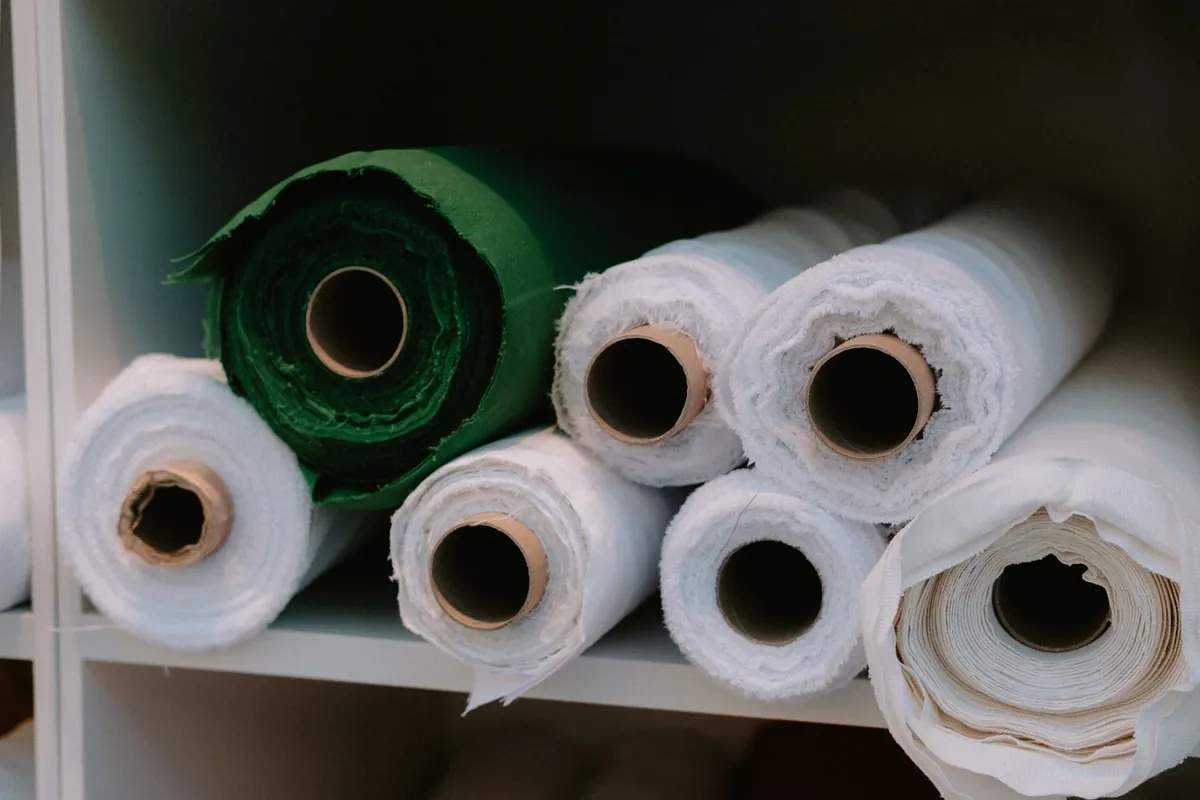
On PU back glue synthetic lawn turf, that secondary layer is a polyurethane film rather than a styrene-butadiene rubber latex. Both coatings hold fibres the same way on a dry day. The difference shows up when water, heat or cold works on the coating for a few seasons.
For most artificial turf installations the coating is the part nobody sees again after laying. That is why the standard roll formats and product range list the backing beside pile height.
Where Latex Backing Falls Short Outdoors
Latex starts with a real advantage: price. It has backed turf for decades and, applied correctly, holds tufts securely. The weakness is water. Latex absorbs moisture, and unless it is fully dried during production, repeated wet-dry cycles slowly reduce tuft lock until fibres start to pull free.
Standing water and coastal salt air speed that up. Supplier testing notes describe SBR latex cracking and powdering under long-term humidity, heavy rain or salt spray, with large-area shedding reported after 3–5 years in those conditions.

Heat and pets add two more failure modes. In very hot weather a latex coating can bubble or wrinkle until temperatures drop. It also absorbs urine odours as they crystallise, which is why latex-backed lawns with dogs are the complaint we hear most often. See the roll construction page for how a coated roll is built up.
How PU Backing Holds Fibres Tighter
Polyurethane is not affected by moisture, so the coating does not weaken against damp ground. Because it penetrates the fibre bundle more evenly, a PU layer reaches the same tuft-pull target as latex with a lighter coating. The extra weight a latex application needs is a production necessity, not extra strength.
The lighter coat does three useful things at once. It gives greater tear resistance, it keeps the roll lighter and more flexible to cut, carry and lay, and it leaves the coating stable in extreme weather instead of crumbling. On PU back glue synthetic lawn turf the backing also takes a stronger seam bond with the correct adhesive, which keeps roll edge joints secure on wide layouts.

Wet-dry cycling is the cleanest way to see the gap. In accelerated aging tests, latex tuft bind declines after repeated soak-and-dry rounds, while PU holds close to its original strength through the whole test.
Wet Strength, Moisture and Heat Compared
The differences are easiest to see side by side. Cold matters as much as rain: latex can turn brittle in a hard freeze, while PU only stiffens slightly and returns to normal. A backing works like a foundation, invisible when it is right and expensive when it is wrong.
The table below puts PU back glue synthetic lawn turf against a latex-coated roll of the same pile.
| Property | Latex (SBR) coating | PU back glue coating |
|---|---|---|
| Wet tuft bind | High when dry, lower when wet | Consistently high |
| Water behaviour | Absorbs water; tuft lock can drop | Not affected by moisture |
| Very hot weather | Can bubble or wrinkle | Stays flexible |
| Hard freeze | May turn brittle | Remains flexible |
| Coating for the same tuft pull | Heavier application | Lighter application |
| Reported outdoor service life | 8–12 years | 12–20 years |
Service-life bands are supplier estimates, not promises; traffic, drainage and upkeep move the outcome more than the coating alone. Ask any bidder for the wet figure, not just the dry one, because the wet number is where the two coatings separate.
Losing Fibres From the Back of Your Roll?
Shedding and delamination usually start in the coating, not the blades. We coat PU and PP+Net backings on our line, cut to your spec. Ask for a sample roll.
Four Backing Mistakes That Shorten Turf Life
Most early failures we trace in PU back glue synthetic lawn turf complaints come back to four buying mistakes rather than bad luck.
Judging a roll by pile height alone
Two rolls with the same pile height can be different products once the coating differs. Fibre decides how a lawn looks in week one. The coating decides how it looks in year five.
Assuming a heavier backing is a stronger backing
Some producers run long backing lines that need more latex, thickened with water and chalk, just to reach the tuft pull a PU film reaches more lightly. The added weight is a production necessity. It is not a strength upgrade.
Putting latex where drainage is poor
Artificial turf installations near the coast, in flood-prone yards or over slow-draining bases put the coating through the wet-dry cycling that latex handles worst. That is the exact scenario where the PU premium repays itself first.
Skipping the wet tuft bind check
Dry tuft bind looks similar on both coatings. The wet figure is where latex drops and PU holds. A spec sheet that quotes only dry numbers hides the one difference that matters outdoors.
Matching the Backing to Climate and Use
PU back glue synthetic lawn turf earns its premium in the worst weather a site serves up, not in the best. The useful question is not which coating wins in the abstract but which one survives your site’s worst week.

| Site condition | Better fit | Why |
|---|---|---|
| Heavy rain or coastal salt air | PU | Latex cracks and powders under sustained humidity and salt spray |
| Homes and yards with pets | PU | Latex absorbs urine odours; PU does not |
| Frost and freeze-thaw winters | PU | Latex can turn brittle in a hard freeze |
| Temporary or dry indoor fit-outs | Latex | Lower cost is adequate for dry, low-traffic use |
| Wide rolls with minimal seams | PU | Bonds roll edge joints more strongly with the correct adhesive |
Roll format still matters alongside coating. Standard rolls come in 2 m, 4 m and 5 m widths by 25 m, and wider rolls cut the seam count on big layouts. Compare our residential artificial grass systems by both backing and width before you fix a layout.
A Backing Checklist Before You Buy
Run this list before your next artificial turf installation and most coating arguments disappear on the quoting table.
Name the secondary coating in writing
Ask for the coating chemistry by name, PU or SBR latex, on the quotation itself. A spec sheet that says only “standard backing” tells you nothing about how the roll behaves in rain.
Ask for dry and wet tuft bind figures
Well-made PU-coated rolls commonly test at 10–12 lbs against an industry norm of about 7–8 lbs, and the wet figure should stay close to the dry one. Numbers belong on the datasheet, not in conversation.
Check the perforation and the seam plan
Confirm the drainage holes are punched at regular spacings and that the seam layout suits your roll widths. A strong coating still needs a seam plan that puts joints where water leaves the site.
Verify on a physical sample
Free samples of 20 cm × 20 cm ship by DHL or FedEx in 4–6 days. A custom sample takes longer. Rub the back: the shiny, plastic-smooth feel is PU, while the matte, rubbery feel is latex. Order a free sample roll before you commit a container.
Get the backing right and every other decision gets easier, because the surface keeps whatever the coating locks in. Custom coating type, fibre and width are all part of our custom roll specification service. Run the checklist, fix the coating in writing, and your next artificial turf installation starts with the layer nobody sees.
Frequently Asked Questions
How can I tell PU backing from latex on a sample?
Rub the back of the sample. PU feels smooth and slightly shiny like a plastic film, while latex feels matte, rough and rubbery, sometimes leaving a faint chalky dust.
Is latex backing still a sensible choice?
Yes, for dry, low-traffic or temporary installations where budget leads. In temperate weather without pets or standing water, correctly applied latex holds tufts securely for years.
Does latex backing hold pet odours?
It can. Urine crystallises inside latex and leaves a smell that is hard to remove, while PU is non-absorbent and cleans through normally.
What tuft bind figure is typical?
The industry norm sits near 7–8 lbs, and well-made PU-coated rolls commonly test at 10–12 lbs. Ask for the wet figure too, not only the dry one.
How long does a PU-backed lawn last?
Reported supplier bands put PU-backed turf at 12–20 years outdoors against 8–12 years for latex, with traffic, drainage and upkeep deciding where a lawn lands inside the band.
Can I check the backing before a bulk order?
Yes. Free samples of 20 cm × 20 cm ship by DHL or FedEx in 4–6 days, with courier freight paid by the buyer. The coating is in your hands before any container is booked.

 English
  Arabic
  French
  German
  Portuguese
  Russian
  Spanish