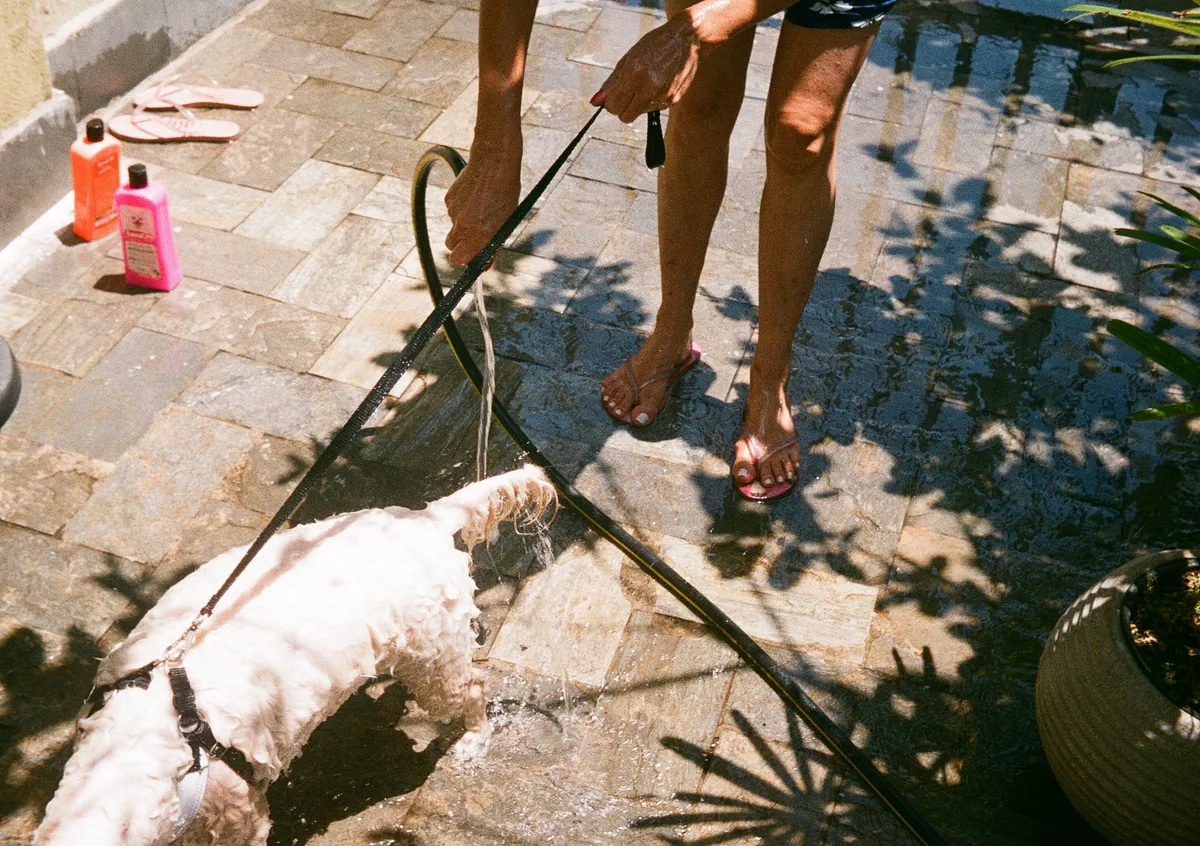
A homeowner spent three Saturday mornings hosing dog spots on his new lawn, and the smell was back by Monday every time. The water runs straight through, so the routine feels productive. But the odor source is not on the surface. It sits in the infill below, where uric acid crystals and bacteria collect beyond the reach of any hose. He was cleaning the wrong layer.
Learning how to clean artificial grass is mostly learning what not to do: no metal rakes, no bleach, no pressure washer aimed at a seam. Every roll we ship is tufted, coated, perforated and inspected on our own line before it leaves the floor. That is why this advice starts from what the backing and the drainage holes tolerate, not from what a bottle promises. A hose, a soft brush and a calendar carry most lawns, and we will point out the places where no routine can save the turf.
How Often Should You Clean Artificial Grass?
Ask five installers how to clean artificial grass and the core answer barely changes. Simple Green’s published baseline is a rinse with plain water once a week and a deeper clean at least monthly. Purchase Green stretches the band by usage. Weekly, when the lawn takes heavy play or collects dust, and at least twice a month for light use.
Dogs change the math again. TurfFresh prescribes an enzyme treatment on pet zones monthly, plus professional deep cleaning every 3 to 6 months for dog households. Exelgreen lands the brushing side at once or twice a year, and flags 50 mm blades for an extra annual pass. Set against a material investment of $7-60 per square meter (indicative — request an exact quote), the whole kit costs a hose and twenty quiet minutes.
| Scenario | Weekly | Monthly | Once or twice a year |
|---|---|---|---|
| Light use, low dust | Quick hose rinse | Full rinse and brush | Power brush the whole lawn |
| Heavy play or dusty area | Rinse plus a debris pass | Full rinse and brush | Consider a second power brush pass |
| Dogs in the yard | Rinse the pet zone | Enzyme treatment with full dwell time | Professional deep clean every 3 to 6 months |
| Tall 50 mm blades | Standard cadence | Standard cadence plus a brush pass | Extra annual brushing session |
The grid merges four sources, so adjust it for your own dust, trees and dog. The one habit no lawn skips is the weekly rinse.
The Four-Step Routine That Actually Works
This is the heart of how to clean artificial grass: debris, water, treatment, brush, in that order. TurfFresh times the loop at about twenty minutes for an average backyard and warns that order matters more than effort. Clean out of sequence and you push dirt deeper into the infill instead of lifting it out. The same discipline holds across our artificial grass products range, because the surface system underneath barely changes from landscape rolls to sport turf.
Step one: clear debris while everything is dry, sweeping leaves, twigs and solid waste with a plastic rake or a leaf blower on its lowest setting. Wet debris turns into a paste that settles into the pile. Step two: rinse with a garden hose, working from one end of the lawn toward the drainage direction rather than across seams. Step three: treat stain and pet spots with a cleaner labeled for synthetic turf, then let it sit for the full dwell time printed on the label.
Step four: once the surface has dried, brush against the grain to set the blades upright again. For bigger lawns, Simple Green’s directions add a habit worth stealing: wash in sections, push foam to the edge, rinse, and let everything air dry before grooming. Mud asks for patience instead of force. Let it dry, lift what lifts cleanly, then rinse lightly toward the drainage line, because aggressive spraying only drives mud into the base.
Tools That Clean Without Damaging Blades
The tool aisle hurts more lawns than the weather does. Every installer we checked — Purchase Green, Exelgreen and TurfFresh — bans the same first offender: the metal rake. Metal prongs snag fibers, loosen seams and leave permanent wear tracks in the lanes people walk most. A plastic rake or a leaf blower on a low setting clears the same debris with none of that risk.
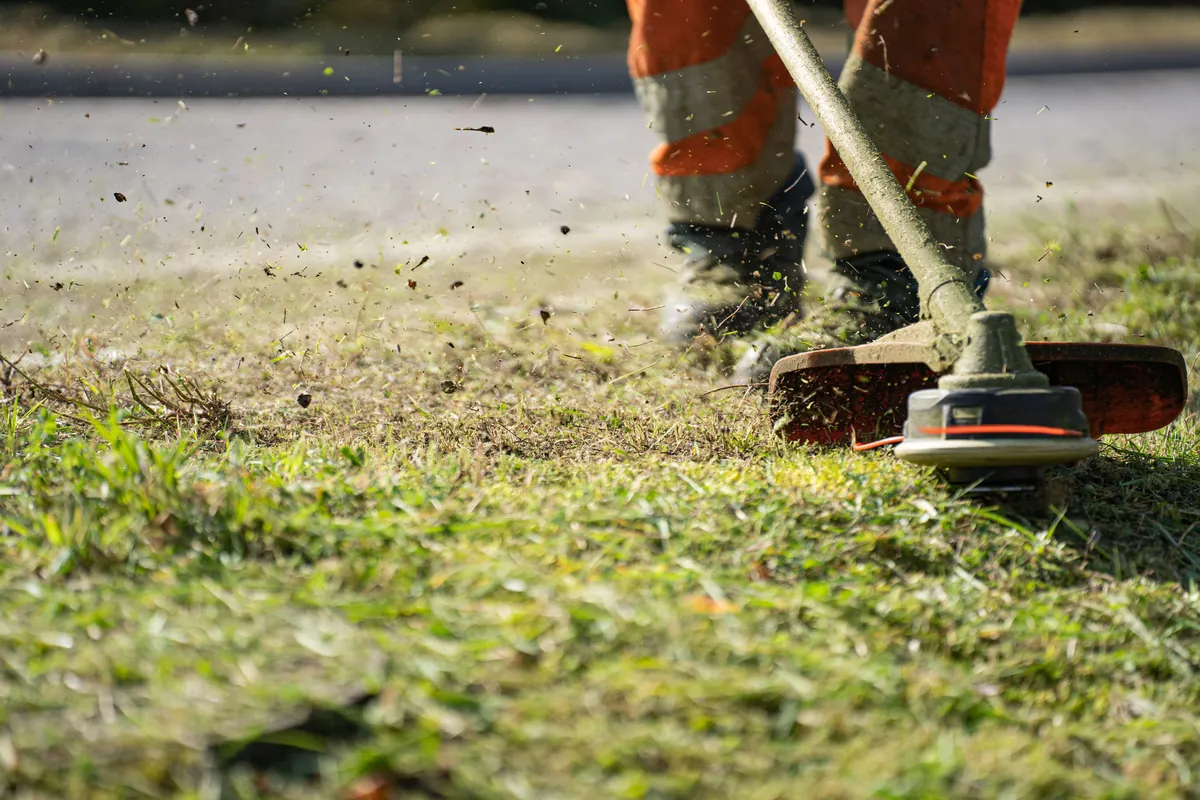
A trade customer once showed us a doorway path flatter than the rest of his lawn. Same turf, same rain, same week — the difference was the metal-edged push broom he dragged along the fence line every Friday. Swapped for a synthetic-bristle broom and two months of against-the-grain brushing, the lane stood back up.
Household vacuums are subtler offenders. They pull infill out along with the debris, quietly unballasting the lawn, which is why TurfFresh ranks a leaf blower or rake as the safer habit. Where a lawn has genuinely matted, a power broom earns its keep about once a year in residential use; Exelgreen’s electric brush class covers a lawn in roughly 25 minutes. Purchase Green even suggests a magnet sweep on play surfaces to lift pins, screws and hairpins.
| Tool | Verdict | Why |
|---|---|---|
| Plastic rake or leaf blower (low setting) | Use weekly | Lifts debris without pulling infill |
| Synthetic-bristle broom or brush | Use at every rinse | Fluffs blades with no snag risk |
| Power broom | About once a year | Restores matted lanes at scale |
| Household vacuum | Avoid | Sucks infill out with the debris |
| Metal rake or wire brush | Never | Snags fibers and loosens seams |
Can You Pressure Wash Artificial Grass?
Plenty of guides explain how to clean artificial grass with a pressure washer, so here is our honest position: the garden hose is the better default. It clears dust, pollen and loose dirt with zero risk to the seams. If you do bring the washer out, TurfFresh’s four conditions are non-negotiable. Cold water only, a wide-angle nozzle, at least 12 inches of standoff, and the lowest pressure setting the machine has.
Never aim the jet at a seam or an edge, and stop the moment you see infill collecting there. Hot water or a direct hit damages fibers and displaces infill in a way no later cleaning reverses. If infill does get blown out, replace it with a coated turf infill rather than basic silica sand, which is the wrong substitute for an engineered, dust-coated grain.
Which Cleaners Are Safe for Artificial Grass?
Water is the default cleaner for a reason. The PU and PP+Net backings we coat on our own production line tolerate water perfectly well, while strong solvents attack coatings the way they attack paint. So start there, spot test anything new in a hidden corner, and read labels with a skeptic’s eye.
The sharpest chemistry warning comes from TurfFresh. Bleach reacts with the ammonia in pet urine and releases toxic fumes, and both bleach and ammonia-based cleaners degrade the backing itself. Harsh degreasers and big doses of vinegar fill out the ban list. Vinegar may soften a light odor, but it cannot reach bacteria that have settled into the infill.
Label language needs one specific check. Pet-safe is a safety claim, not a performance claim, so look for products described as formulated for synthetic turf. As a worked example of a tuned dilution, Simple Green publishes 1 1/2 cups of its all-purpose cleaner per gallon of water for turf. Exelgreen’s gentle kit — warm water, mild soap, or a little white vinegar on a soft brush — covers most stains inside that same boundary.
Dog Urine and Odor: What Actually Works
The moment a dog moves in, how to clean artificial grass stops being a dust question and becomes a smell question. Urine soaks through the pile into the infill, where uric acid crystals and bacteria sit far below the reach of any hose. That is why rinsing feels productive and changes nothing.
An enzyme-based cleaner formulated for synthetic turf does reach that layer, but only if it dwells for the full time on the label. Apply it and rinse immediately, as TurfFresh warns, and you wash the cleaner away before it has done anything. Give the zones your dog actually uses a monthly enzyme treatment, then brush them against the grain once dry.
Then run the 48-hour test. If odor comes back within two days of a correct treatment, the infill is saturated and needs professional extraction, not another bottle. Balconies deserve their own note, because forum threads full of apartment dwellers prove the point: no hose, no easy fix. Small balcony pieces can be lifted, treated and air-dried out of position, a move the hose-first guides never mention.
For a whole system built around dogs — drainage layers, surface choice, the works — see our artificial grass for dogs guide. Keep this page for the cleaning discipline itself, because even the best pet system still needs the monthly routine above.
Test the Turf Before You Spec It
Cleaning advice is easier to trust once you have felt the product. When we pack samples, we drop in the same 20cm × 20cm pieces our line cuts for full rolls — usually three to four pieces, free, freight on you. They ship by DHL or FedEx in 4 to 6 days, or 7 to 9 to remote areas.
Bringing Flat and Matted Blades Back
Blades flatten wherever feet and furniture repeat themselves. The fix costs nothing but attention: look across the lawn at a low angle, find the direction the blades lean, and brush the opposite way. Brushing with the lean presses them further down, while brushing against it is what lifts them. Think of wet hair — nobody brushes it flat against the scalp on purpose, and turf behaves best when dry too.
Brush the walkways, pet zones and chair-leg circles at every rinse, not just when the lawn looks tired. Pile height sets the ceiling on easy recovery. Twenty to 25 mm lawns stay tidy with little effort, and 30 to 40 mm balances comfort against cleaning. Fifty millimeter blades buy cushioning at the price of an extra annual brushing.
And the honest boundary: if blades stay down despite patient brushing and the infill feels hard underfoot, the lawn is compacted rather than dirty. That is a professional-service signal, the same one TurfFresh raises when odor returns within a day or two. It applies too when a lawn has gone more than 12 months without professional attention.
The Annual Deep Clean and Infill Checkup
Once a year, the lawn deserves more than a rinse. Purchase Green puts the residential deep clean at about once a year with a power brush that lifts debris and restores the pile, and athletic surfaces need it more often. The deeper job is infill care: de-compact it, clear the contamination, and spread what remains evenly across the surface.
Uneven compaction quietly costs traction and invites algae, so this pass protects how the lawn plays, not just how it looks. Where extraction losses have thinned the infill, top it up with a coated product. The family trade-offs are compared in our guide to the best infill options for artificial grass. Raw silica sand is not the refill.
Seam planning helps the rinse water too. The 2m, 4m and 5m rolls we cut to order cover 50, 100 and 125 square meters respectively. A layout with fewer seams gives rinse water one clear path instead of many joints to test. It is the same planning logic we apply at Relyir on wholesale sport fields, scaled down to a back garden and a garden hose.
Handled this way, the surface repays you with lifespan. TurfFresh puts properly maintained turf at 15 to 20 years of service, and Exelgreen’s estimate lands near fifteen. Either way, the gap between those numbers and a sad, flat lawn is rarely the product — it is the calendar above.
Frequently Asked Questions
How often should you clean artificial grass?
Give it a light rinse weekly and a proper clean monthly under normal use. Double the rinsing for dust or heavy play, and add a monthly enzyme treatment to any zone your dog uses.
Can you use bleach on artificial grass?
No. Bleach degrades the backing, and where pet urine is present it reacts with ammonia to release toxic fumes. Water plus a cleaner labeled for synthetic turf covers every routine job.
Why does my artificial grass still smell after cleaning?
The odor source sits in the infill, where uric acid and bacteria collect below the surface. If smell returns within 48 hours of a correct enzyme treatment, the infill is saturated and needs professional extraction.
Can you vacuum or pressure wash artificial grass?
Vacuuming pulls infill out along with the debris, so use a blower or plastic rake instead. Pressure washing is workable only with cold water, a wide-angle nozzle, low pressure and a 12 inch standoff.
How to clean artificial grass with dogs?
Pick up solids quickly, rinse the dog zone weekly, apply an enzyme cleaner monthly, and let it dwell for the label’s full time. Brush the area against the grain once it has dried.

 English
  Arabic
  French
  German
  Portuguese
  Russian
  Spanish