
Ask a caretaker what a wet autumn week costs and the answer arrives quickly: closed gates, muddy clothes, and three days lost while the ground recovers. That arithmetic repeats every year, and it is usually what pushes a school or council to price a synthetic play surface.
We build artificial grass for playgrounds on our own tufting and coating line, so we read the same numbers as the people specifying them. On most artificial turf installations the starting point is fall height, drainage and cleaning hours, and colour comes last. Those same figures decide whether a synthetic surface beats grass, bark or loose fill on a given site.
Why Schools Rethink Grass for Playgrounds
Natural grass is generous for about half the year. Rain turns goalmouths and slide exits into mud, dry spells bake the ground hard, and both states reduce the hours children can use the space.
Safety data explains why the surface gets so much attention. A figure quoted from the United States consumer product safety handbook puts falls from equipment at 79% of playground injuries. More than 200,000 children are treated for playground injuries every year. Half of those injuries occur at schools and sporting facilities.
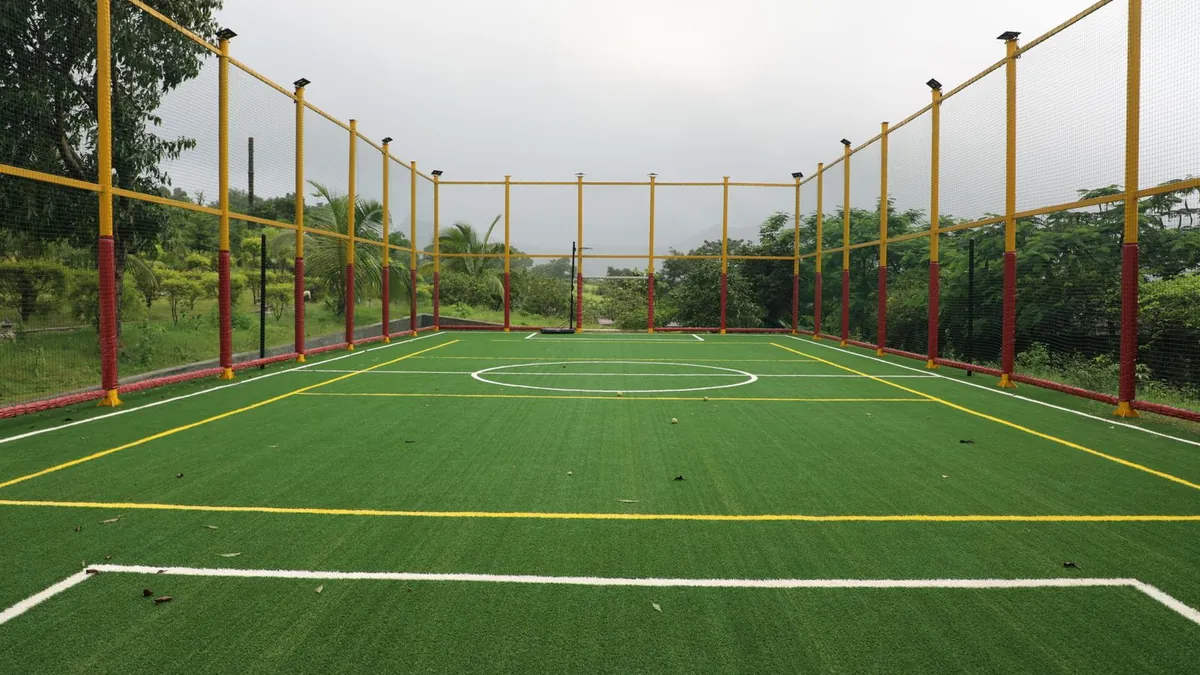
Anyone weighing artificial grass for playgrounds against grass is comparing three things at once. Time given back matters first, then how predictably the surface behaves when a child lands on it. Labour removed from the weekly budget comes third.
Our playground artificial grass builds are specified around those three questions, which is why the conversation usually starts with equipment height rather than with a swatch.
What Fall Height Means for Surface Choice
Fall maths begins at the highest point a child can reach on each piece of equipment. The whole build above the subgrade carries that rating: turf, shock layer, infill, base and edging working together. That single rating is why specifiers reach for artificial grass for playgrounds instead of loose fill.
Impact is measured, not judged by eye. Industry tests track the Head Injury Criterion and peak deceleration on impact. Third-party reports commonly quote a Head Injury Criterion at or below 1000, with Gmax at or below 200.
The shock layer does most of the work. Published installer mappings put a 25 mm pad at protection up to about 1.4 m, and a 50 mm pad at about 2.8 m. Another example pairs a 35 to 45 mm pad with an eight-foot fall height, and market thickness runs from 20 mm to 65 mm.
Facing a Fall Height You Cannot Match?
An unmatched rating stalls handover. We tuft playground pile from 30 to 50 mm, then send a 20 cm sample with the fall-height sheet.
How Pile Height and Infill Change Impact
Pile height sets the look and the feel underfoot, but it is not the safety switch many buyers assume it is. Absorbing that fall is mainly the job of the layer underneath, and very tall fibres flatten faster where children run every break.
Guidance for schools puts the sensible pile band between 20 mm and 35 mm, with higher fall zones often specified from 30 to 50 mm. The lower part of that band suits early-years areas, where short, dense fibre stays upright and clean.
Ask for density and face weight alongside it, since two rolls can share the same pile height and still behave very differently underfoot.
Infill is the second half of the system. It supports the yarn, spreads load and gives surface stability, so when it compacts the surface loses resilience and with it some of its impact performance.
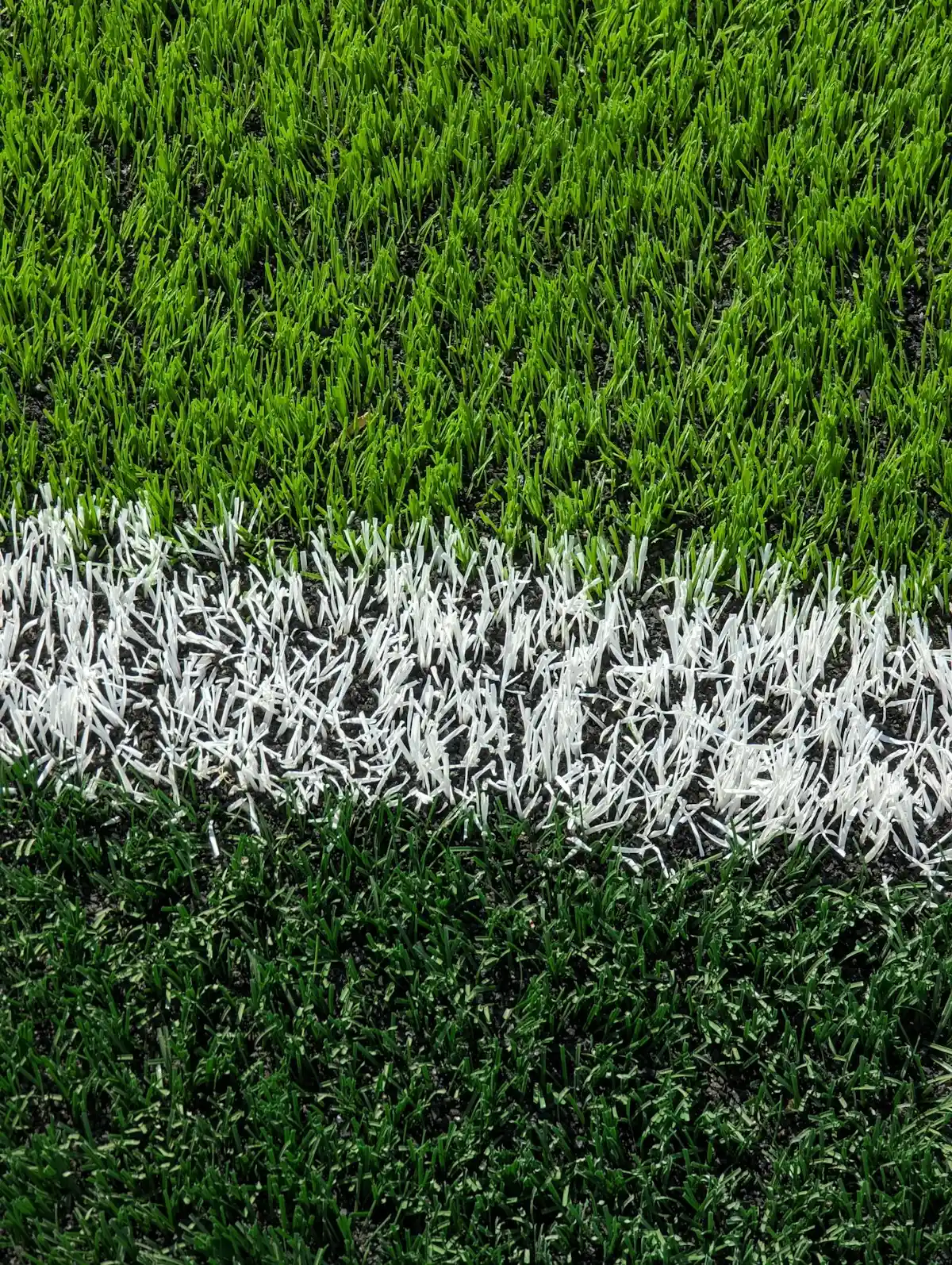
Yarn choice matters here too. Blade shapes and how they recover decide how quickly the pile springs back after hundreds of feet have crossed it in one morning.
Where Wear Concentrates First on Playgrounds
Traffic on a playground is not even. Across the artificial turf installations we have supplied for school yards, wear lands in three spots: slide exits, the swing arc, and the gate threshold. Plan for those strips before fixing anything else.
Fibre that stays flat after brushing is telling you about compacted infill, not tired yarn. Redistribution restores bounce and cushioning, and leaves the pile looking new for another term.
Map those three zones before you fix quantities. Taller pile or a denser stitch rate in the landing strips costs little at specification stage and removes the patch that otherwise shows up in year three.
Hygiene Routines After a Full Play Week
A school yard sees spills, sand and a great deal of traffic, so hygiene is a schedule question rather than a product question. The shape of the week sets the shape of the cleaning plan.
Artificial turf installations built for busy yards follow that weekly rhythm, whereas natural grass simply adds mowing, reseeding and watering to it. Neither option is care-free; one of them is predictable.
One maintenance provider sets the school routine out plainly. Debris is cleared every day and surfaces are rinsed two to three times per week. Weekly brushing against the grain is followed by monthly sanitising, or a pass after any illness event. Professional deep cleaning is booked one to three times a year.
Written records close the loop. The public playground safety handbook recommends keeping inspection and maintenance logs, and a dated log is what answers a parent or insurer two years later.
Drainage supports all of it. Perforated backing typically sheds more than 1000 mm per hour per square metre, so the surface dries between uses instead of holding the damp that makes cleaning harder.
Choosing Roll Widths to Cut Playground Seams
Roll width decides seam count before a single square metre is measured. Our rolls come in 2 m, 4 m and 5 m widths at 25 m long, and custom widths remove seams entirely in oddly shaped yards.
For most artificial turf installations the choice is unglamorous. A 4 m roll covers standard play layouts with the least waste. The 5 m width suits open sites where seam lines would cross busy routes, while 2 m works where access is tight.
Plan seam placement as carefully as the run itself. Keep seams out of landing zones and swing paths, then check the standard roll formats against your layout before quantities are fixed.
Reading a Playground Turf Specification Sheet
A specification sheet becomes useful once every line is tied to something you can check on site. Buyers reading artificial grass for playgrounds rather than a garden lawn are really checking six lines.
| Line item | What the market shows | Why it matters |
|---|---|---|
| Pile height | 20 mm to 35 mm for schools; 30 to 50 mm for higher fall zones | Sets feel, wear behaviour and infill retention |
| Shock layer thickness | 20 mm to 65 mm by target height; about 25 mm for 1.4 m, 50 mm for 2.8 m | Carries most of the impact absorption |
| Drainage through backing | More than 1000 mm per hour per square metre | Decides how soon children can play after rain |
| Fibre build | Polyethylene monofilament with polypropylene thatch | Softer against skin, denser appearance |
| Service life | 8 to 15 years by traffic, climate and care | Sets the replacement horizon in the budget |
| Roll format | 2 m, 4 m or 5 m wide, 25 m long | Controls seam count and handling weight |
Two figures on that sheet repay a closer look. A face weight reading tells you how much yarn sits above the backing, and how backing choice changes tuft lock predicts how well the pile stays put under sliding feet.
Three Mistakes That Shorten Playground Life
Buying Pile Height Instead of Fall Height
Specifiers pick artificial grass for playgrounds by describing the feel they want, then discover at inspection that no one named the tallest fall point. Ask for pile height, density and shock layer together, matched to that one number, and keep the three on the same quote line.
Letting the Shock Layer Be Value-Engineered Out
The pad is invisible once the grass is down, which makes it the easiest line to cut. Published mappings tie those millimetres directly to the metres of fall they cover, so trimming them quietly lowers the rating. Every artificial turf installation is only as protective as that hidden layer.
Treating Cleaning as a Summer Job
Delay is what turns surface dirt into compacted infill. A weekly brush against the grain plus a rinse keeps the pile open. A monthly sanitising pass keeps high-contact zones pleasant through the cold months.
A Short Acceptance Checklist Before Handover
Check Pile Height Against the Dated Spec
Measure the delivered roll against the sheet before it is cut, using a rule rather than an eye. A few millimetres of shortfall across a whole yard is easier to settle before the roll has been trimmed into awkward shapes.
Walk the Slide Exits and Swing Paths
Stand in each landing zone and look down. Fibre should stand upright and feel even underfoot, because these are the strips that will carry most of the traffic in the first year.
Time One Rinse and Watch Where Water Goes
Wet a corner and see how quickly it clears. Standing water points to compaction or a drainage layer that was not built to shed, and both are far cheaper to fix before the fence line closes.
Write the Cleaning Schedule Before Opening
Debris clearance, rinsing, brushing and deep cleaning dates belong in a log from day one. Order a sample square alongside the paperwork so the maintenance team knows exactly what it is looking after.
Frequently Asked Questions
How much of playground injury risk comes from falls?
Most of it. Falls from equipment account for 79% of playground injuries, and more than 200,000 children are treated for playground injuries every year. Roughly half happen at schools and sporting facilities.
Does playground turf need watering or irrigation?
No irrigation is needed to keep it usable. Water goes on to rinse dust and spills, and a short rinse before play also takes the edge off a hot surface on bright days.
Can a play area run without infill?
Yes, under low equipment. Many early-years areas use non-infill turf from 20 to 25 mm over a shock pad, which avoids loose particles and reduces routine cleaning work.
How long does artificial grass for playgrounds last?
Commercial artificial grass runs to 10 to 15 years of service life. Sector supplier guidance quotes 8 to 15 years, with the exact point set by traffic, climate and how faithfully the cleaning plan is kept.
How do you deal with heat on a summer surface?
Synthetic surfaces do run hotter than grass in direct sun. Plan vigorous play for cooler hours, use shade over the busiest zones, and rinse before children go out on the hottest days.
How can we check a roll before committing quantities?
Request free 20 cm by 20 cm samples, usually three or four pieces. They travel by courier in 4 to 6 days, with courier freight paid by the buyer, so the spec can be checked in daylight on site.

 English
  Arabic
  French
  German
  Portuguese
  Russian
  Spanish