

A facilities officer opens a brief with one line of scope: resurface the athletics area. The oval, the infield and the runways get priced as a single ground. That is how a project buys the wrong surface without ever noticing.
Artificial turf running track projects go wrong at that first line, not at the final inspection. Competition lanes need rubber or polyurethane underfoot for grip and energy return, while the infield, runways and warm-up zones work better as turf. We build turf rolls on our own line and watch this split decide budgets, so we ask which zone is which before anything else.
Where Turf Belongs on an Athletics Track
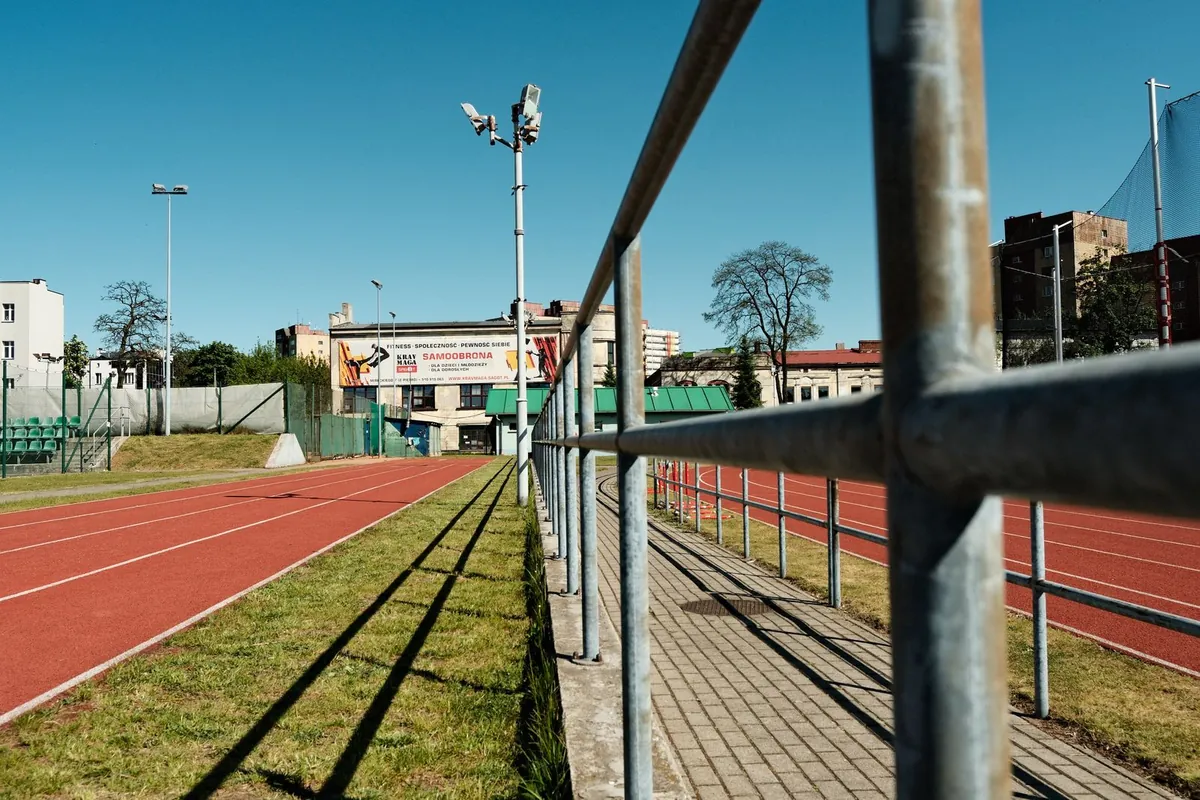
The division is simple once it is written down. Competition lanes stay rubber or polyurethane. Turf covers the infield, the runways and the training areas beside the oval.
Turf complements the track oval rather than replacing it, so an artificial turf running track is a mixed facility rather than one surface. Turf absorbs the warm-up, cool-down, field-event and conditioning traffic that would otherwise chew up the lanes.
Once the map is agreed, the turf side can be specified from our athletics track turf range against the pile height, backing and roll width that each zone needs.
The Adjudication Map: Track Surface or Turf
Treating the whole facility as one surface is like tiling every room in a building with the same slab. Lanes, runways and warm-up areas carry different loads and different footwear, so each one wants its own floor.
Most artificial turf installations fail at the point of assignment rather than at installation. Our own view is blunt: if a quotation prices the oval and the infield as one item, the project has already lost value.
The table below settles the question zone by zone, before anyone commits to a layout or a budget line.
| Zone | Governing surface | Reason |
|---|---|---|
| Competition lanes on the oval | Rubber or polyurethane track | Grip, energy return and lane lines for timed events |
| Sprint start and relay changeover zones | Rubber or polyurethane track | Starting blocks need a dense, stable surface under load |
| Field-event infield | Artificial turf | Softer footing for jumping, throwing drills and cool-downs |
| Long jump, triple jump and vault runways | Artificial turf beside a defined approach strip | Consistent footing next to the board without wearing the lane |
| Perimeter training lanes | Artificial turf | Conditioning and jogging without chewing up the oval |
| Warm-up and agility zones | Artificial turf, over a pad where the brief requires one | Lets school sessions and several sports share one surface |
| Throwing sectors and service margins | Artificial turf | Keeps debris and footfall away from the timed lanes |
Two boundaries sit outside that map. The pad under a turf zone and the base beneath both surfaces carry their own specifications, and neither is a turf-roll decision.
Why Running Lanes Stay Rubber, Not Turf
A lane is a timing instrument as much as a surface. Rubber and polyurethane return part of the energy a sprinter puts into the ground, and that return is what makes a fast time possible. Turf is softer on joints but gives less back, so lane times are slower on it.
Polyurethane lanes are usually poured in place, while prefabricated rubber arrives as sheets glued to an asphalt or concrete base. Both are chosen for grip, resilience and shock absorption under a spike.
Grip matters most at the start and through the bend. A spike has to bite the surface, and a layer that gives too much under load wastes force the athlete has already produced.
Anyone who wants background on how synthetic turf surfaces are built and behave will find the fibre, backing and infill stack described there. The point for specifiers is narrower: that stack suits an infield, not a timed lane.
The Infield Question for Field Events
Infields divide three ways: natural grass, synthetic turf and rubber. Natural grass fails the calendar test first, because it recovers slowly and turns soft after rain.
Synthetic grass infields inside a 400 m oval are now common, for a practical reason. One all-weather surface can serve warm-ups, field events, school sport and community bookings without a second facility.
An artificial turf installation inside the oval also settles a wear problem. Track lines and field wear patterns stop competing for the same ground once each sport has its own zone.
An artificial turf running track infield also survives weather that closes a grass field. A wet natural-grass infield shuts the warm-up area for days, while turf keeps sessions running around a watered or repaired oval.
Where the infield is shared with football, third-party testing criteria for ball bounce, roll and slip resistance apply to the surface. Those are neutral industry references, not tests we run or claims we make about our turf.
Indoor infields and warm-up halls often use non-infill systems used indoors, where a shorter pile over a firm base suits sprint drills and landings.
What Pile Height Gets Wrong for Athletics
Pile height is where artificial turf running track projects most often go wrong, because the instinctive answer, a longer and softer pile, is the wrong one here.
Published market bands for conditioning turf run 10 to 12 mm for entry-level work, 12 to 15 mm for mid-range surfaces and 15 to 16 mm for premium ones. All three bands suit athletics.
Above that, 20 to 25 mm and higher belongs to landscaping and field-sport turf. Longer fibres create excess friction and lie flat under load, which is the opposite of the fast foot turnover a lane needs.
An artificial turf installation for a sprint lane is specified at 12 mm fibre height, 35,000 tufts per square metre and a reinforced backing. Density, not pile height alone, keeps that surface stable through repeated passes.

Once the band is fixed, how face weight shapes turf performance and the quality factors that separate durable turf decide how the roll ages under sprint traffic.
Shockpad Specification by Track Zone
A shock pad is the resilient layer between the subfloor and the surface. For turf and agility work it is usually a cross-linked polyethylene foam, while bonded rubber suits areas under static heavy load.
Published guidance for sled push and sprint tracks recommends 10 to 15 mm of pad at a high density of 60 to 70 kg per cubic metre.
Density matters more than thickness. A pad that is too soft allows lateral instability, and that is what produces rolled ankles and strained knees rather than protection.
Third-party impact figures published under a national playground standard, NZS 5828, record critical fall heights up to 1.5 m over a 35 mm pad. The same reference puts the figure at up to 3.0 m over a 70 mm pad. Those are external references, not claims about turf we produce.
Pad, pile and backing interact, so ask us for custom yarn and backing to your spec in one brief rather than three separate ones.
Drainage and Who Owns the Base
Water leaves a turf zone through two layers: the backing inside the roll and the sub-base beneath it. An artificial turf installation drains only as well as the slower of those two layers. Drainage is also the part of an artificial turf running track that involves three parties rather than one.
Perforated backing coats the whole backing and then punches thousands of holes through it. Finger-unit backing coats only the tuft rows and leaves the rest fully porous. Both move water quickly, and the choice belongs in the specification.
Published drainage rates for synthetic turf run from 30 to 1,200 inches per hour depending on the product, against 5 to 20 inches per hour for natural grass. The sub-base is typically 2 to 4 inches of compacted crushed stone laid to a 1 to 2 percent slope.
Flatness and fall belong to the base scope, not to the roll. If the sub-base fails a straightedge or laser-level check, no carpet quality brings the finished surface back into compliance. Base excavation commonly runs 12 to 18 inches, with perforated pipes or drainage tile to stop water pooling under the carpet.
Large outdoor rolls also need edge anchoring and secure seams against wind, and those are fixing details for the installer to engineer. Ask how load and uplift are handled on paper. It also helps to know how drainage bases are specified before the rolls are ordered.
The practical test is simple. Whoever owns the base owns the flatness, the fall and the pipework, and that responsibility should be named in the contract before turf is cut.
Acceptance Checks Before You Sign Off
Acceptance is a paper exercise as much as a visual one, and an artificial turf installation should be signed off against written minimums rather than impressions. The first move is to request free samples before you specify, then hold the delivered roll against that reference.
Set Written Performance Minimums
A written minimum should cover surface hardness and impact absorption, traction for the footwear actually used, and the balance of speed against comfort in each zone. Plan how hardness and consistency will be re-tested over time, not only on day one.
Measure Line Width and Position
Line accuracy depends on installation tolerance. Misaligned inlaid lines are labour-intensive to rework, so line widths and positions belong in the quotation rather than in a later instruction.
Inspect Seams and Infill Levels
Closeout checks normally cover surface hardness, seams and infill depth. Walk the high-traffic channels, the starting areas and the runways, because flattening shows there first.
Confirm the Base Passed Its Straightedge Test
Ask for the sub-base survey before the carpet is laid. If the base fails a straightedge check, the turf is being asked to hide a fault it cannot correct.
Specify Turf for Your Facility
Still unsure which zones need turf?
Send your facility layout and event list. We match pile height, backing and roll width to each zone, and sample the surface before you commit.
Common Specification Mistakes to Avoid
Three mistakes appear on athletics briefs again and again, and each one carries a measurable consequence rather than a cosmetic one.
They share a single cause. The turf decision gets treated as a finishing choice, when it is really a selection problem with a different answer for each zone.
None of the three is exotic, and all of them can be prevented at the specification stage rather than discovered at handover.
Choosing Pile Height by Eye
A 20 mm pile looks generous in a sample book. On a training lane it creates excess friction and flattens under load, which is the exact fault the 10 to 16 mm bands avoid.
Leaving Line Markings to Delivery
Painted lines fade under weather and heavy use and need repainting. Inlaid lines are permanent and low-maintenance, but they can crack when the work is poor, so method and line widths should be fixed at quotation.
Treating Wind Fixing as an Afterthought
A large outdoor roll needs edge anchoring and secure seams. That fixing detail should be engineered with the surface rather than after it, so ask the installer for the wind-load approach in writing.

Maintaining Turf Beside a Running Track
Picture the Tuesday after a school meet. Grit lines the infield edge, and the runway approach has flattened where a hundred spikes crossed it. An artificial turf running track shows that wear in the same three places every season.
A short routine keeps an artificial turf installation presentable. Brushing lifts flattened fibres, debris is cleared after events, and infill is topped up where levels drop.
The heavy channels tell you where to look. Starting zones, runways and warm-up areas flatten first, so they deserve a closer look than the rest of the infield. Keep the routine written into the handover file so a new grounds team can pick it up.

Between seasons, check seams and edges against the notes from handover. Turf beside a track also collects rubber dust and grit from the lanes, so keep turf clean between events as a habit rather than a seasonal task.
Frequently Asked Questions
Can artificial grass be used on a running track?
Yes, for the parts around the timed lanes. An artificial turf installation suits the infield, runways, perimeter training lanes and warm-up zones. Competition lanes stay rubber or polyurethane because they need grip and energy return.
What pile height suits a track infield?
Entry-level turf runs 10 to 12 mm, mid-range 12 to 15 mm and premium 15 to 16 mm. Piles of 20 to 25 mm and above are field-sport or landscaping turf and lie flat under sprint traffic.
Does a running track infield need drainage?
Yes. Water leaves through the backing and the sub-base. Published rates for synthetic turf run from 30 to 1,200 inches per hour. The sub-base is usually 2 to 4 inches of compacted stone at a 1 to 2 percent slope.
Is turf or rubber better beside a track?
It depends on the zone. Rubber wins where times are recorded, because it returns more energy and holds lane lines. Turf wins in the infield, on runways and in training areas, where softer footing and multi-sport use matter more.
Who installs the base under track turf?
The base scope covers excavation, stone layers and pipework, and it carries its own flatness and drainage risk. The turf scope covers the rolls and the backing that drains them. Treat them as two separate specifications.


 English
  Arabic
  French
  German
  Portuguese
  Russian
  Spanish