





Insights & Guides

Artificial Grass Insights

Yarn engineering, installation know-how and sourcing insights from the Relyir Grass factory team — sports turf, landscaping, playgrounds and putting greens.

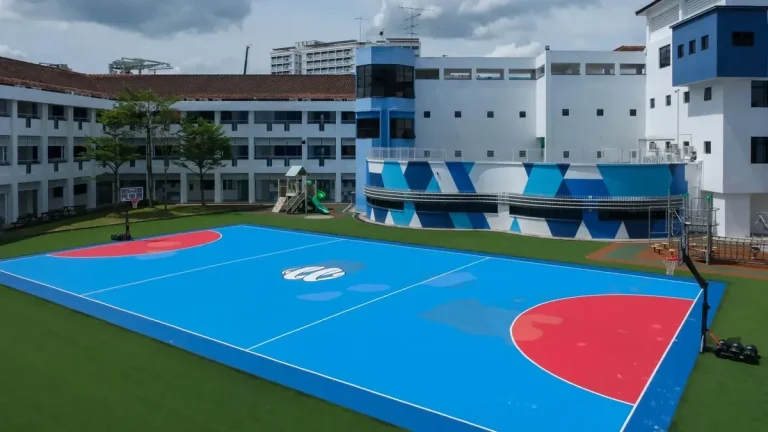
Basketball Court Sizes, Rule Set by Rule Set

Basketball Court Sizes, Rule Set by Rule Set

Most buyers asking for basketball court dimensions want a short list of numbers. The international court is 28 m by 15 m. The NBA and NCAA court is 94 ft by 50 ft, and the high school court is 84 ft by 50 ft. Each figure is measured from the inner edge of the boundary ...

Read Article
Size the Fall Zone, Not the Footprint

Size the Fall Zone, Not the Footprint

Surfacing is the one playground component that only does its job after something goes wrong, and its size follows equipment geometry rather than the material catalogue. When we size playground turf rolls from job drawings, the gap we see most often is simple: the buyer measured the equipment footprint, not the fall zone. The shortfall ...

Read Article
Synthetic Thatch: Polymers and Fiber Forms Explained

Synthetic Thatch: Polymers and Fiber Forms Explained

Most buyers compare pile height and color charts, then discover after a season of flattening and fading that the curled layer they never asked about decided the outcome. The blades get all the attention. The band underneath them quietly settles how the surface ages. We build turf rolls, and on our bench the cross-section gets ...

Read Article
Visible Seams Are Decided at Order Time

Visible Seams Are Decided at Order Time

The lawn rolls out green and even, the crew packs up, and a week later the sun lifts a line of shadow across the yard. Nobody planned a stripe, yet there it is. A seam is not created at install time – it is approved at order time. Roll width, seam position, batch and direction ...

Read Article
Putting Green Fringe and Collar: Roles and How They Differ

Putting Green Fringe and Collar: Roles and How They Differ

A putting green looks like one blanket with a cup in it, and budgets get written that way. Then the green goes in, and the ring around it starts deciding what matters: where balls stop, whether chips find a lie, whether the edge reads like a course. That ring – the fringe collar turf framing ...

Read Article
Turf for Fences and Hoarding: Where Vertical Turf Works

Turf for Fences and Hoarding: Where Vertical Turf Works

A construction site shows the city one face for its whole build: the hoarding line. Dust complaints, a metal panel working like a sail, a banner bleached pale by midsummer. Project teams inherit that relationship long before the building rises – the line is a compliance item and an image item at once. Vertical turf ...

Read Article
Straight and S-Seams: What They Are and When Each Fits

Straight and S-Seams: What They Are and When Each Fits

Same rolls, same adhesive, same crew – and still two different finished lawns. The variable nobody priced is seam direction. When a seam shows, the instinct is to brush it flat. Visibility was mostly decided in the layout call, and no brushing rewrites it. We price seam visibility before meters, so read straight seams vs ...

Read Article
Seaming Tape: Which Route for Which Scene

Seaming Tape: Which Route for Which Scene

A seam that opens rarely blames the tape. The fault gets assigned to the glue, the installer or the weather, while the real miss is a tape matched to the wrong scene. A light-duty lawn bought with a heavy two-component working window, or a busy field trusted to a peel-and-stick roll, fails the same way: ...

Read Article
Back to top