

A filled pitch never fails all at once. The granules that hold its blades upright drift out of the traffic zones first, and then the surface starts to firm up underfoot. By the time the change is obvious, the support layer the whole system depends on has been quietly working its way out of the carpet.
The reason non-infill turf lasts longer comes down to where that support lives. In a filled system it is poured in loose; in a non-infill system it is built into the yarn and the backing before the roll ever ships. We tuft and coat rolls for artificial turf installations on our own line, so we watch where support comes from and where it goes. That question sits at the centre of how we judge every specification that leaves the plant.
Why Filled Turf Ages From The Infill Up
Traditional filled turf relies on external materials for everything a surface has to do. Silica sand and rubber granules provide the support, the resilience and much of the shock absorption, while the pile simply stands in it. Published mechanism comparisons describe what happens next: the infill may migrate, compact, harden or become uneven. The fibres also take repeated friction from the particles around them, on top of UV ageing.
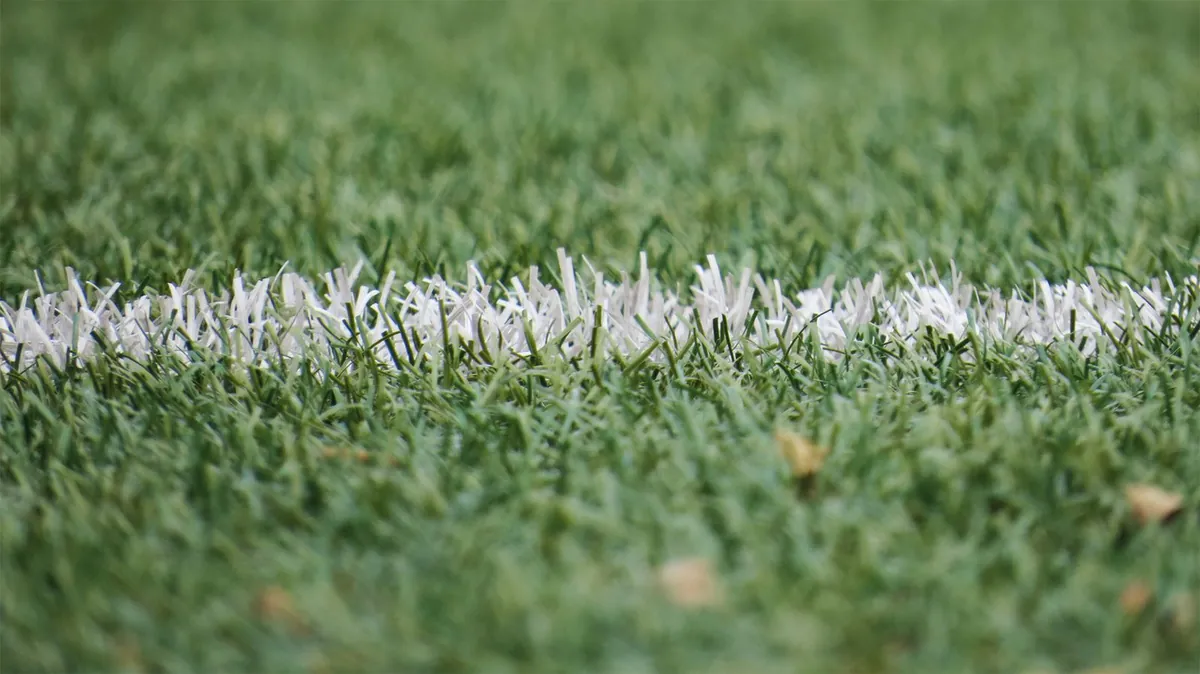
That friction matters more than it sounds. Under sustained wear it shows up as flattening, fibrillation and eventually powdering of the yarn. None of it is sudden, which is why worn artificial turf installations still look serviceable while their support quietly thins.
Where Filled Systems Lose Their Support Layer
The first failure mode is straight-line loss. Published industry figures put annual particle loss at 10–15% on an infilled standard football field, with 5–8 tons of rubber replenishment cited to keep levels up. Traffic shoves what remains toward goal mouths and low spots, so support thins unevenly across the same field.
The second mode is compaction, and it is the one federation guidance warns about most. In sand-filled systems the sand packs tighter through use and rain, and the fibres act as reinforcement that holds the compaction in place. A hard layer forms above the elastic layer, the pitch plays firm, and the published guidance notes that the surface’s functional and safety values change with it.
| Failure mode | Traditional filled turf | Non-infill turf |
|---|---|---|
| Support source | Loose sand and rubber granules between the fibres | Built into shaped yarns and the backing |
| Material loss | Published figures: 10–15% of particles lost per year | No granular layer to lose |
| Layer condition | Sand compacts into a hard layer over time | No granular layer to compact |
| Typical response | Top-ups every 1–2 years plus periodic loosening | Routine sweeping and rinsing |
| Surface drift | Support shifts and rebound varies as infill moves | Support fixed at manufacture, rebound holds steadier |
Every row in that table shares one root cause: the surface depends on a layer it cannot hold in place. Add displacement and organic contamination and you get the third pattern facility managers report across older artificial turf installations. Support moves faster than the maintenance crew can chase it.

How Non-Infill Turf Carries Its Own Structure
Non-infill systems take the opposite bet: support is engineered into the carpet itself. High-quality non-infill yarns use shaped cross-sections — S-shaped, C-shaped and diamond profiles among them — that interlock and hold each other upright without granules. Published manufacturer bench data on one modified-yarn system puts bending stiffness at about 1.8 times a conventional fibre, which keeps blades recovering after each pass instead of lying down.
The backing carries the rest of the load. With no infill pressing fibres into place, the backing must provide anchoring and dimensional stability. Published comparisons describe composite structures — PP base cloth with nonwoven reinforcement and latex or PU coating penetration — as the answer. Bench data on such systems cites yarn pull-out strength of 90 N or more, against an 80 N reference used in third-party quality schemes.

This is the mechanism behind the claim that non-infill turf lasts longer: nothing that carries load is loose enough to leave. A filled field spends its life fighting loss and compaction at once; a self-supporting carpet has neither path to failure. For how long these structures hold up year by year, our guide on how long non-infill artificial grass lasts covers the service-life side. The yarn engineering gets its own treatment in our piece on keeping the pile upright without infill.
Maintenance Burden That Compounds Over The Years
Maintenance is where the structural difference compounds. Most filled artificial turf installations need topping up every 1–2 years by one published maintenance guide, and every 1–3 years by another. High-traffic zones need brushing every 2–4 weeks just to redistribute what has migrated. Federation guidance adds periodic loosening beyond brushing, because levelling the sand surface alone does not decompact it.

The published cost analysis frames the same burden in staffing terms. A standard football field takes 3–4 professional maintenance cycles a year with a five-person crew, against monthly sweeping by one person in under an hour for non-infill. Skip the filled-system routine and the damage is cumulative — hardness drifts, footing turns uneven, and drainage clogs. That loop is the second half of the answer to why non-infill turf lasts longer: the surface that needs less rescue work degrades on a flatter curve.
None of this makes non-infill maintenance-free. Sweeping, rinsing and inspection still belong on the calendar. The difference is the size of the list, not its existence.
Performance Drift You Can Actually Measure
Drift shows up in measurements before it shows up to the eye. Published lifecycle guidance tracks surface hardness climbing toward recommended thresholds as infill compacts, traction changing as fibres mat, and footing turning inconsistent as infill redistributes. A field can pass every test on installation day and still move steadily away from those numbers.
One manufacturer’s published bench data puts the gap between the two systems like this:
| Published measure | Conventional filled-system yarn | Non-infill yarn (published) |
|---|---|---|
| Bending stiffness | Baseline | About 1.8 times baseline |
| Yarn pull-out strength | 80 N reference in quality schemes | 90 N or more with reinforced backing |
| UV retention, accelerated xenon-arc ageing | May fall to 70% after 500 hours | Can hold 85% after 1000 hours |
| Fibre thinning in Taber wear testing | 15% or more after 3000 cycles | Held at 8% or less after 5000 cycles |
| Vertical ball rebound variation | 15% or more as infill shifts | Within 8% |
Read the table as a directional argument rather than a promise: these are published manufacturer laboratory figures, and any field’s real numbers depend on usage, climate and upkeep. The pattern still holds. A surface whose support cannot migrate has one fewer way to drift, and steadier rebound over time is the practical expression of that.
Specifying Non-Infill Rolls With Confidence
Selection starts with hours, not brochures. Count the sessions a week, the sports involved and the seasons of use; then let yarn shape, density, pile height and backing follow from that brief. Our sports artificial grass systems are built to a stated pile, density and backing spec, so the roll matches the programme it has to carry.
Roll format is the other practical decision. Widths of 2 m, 4 m and 5 m at 25 m long cover most layouts, and wider rolls cut seam count across the main playing area. Yarn colour, shape, density, pile height, backing and roll size are all made to order, which is how a non-infill specification gets tuned to its venue.
If the mechanism argument above holds for your usage pattern, the specification conversation is worth having early. Non-infill turf lasts longer wherever loose support would be the first thing to fail, so confirm the yarn, the backing and the roll format before the season decides for you.
Tired Of Fields That Fade From The Infill Down?
One specification rarely covers every zone. Give us the traffic, the climate and the dimensions, and we tuft to those figures before production runs.
Mistakes That Undermine Either Turf System
The same failure logic produces the same avoidable mistakes, in filled and unfilled artificial turf installations alike.
Skipping Infill Inspections On Filled Fields
Infill depth is invisible until it is gone. Walk the high-wear zones with a simple depth check on a fixed cadence, because published guidance shows migration starts in exactly those zones.
Treating A Hardened Surface With More Granules
Refilling a compacted field does not reverse compaction. Published federation guidance is explicit that granule shortage is often not the cause of changed playing characteristics, and that the compacted layers themselves need loosening.
Ignoring Drainage And Base Condition
Water that sits under any carpet accelerates every other failure mode. Clogged drainage and uneven bases show up first as pooling and soft patches, and they undermine filled and non-infill systems equally.
Brushing With The Wrong Tools Or Cadence
Brushing is maintenance, but the wrong brush or an absent schedule is wear. Harsh equipment and missed weeks both shorten the life of the pile, whatever the system underneath.
Checklist Before You Commit To A System
Work this list in order before you commit budget to either class of surface.
Count The Hours Before You Compare Systems
Weekly playing hours decide which failure modes will dominate. A field running daily sessions lives or dies on support stability; a lightly used lawn carries a much shorter list of risks.
Ask Where The Support Comes From
Put the support question directly to every supplier: poured loose or built into the carpet? The answer predicts the maintenance schedule in year three, and it is where the claim that non-infill turf lasts longer gets tested.
Price The Maintenance, Not Just The Roll
Two quotes with different maintenance demands are not the same price. Ask each supplier what the annual upkeep list looks like, then compare totals across the seasons you plan to keep the surface.
Verify The Structure On A Sample First
Free 20cm × 20cm samples, usually three to four pieces, let you check yarn shape and backing quality in person. They dispatch by DHL or FedEx in 4–6 days, with courier freight paid by the buyer.
Frequently Asked Questions
Why does filled turf need regular infill top-ups?
Because the support layer leaks. Published industry figures put annual particle loss at 10–15%, and traffic pushes what remains into low spots, so support thins until the pile collapses.
What keeps non-infill grass upright without sand?
Engineered yarn cross-sections. Published manufacturer data shows S-shaped, C-shaped and diamond profiles interlock without infill, while a reinforced composite backing anchors every tuft against pull-out.
Can compacted infill be repaired?
Partly. Decompaction can loosen a compacted layer for a while, but published federation guidance treats loosening as recurring work, and a hardened surface already plays differently from day one.
Where does lost infill actually go?
It moves. Traffic shoves granules toward goal mouths and low points, rain washes fines toward the perimeter, and wind or drainage carries the rest off the field.
What maintenance does non-infill turf remove?
Topping up, decompaction and granule-level deep cleaning leave the list. What remains is sweeping, occasional rinsing and periodic inspection, per published maintenance comparisons.
How do I verify the structure before a bulk order?
Order free samples first. Swatches come in 20cm × 20cm, usually three to four pieces, letting you check the structure before the full artificial turf installation. Dispatch is by DHL or FedEx in 4–6 days, courier freight paid by the buyer.


 English
  Arabic
  French
  German
  Portuguese
  Russian
  Spanish