








A quote for a tennis court arrives with one word on the surface line, and that word is doing too much work. I answer which-of-the-nine questions daily, and the same muddle returns every week. Clay can mean three different builds, and grass can mean a living sward or a synthetic carpet. Most buyers cannot name which of the nine surfaces their quote actually covers, so the gap stays hidden until work starts. The nine are not secret – they sit in a public table that almost nobody reads before signing.
This guide sorts tennis court surfaces types by how each is built, then by what each build asks of the person who owns it. The frame comes from the ITF, which keeps the classification the trade quotes back at each other. No surface gets crowned here. The aim is that your next quote names its surface precisely, and that you know what the name commits you to. The classification is public, the code table is short, and neither costs anything to consult before signing.
How Tennis Court Surfaces Are Classified First
Classification comes before comparison, and the sport’s governing body supplies the frame. Per the ITF Technical Booklet, the federation devised a table of surface descriptions to standardise the way surfaces are described as to their type. The descriptions relate only to court construction, and never to performance characteristics. That one sentence is the most useful discipline in this whole topic. The booklet’s own wording keeps type and performance apart, and the distinction protects buyers more than suppliers.
The classification is often restated as a nine-row code table, lettered A through J with the letter I left out. Each row is one of the tennis court surfaces types, defined by construction alone, and every surface a quote can name lands on exactly one row. One note inside the table does a lot of quiet work. Asphalt and concrete count as surfaces only when the material itself forms the playing layer, so a coated court is classified by its playing surface, not its base.
For a decision-first comparison of the four big families, start with the surface guide. Then come back for the full nine-row territory, because the families only cover part of the map. The two reads complement each other rather than repeat.
Classification is not endorsement. Descriptions in the ITF frame cover construction only, never performance. An ITF Classification itself runs for three years and, by the booklet’s own note, implies no form of ITF approval. Read a classification line on a datasheet as a type label, not a quality verdict.
The Nine Tennis Court Surfaces, One by One
Here are the tennis court surfaces types, in code-table order: acrylic, artificial clay, artificial grass, asphalt, carpet, clay, concrete, grass and other. Each is defined by construction alone, and each entry keeps to one job – what the surface is made of and what that build means for its owner. Where a row has famous quirks, they are named for what they do to a quote, not to a ball.

Acrylic: The Resin-Bound Coating
Acrylic is a textured, pigmented, resin-bound coating that normally forms only the uppermost few millimetres of a court. The rigid material beneath is typically asphalt or concrete, and the acrylic seals it, carries the playing lines and contributes some cushioning. This is the construction most buyers mean by an acrylic hard court. Because the coating is so thin, the base beneath it supplies nearly all of the court’s body. The sand mixed into the paint is a genuine specification lever, because it sets texture at the very top.
Cushioned builds stay inside the same category. The trade names change while the row does not, because interlayers under the coating still leave the playing surface a resin-bound acrylic. Two of the four Grand Slams currently run on acrylic-topped hard courts, which shows how far this single row reaches. When a quote says hard court, the useful question is what the coating and its base each contribute.
Artificial Clay: A Dressed Carpet Build
Artificial clay is a sand-dressed and-or rubber-dressed surface with the appearance of clay. Within the clay family’s three variants it is the fully synthetic branch, standing beside the natural mineral original and the hybrid version. What looks like loose top dressing sits on a built system rather than on packed aggregate. In a quote the branch usually appears under names that lead with clay, so the carpet underneath is the part to ask about.
The system has four layers, per the Chalmers study. The stack runs from a base of porous concrete or draining asphalt, through an adhesive layer and the carpet, up to an infill that carries the lines. The carpet arrives in rolls, is glued to the base and then rolled for consolidation. The reported benefit of the build is lower maintenance cost combined with playability in all weather.
For owners the branch trades mineral character for a fixed carpet underneath. Dressing can be topped up, and lines are built into the infill rather than painted on. The court also returns to play without the rolling a loose mineral surface demands.
Artificial Grass: The Sand-Filled Turf Row
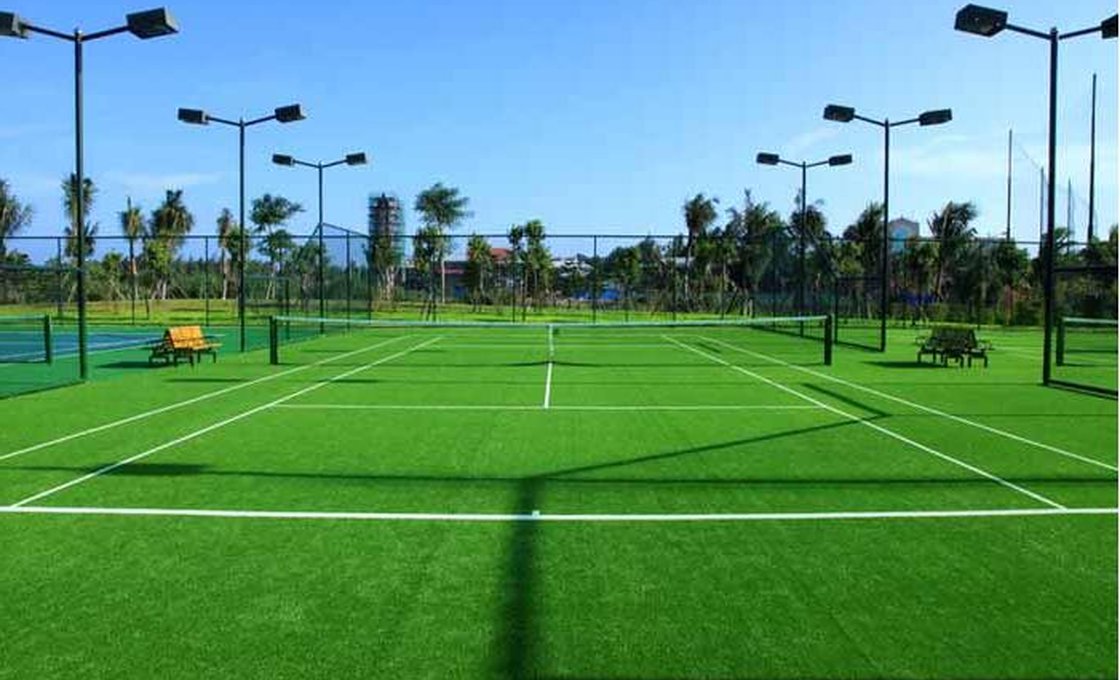
Artificial grass is a synthetic surface with the appearance of natural grass, built on a carpet matrix filled with sand and rubber aggregate. The sand-filled artificial grass branch runs a short pile, and it appears on outdoor courts in several regions, particularly in Asia. Construction is exactly what the words say – a textile carpet, ballasted with mineral infill. Sand dressing is what keeps the fibres upright and the carpet stable under footfall.
Because the carpet is the surface, its specification does the talking. How pile height, density and sand dressing translate into spec numbers is the subject of the artificial grass specifications guide. Pile, yarn, density, backing and dressing are all real choices, and each one is decided before the roll ever ships. That is the row’s defining trait – the surface is manufactured to a document, not grown or poured to a season.
Asphalt: Bitumen-Bound Aggregate
Asphalt is bitumen-bound aggregate, and it counts as a surface only when the material itself forms the playing layer. On most courts that never happens, because asphalt sits under acrylic as the base and the classification then points to the playing surface above. A bare asphalt court is therefore the uncommon case, and it announces itself through the absence of any coating on the quote. Exposed rather than sealed under paint, the bitumen binder ages differently, while the usual job in tennis stays structural – load spread and a stable plane under the coats above. The owner’s takeaway is a quoting habit – ask whether the price covers a surface, or a base waiting for one.
Carpet: The Removable Covering
Carpet is textile or polymeric material supplied in rolls or sheets of finished product, and in tennis the word covers any removable court covering. The branch seen outdoors is the sand-filled artificial grass type already met above. The indoor branch is a textile surface of nylon or rubber matting laid on a concrete base. Both branches share one procurement trait – the playing layer arrives as a finished product, so the datasheet travels with it. Supplied as finished product, it is the one row that can be picked up after the event.
The tournament story is the memorable part. Indoor arenas still store rolls of rubber-backed surfacing and install them temporarily for events. The top tier of the ATP has discontinued carpet since 2009, and the WTA’s last carpet court event ended after 2018. The row survives because the product survives in facilities – it just no longer tops the professional tours.
Clay: Unbound Mineral Aggregate
Clay is unbound mineral aggregate, and the classification note insists on the detail. A clay surface is built from naturally-derived materials with an unbound fine gritty layer as the playing top, and its integrity must not rely on a carpet or membrane underneath. Classic courts are made of crushed shale, stone or brick, and the French Open’s crushed red brick courts carry the name terre battue.
Clay in the United States is mostly green clay, crushed basalt known widely under a brand name. The construction economics are famous – cheaper to build than other court types, but the surface costs more to maintain. It must be watered and rolled regularly to preserve texture and flatness, and brushed carefully before and during play. The gritty top layer is renewed by brushing and top dressing, which is why the surface behaves like a material in stock rather than an installed product. Nothing is glued down – this is a material you tend, not a product you install.
Concrete: Cement-Bound Aggregate
Concrete is cement-bound aggregate, and it shares asphalt’s classification note almost word for word. It is a surface only when the material itself forms the playing layer. As a base beneath acrylic or a carpet system, it stays out of the surface column entirely. A quote naming bare concrete as the surface describes a pour left uncoated, and where coatings are skipped the slab itself is the court. The frame’s honesty is the point – it describes what the ball meets, not what the builder ordered.
Grass: The Grown Original
Grass is natural grass grown from seed, the only row in the table that is literally alive. It grows on hard-packed soil, so the playing character shifts with the health of the sward and the wear of recent use. Seed choice, soil and usage all feed the sward, which is why two grass courts rarely behave alike. Even under the best upkeep, a regularly played grass surface quickly shows obvious signs of wear.
The cost of that upkeep is why the row has shrunk. Grass courts must be watered and mown often, and they take longer to dry after rain than hard courts, so they are now rare. The Grand Slam record still honours them – Wimbledon has run on grass since 1877, and both the US Open and the Australian Open held long grass eras before switching.
Other: Tiles, Wood and Canvas
The ninth row is a deliberate catch-all – other surfaces, exemplified by modular systems of interlocking tiles, plus wood and canvas. Modular tiles are the version a buyer is likeliest to meet, locking together over a hard base where a court must be reversible. Wood belongs mostly to indoor halls, and canvas to temporary builds. For temporary venues and multi-use halls, the reversibility of tiles is often the whole reason the row is chosen. The row exists so the classification stays honest – a court fitting none of the eight built rows is described accurately instead of being forced into one.
One word, three rows. When a quote says clay, it can mean the unbound mineral original, the hybrid version dressed with clay, or the artificial version dressed with sand. The three share a colour and not a construction, and they occupy different rows of the table. Ask which row the price covers before anything is signed.
What Each Family Asks of Its Owner
Construction determines chores, because each build fails in its own way. Read by ownership rather than by chemistry, the tennis court surfaces types group into four duty profiles. Grouping them this way turns a quote from a colour choice into a weekly routine you can predict.

The nine rows compress into four duty profiles, and each profile carries its own inspection list. The list below is deliberately blunt – it is what you would actually walk and check. Use it to test any maintenance handover clause before signing.
- The tended mineral profile – clay. The surface is watered and rolled regularly, and brushed carefully before and during play. Green clay builds also lean on slope, because water must run off rather than sit.
- The grown profile – grass. Mowing and watering are frequent, drying after rain is slower than on hard courts, and wear shows fast. No other profile changes with the season this way.
- The coated profile – acrylic. The coating is only millimetres deep, so its fate rides on the rigid base underneath. Repairs stay local, but base faults are structural news.
- The carpet profile – artificial grass, artificial clay and hybrid clay. A carpet in the stack puts dressing levels, seams and glue lines on the inspection list. Dressing top-ups and seam checks are quick, but skipping them is what turns a carpet court into a base problem. The carpet’s spec sheet becomes part of the court’s paperwork.
Drainage then cuts across every profile. All surfaces may be built porous or non-porous, with two exceptions – clay and grass are always porous. That one sentence explains why those two families are designed around water passing through, while every coated and carpet court can go either way. It also explains why those two profiles dominate the wet-climate conversation, whatever else a quote promises.
The Family Map: Reading the Nine at a Glance
A map earns its space when a quote is open on the other side of the desk. Read as families, tennis court surfaces types reduce to what the ball meets and what holds that layer up. The table keeps one row per surface and one line of construction truth per row. It is the page to keep open when three quotes use three words for the same build.
| Code | Surface | Construction in one line |
|---|---|---|
| A | Acrylic | Textured, pigmented, resin-bound coating, normally a few millimetres over a rigid base |
| B | Artificial clay | Sand or rubber dressing over a carpet, with the appearance of clay |
| C | Artificial grass | Synthetic carpet matrix dressed or filled with sand and rubber aggregate |
| D | Asphalt | Bitumen-bound aggregate, classified as a surface only when it is the playing layer |
| E | Carpet | Textile or polymeric product supplied in rolls or sheets |
| F | Clay | Unbound mineral aggregate, tended as a gritty playing top |
| G | Concrete | Cement-bound aggregate, classified as a surface only when it is the playing layer |
| H | Grass | Natural grass grown from seed |
| J | Other | Modular interlocking tiles, wood, canvas |
Three reading rules make the table pay for itself. Asphalt and concrete rows apply only when the material is the surface, never when it is the base. Clay and grass are always porous, while everything else can be built either way. And any quote word that names a look instead of a construction – clay being the worst offender – needs decoding back to a row before money moves. Keep the table beside the quote, and every surface line becomes a lookup instead of a debate.
Sizing Up Sand-Filled Turf for Your Courts?
Compare sand-filled tennis turf by spec – pile, density and backing configurable, with samples to walk before deciding.
From a Surface to a Playing System
A surface never plays alone – it is the top layer of a system. Every synthetic row of the table rides on the same stack: a prepared base, drainage, the carpet and its dressing. The layer stack beneath any synthetic turf surface decides more of the court’s behaviour than the colour on top does.
For sand-filled turf the specification chain runs through pile height, yarn, density, backing and sand dressing, and each setting is a real decision. The carpet itself is chosen from our tennis turf – pile, density and backing specified per project, with the sand dressing tuned to the court’s use. Infill sand, shock pads and drainage layers sit outside a roll supplier’s scope, so they are specified as their own line items. That separation is not a gap in service – it is the honest structure of the system.
Inspection then follows the system, not the label. On a carpet-based court the joints and glue lines are checked as built elements. The dressing level is checked as a consumable, and the base as the layer everything else depends on. Handover paperwork should name all three, because a system specified in parts is only provable in parts. Photographs of each layer at handover complete the file without slowing the crew.
Spec the system, not the colour. Two sand-filled courts can look identical and differ in pile, density, backing and dressing. Ask for the written specification behind each and walk a sample before deciding – the real differences live underfoot, not in photographs.
Matching the Nine to the Job Your Court Does
Matching tennis court surfaces types to a court’s job beats matching them to a brochure. The job is the set of facts no quote can change – who plays, how often, what the ground does through winter and who holds a brush afterwards. Answer those questions first and the nine rows narrow themselves without any ranking exercise.
A private court that cannot interrupt its calendar points toward built systems that return to play quickly. A club that sells the clay experience weighs the tended mineral original against the carpet-based versions of it. A facility that turns one pad over to different events leans toward removable or modular answers. Each of those answers also settles the maintenance question in advance, because the duty profile follows the job. None of this is a ranking – each row simply pays off under a different job.
The discipline pressed throughout this guide applies hardest at the decision. Name the construction, name the base and name who maintains what, in writing. None of the three questions costs anything to ask at quote stage, and all three are expensive to answer retrospectively. A quote that survives those three questions describes a surface that will still be true at handover.
Frequently Asked Questions
What are the main tennis court surfaces types?
Nine – acrylic, artificial clay, artificial grass, asphalt, carpet, clay, concrete, grass and other. The ITF code table assigns each a letter and defines it by construction, so every quote can be traced to exactly one row.
Is cushioned acrylic a different surface type?
No – cushioned builds stay inside the acrylic category. Shock-absorbing layers sit beneath the same resin-bound coating, so the playing surface is still Code A. The base construction differs, the classification row does not.
Why do clay and grass always drain differently?
Because both are always porous, while every other surface can be built either way. Water is designed to pass through them, so their bases and upkeep revolve around drainage in a way coated and carpet courts do not.
Are carpet courts still used?
Yes, though not at the top of professional tours. The ATP has discontinued carpet on its top tier since 2009, and the WTA’s last carpet court event ended after 2018. Indoor facilities still store and install removable carpet surfacing for events.
What should I check before comparing surface quotes?
Ask which of the nine types each quote names, and what construction sits beneath the playing layer. Then check who maintains the surface and what the base and drainage include. A quote that cannot name its row is guessing.


