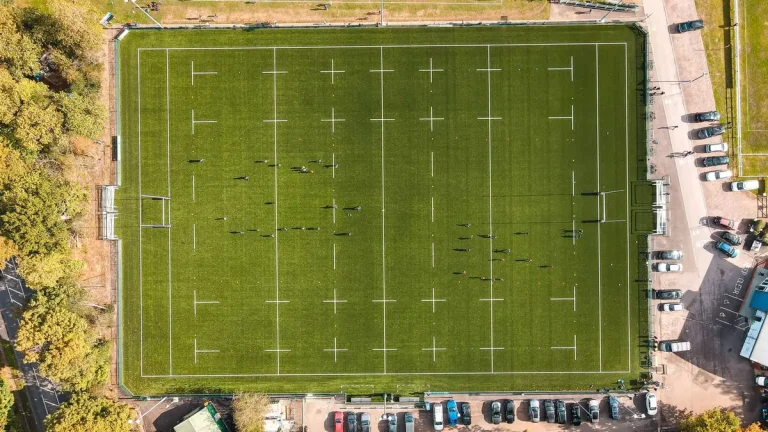
There is no single standard size for a 5-a-side soccer field. The FA’s written Law 1 for 5v5 football gives a range of 25-50 m by 16-35 m, and Appendix A lets venues adjust it. That is why two pitches in the same city can look nothing alike: one a netted cage, the other an open rectangle with painted sidelines. So what is 5-a-side soccer field, exactly, when the written rule allows both?
The short answer is five players a side, a smaller pitch, smaller goals and no offside, usually on artificial grass. The useful answer takes longer, because every dimension here comes from a written law with a range attached. This guide works through both, the way we read them with buyers every week.
What Is a 5-A-Side Soccer Field?
A 5-a-side soccer field is the playing surface for five-a-side football, a version of minifootball where each team fields five players: four outfield players and a goalkeeper. It uses a smaller pitch, smaller goals and shorter games than association football. Matches run indoors or outdoors on artificial grass, on pitches that may be enclosed. Its close cousin futsal runs on a hard, flat court instead.
Ask what is 5-a-side soccer field in the FA’s own terms and nothing about it is informal. The English FA publishes a full list of laws for the small-sided game, from pitch shape to permitted modifications. That written frame is what this guide works through, and what we build football turf rolls against.
Anatomy of a 5-A-Side Pitch: Boards, Goals and Lines
Start with the shape: the playing area must be rectangular, with the touchline longer than the goal line. The FA’s written laws for small sided football specify each element in turn. Three of them decide how the pitch plays and reads at a glance.

Barriers or Open Sidelines
Per the FA, small sided football may be played with or without barriers, and both are legal. Barriers keep the ball in play and matches flowing, which is why commercial venues favour enclosure. Open pitches trade that continuity for a traditional look, with throw-ins and corner arcs instead of rebounds. House rules govern ball contact with the boards.
The Markings, Line by Line
Every line is 8 cm wide, per the FA small sided laws. The halfway line carries a centre mark with a 3 m radius circle around it. The signature feature is the penalty area: a 6 m radius semicircle drawn from the centre of each goal line, with its extremities reaching the goal line, barrier or wall.
The penalty mark sits 6 m from the midpoint between the posts. Open pitches add a quarter circle of 25 cm radius at each corner, required where barriers do not surround the playing area. That semicircle, not the full-sized rectangular box, is the fastest way to recognise the format.
Goals That Sit in a Range
Goals are written as a range, not a single size. Per the FA small sided laws, the posts stand 3 m to 5 m apart, with the crossbar 1.20 m to 2 m above the ground. Posts and crossbar share an 8 cm width and depth, with nets attached behind. Goals may be portable, but they must be anchored securely during play under safety requirements.
Pitch Sizes: The 5, 6 and 7-A-Side Ranges
The honest answer to what is 5-a-side soccer field, size-wise, is a range with a written floor and ceiling. Per the FA, 5 and 6-a-side pitches share one recommended range: 25 m to 50 m long and 16 m to 35 m wide. Seven-a-side steps up to 50 m to 60 m by 30 m to 40 m. Youth football runs on separate numbers, summarised below.
| Format | Size per the FA | Common built size |
|---|---|---|
| 5 and 6-a-side | 25–50 m long × 16–35 m wide | 30–40 m × 18–25 m |
| 7-a-side | 50–60 m long × 30–40 m wide | Upper half of the range |
| 5v5 Mini-Soccer, U7/U8 | 40 × 30 yd maximum without run-off; 46 × 36 yd including run-off | 6 × 12 ft goalposts |
The middle column quotes the FA’s written ranges and the Section 40 table. The last column is common practice, not a regulation value. Treat the FA range as the compliance boundary when a project is specified.
Why a range rather than a number? Appendix A expressly permits modifications to the playing area, the ball, the goals, the duration of play and substitutions. Every venue adjusts within that frame, so no two pitches match.
Run-Off and Safety Margins Around the Pitch
The pitch is only part of the footprint, and the run-off is the margin planners forget first. For natural grass pitches the FA recommends a minimum of 3 yards, or 3 metres, all around the pitch. Clubs in the football pyramid have a 1.83 metre minimum, ideally 2 metres, and a new ground needs at least 3 m. That margin must be natural grass, not tarmac or concrete, free of barriers and obstructions.
Artificial surfaces get one conditional entry. Where 3G Football Turf serves as a run-off, it must meet the performance standards of a full size pitch and be green in colour. Where pitches neighbour each other in a confined area, the FA recommends ideally 6 yards between them.
The Surface: Why 5-A-Side Is Played on Artificial Grass
Five-a-side and artificial grass travel together for practical reasons. Commercial venues run matches back to back into the late evening. Play continues in the rain, so the carpet must drain and recover quickly. Ten players share a far smaller area than the full-sized game, so wear concentrates. Natural grass degrades fast under that schedule, so the FA accepts artificial turf only at full size pitch performance standards.

What the Surface Must Deliver
Four properties decide whether a small-sided surface lasts. The carpet must resist abrasion and keep bounce and ball roll consistent. It must drain fast enough to stay playable after rain. It must also survive studs; metal studded boots are banned indoors precisely because of the damage they do. Pile height, density and infill deserve their own treatment elsewhere.
Markings That Don’t Fade
Paint struggles on this schedule. Painted lines wear away first, so commercial projects increasingly order turf with white lines tufted straight into the carpet. We cut rolls to the venue’s marking plan, and a 5 m wide sports roll covers most of a small-sided pitch with almost no seams. The football turf range shows the roll sizes and marking options in detail.
Indoor Cages, Outdoor Boards and Open Pitches
One rulebook produces three built forms, chosen by land, climate and business model. The FA allows the game with or without barriers, so the enclosure is an operator’s decision. What changes is how the ball behaves at the edge.
- Cage: fully enclosed with netting on all sides and overhead, so the ball never leaves play.
- Boards: perimeter boards keep play flowing while preserving sightlines.
- Open: sidelines, throw-ins and 25 cm corner arcs, the form most schools choose.
Whichever form a site takes, the next step is identical. Put the dimensions and intended use in front of the surface supplier, and the roll spec follows. It is cheaper before the base goes in than after.
Ready to Size Your 5-A-Side Pitch?
Tell us your pitch size, indoor or outdoor format and weekly hours of play, and we will recommend football turf rolls with marking options to match.
Who Plays on 5-A-Side Fields
The same field shape serves three very different owners. Schools, commercial operators and community leagues all run it, each valuing a different part. The pattern repeats in almost every city.
Commercial Operators
Across Europe, and most densely in the UK, networks such as Powerleague, Goals Soccer Center and UrbanSoccer run commercial small-sided venues. The format is the commercial workhorse: several floodlit pitches side by side, rented by the hour. Enclosure keeps every session moving.
Schools and Youth Programs
Schools run the same shape at a smaller scale. Per the FA Section 40 table, the U7/U8 Mini-Soccer pitch tops out at 40 by 30 yards without run-off, with 6 by 12 ft goalposts. That written baseline makes a school funding case straightforward.
Community and Workplace Leagues
The amateur ecosystem is the largest user of all. The World Minifootball Federation unites 71 national associations, and workplace and community leagues stack on top. No offside and a ball that rarely stops on enclosed pitches keep the format easy to organise.

Two Questions That Deserve Their Own Answers
Two questions sit just outside the definition. Both deserve full answers and have dedicated guides. This section points the way.
How Is It Different from a Full-Size Pitch?
In short: fewer players, a semicircular penalty area instead of a rectangular box, smaller goals and no offside. Our guide to the standard 11-a-side pitch dimensions covers the full-size markings. The comparison matters most when a multi-pitch site is set against a full-size option.
How Much Turf Does One Need?
In short: the playing area is length times width, and the run-off margin adds to the footprint. Our breakdown of 5-a-side pitch turf quantities shows the roll and square-metre maths for a real site. Working from roll width keeps the estimate honest.
If the definition stage is behind you, the 5-a-side field cost guide takes the next step. It moves from sizes to what a build involves. Same sources, one stage on.
Frequently Asked Questions
What is 5-a-side soccer field, in one sentence?
It is five-a-side football: five players per side, four outfield players and a goalkeeper, on a smaller pitch with smaller goals, no offside and, often, boards around the edge.
Is 5-a-side the same as futsal?
No. Futsal is played on a hard, flat court with a smaller, heavier, low-bounce ball; 5-a-side is usually played on artificial grass with optional boards and venue house rules.
What size is a standard 5-a-side pitch?
Per the FA, 5 and 6-a-side pitches run 25 m to 50 m long and 16 m to 35 m wide. For U7/U8 Mini-Soccer, the Section 40 table caps the 5v5 pitch at 40 by 30 yards without run-off.
How big are the goals?
Per the FA small sided laws, goals are 3 m to 5 m wide, with the crossbar 1.2 m to 2 m high. Futsal goals measure 3 m by 2 m.
Can you play on natural grass?
You can, but natural grass wears out fast under heavy use, so most venues choose artificial grass. Where 3G turf is a run-off, the FA requires full-size performance standards and a green colour.