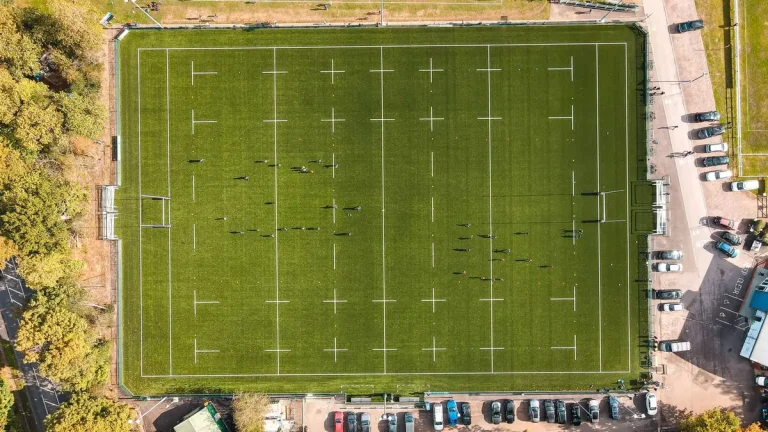
In the ITF’s own classification, most acrylic surfaces sit in Category 3 (medium pace) while most grass surfaces sit in Category 5 (fast). Court pace rating, though, is a tested-product reading, not a guarantee for one court. That pace gap divides the two surfaces cleanly. We manufacture turf rolls, and the question that reaches us most is whether grass plays better than the hard court next door.
The honest answer is that neither surface wins on its own. Pace, maintenance capacity, cost rhythm, climate and users decide the outcome together. This synthetic grass vs acrylic tennis court comparison runs those dimensions one by one, each anchored to a governing-body source, and closes with a scenario table instead of a crown.
Where Each Surface Sits in the ITF Pace Framework
Both surfaces are mainstream, and the ITF defines both in the same vocabulary. Artificial grass is a synthetic surface with the appearance of natural grass, while acrylic is a textured, pigmented, resin-bound coating. First, place each surface on the pace scale the ITF actually tests.
How the ITF Reads Court Speed
The ITF grades court speed through Court Pace Rating, a tested reading of ball and surface interaction. Friction decides the horizontal speed the ball loses on impact; vertical restitution sets the time between bounces. The published bands run Slow 0-29, Medium-slow 30-34, Medium 35-39, Medium-fast 40-44 and Fast 45 or higher, per the ITF technical booklet on court pace rating.
Where Turf and Acrylic Typically Land
Most acrylic coated surfaces fall in Category 3, the medium pace band, while most natural grass, artificial grass and some carpet surfaces fall in Category 5, the fast band. That is the classification backdrop for any synthetic grass vs acrylic tennis court decision. Tennis Australia adds that acrylic speed is dictated by the quantity and particle shape of its silica sand layers, tunable faster or slower at construction. Sand-filled turf ranges wider: readings span medium slow to very fast, with the landing set by pile height, density and sand fill. Our court pace categories page carries the sand-filled specifications alongside.
Maintenance: Two Different Workloads, Not One Being Free
Per the Tennis Australia National guide, acrylic hard courts need the least regular maintenance of any court surface, and least is not none. Sand-filled turf sits at the other end: playability depends on a working routine, which Tennis NZ turns into cycles. That asymmetry is the first workload fact in any synthetic grass vs acrylic tennis court decision.
- Weekly brushing, which keeps fibres upright and stops sand crusting into a waterproof skin that blocks drainage.
- Monthly sand level checks, with silica sand infill topped up where play has moved it.
- Preventive moss and algae treatment before green growth takes hold in damp corners.
- Seam and high-wear inspections, with tears repaired promptly.
- Rejuvenation at about half carpet life, generally 4-7 years after installation, to restore drainage.

The acrylic routine is four habits: periodic cleaning, debris removal, clearing standing water and repairing surface cracks. The big periodic item is resurfacing, which Tennis Australia budgets at every 7-10 years. One surface asks weekly diligence; the other a budget event every 7-10 years.
Cost Structure: The First Invoice Is Only the First Line
What the First Invoice Contains
Third-party pricing is thin here, so the cleanest public anchor is the Queensland Government indicative sport facility cost reference. Per that reference, January 2023, a tennis court base build on a 593 square meter footprint, with fencing, nets and posts included, runs about $52,000. The acrylic non-cushioned applied surface is listed separately as an add-on of about $27,000 per court. These are two different lines, whole-project and surface-only, never to be added into a grass court total.
The same reference excludes adverse soil, contaminated soil and electrical upgrades, and is indicative for the Queensland market. Tennis NZ records artificial grass as cost effective to install and cushioned acrylic as a higher capital outlay. Tennis Australia agrees that cushioned systems generally cost more, mostly in base and cushioning materials.
What the Ten-Year Ledger Adds
Tennis Australia’s asset table gives acrylic surfaces 8-12 years and synthetic filled surfaces 8-12 years, with asphalt or concrete pavement lasting 20-plus years. Its surface chapter separately records acrylic at 7-10 years. Both are governing-body budget readings from the same guide; hold them together.
Converted into rhythm, a single pavement life carries about two acrylic resurfacings, and cushioned systems may need a rubber top-up every second resurface. The turf side carries one recarpet plus one mid-life rejuvenation. That is the real cost structure of a synthetic grass vs acrylic tennis court project: one carpet change against two resurfacing events, not two invoices on day one.
Climate and Site: Where Each Surface Shows Its Weak Side
Tennis Australia ties surface life to usage, maintenance, construction quality and environmental factors such as UV. It asks buyers to select products that withstand the local climate and UV. Climate is therefore not a question of which surface wins a synthetic grass vs acrylic tennis court debate, but of which surface fears what at your site. The list below pairs each surface with the weather that finds its weak side.
- Acrylic fears cracking: crack repair sits inside its routine regime, and base movement or freeze-thaw widens every gap.
- Acrylic fears ponding: standing water removal is a regime item, and a low spot becomes a permanent puddle.
- Turf fears neglected brushing: unbrushed sand compacts, drainage slows, moss follows, and grip goes with them.
- Turf fears damp shade: moss and algae prevention is a regime item for a reason.
- Wet grip cuts both ways: turf can turn slippery as sand migrates, while acrylic is slippery if not dry.
Rain recovery splits them most clearly. A correctly constructed SFAG court can be played on when damp and shortly after rainfall, per the Tennis Australia National guide. Acrylic has to wait for the sheet to dry. List your three most common weather days, then read the list above again.
How Each Surface Plays, and Who It Suits
The ball reports the difference first. Acrylic sends the ball up regular and high; sand-filled turf keeps it low and skidding. Neither is a defect, and the next two headings sort them.

The Ball Tells the Difference First
Per Tennis NZ, artificial grass plays low and skids at a medium pace, while acrylic hard courts give a regular, high bounce and play fast. Tennis Australia’s fact sheet widens the turf range: ball speed from medium slow to very fast, bounce from medium to low, with topspin earning little reward. That low, skidding ball is a trainable asset: slice drives skid away from attackers, low volleys stay honest, and reaction footwork gets daily practice.
Matching the Surface to the Player
Competition training and match play lean acrylic, because regular bounce and tunable pace reward consistent technique. Acrylic is also the most common multi-use surface, friendly to line-marking paint. Families, casual players and older members lean turf, which Tennis NZ records as kind on muscles and joints.
Junior coaching is a genuine split: low skids and slice work on turf, standard bounce rhythm on acrylic. When the mix is unclear, ask who plays most weeks, because that question settles more synthetic grass vs acrylic tennis court arguments than any lab number. Our artificial turf tennis courts page carries the full pros and cons list.
Switching Between the Two: What a Conversion Actually Involves
A conversion is not a reskin. Tennis Australia is explicit that converting an acrylic hard court to SFAG requires removing the acrylic surface by grinding or appropriate treatment, due to long-term performance issues. The reverse trip ends in the same place: a base assessment. Tennis Australia prefers acrylic over flexible asphalt or rigid concrete, and SFAG over asphalt or concrete for tolerance and easy resurfacing.
The good news is that Tennis NZ records both surfaces as installable over the top of existing courts, provided base type, levelness and drainage pass the same checks. Confirm those site conditions first, then browse tennis turf rolls with the specification you need. Site first and carpet second separates a conversion from an expensive mistake. It is also the step most often skipped in a rushed synthetic grass vs acrylic tennis court upgrade.
Still Weighing Turf Against Acrylic?
Ask for tennis turf samples: tell us your court size, existing surface and weekly playing hours and we will build a custom specification to compare on site.
Scenario Verdicts: Which Surface Wins Where
The sections above were dimensions; this one hands out verdicts. Match your site to a row; where rows overlap, weight the heaviest users. Every reason below is a governing-body reading.
| Scenario | Better fit | Deciding reason |
|---|---|---|
| Club competition training and matches | Acrylic | Bounce regular and high, fast paced; speed tunable through the silica sand mix (Tennis NZ / TA) |
| Multi-use court, tennis plus netball or basketball | Acrylic | Most common multi-use surface, strong, easy to clean, friendly to line-marking paint (TA) |
| Backyard and casual play | Synthetic grass | Kind on muscles and joints, medium paced and easy to start on (Tennis NZ) |
| Rainy markets needing a quick return to play | Synthetic grass | Correctly built SFAG playable when damp and shortly after rain (TA) |
| Limited maintenance labour, resurfacing budget available | Acrylic | Least regular maintenance of all surfaces, with a 7-10 year resurfacing budget line (TA) |
| Junior coaching and teaching | By teaching goal | Low-skid slice work suits turf; standard bounce rhythm suits acrylic (TA / Tennis NZ) |
Note: all figures cited in this table are governing-body readings (Tennis Australia and Tennis NZ), not product promises.
Read the middle column as fit rather than victory. Fill usage intensity and maintenance discipline into any row and the verdict sharpens itself. Where a row says by teaching goal, the coaching syllabus decides.
Three Questions That Settle the Decision
- Who is this court’s main user: competition training, family play, or both sharing the timetable?
- Which maintenance rhythm can you guarantee for years: weekly brushing with monthly sand checks, or seasonal washing plus a resurfacing budget every 7-10 years?
- Does the court need to serve a second sport or activity?
Three honest answers leave one surface standing. If the candidates still feel crowded, narrow the field across our nine tennis court surfaces overview, then return to the scenario table. That is the whole discipline of a synthetic grass vs acrylic tennis court call: define the users, price the workload, and let the surface name itself.
Frequently Asked Questions
Is synthetic grass or acrylic better for tennis?
Neither is universally better. Choose acrylic for competition consistency and line-marked multi-use; choose synthetic grass for comfort, kinder landings and play soon after rain. In ITF pace terms they typically sit in the medium and fast categories.
Which surface needs less maintenance?
Acrylic. Tennis Australia records it as needing the least regular maintenance of all court surfaces, while synthetic grass needs weekly brushing and monthly sand checks. Both still carry periodic costs: resurfacing on one side, rejuvenation on the other.
Can you convert an acrylic court to synthetic grass?
Yes, but not by laying turf straight over. Tennis Australia says the acrylic surface must first be removed by grinding or appropriate treatment, and the existing base should be assessed before conversion.
Do artificial grass tennis courts get slippery?
They can. Slip comes from sand migration, compaction and moss or algae growth, all of which sit inside the normal maintenance regime. A neglected surface is the slippery one, not the product itself.
How long does each surface last?
On governing-body budget figures: acrylic surfaces are resurfaced every 7-10 years, synthetic grass carpets are replaced every 8-12 years, and the pavement beneath lasts 20-plus years. Usage and maintenance move both ranges.