








Early on a spring morning, a club groundskeeper walks an artificial court with a drag brush, pulling sand back across baselines where play left the pile thin. The members see a tidy green surface. The operator sees a labour line that never quite ends, and a list of trade-offs nobody priced at handover.
That is the honest starting point for weighing artificial turf tennis courts pros and cons. The question is not whether the surface is good, but which trade-offs your facility can live with. We price both columns from published figures, mechanize where the surface bites, and close with the checks to run before signing. From our spec desk, the complaints we hear are about the sand, rarely the carpet.
How an Artificial Turf Tennis Court Is Built
Every artificial grass tennis court is a system laid bottom-up, and each layer changes how the ball behaves. The carpet is a tufted product: yarn tufts looped through a woven mesh primary backing and anchored by a latex screed compound. The backing is perforated about every 100 mm so water drains through, and the carpet is laid directly onto a base, most commonly asphalt. What actually holds the surface up is sand of a selected size, brushed into the pile until it supports every fibre.
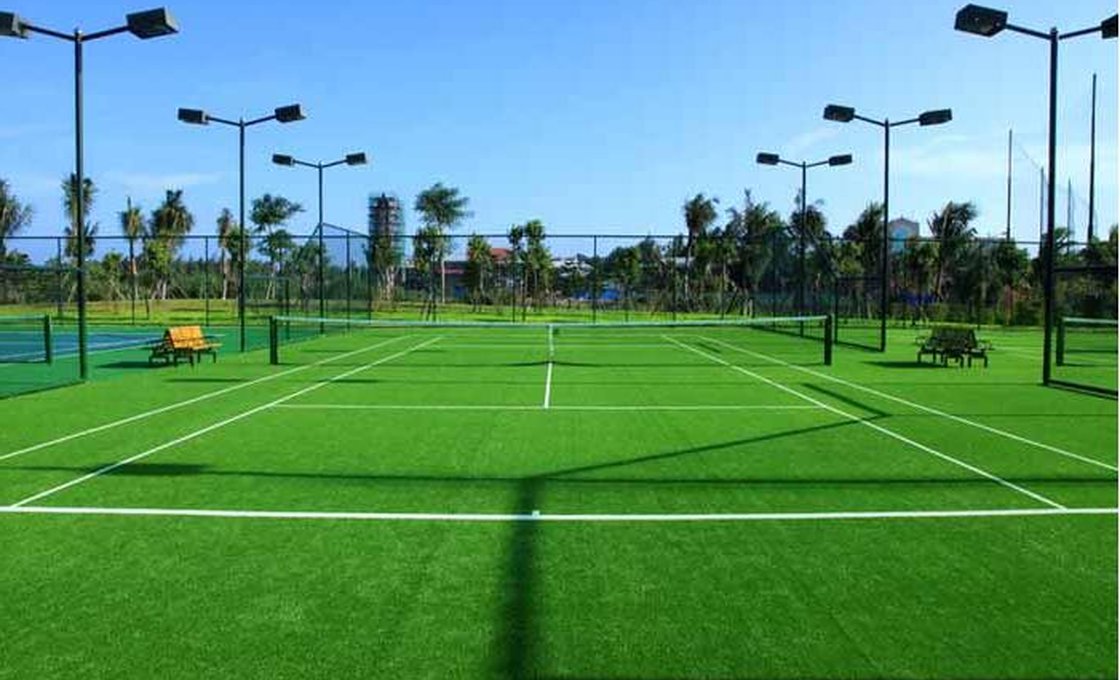
That sand is why this surface plays the way it does. If you want the layer-by-layer detail, our post on sand-filled tennis turf specifications in detail maps pile height, density and backing choices against play style.
- Sand-filled: sand brushed into the pile adds stability and a more natural feel, which suits recreational and club-level courts.
- Non-sand-filled: less friction and a faster game, which suits quick movements in performance and tournament settings.
Sand grade is a selection decision worth attending in person. Sand of a specifically selected size and shape is brushed into the pile to the top of the carpet. The wrong grade changes grip, drainage and wear all at once. We treat the sand specification as part of the surface conversation, because the carpet is only half the system.
Three pile generations explain today’s grooming discipline. Long-pile carpet, the original form laid through the 1980s and early 1990s, failed on sand moving during play and courts skipping the brush. Medium pile followed. Modern surfaces run 55,000 to 65,000 tufts per square metre, which cuts sand movement but lets the sand compact harder, so drainage becomes the trade-off.
The Pros: Where Artificial Turf Tennis Courts Win
Set against natural grass, the wins are measurable. Artificial grass tennis courts are far less slippery in wet weather, dry out much quicker, and put players back on court sooner, which adds playable hours across a season. There is no mowing, watering or fertilising, though the honest qualifier is that routine work moves to brushing and infill top-ups rather than disappearing.
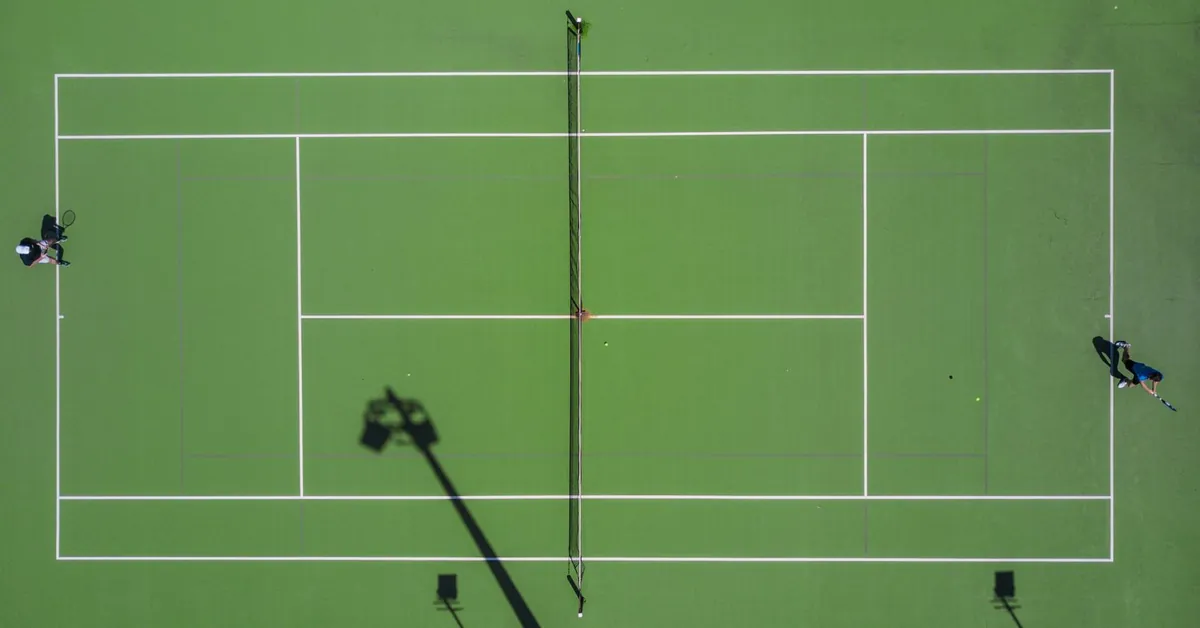
The artificial turf tennis courts pros and cons below each carry a condition, because none of these wins is free.
- True bounce: the carpet stays smooth and even, so play stays consistent where natural grass develops bumps and hollows.
- Joint-friendly: softer than a hard court, gentler and more forgiving on the joints of senior and junior players.
- Coaching pace: the surface plays a little slower, so rallies last longer and developing players can construct points.
- Permanent lines: cut-in lines do not fade under sunlight and vigorous play, and the carpet resists pivoting and twisting.
- Club identity: various colour combinations are available, in a surface category whose top playing standards are set by the International Tennis Federation.
All-Weather Hours and Coaching Pace
The wet-weather win compounds over a season. A court that dries quickly after rain returns to service the same day, and hours that a muddy grass court loses become bookable coaching slots. The slower pace suits teaching programmes too, because developing players can construct a point instead of rushing an error. For a club running morning clinics and evening league on the same pad, that recovered time is the quiet pro. Where lines are shared across sports, multi-sport turf for shared facilities extends the same logic beyond tennis.
The Cons: Heat, Infill Migration and Real Upkeep
Now the other column, and none of it is cosmetic. The same carpet that plays true in August punishes a facility that skips grooming by the following spring. Most of the pain clusters around the sand that makes the surface work.
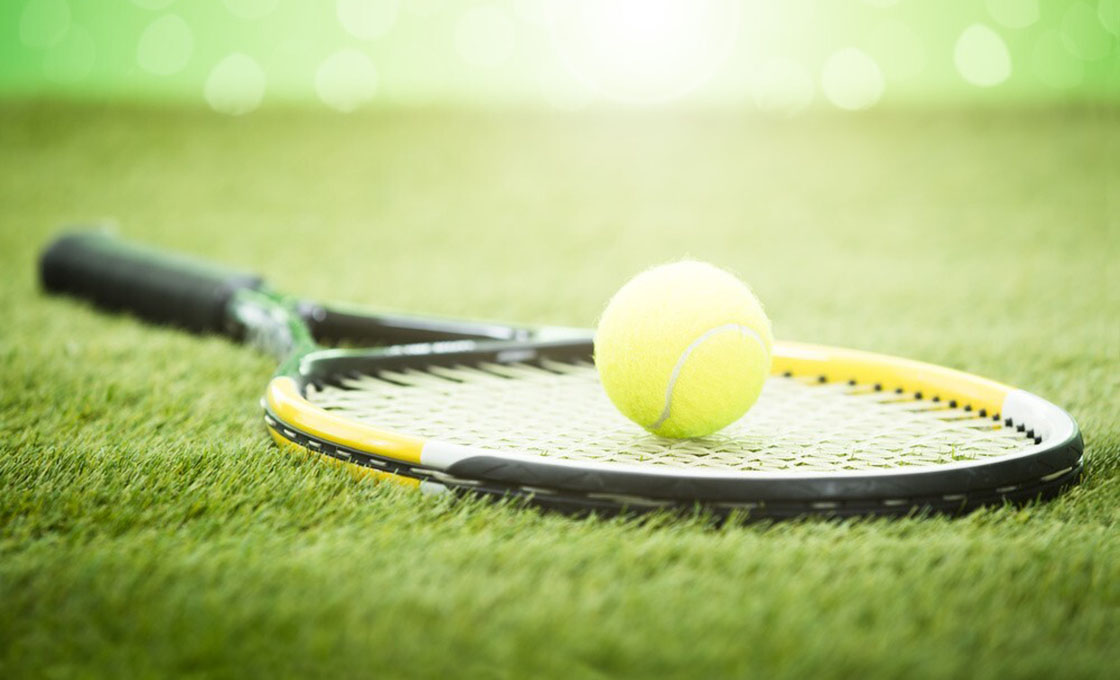
A fair accounting of artificial turf tennis courts pros and cons prices this column in maintenance hours, not adjectives.
- Higher upfront cost: more than an acrylic resurfacing job on the same pad, with the numbers broken out in the cost section below.
- Surface heat: dark acrylic and synthetic fibres both run hot in direct sun, so mitigation is shade, lighter finishes, scheduled watering where appropriate and cooler playing times.
- Sand migration: play pushes sand toward one spot, leaving thin patches and grip changes that coaches notice first as rallies die near the fence line.
- Compaction: dense high-tuft carpets compact the sand, and compaction drags drainage performance down with it.
- Drainage failure: compacted infill, organic debris, poor sub-base construction, blocked peripheral drains and surface settlement each cause standing water, which brings slippery patches, moss and algae, and accelerated fibre wear.
- Real upkeep: weekly brushing, moss treatment twice a year, and drain and edge-channel checks every 3-6 months.
- Shorter life than macadam: the carpet will likely need replacing sooner than an asphalt court’s next crack repair.
Put drainage and grooming in the acceptance checklist. Verify base drainage falls and agree a sand-grooming plan at handover, not after the first mossy winter. Standing water brings slippery patches, moss and algae, and fibre wear that no amount of later brushing fully reverses.
What an Artificial Turf Tennis Court Costs
A standard court with run-offs covers about 7,200 sq ft, which is why the cost question never has one number. Per one manufacturer guide, high-quality artificial tennis grass runs $5 to $15 per square foot, materials only. The same guide puts professional installation at another $2 to $6 per square foot. Per a published court-cost table, a full artificial-grass build lands at $50,000 to $80,000 and carries a published band of $7 to $11 per square foot. The arithmetic sanity-checks: 7,200 sq ft at $7 to $11 comes to roughly $50,400 to $79,200.
| Cost layer | Published range | Source qualifier |
|---|---|---|
| Turf materials | $5-15 per sq ft | Per one manufacturer guide |
| Professional installation | +$2-6 per sq ft | Same manufacturer guide |
| Routine upkeep | $500-2,000 a year | Same manufacturer guide |
| Full court build | $50,000-80,000 ($7-11 per sq ft) | Per a published court-cost table |
| UK full install | £50,000-85,000; turf from £20 per sqm | Per a UK installer’s published rates |
| Per-m2 conversion, US bands | about $54-161 per m2 (turf); about $75-118 per m2 (build) | Conversion of published third-party ranges |
Converted, the published US bands read roughly $54-161 per square metre for turf materials and about $75-118 per square metre for the full build. That is a conversion of third-party published ranges, never a quote from us. Routine upkeep such as brushing and infill top-ups runs roughly $500 to $2,000 a year per the same manufacturer guide.
Per the same court-cost table, high-cost regions add 20 to 35 percent for labour and permitting. Extras stack separately: fencing with windscreen runs $5,000 to $10,000; night lighting $8,000 to $15,000; net and posts $1,000 to $2,500; drainage systems $3,000 to $7,000. Per a UK installer’s published rates, tennis turf starts from £20 per square metre, with full installs at £50,000 to £85,000.
Treat those layers as separate budget lines, because a committee comparing a turf quote against a recoat quote is comparing different objects. Layered like this, the artificial turf tennis courts pros and cons cost column becomes comparable instead of anecdotal. Add the upkeep line, not just the build line, and the comparison turns honest. The same committee should also price the drainage system before the first invoice arrives, because poor planning here leads to water pooling and structural damage.
Worried the Turf Spec Will Not Match Your Courts?
Bring your court spec – we match pile height, density, colour and roll size to your programme, and free 20 x 20 cm samples ship by DHL or FedEx.
Lifespan and Long-Term Value Against Hard Courts
Lifespan claims vary more than any other figure in this space, because every source quotes a different band. Committees see 6-8 on one spec sheet and 15-20 on another, both published in good faith. The honest reading is a spectrum, and where a court lands is decided by base quality, upkeep and sun exposure.
One product page’s published tennis spec sheet puts life span at 6 to 8 years at the low end. Per a Synthetic Turf Council report as cited, well-installed synthetic turf lasts 8 to 15 years. Industry reports cited on the same page run 15 to 20 years for well-maintained courts. Proper aftercare adds an estimated 2 to 4 years, per a Research and Markets report as cited.
- Base quality and drainage: a crushed stone and gravel mix base that prevents water pooling underpins everything above it.
- Fibre and infill quality: cheaper fibres flatten sooner, and thin infill accelerates the whole wear chain.
- UV stabilizers: fibres with proper stabilizers resist fading and degradation in direct sun.
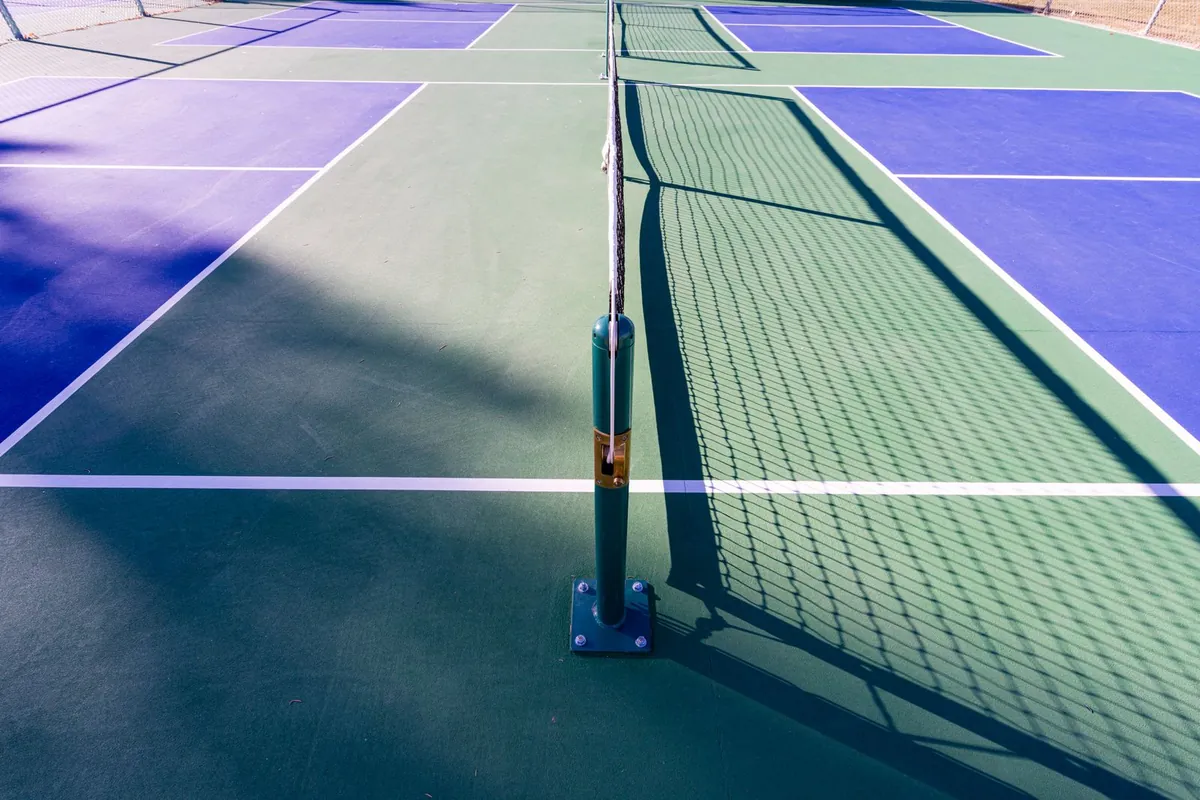
Our own commercial turf carries an up-to service figure of 10 to 15 years, stated as a ceiling and never as a warranty. The counter-account, per a published court-cost table: hard courts need resurfacing every 5 to 8 years at roughly $10,000 per cycle. Acrylic recoats come every 2 to 3 years at $5,000 to $8,000 and clay runs $2,000 to $5,000 a year in weekly labour. That closes the artificial turf tennis courts pros and cons arithmetic: more upfront, fewer periodic recoats, and a grooming rhythm in exchange.
Choosing Turf for Clubs, Schools and Facilities
Buyers at this stage are contractors, landscape professionals, clubs, schools and facility managers, and the checklist below is the one we would run before any budget is committed. Anchor the checks in hard numbers from our tennis court artificial grass specifications page before comparing quotes.
Order free turf samples first
Order free turf samples to test colour, hand feel and density before a single roll is specified.
Spec the pile by intended use
Spec by use: sand-filled for recreational and club play, non-sand-filled where pace matters.
Verify base and drainage falls
Verify base and drainage falls at handover, while acceptance leverage still exists.
Budget the grooming rhythm
Budget the grooming rhythm, brushing and infill top-ups, into year-one operating costs.
Confirm cut-in line layout early
Confirm cut-in line layout against multi-sport needs before production starts.
Where a site needs non-standard widths, colours or densities, tennis turf made to custom spec beats forcing a standard roll to fit. Wide rolls in 2, 4 or 5 m by 25 m lengths also cut seam count on larger courts. And before the first purchase order, order free turf samples to test against your own court conditions, because a swatch in hand settles debates that no datasheet can.
Schools and municipal facilities carry one more variable: multi-sport use changes line layout, pile choice and grooming frequency at the same time. Confirm the cut-in layout before production, and the same carpet can serve tennis in spring and another sport in autumn without a re-build. For the football side of that same surface decision, the FIFA certified turf vs soccer turf comparison covers what certification changes.
Frequently Asked Questions
Is artificial grass good for tennis courts?
Yes for high-use facilities. It delivers consistent bounce on an even surface, needs no mowing or watering, and stays playable in wet weather. The trade is real upkeep: weekly brushing and periodic infill top-ups.
How much does an artificial turf tennis court cost?
Per published manufacturer guidance, turf materials run $5 to $15 per square foot with installation adding $2 to $6. Per a published court-cost table, a full build lands at $50,000 to $80,000.
Does the sand infill need topping up?
Yes. Sand migrates under play and compacts in dense carpets, so thinning infill changes grip and slows drainage. Weekly brushing and top-ups with clean sand restore the playing surface.
How long does artificial tennis turf last?
Published bands run from 6 to 8 years on one product page to 15 to 20 years for well-maintained courts, with 8 to 15 years the commonly cited range. Base quality and upkeep decide where a court lands.
Is artificial turf slippery when wet?
Less slippery than natural grass, and it dries quicker. Moss from neglected drainage is what actually skids, which is why moss treatment and drain checks belong in the routine.


