Most buyers meet this category at its most confusing moment: a listing that promises a fast roll on a surface that rolls up into a tube. Roll-up carpets, strip mats and modular kits all sit under one label, and almost nothing on the page says which one you are looking at. The word fast appears everywhere, yet no listing shows how the number was measured. The category, in short, sells speed without a stimpmeter register.
This guide draws the boundaries the listings skip. It defines what is a portable golf green in plain terms, names the forms it takes, and hands you the checks that separate a trainer-grade surface from a toy. It closes with the honest trade-off against a fixed build, so the product matches the site instead of the headline.
What Is a Portable Golf Green?
A putting green is a closely mown, firm and level grass surface built around a hole for accurate putting. A portable golf green assigns that same job to synthetic turf. It is a rolled or panel-built surface with pre-cut cups that you lay on any hard, flat ground and pick up when the session ends. No excavation, no base layer, no adhesive – unroll it, drop in the cups and putt.
That definition separates the category from both a backyard fixed green and an ordinary indoor mat. A fixed green is landscaping; a portable one is equipment. It ships, it stores and it relocates, which is exactly why resellers and event buyers keep it on hand.
The problem it solves: golfers keep practicing on surfaces never designed to receive a putt – hotel terraces, showroom floors, event warm-up zones. A portable green turns any of those hard, flat spots into a surface that plays the way a course green plays.
The Three Forms a Portable Green Takes
Ask three suppliers what is a portable golf green and you can get three different products. The label covers three distinct builds, each with its own price logic and shipping profile. None of the three is better in the abstract; each fits a different buyer.
Roll-Up Carpet Greens
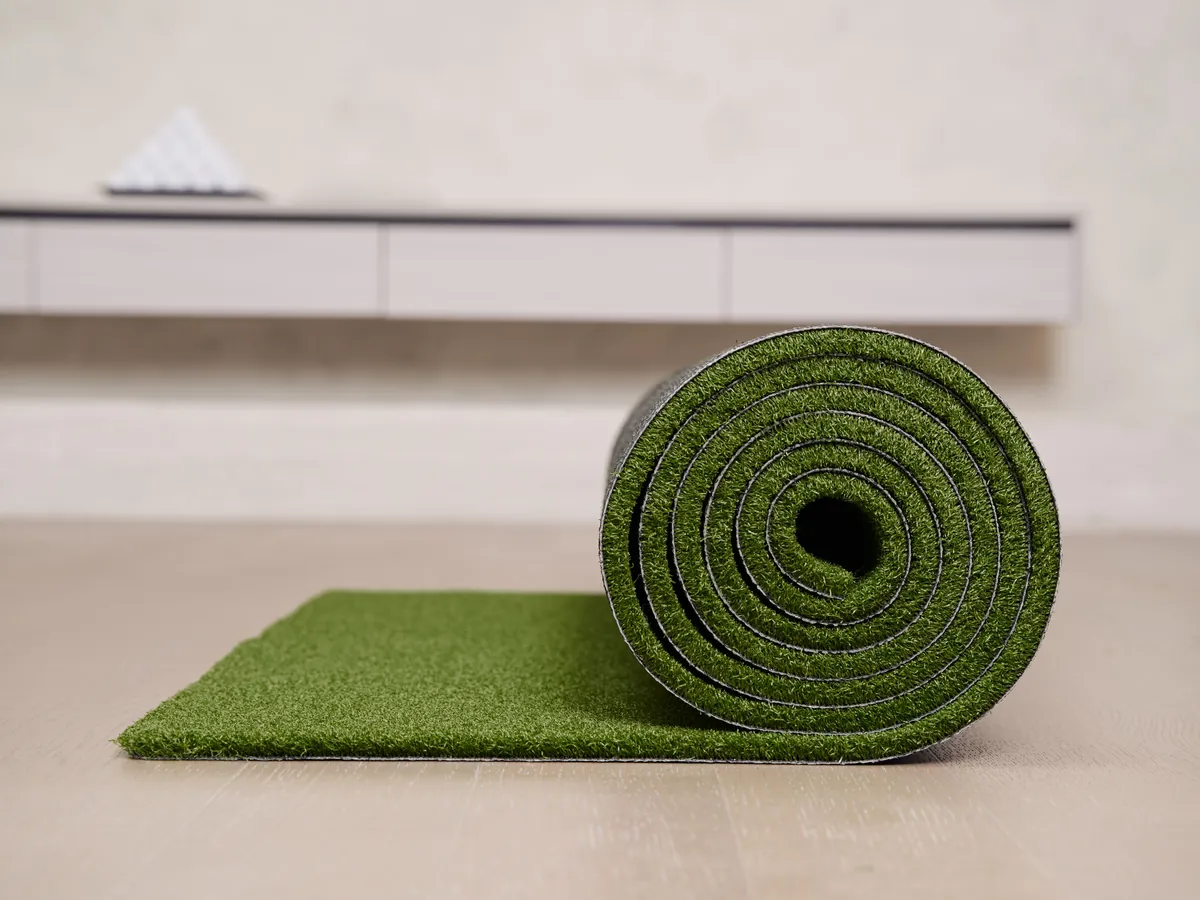
A single sheet of tufted synthetic yarn that rolls into a tube. It lays flat on concrete, decking or compacted ground, with pre-cut cup holes and a bound or weighted edge to hold it down. On our portable line, the 2×3 m single-cup mat weighs roughly 15-20 kg and the 3×6 m multi-break mat about 45-55 kg, so one or two people can move either. This is the form most buyers picture first.
Strip and Mat-Style Putting Mats
Narrower mats built for indoor lanes – a home office, a pro shop counter, a hallway. Strips trade width and breaks for a near-zero setup footprint, and many run to a single cup at one end. They suit buyers who want a daily stroke habit rather than a practice course.
Modular Panel Kits
Interlocking panels that assemble into larger, custom shapes with real breaks between cups. Kits scale from a small corner build to a multi-cup layout, and a damaged panel can be swapped without retiring the whole green. The trade is assembly time and a higher shipped volume.

Listings blur these boundaries on purpose, because the form-factor name sells better than the spec sheet. The evaluation features in the next section cut through that. Judge the build, not the label.
Key Features That Separate a Trainer from a Toy
Asking what is a portable golf green worth its price means asking one question: does it train the stroke or decorate the room? Five features draw that line. A listing that skips them is usually hiding a toy.
- Measured roll speed. A stimpmeter releases a ball at a known speed and counts the feet it travels, per the Wikipedia Stimpmeter page. USGA-based ratings put ordinary greens at roughly 8 ft slow, 10 ft medium and 12 ft fast, and our portable configurations target a Stimp 10-11 roll. A mat that publishes no number has none.
- A regulation cup. Course cups measure 108 mm across, and a trainer-grade portable green cuts its holes to that standard so a flag and a practiced stroke transfer. Toy mats shrink the target and quietly reward the wrong pace.
- A backing that survives rolling. Repeated roll-up is the harshest thing a portable surface endures, so the backing matters as much as the face. Our configurations use a grid-reinforced PP backing, with an optional PU coating for moisture, that holds together through repeated rolling and unrolling.
- Edges and seams that stay flat. A lip at a seam or edge deflects putts and teaches a wrong stroke. Bound edges or weighted edge strips keep the surface true, and seams that are built properly need almost no upkeep afterwards.
- More than one cup and some break. A single flat lane practices exactly one putt. Multi-cup layouts with built-in slopes force a player to work pace and line, which is where the scoring strokes live.
Where Portable Greens Actually Get Used
The same three forms serve very different floors. Because the surface needs only hard, level ground and nothing beneath it, the list of workable sites for a portable putting green runs longer than most buyers expect. Five settings cover most of the demand.
- Patios, decks and garages, where the ground is already hard and level and no installation budget exists.
- Indoor off-season practice, which is where the category earns its keep in cold climates – see how indoor practice setups extend the season for portable green owners.
- Events, trade show booths and hotel or resort amenities, where a green appears for a weekend and disappears without a trace.
- Academies and junior programs, where several small surfaces cost less than one renovation and move between teaching stations.
- Rental and staged properties, where anything permanent is off the table but a putting corner still sells the space.
How to Evaluate a Portable Green Before Buying
So what is a portable golf green that survives a season of demos and deliveries? It passes three checks, and none of them appear on a typical listing. Work through them with a sample in hand.
The Cup Comes First
Measure the hole, not the marketing. A regulation cup runs 108 mm across, per the Wikipedia putting green overview, and a portable green cut to that size accepts standard cups and flags. Our configurations also offer a weighted cup base for outdoor setups where wind is a factor.
Speed, Then Seams
Ask for a roll number and how it was measured, then ask what the seams look like after dozens of roll cycles. For reference, per the USGA Green Section Record, standard nylon surfaces roll at about 11 ft or less and sand-filled nylon can approach 13 ft. Anything quoted far above that range for a plain nylon mat deserves suspicion. Then unroll the sample twice and roll a ball across every seam.
Before you order, ask three questions: is the cup a standard 108 mm? Is there a measured register behind the roll claim? Do the seams still sit flat after dozens of rolls? A supplier who answers all three in writing has earned a sample request.
Want a Portable Line That Passes the Three Questions?
See the portable putting green configurations – roll widths, cup layouts and logo tufting made to spec, samples first.
Portable vs Fixed: An Honest Trade-Off
A fixed green wins on terrain and permanence; a portable golf green wins on flexibility and total spend. The honest comparison is not which is better but which problem you are actually solving. The table does the rest.
| Factor | Portable green | Fixed green |
|---|---|---|
| Setup | Unroll on hard, flat ground, seat the cups, putt within minutes. | A construction project: excavation, base layers and drainage built in first. |
| Realism | Single-plane roll with optional built-in breaks. | Shaped terrain and multiple tiers – see fixed backyard installations with shaped terrain. |
| Maintenance | Sweep debris, roll it dry, done. | Surface care never fully stops – see what a permanent green system adds beneath the surface. |
| Storage | Rolls into a tube on a rack. | Permanently occupies the site. |
| Cost shape | Mostly the surface itself; site work is zero. | Site work and drainage dominate the budget. |
The upkeep gap is the part listings rarely mention. A natural grass green, per Purdue Extension guidance, wants full sun and mowing four or more times per week. Greens built to the USGA method must also include a subsurface drainage system. A portable synthetic surface needs a broom and a dry roll for storage.
Using and Storing a Portable Green
Daily use is unglamorous: unroll, seat the cups, putt, then sweep or vacuum debris before rolling up again. Synthetic turf is built for consistent year-round, all-weather use per the Synthetic Turf Council, so an outdoor spell will not ruin the face. Standing water against the backing is a different story.

Store the roll dry, upright or on a rack rather than flat under stacked weight. If the mat came with the PU-coated backing option, that coating earns its keep in humid or outdoor storage. Kept that way, a portable golf green stays demo-ready for whichever customer asks next.
Frequently Asked Questions
What is a portable golf green?
It is a synthetic putting surface with pre-cut cups that lays on any hard, flat ground and rolls up for storage or transport. It needs no excavation, base layer or adhesive. You unroll it, seat the cups and putt.
How fast should a portable green roll?
Measured greens commonly fall between 8 ft slow and 12 ft fast on the USGA scale, per the Wikipedia Stimpmeter page. Our portable configurations target a Stimp 10-11 roll. Ask any supplier for a number and its measuring method.
Can a portable green go outdoors year-round?
Yes on hard, flat outdoor surfaces such as concrete, decking or compacted ground. Synthetic surfaces are built for year-round, all-weather use per the Synthetic Turf Council. Keep the backing out of standing water and store the roll dry between sessions.
Portable or fixed – which should I stock or install?
Stock portable when customers need movement, events, rentals or indoor seasonal use. Install fixed when the site is permanent and the owner wants shaped terrain and a built-in system. Many resellers carry both and let the site decide.