

A member asks where the sled lanes are. A coach wants space for Hyrox-style circuits. The operator looks across a slab of black rubber and sees programming that cannot happen there. That conversation now plays out in commercial gyms everywhere.
Seven reasons explain why your gym needs synthetic turf, and none of them is decoration. We roll gym turf on our own line, so we hear what a missing lane costs. Classes get cut, sleds stay stacked, and members drift to the facility across town. The case below is written for operators, facility managers and contractors buying in volume.
The Business Case Under Your Gym Floor
Functional training has moved from a niche corner to the core of many commercial timetables. Sled push stations, sprint runways, bootcamps and HIIT circuits appear on nearly every gym fit-out brief. Artificial turf installations in commercial gyms now follow the class timetable rather than the other way around. A floor that cannot host them quietly caps what the business can sell.
Member demand has done the persuading. Functional fitness and Hyrox-style racing have become one of the defining trends heading into 2026. Operators across commercial gyms, health clubs, corporate wellness spaces and elite sport now ask the same question: can our floor actually take this training? For many, the honest answer arrives before the next membership renewal does.
This is not an argument to rip out the rubber. Most artificial turf installations sit alongside it: one surface engineered for friction and floor work, placed exactly where the timetable needs it.
That is the short answer to why your gym needs synthetic turf: it unlocks programming rubber never could. The seven reasons below put operations and figures behind that claim, and the limits section keeps the picture honest.

Reason 1: Sled Programming Needs Real Glide
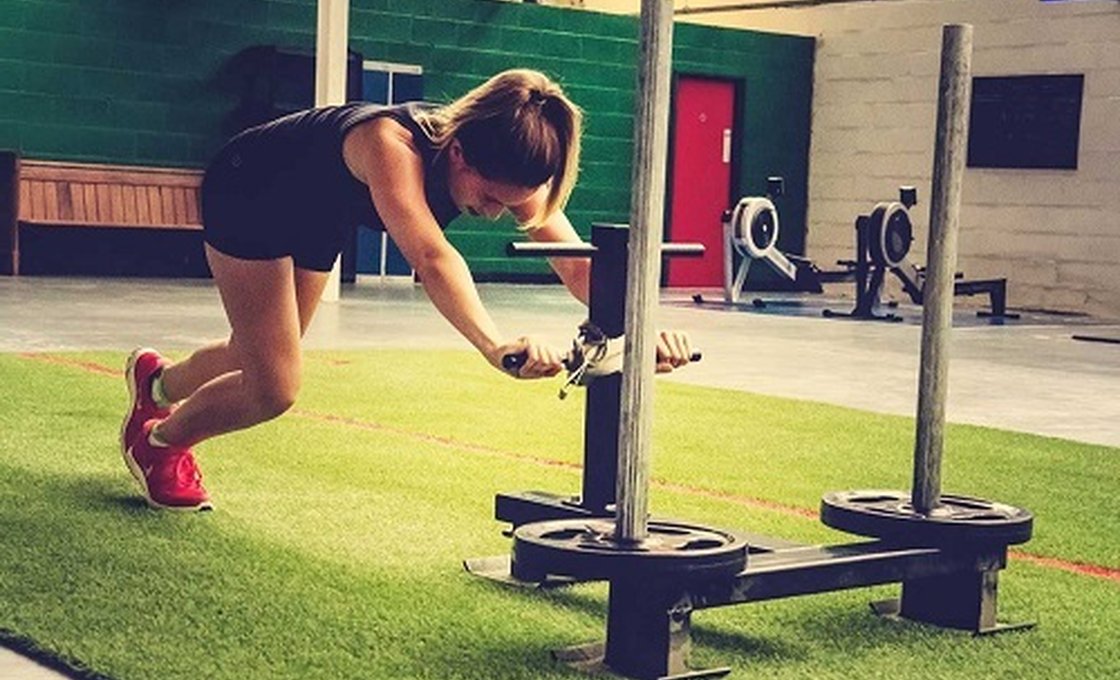
Push a loaded sled across rubber and the base catches, skips and stops. Rubber is grippy by design, and that grip turns a smooth overload tool into a jerky grind that loads shear stress into hips and lower backs. On turf specified for sled work, the same sled glides at a consistent resistance from the first metre to the last.
Controlled friction also buys accurate coaching. When the sled moves the same way on every pass, load progressions mean something, performance tracking stops being guesswork, and the equipment itself takes less abuse from stop-start dragging.
The lane also concentrates the abuse. Sled bases drag the same strip every session. A surface built for that friction takes it without deforming, so the design case and the worst case are the same case.
That consistency is why coaches treat a turf lane as the only practical sled surface. For any facility running functional or Hyrox-style programming, sled work is the design case, not an exception. This reason alone explains why your gym needs synthetic turf if sleds appear anywhere on the timetable.
Reason 2: One Zone Hosts Every Class Format
A turf strip is the most versatile footprint in the building. The same lane carries sled pushes, sprint intervals, agility ladders, bear crawls, battle ropes, partner drills and open-floor circuits within a single day.
Group formats stack cleanly on top: Hyrox-style stations, bootcamps and HIIT classes all run on the runway, and indoor turf lanes are installed precisely for these programmes. One zone hosts one timetable slot after another without moving machines or re-taping floor lines.

Versatility also defends the schedule when plans change. A cancelled class frees the lane for open conditioning, a small-group session or personal training, so the floor keeps earning through every gap in the timetable.
Smaller footprints gain too. Hotels, clubs and corporate facilities add a compact conditioning lane to bring in capability without filling the room with machines. Personal training studios use a short runway as the centrepiece of their offer. Rehab and physio movement work rounds out the list, since low-impact drills belong on a joint-friendly surface.
Reason 3: Zoning That Steers Member Traffic
A defined lane does work a blank floor never does: it tells people where high-intensity movement happens. Clear zone marking acts as a psychological anchor, keeping sprint work away from the dumbbell racks and keeping sightlines open for coaching.
Gyms commonly install turf runways of 6 to 20 metres, sized to the room and the programming. Concentrating abrasive sled work onto one dedicated track also protects the investment in the rest of the floor. The heaviest friction lands where the surface was built to take it.
Most commercial artificial turf installations plan markings, colours and roll widths together at the ordering stage, so the lane arrives as a finished feature rather than an afterthought.
Transitions deserve the same attention as the lanes themselves. Athletes cross from turf to rubber at pace, so the joins need to sit flush and secure. A layout that maps the movements first will always beat one that lays the flooring first.
Reason 4: A Floor That Markets Your Gym
A 10 by 3 metre turf strip photographs. Gym photos are marketing material shared on Instagram, Google Business profiles and websites, and a green lane communicates a serious training facility in a way black tiles do not. In a crowded membership market, that visual value is genuinely commercial.
Custom work goes further. Logos, colour combinations and brand patterns can be produced into the turf itself, while markings such as sprint zones and metre-by-metre numbering turn the same lane into a coaching tool. One surface, two jobs: brand asset and training equipment.
The markings carry the identity further than colour alone. Contrast line colours keep every zone readable from the entrance. Metre numbering gives sprint work a measurable target. A logo tufted at the lane entrance tells every visitor whose floor they are standing on.
Reason 5: Members Feel It and Stay
Members who train on turf consistently rate it above rubber for the movements that define functional training: sprints, agility drills, crawls, skipping and ground-based core work. The pile cushions impact slightly more than rubber, which reduces fatigue across long sessions.
There is biomechanics behind the comfort. A slightly compliant surface recruits the stabilising musculature more than a rigid floor, adding natural resistance to every step, jump and change of direction.

There is a revenue line attached to the feel. Facility owners are often seen justifying a 15 to 20 per cent increase in personal training rates once a professional functional lane is in. Trainers can sell programming the floor visibly supports. Higher perceived value and higher session prices arrive on the same roll, which is one more reason why your gym needs synthetic turf.
That felt difference is the retention side of why your gym needs synthetic turf. Members renew where the training feels best, and the floor is the one piece of equipment every single member touches on every visit.
Reason 6: Built for Commercial Operating Hours
A conditioning lane in a busy gym sees more passes in a week than a domestic surface sees in a year. Commercial gym turf is engineered for exactly that workload. High stitch counts of 20,000 or more stitches per square metre are typical. Densities reach up to 63,000 stitches per square metre at the top end, keeping fibres upright under daily traffic.
Commercial-grade installations pair dense tufting with a polyurethane backing that shrugs off sweat and disinfectant. Quality gym turf typically delivers 7 to 10 years of service in a busy facility. Artificial turf installations specified for looks rather than workload are the ones that fail early, which is why the spec sheet matters more than the colour card.
Fibre shape carries much of that endurance. Texturized or curled monofilaments act like a spring, helping the pile stand back up after a heavy sled crushes it flat. That is why density figures deserve a close read before anything is ordered. Backing choice shows up here too, because a polyurethane layer resists the sweat and disinfectant cycle that pulls cheaper carpets apart indoors.
Reason 7: Cleaning Fits a Staff Rhythm
Turf maintenance slots into a normal cleaning rota. Vacuum to lift chalk and rubber granules, and brush the pile lightly so flattened fibres stand again. Wipe sweat marks with mild soap where traffic is heaviest. There is no watering, mowing or fertilising, and the surface disinfects easily, which matters when the floor is also a hygiene surface.
The rhythm scales with usage rather than with the calendar. A lane that hosts three evening classes needs more vacuum passes than one used for personal training, and seams and edges deserve a periodic walk-through. None of it requires specialist plant or outside contractors.
Hygiene closes the loop. In a shared facility the floor is a hygiene surface as much as a training surface. Turf that disinfects easily lets staff keep the lane presentable between classes without closing the zone for a day.
Turning Dead Floor Space Into Revenue
Every week without a lane is programming you cannot sell and members you cannot hold. That arithmetic is the closing argument in why your gym needs synthetic turf, and the fix is a specified lane sized to your room and rolled to your brief.
Watching Members Walk Past Your Sled Zone?
Dead floor space costs memberships every month. We tuft factory-direct gym rolls to your pile, density and colour spec, and send free 20 by 20 cm samples.
Matching Turf Specifications to Your Zones
Write the zones down before you call suppliers: which lane takes sleds, which surface takes sprints, and which floor carries classes. Every line in the grid below answers why your gym needs synthetic turf for a specific zone, so take it straight into a quote conversation.
| Zone | Primary demand | Typical pile height | Density and backing | Roll width fit |
|---|---|---|---|---|
| Sled lane | Consistent glide under load | 12 to 15 mm, short and dense | 20,000+ stitches per square metre, PU backing | 2 m or 4 m |
| Sprint runway | Traction over distance | 10 to 20 mm, curled pile | Up to 63,000 stitches per square metre available | 4 m or 5 m |
| General functional zone | Mixed drills and circuits | 12 to 25 mm | Infill-free common; some light sand or rubber | 4 m |
| Group class floor | Comfort under repeated floor work | Short dense pile, comfort grade | Non-porous backing for disinfectant cleaning | 4 m or 5 m |
| Personal training studio lane | Compact footprint, mixed sessions | 12 to 15 mm, short and dense | 20,000+ stitches per square metre | 2 m or 4 m |
Our line rolls 2, 4 and 5 metre widths at 25 metres, so a long runway runs from one roll and wider rolls cut seams across bigger floors. Review the standard roll formats and product range and the commercial artificial grass grades before you fix a layout.
Plan the artificial turf installation around the sub-floor as much as the carpet. A flat, clean slab decides the result. An uneven base reads through as a wear line within months. Custom pile heights, densities, colours and markings are produced against a written brief.
Specs settle arguments faster than brochures. Put the candidate pile under a loaded plate, drag a sled base across it, and compare two densities side by side before the purchase order goes out. The lane you commit to will carry thousands of passes, so the test is worth the afternoon.
Where Gym Turf Still Needs Care
Honest limits first. A lane concentrates wear exactly where the sled runs. If the pile is too tall or the density too soft, fibres mat and the glide degrades, which is why sled zones run short and dense. Cheap latex backings absorb sweat and hold odour indoors, so backing choice is an air-quality decision as much as a budget line.
The surface also inherits everything beneath it. An uneven or unsuitable sub-floor undermines even good turf, and transitions between turf and rubber must sit flush so athletes moving at pace do not trip. Budget for the base and the seam plan, not only for the roll.
Cleaning still matters more than the sales pages admit. Chalk, sweat and rubber granules build up, and in humid or high-traffic setups the rota needs to run harder. Order free sample squares and test the pile with a loaded plate before you commit a whole lane.
Frequently Asked Questions
How long does gym turf last in a busy facility?
Commercial gym turf typically lasts 7 to 10 years under heavy daily use. Daily sled passes, chalk load and cleaning discipline decide where a floor lands inside that band.
What pile height works for a sled lane?
Short and dense wins: commercial sled zones run 12 to 15 mm so sled bases glide instead of digging in. Taller pile catches the base and frays early.
Does gym turf need infill?
Usually no. Commercial gym turf commonly runs infill-free, and some products take light sand or rubber for stability, but sled lanes perform best without loose fill.
Can my logo be tufted into the floor?
Yes. Colours, logos and metre markings are customisable, so the lane can carry your brand and give coaches distance markers for sprint and sled work.
How wide should gym turf rolls be?
Standard rolls come in 2, 3 and 4 metre widths, and wide rolls cut seams in most artificial turf installations. Our line rolls 2, 4 and 5 metre widths at 25 metres.
How often should a turf lane be cleaned?
Frequent vacuuming clears chalk and rubber granules, and light brushing keeps fibres upright. Wipe sweat marks with mild soap, more often in humid or high-traffic setups.


 English
  Arabic
  French
  German
  Portuguese
  Russian
  Spanish