A functional training zone rarely fails because the turf was cheap. It fails because one pile height was written across the whole area, and four different movement patterns were asked to share that single number. Friction, compression and fiber recovery do not scale the same way, so a surface that suits a loaded sled fights a barefoot stretch corner. The buyer then inherits an installed floor that no single training prescription fits.
We build turf rolls, and the order forms show the pattern clearly: one pile figure written for a zone that needs four. Our line takes a blunt position on the cause. The zone was specified as a surface rather than as a set of force paths, and every downstream number drifted with that first error. Density, backing and lane width all inherit the mistake. The fix belongs at the first decision, not at the symptoms.
Why Does Sub-Zone Layout Follow Movement Patterns?
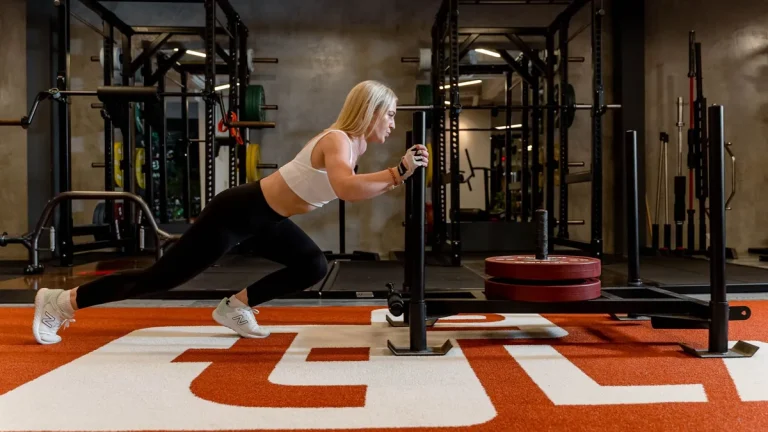
Split a functional training turf zone by force path rather than by area. Four bands carry almost every session: a rig and free-weight buffer strip, a sled lane, a plyometric and bodyweight bay, and a stretch or mobility corner. Each band loads the pile differently, so each band earns its own pile height, density and backing. This single split is the only structure used here, and every number after it is arithmetic.
A single value fails because fiber behavior is not linear. When the pile is too high, the fibers fold over and mat down under pressure. A 30 mm surface used for sled work generates friction heat that can melt polyethylene fibers over time. A short, dense surface that survives those loads feels unforgiving under a jump landing. The conflict is physical rather than commercial.
Sub-zone specification only works if the roll can be made to match. We supply 2 m, 4 m and 5 m roll widths at 25 m length, plus custom widths. Pile height, density, colour and backing are all made to the client’s specification. That flexibility is the precondition for a four-band layout. Without it, the zone collapses back to one number and the conflict returns.
For background on why artificial turf suits a gym floor, the movement pattern is the right starting point. Product comparisons come after the force paths are drawn.
Rig and Free-Weight Buffer Strips Need Shorter Pile

Buffer strips sit where plates get racked and where a dropped bar lands. There the pile is judged by how quickly it recovers, not by how it feels on day one. Short and dense wins here. The functional benchmark is 10 to 15 mm, and the commercial range tops out at 3/4 in, about 19 mm, for sled-rated surfaces. A rig buffer belongs at the short end of that band.
Fiber choice follows heat. Per one commercial spec guide, local surface temperature during sled passes can exceed 250 °F, and nylon melts near 490 °F while polypropylene sits near 320 °F. On high-impact buffer strips we specify nylon, or we confirm the polypropylene melting margin before the roll is tufted. Nylon also resists abrasion and break better, while polypropylene is the economical option where traffic is lighter.
Backing keeps the strip flat. Our two backing systems are PP plus Net and PU, and either is matched to the load the strip will take. A buffer strip is the one place where an underlay enters the conversation, and there it appears only as an acceptance item. The owner confirms that whatever sits beneath the roll does not lift the finished surface above the adjacent floor.
Pile tips on a good buffer strip stand up a week after handover rather than lying flat like a brushed rug. If they mat down early, the fiber, the density or the infill decision is wrong. On a functional training turf zone, the buffer is the first place this failure shows.
For a wider comparison of gym surfaces, see how to choose artificial turf for gyms before fixing the buffer numbers.
Sled Lanes Demand a Friction-Controlled Pile
A sled lane is a friction problem before it is a comfort problem. Training-science reference points put standard artificial turf at a kinetic friction coefficient (μk) of 0.60 to 0.80. A specialized low-friction track sits at 0.20 to 0.35, and concrete or asphalt at 0.80 to 1.00 or higher. The same plate load behaves entirely differently across those bands. That makes the surface a training variable rather than a backdrop.
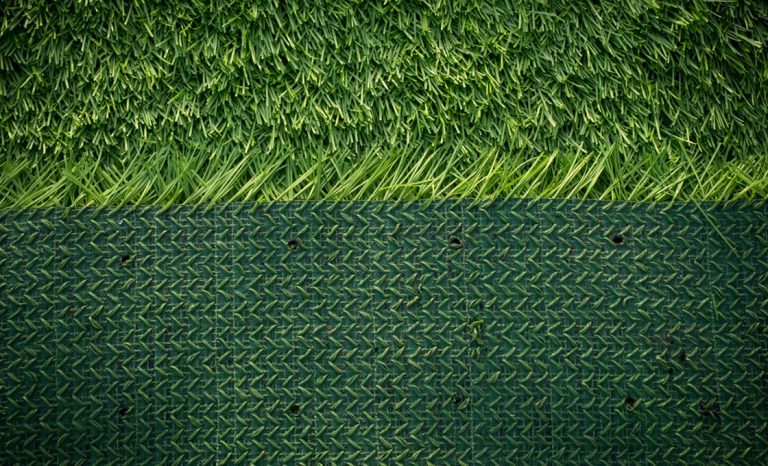
Friction on an artificial turf installation is set by three things at once: pile height, tuft density and backing. Short dense pile of 10 to 15 mm on a strong backing holds the standard band most reliably. Skelcore’s published sled lanes run 0.5 to 0.75 in, a looser band that trades some sled speed for cushion. Long, loose pile pushes friction up past the baseline band instead of down it, while very short hard-backed surfaces climb toward the concrete end.
Sled work carries its own rules. The working range is 10 to 20 m of push or pull; past 20 m the effort shifts into sprint mechanics and raises hamstring injury risk. A flat-base sled is mandatory on turf because a rounded base tears the surface. A 30 mm build under sled work can also generate enough friction heat to melt polyethylene fibers over time, so length is a liability rather than a luxury.
The table below maps friction bands to roll specification on a functional training turf zone, which is the step most catalogues skip.
| Target friction band | Pile height and density | Backing behaviour | Typical use |
|---|---|---|---|
| 0.60 to 0.80, standard artificial turf baseline | 10 to 15 mm, short and dense, laid on a high-density tufted face | Strong and stable under a moving plate load | Sled lanes, rig buffers and entry strips |
| 0.20 to 0.35, low-friction track | A purpose-built track surface, not a pile-height setting on a gym roll | Reference band for low-resistance conditioning loads | Comparison only |
| 0.80 to 1.00 or higher, concrete or asphalt | 6 mm or no pile at all, with a very hard and unforgiving face | Rigid with almost no give at all | Reference surface only |
| Sled lane target band for a functional zone | 10 to 15 mm short pile, with high tuft density and a firm hand | Strong backing, PU or PP plus Net construction | Push and drag lanes for sled work |
Read the table as a target rather than a measurement. Pile above 19 mm does not slide toward that band; friction rises unpredictably and a loaded sled digs in, so long loose pile stays out of sled lanes. A lane specified to the baseline band pairs short pile with high density and a strong backing. On an artificial turf installation where the pile runs long and the density drops, the same plate load slides and the prescription loses its reference.
Whether should an artificial turf sled track be built long and loose or short and dense is settled by the load, not by preference. Where infill is not an option indoors, non infill turf for indoor fields changes the density calculation again.

Plyometric and Bodyweight Bays Favor Mid Pile
Plyometric and bodyweight work inverts the sled requirement. Jump landings and bear crawls want cushioning and a stable stance, so the pile can run slightly longer than a sled lane. The commercial range starts at 1/4 in (6 mm) for sprint and agility work and reaches 3/4 in (19 mm) for sled-rated surfaces. A plyometric bay sits in the middle of that range.
We set plyo and bodyweight bays at 15 to 20 mm, the band the meettfit guide assigns to speed and agility drills. That is long enough to absorb a landing and short enough that fibers do not fold over and mat down under repeated pressure. Push past 20 mm and the bay starts to behave like a lawn instead of a training surface.
Face weight carries the impact side. Heavy commercial turf runs 50 to 70 oz face weight, and the heavier face keeps a bay stable under high-frequency footfall. A foam-backed build is the usual choice on an artificial turf installation where agility, sprinting and plyometrics share one bay. There the foam takes the landing load rather than the fiber alone.
Watch a circuit class on a well-specified bay and the tell is where feet stay planted. An athlete lands a box jump and the pile compresses and recovers inside the same step; on an under-built bay the same landing slides. That difference was decided months earlier, when density was written on the drawing.
Stretch and Mobility Corners Need Soft Density
Stretch and mobility corners ask for the opposite of a sled lane. Sessions are low impact and often barefoot, so the surface is judged on comfort and on grip for skin rather than on friction under a loaded sled. The meettfit guide puts stretching and yoga areas at 20 mm and above with a shock pad, and a mobility corner should follow that band.
Where traffic is light, a 30 to 50 oz face weight is sufficient and uses less material than a heavy commercial build. That is not a downgrade; it is the correct match for a corner where the hardest contact is a knee or a forearm on a mat. Specifying 50 to 70 oz here spends density on loads the corner never receives.
This corner is the clearest proof that the four-band split is necessary. A sled lane needs high density to control friction, while a stretch corner needs softness to stay usable barefoot. No single value on a whole-zone specification resolves that, which is why the zone gets split. Rubber-backed heavy-impact systems suit the impact bays and not this corner.
Turf Over Rubber Transitions Must Stay Flush
On a functional training turf zone, a transition is a height problem rather than a material problem. The number that matters is total height: pile height plus backing thickness, not pile height alone. A 0.5 in pile on a 5 mm backing lands near 0.7 in total, which aligns closely with a 0.75 in (19 mm) vulcanized rubber tile.
Get it wrong and the failure is immediate. A 15 mm turf beside an 8 mm rubber floor leaves a 7 mm cliff. People trip on it, and the edge of the turf begins to peel back under repeated scuffing. On any artificial turf installation that meets a rubber floor, that gap is the most predictable defect on the whole job.

The fix is a chain rather than one part. A beveled reducer strip carries the edge, a 1:12 slope spreads the change over a walkable distance. Levelness inside 3 mm over 3 m keeps the joint from rocking. All three must be present, because a reducer alone hides the cliff without removing it. The slope and levelness figures here are our own acceptance position, not a published standard.
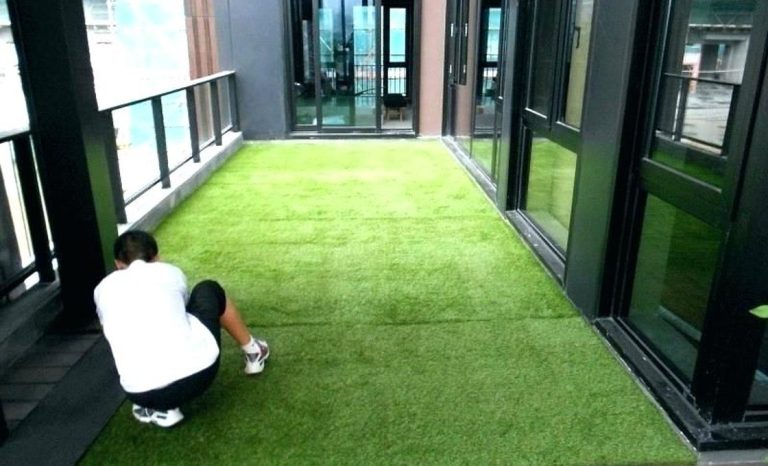
Seams in the same area follow the same logic. Rolls are laid with the grain running in one direction so the joint does not read as a stripe, and the seam is bonded with a full-spread PU adhesive. Vendor guidance also asks for a substrate moisture precondition before bonding. For the surface pairing itself, see rubber flooring and artificial turf solutions.
Roll Width and Seam Planning for Lanes
Lane width drives the roll order on a functional training turf zone. A single sled lane needs about 80 cm, so a 2 m roll carries two lanes side by side. A 4 m roll covers a wide bay in one sheet, or two 2 m rolls bonded along a mid-seam. Roll widths of 2 m, 4 m and 5 m at 25 m length are our regular sizes, with custom widths available.
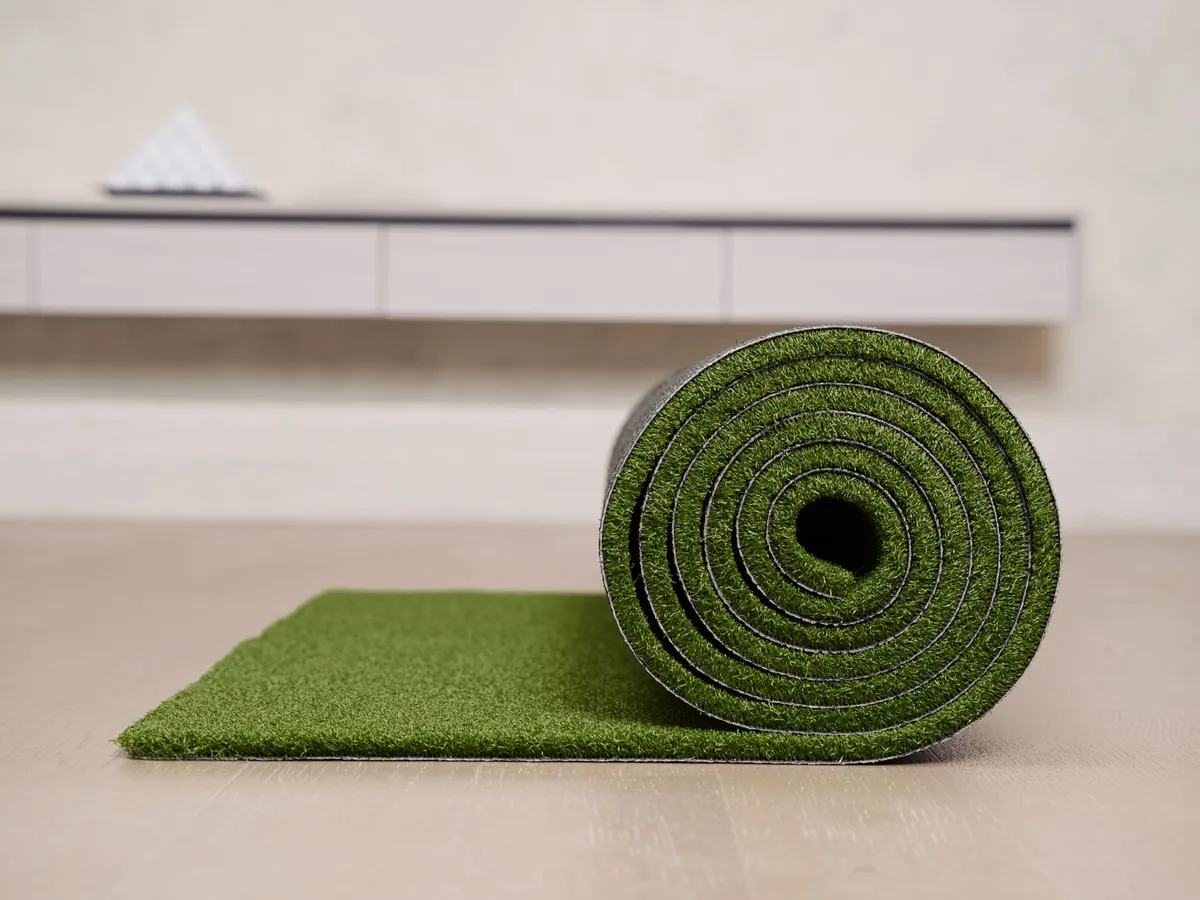
Layout follows the lanes rather than the room. Rolls should run in the same direction, and any seam should stay away from doorways and turning zones where feet pivot. On an artificial turf installation with more than two lanes, that usually means one 4 m sheet instead of a mid-seam.
Weight is the constraint that surprises contractors. A 4 m sheet at 15 m length runs about 210 kg, so it needs a forklift and a wide approach path rather than four people and a dolly. Plan the delivery route and the seam position together, because a roll that cannot reach the bay gets cut in the wrong place.
A seam that sits under a rig rather than across a lane lasts longer, because the load spreads and the join stays out of the sled path. Draw the lanes first, then place the seams where traffic will not concentrate.
Can one turf spec fit every zone?
Send your zone layout with pile heights and lane count. We set pile, density and backing per zone, then match rolls to your gym floor.
Hygiene and Cleaning Cycles by Zone
Cleaning frequency should follow the traffic map rather than a calendar. Most professional gym turf is manufactured with antimicrobial agents, and on an artificial turf installation the routine is brushing to keep fibers upright, vacuuming, and spot cleaning as needed. Applying one frequency to every band of the zone is the common mistake.
On a functional training turf zone, the sled lane and the zone entry collect the most dust, chalk and hair. Dry vacuum those high-traffic bands every one to two days and brush them weekly. Low-impact stretch corners can wait: a weekly vacuum and a monthly brush keep them serviceable.
Judge the result by two things an owner can see. Fibers should stand upright after brushing rather than lying flat, and there should be no dust line along the lane where a sled runs. Spot clean spills immediately, because a dried spill sets into the pile and becomes a stain rather than a mark.
Checking the Installed Turf Against Your Zones
Handover is where a four-band specification is either proven or lost. Walk the zone with a tape measure and the drawing, and check each band against the number it was specified to. The four checks below take about an hour and catch the defects that show up in the first month.
Check pile height band by band
Measure pile at the rig buffer, the sled lane, the plyo bay and the stretch corner. Sled lanes read 10 to 15 mm, plyo bays 15 to 20 mm, and stretch corners 20 mm and above with a shock pad. A single reading across the whole zone means the split was never built.
Feel the friction on the sled lane
Push a loaded sled the length of the lane and note the resistance. A lane specified to the standard artificial turf band should feel firm and controlled, inside the 0.60 to 0.80 reference range. A surface that slides more easily than the sled lane should has drifted toward the low-friction reference band, so the pile or the density needs review.
Confirm the transition is flush
Measure total height, pile plus backing, against the adjacent rubber tile, which should read 0.75 in (19 mm) where the two meet. There should be no 7 mm cliff between a 15 mm turf and an 8 mm rubber floor. Confirm the beveled reducer, the 1:12 slope and levelness inside 3 mm over 3 m.
Verify grain direction and seam bonding
Check that both rolls run with the grain in the same direction and that the join does not read as a stripe under overhead lighting. The seam should be bonded with full-spread PU adhesive, and the substrate moisture precondition should be satisfied before bonding. On any artificial turf installation, a mismatched grain is visible from the far end of the room.
Frequently Asked Questions
What pile height suits each functional training sub-zone?
In a functional training turf zone, sled lanes and rig buffers take 10 to 15 mm dense pile. Speed and plyo bays take 15 to 20 mm, and stretch or yoga corners take 20 mm and above with a shock pad.
How wide should a single sled lane be?
Plan about 80 cm per lane, so a 2 m roll carries two lanes side by side. A wider bay usually moves to a 4 m sheet.
Does turf over rubber create a trip hazard?
Yes, if total heights differ. A 15 mm turf beside an 8 mm rubber floor leaves a 7 mm cliff that trips people and peels the turf edge. On any artificial turf installation, align total height, then add a beveled reducer.
How are gym turf rolls sized for lanes?
Size lanes by lane count and width. Two lanes at 80 cm fit a 2 m roll; three or more lanes usually take a 4 m sheet, which also removes a mid-seam.
How often should each zone be cleaned?
Clean by traffic rather than by calendar. The sled lane and zone entry need dry vacuuming every one to two days with a weekly brush. Stretch corners need a weekly vacuum and a monthly brush.
Is nylon or polypropylene better for sled lanes?
Nylon handles sled lanes better. It resists abrasion and break, and it melts near 490 °F against polypropylene near 320 °F. Polypropylene is the economical option where traffic is lighter.